Prioritizing
The 1-3-5 rule: how to plan a day with 9 tasks
Updated · Done Enough
In this guide (9 parts)
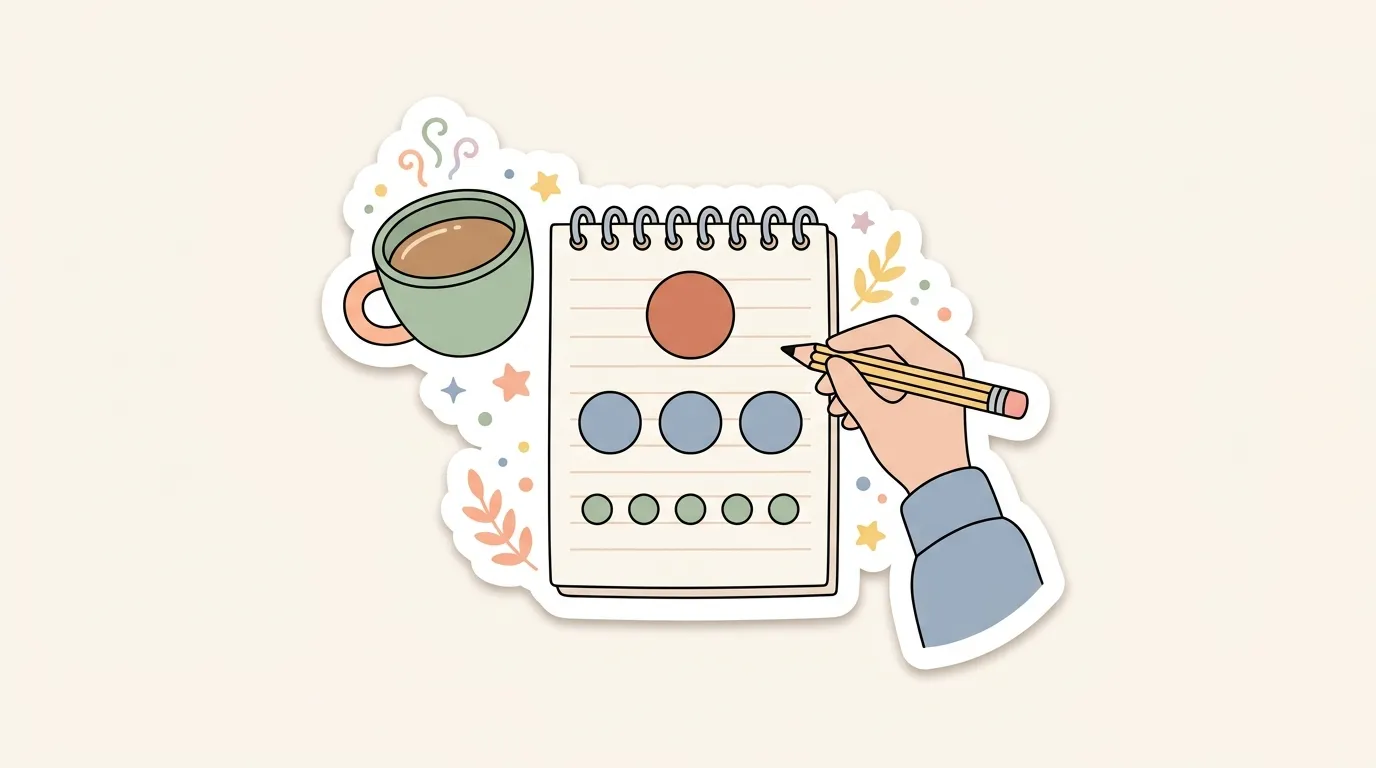
The 1-3-5 rule says you can get through 1 big task, 3 medium tasks and 5 small tasks in a day, so your daily to-do list holds those nine items and nothing else. It forces you to choose, and the mix of sizes keeps the day from being all hard work or all small stuff.
Where the 1-3-5 rule comes from
The Muse published the method in “A Better To-Do List: The 1-3-5 Rule” (page dated June 19, 2020) and credits it to its founder and president, Alex Cavoulacos. The idea is to accept that a day has limits and plan to them. Read the original on The Muse.
How the 1-3-5 rule works
| Slot | How many | Size (rule of thumb) | Example at home |
|---|---|---|---|
| Big | 1 | Over an hour | Deep-clean the bathroom |
| Medium | 3 | 20 to 45 minutes | Meal plan, return a package, fold laundry |
| Small | 5 | Under 10 minutes | Pay a bill, reply to the school email, book a haircut |
The time sizes are our guideline, not part of the original rule. Use whatever fits your day.
How to fill in a 1-3-5 list
- Dump everything first. Write every task on one page. The brain dump template helps.
- Pick the big one. Choose the one task that would make today count.
- Pick 3 medium. Things that matter but don’t need your whole morning.
- Pick 5 small. Quick tasks to slot between the others.
- Park the rest. Move everything else to a “later” list, where it stays until another day.
- Plan tomorrow tonight. Write the next list at the end of the day, while you remember what’s left.
A filled-in 1-3-5 example
A normal Saturday with kids:
| Slot | Task |
|---|---|
| 1 big | Clear and sort the hall closet |
| 3 medium | Grocery shop · Wash and fold two loads · Prep lunches for Monday |
| 5 small | Pay the water bill · Text the babysitter · Order printer ink · Sign the field trip form · Water the plants |
| Later | Paint the fence, sort photos, call about the warranty |
The fence and the photos stay on the later list for another weekend.
When the 1-3-5 rule doesn’t fit
| Situation | Problem | Adjust |
|---|---|---|
| Low-energy day | Nine tasks feel like too many | Try 1-2-3, or 1 big + 1 small |
| Meeting-heavy workday | No room for a big task | Make the big task 30 minutes, or skip it |
| Not sure which task is “big” | Everything looks important | Sort first with the Eisenhower matrix |
| One long project | Nine separate tasks split your focus | Try the 3-3-3 method |
How to tell if a task is big, medium or small
Most 1-3-5 lists fail at the sizing step: three “medium” tasks turn out to be three big ones. Before you slot a task, ask:
| Question | If yes |
|---|---|
| Will it need more than one sitting? | It’s a project. Put only its next chunk on the list. |
| Does it need your full focus for over an hour? | Big |
| Can you do it between other things, in under 45 minutes? | Medium |
| Can you do it while waiting for the kettle? | Small |
| Have you moved it to tomorrow three times? | It’s bigger than it looks. Size it up, or split it. |
A useful check at the end of the day: count how many slots you actually finished. If it’s often 1-2-2, your sizes are off, not your effort. Shrink the list until most days end with everything ticked.
A 1-3-5 workday example
| Slot | Task |
|---|---|
| 1 big | Draft the client proposal |
| 3 medium | Prep slides for Thursday · Review Sam’s pull request · Update the project budget |
| 5 small | Approve two timesheets · Book the meeting room · Reply to IT · File the receipt · Confirm Friday’s call |
| Later | Clean up the shared drive, write the onboarding doc |
On meeting-heavy days, the big slot is the first thing to go. It’s better to plan a 1-3-5 with the “1” empty than to pretend a big task fits around six meetings.
If you have ADHD
There’s no ADHD-specific 1-3-5 rule, but the cap itself can help: a list with a fixed end is easier to face than an open one. Some adaptations people find useful:
- Shrink it to 1-2-3 or 1-1-3. Nine items can still be a lot to look at. Fewer slots, same idea.
- Start with a small one. Doing one 5-minute task first gets you moving before the big one.
- Write a first move next to the big task. “Draft the proposal” becomes “open last year’s proposal and copy the headings.”
- Hide the later list. Keep it on a separate page so today’s page only shows nine things or fewer.
- Keep a stuck-day version. On bad days, a 0-1-3 list (no big task) still gives you a win.
The Stuck-day printable workbook in our shop has short pick-3 pages for those days, with space for first moves. For more, see the ADHD to-do list guide.
1-3-5 and other ways to plan a day
The 1-3-5 rule decides how many tasks you take on. It doesn’t say which one should be the big one, or what order to do them in. Pair it with:
- Eat the frog to decide what goes first: usually the big task, on good-energy days.
- The 3-3-3 method if your day is about one project rather than many separate tasks.
- How to prioritize tasks for a side-by-side comparison of all the methods.
Want the 1-3-5 layout ready to fill in? The to-do list template has a printable daily version. If you plan on paper, the Done Enough shop on Etsy has printable planners with a pick 3, circle 1 layout.
FAQ
What is the 1-3-5 rule in time management?
It's a cap for your daily list: 1 big task, 3 medium tasks and 5 small ones, nine in total. Anything else waits for another day. The Muse, which published the method, credits it to its founder Alex Cavoulacos.
What is the 1/3/5 rule for ADHD?
It's the same 1-3-5 rule, not a separate ADHD method. Some people like it because it caps the list. If nine tasks still feel like too many, try 1-2-3, or just one big task plus one small one.
What are the 5 levels of priority?
There's no single official list. One common way to rank tasks is: must do today, should do today, could do this week, delegate, and drop. The 1-3-5 rule skips ranking and sorts by task size instead.