Food lists
GERD diet food list: what to eat, limit and test
Updated · Written by the Done Enough team · Sources linked below
In this guide (13 parts)
- The list at a glance
- Drinks and alcohol
- Citrus, tomato and spicy food
- Fiber, whole grains, beans and vegetables
- Habits that go with the list
- Meal ideas from Harvard Health
- Why lists disagree
- When to talk to a doctor
- Track meals and symptoms
- Get the printable
- Who’s behind Done Enough?
- How we wrote this guide
- Sources
Free printable: get the PDF for this guide.
A GERD diet food list sorts foods into those people often tolerate, those often limited and those worth testing one at a time. GERD (gastroesophageal reflux disease) is a condition in which stomach acid backs up into the esophagus (Harvard Health, July 20, 2023).
Cleveland Clinic and Harvard Health favor lean meats, fish, vegetables, fruit and whole grains, and Cleveland Clinic adds non-citrus fruit and fiber. All four sources name fatty or high-fat foods, spicy foods, coffee or caffeine and alcohol among common triggers, and tomatoes too (Harvard Health names tomato sauces, not fresh tomato). Cleveland Clinic and Harvard Health say your own triggers may differ, and NIDDK says some people find that certain foods or drinks trigger symptoms. This is informational, not medical advice.
All four sources (Cleveland Clinic, May 21, 2025; Harvard Health, July 20, 2023; NHS, 20 November 2023; NIDDK, July 2020) are older than 12 months, so check for updates. The NHS page is due for review on 20 November 2026, so re-check this list after that date.
The list at a glance
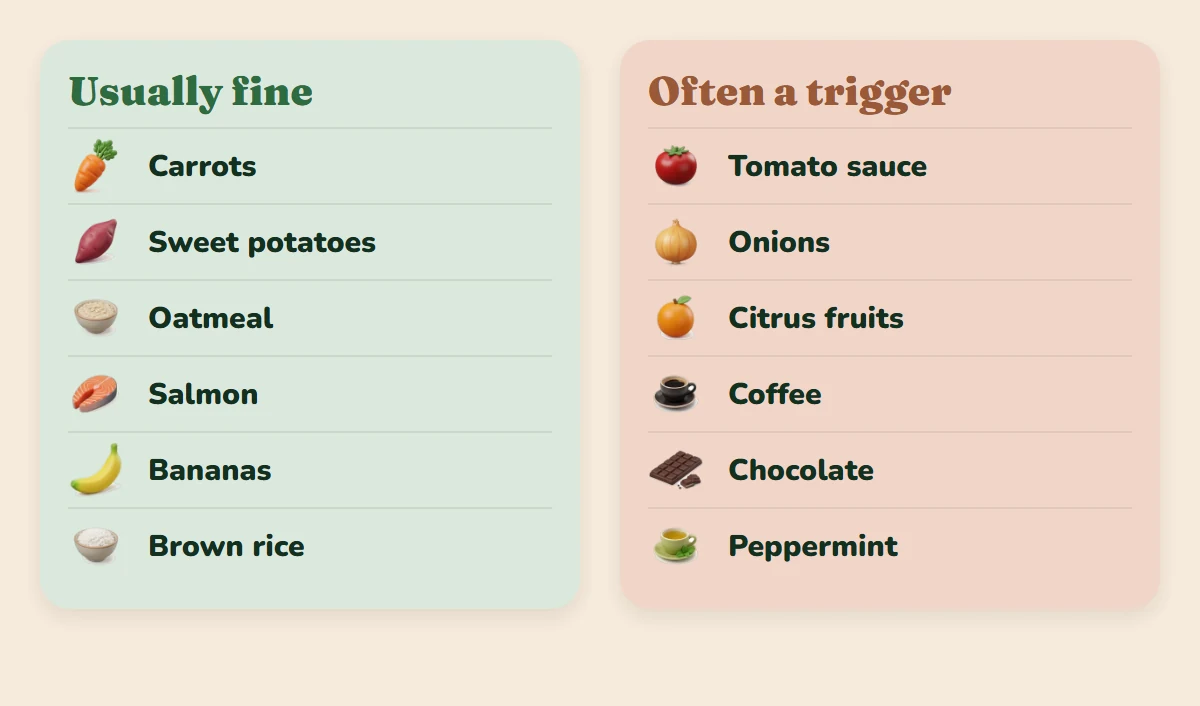
Cleveland Clinic splits foods into those often tolerated and those to limit; the table below gives both lists with the source and date of each row (Cleveland Clinic, May 21, 2025, more than 12 months old).
| Group | Foods | Source |
|---|---|---|
| Often tolerated | Lean meats (chicken, fish, lean beef or pork); vegetables; non-citrus fruit such as bananas, berries and melons; whole grains such as oatmeal and brown rice; beans and lentils; egg whites; lower-fat dairy | Cleveland Clinic, GERD diet, May 21, 2025 |
| Often limited | Fried and high-fat foods; citrus fruit; tomatoes; onions and garlic; coffee; spicy food; chocolate; peppermint; high-fat dairy; carbonated drinks; alcohol | Cleveland Clinic, GERD diet, May 21, 2025 |
| Also named by NIDDK or Harvard Health | NIDDK: acidic foods such as citrus and tomatoes, alcohol, chocolate, coffee and other caffeine, high-fat foods, mint, spicy foods. Harvard Health adds vinegar, tomato sauces, onions and carbonated drinks | NIDDK, last reviewed July 2020; Harvard Health, reviewed July 20, 2023 |
| To test one at a time | Any food from the limited rows that you miss, in a small portion, with notes on what happened (our suggestion) | Our suggestion; Cleveland Clinic and Harvard Health both advise a food journal |
Cleveland Clinic and Harvard Health both say triggers differ by person, so treat the last row as a test. For a one-page chart, see our acid reflux food list.
Drinks and alcohol
Coffee or caffeine and alcohol appear as possible triggers in all four sources we read (Cleveland Clinic, NIDDK, Harvard Health, NHS), and carbonated drinks in two of them.
| Source | Coffee | Carbonated drinks | Alcohol |
|---|---|---|---|
| Cleveland Clinic, May 21, 2025 | Limit, for acidity and caffeine | Limit, for acidity and fizz | Limit; can relax the stomach valve and raise acid |
| NIDDK, July 2020 | Commonly linked, with other caffeine | Not named | Commonly linked |
| Harvard Health, July 20, 2023 | Caffeine named as a trigger | Named as a trigger | Named as a trigger |
| NHS, 20 November 2023 | Possible cause | Not named | Possible cause; do not drink too much |
None of the four pages gives an amount of any drink that counts as too much.
Citrus, tomato and spicy food
Citrus is named as a possible trigger by three of the four sources. Cleveland Clinic names oranges, grapefruit, lemons and limes among acidic foods to limit. NIDDK gives citrus as an example of acidic foods commonly linked to symptoms, and Harvard Health lists it among foods that may intensify heartburn. The NHS does not name it.
Cleveland Clinic lists tomatoes and tomato-based products such as sauces and salsa. NIDDK and the NHS both name tomatoes. Harvard Health names tomato sauces, adding that sauce may bother you while a fresh tomato may not.
All four sources list spicy foods. Cleveland Clinic says capsaicin slows digestion, adds pressure on the stomach valve and may irritate the esophagus, and that spicy dishes often contain tomatoes and onions too. Harvard Health suggests small amounts of spice, care with cayenne or chili blends, or fresh herbs, which it calls less concentrated.
Can I eat citrus?
Cleveland Clinic’s fruit suggestions are non-citrus, and none of the sources lists citrus as a recommended food, so citrus belongs in the “test, do not assume” group (our reading). Harvard Health says the foods that trigger your heartburn may or may not be on the usual lists, so a listed food may be fine for you and an unlisted one may not. Ask your doctor or dietitian, and bring a log.
Fiber, whole grains, beans and vegetables
Cleveland Clinic recommends vegetables, non-citrus fruit, whole grains, beans and lentils for acid reflux, mostly because of their fiber. These are Cleveland Clinic’s reasons.
- Vegetables. Cleveland Clinic says the fiber can help manage stomach acid production and support digestion.
- Non-citrus fruit. Bananas, berries and melons are less acidic and typically higher in fiber, and may calm stomach acid.
- Whole grains. Oatmeal, brown rice and whole-wheat bread are rich in fiber.
- Beans and lentils. High in fiber and, it says, more alkaline, which it links to managing stomach acid.
Harvard Health points the same way without a fiber rationale: lean meats, fish, poultry, vegetables, legumes, fruits and whole grains, made flavorful, with roasted vegetables and chilled whole grains such as quinoa. NIDDK and the NHS do not discuss fiber, and none of the four pages gives a daily amount.
Habits that go with the list
Cleveland Clinic, NIDDK, Harvard Health and the NHS pair the food list with habits: smaller meals, staying upright after eating, leaving at least 3 hours before bed, and weight. The list below keeps each habit with its source.
- Smaller meals. Cleveland Clinic says the more food in your stomach, the more likely backflow is. The NHS suggests smaller, more frequent meals.
- Stay upright after eating. Cleveland Clinic suggests sitting, standing or walking rather than lying down.
- Leave time before bed. NIDDK says eating at least 3 hours before bed may improve night symptoms. The NHS says not to eat within 3 or 4 hours before bed. NIDDK says at least 3 hours and the NHS says 3 or 4 hours, so both sources point to a gap of at least 3 hours.
- Weight. NIDDK and the NHS both mention weight loss if you are overweight; NIDDK says your doctor can recommend an eating plan.
- Other NHS points. Raising the bed head by about 10 to 20 cm may help, but extra pillows can add belly pressure.
- Medication does not cancel triggers. Harvard Health warns that frequent trigger foods can bring heartburn back even if medicine controls it.
In a September 24, 2026 r/GERD thread, one r/GERD post (September 24, 2026) lists eating speed and sleep position as factors; none of the four sources above discusses eating speed, and the NHS only covers raising the bed head (see above). These are one person’s views and untested.
We do not give personal advice: ask your own doctor.
Meal ideas from Harvard Health
Harvard Health’s meal ideas (oatmeal with banana, a salad with chicken or beans and a yogurt dressing, lean protein with roasted vegetables) are laid out by meal in our GERD meal ideas, with the source and date of each idea. On eggs, Harvard Health accepts any kind and Cleveland Clinic prefers egg whites.
Why lists disagree
Cleveland Clinic and Harvard Health say triggers are individual, NIDDK says some people find that certain foods trigger symptoms, the NHS says there is often no obvious reason, and the four name different foods (see the list below).
- On specifics, Cleveland Clinic names onions and garlic, Harvard Health only onions, NIDDK and the NHS neither. Only Harvard Health names vinegar. NIDDK says mint, Cleveland Clinic and Harvard Health say peppermint, and the NHS names neither.
A list can still miss your own pattern. In a July 8, 2026 r/GERD thread, a poster who logged 429 meals and 78 symptom events over about 4.5 months wrote “Zero food categories were statistically significant” and reported more symptoms on stressed, sedentary days than on active, calm ones. This is one person’s account, not a study, and the poster notes a fairly consistent diet. The NHS lists stress and anxiety among possible causes. Log your own meals.
When to talk to a doctor
According to the NHS (page reviewed 20 November 2023, UK advice), see a GP if lifestyle changes and pharmacy medicines are not helping or you have heartburn most days. This page does not diagnose anything.
The NHS names burning in the middle of the chest and a sour taste as the main symptoms of acid reflux, and lists a recurring cough or hiccups, a hoarse voice, bad breath, bloating and feeling sick as others. Harvard Health adds difficulty swallowing, a sore throat and tightness in the chest.
The NHS says to see a GP if:
- lifestyle changes and pharmacy medicines are not helping your heartburn;
- you have heartburn most days;
- you also have other symptoms such as food getting stuck in your throat, frequently being sick, or losing weight for no reason.
If symptoms worsen, the NHS says to contact a GP, or use 111.nhs.uk or call 111 (UK services; our sources do not cover other countries). It says a pharmacist can suggest antacids or alginates, which it says help short term but do not cure the problem, and that a GP may prescribe a proton pump inhibitor, usually for 4 or 8 weeks, or refer you for tests if symptoms are severe.
Track meals and symptoms
Cleveland Clinic recommends a journal to connect heartburn with what you ate before it, and Harvard Health suggests keeping one too. A simple log has one line per meal or symptom:
| What to write | Example (illustrative) |
|---|---|
| Date and time | October 12, 19:30 |
| Food and amount | One bowl of pasta with tomato sauce |
| How soon after, and what happened | 30 minutes later, burning in the chest for 20 minutes |
| Other context | Stressful day, 5 hours of sleep, no walk |
Our own suggestion: test one food at a time, in a small portion, not late at night, and wait a few days before the next one. To log on screen, try our free GERD meal and symptom journal: 14 days, saved only in your browser.
Get the printable
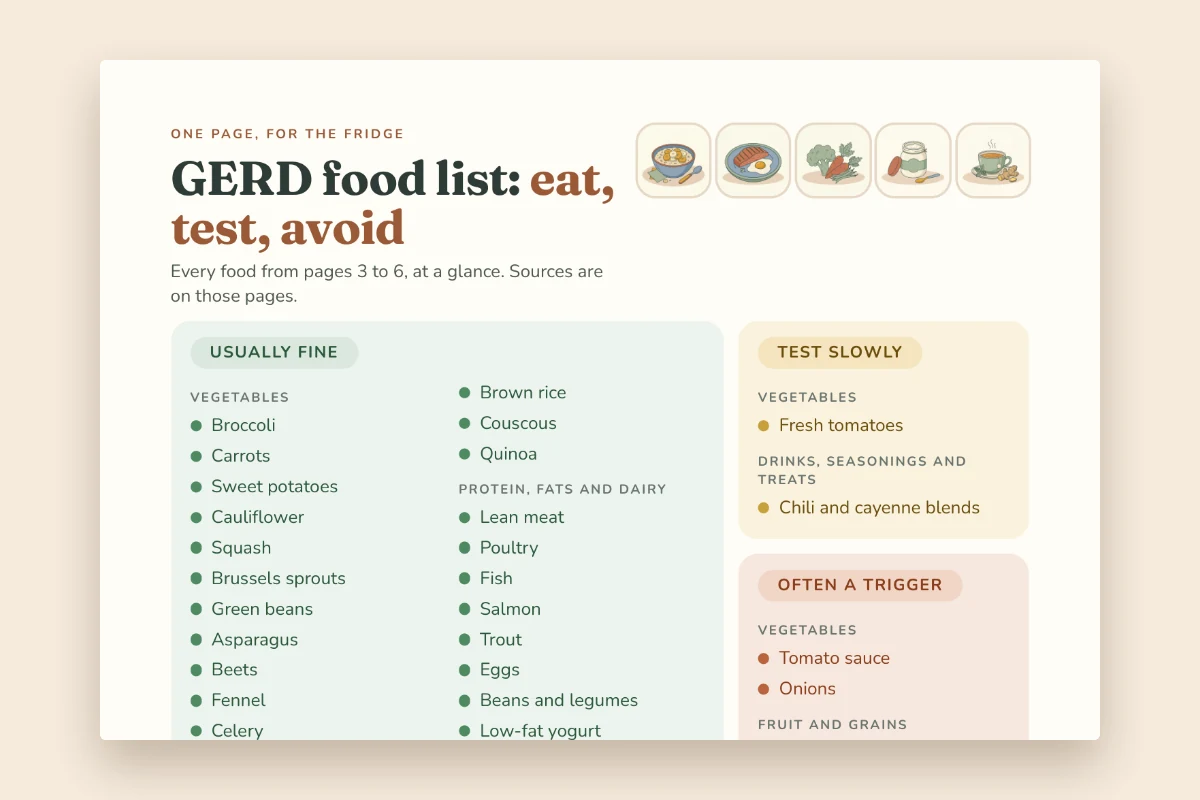
The printable is the one-page acid reflux food list: the groups above, a tick box for each food and a notes box, in US Letter and A4. Print it, tick what you eat and bring it to your next appointment: acid reflux food list printable.
Who’s behind Done Enough?
Done Enough is a small independent shop. These guides are written by The Done Enough Team, the site’s editorial team, which compiles published sources and has no doctors or dietitians. How we compile guides has the method.
How we wrote this guide
No medical reviewer. Sources: the four pages below and two Reddit threads, all read on October 11, 2026. All four pages are more than 12 months old. The meal day and the log are our own arrangement.
Sources
- Cleveland Clinic. “GERD diet: foods to eat and avoid”, with Beth Czerwony, RD, LD, May 21, 2025 (link). Read October 11, 2026. More than 12 months old.
- NIDDK. “Eating, Diet, & Nutrition for GER & GERD”, last reviewed July 2020 (link). Read October 11, 2026. More than 12 months old: used for habits and the commonly linked foods only.
- Harvard Health Publishing. “What to eat when you have chronic heartburn”, reviewed July 20, 2023 (link). Read October 11, 2026. More than 12 months old.
- NHS. “Heartburn and acid reflux”, page last reviewed 20 November 2023, next review due 20 November 2026 (link). Read October 11, 2026. More than 12 months old.
- Reddit, r/GERD, threads posted July 8, 2026 and September 24, 2026; dates from the Reddit post timestamps checked on October 11, 2026. Personal accounts.
- Questions in the FAQ: Google US “People also ask” for the searches “gerd diet food list”, “gerd meal ideas” and “acid reflux food list printable”, collected through DataForSEO on October 11, 2026. The answers are ours, from the sources above.
FAQ
Can scrambled eggs be good for acid reflux?
Harvard Health accepts eggs of any kind in its breakfast ideas, while Cleveland Clinic prefers egg whites and lists high-fat dairy and fried food among foods to limit. Neither names scrambled eggs on their own, so the butter or oil used to cook them is worth noting in your journal. (Harvard Health, July 20, 2023; Cleveland Clinic, May 21, 2025; both more than 12 months old.)
What are some ways to relieve heartburn?
Cleveland Clinic suggests smaller meals and staying upright after eating, and the NHS suggests smaller, more frequent meals and raising the bed head by about 10 to 20 cm. NIDDK says eating at least 3 hours before bed may improve night symptoms. The NHS says a pharmacist can suggest antacids or alginates for short-term relief, and that a GP should be seen if you have heartburn most days. (Cleveland Clinic, May 21, 2025; NHS, 20 November 2023, UK advice; NIDDK, July 2020; all more than 12 months old.)
Can people with acid reflux eat white bread?
In the parts of the four sources we used, white bread is not named as a trigger or as a recommended food. Cleveland Clinic names whole-wheat bread among fiber-rich whole grains and Harvard Health suggests whole-grain toast, so those are the breads the sources point to. Whether white bread bothers you is something to test and note. (Cleveland Clinic, May 21, 2025; Harvard Health, July 20, 2023; both more than 12 months old.)
Can I eat a grilled hamburger with acid reflux?
No source we used rates a grilled hamburger, but Cleveland Clinic (May 21, 2025) uses a "greasy burger" as an example of fatty food that lingers in stomach acid. It prefers grilling, broiling or baking to frying, lists high-fat foods to limit and names less fatty cuts of beef and pork as less likely to trigger reflux; Harvard Health (July 20, 2023) says to avoid fatty meats like ham or bacon. Tomato, onion and spicy toppings are on the trigger lists, so a plain, lean patty is easier to test than a loaded one. That reading is ours.
What is the best breakfast for acid reflux?
Harvard Health gives oatmeal with banana, raisins and perhaps a hint of cinnamon, low-fat yogurt with fruit or nuts, eggs of any kind, and whole-grain toast, and its breakfast and lunch section says to avoid fatty meats like ham or bacon. Cleveland Clinic lists oatmeal among whole grains. No source says one breakfast suits everyone. (Cleveland Clinic, May 21, 2025; Harvard Health, July 20, 2023; both more than 12 months old.)
What is a GERD friendly dinner?
Harvard Health's dinner ideas are lean meat, fish or poultry with roasted vegetables such as carrots, sweet potatoes, broccoli or squash, flavored with fresh parsley, oregano or basil. It also suggests a low-fat yogurt, cucumber and basil sauce. Cleveland Clinic prefers grilling, broiling or baking to frying. (Harvard Health, July 20, 2023; Cleveland Clinic, May 21, 2025; both more than 12 months old.)
What are the ten worst foods to eat if you have acid reflux?
No source we used ranks the worst ten, because triggers are individual. Cleveland Clinic's list of foods to limit is fried and high-fat foods, citrus, tomatoes, onions and garlic, coffee, spicy food, chocolate, peppermint, high-fat dairy, carbonated drinks and alcohol, which is where to start testing. (Cleveland Clinic, May 21, 2025, more than 12 months old.)
Can I eat pizza when I have acid reflux?
No source we used names pizza. It combines tomato, which all four sources list (as sauce in Cleveland Clinic and Harvard Health), with cheese and often fat, which Cleveland Clinic lists among foods to limit. Testing it in a small portion, not late at night, is our reading and not a rule. (Cleveland Clinic, Harvard Health, NIDDK and NHS; dates in Sources; all more than 12 months old.)