Food lists
Foods to avoid with acid reflux: a printable chart
Updated · Written by the Done Enough team · Sources linked below
In this guide (11 parts)
Free printable: get the PDF for this guide.
A printable acid reflux food chart is a one-page list that sorts foods into often tolerated, often limited and to test, so you can tick what you eat and note what bothers you. This one draws on public health sources and has no doctor of our own behind it. It is informational only and does not replace medical advice.
This is the printable version. The full reasoning, drinks, habits and a day of meals are in our GERD diet food list.
The chart at a glance
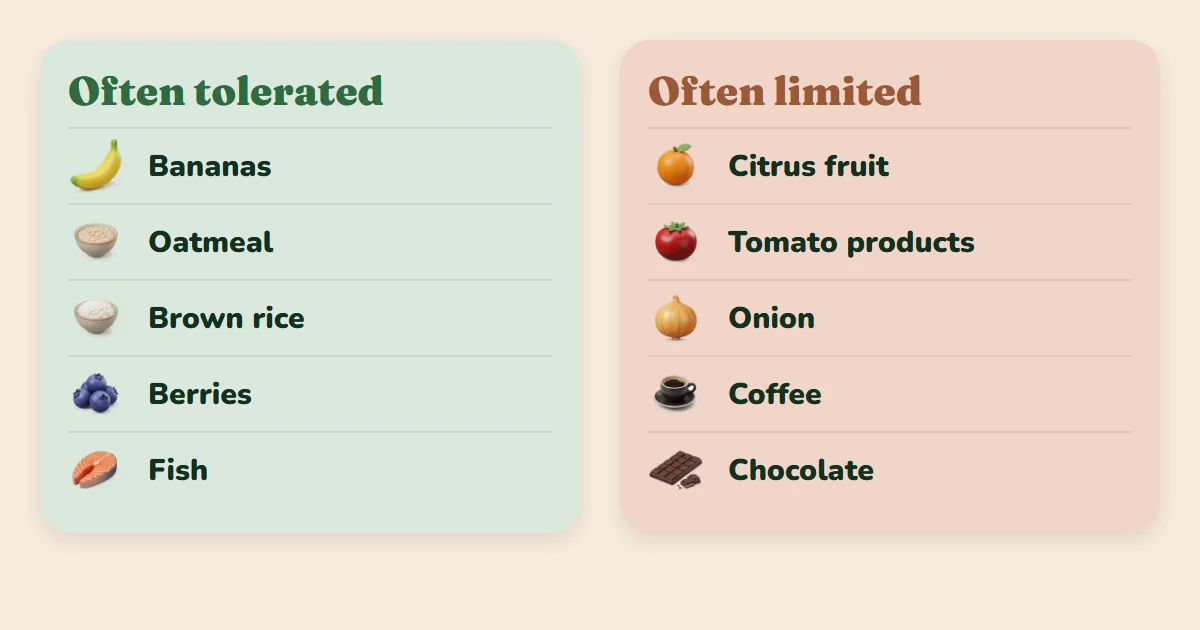
The chart below groups foods as often tolerated, often limited and to test, using Cleveland Clinic (May 21, 2025) as the main source.
Talk to a doctor or registered dietitian before changing what you eat, especially if symptoms are frequent or severe.
| Group | Foods | Source |
|---|---|---|
| Often tolerated | Lean meats (chicken, fish, lean beef or pork); vegetables; non-citrus fruit such as bananas, berries and melons; whole grains such as oatmeal and brown rice; beans and lentils; egg whites | Cleveland Clinic, GERD diet, May 21, 2025 |
| Often limited | Fried and high-fat foods; citrus fruit; tomatoes; onions and garlic; coffee; spicy food | Cleveland Clinic, GERD diet, May 21, 2025 |
| To test one at a time | Any food from the limited row that you miss, in a small portion, with notes on what happened (our suggestion) | Our suggestion; Cleveland Clinic and Harvard Health (reviewed July 20, 2023) both advise a food journal |
The full lists, with every food and source, are in our GERD diet food list.
Cleveland Clinic says food triggers are “very individualized” and suggests connecting “the dots between your heartburn and what you ate before it”.
What the other sources add
NIDDK (last reviewed July 2020) lists “acidic foods, such as citrus fruits and tomatoes, alcoholic drinks, chocolate, coffee and other sources of caffeine, high-fat foods, mint, spicy foods” as commonly linked to GERD symptoms.
Harvard Health (reviewed July 20, 2023) also names vinegar and onions and says the foods that trigger your heartburn “may or may not be on the usual lists”, so the “often limited” row is a place to start testing, not a ranking.
Download and print
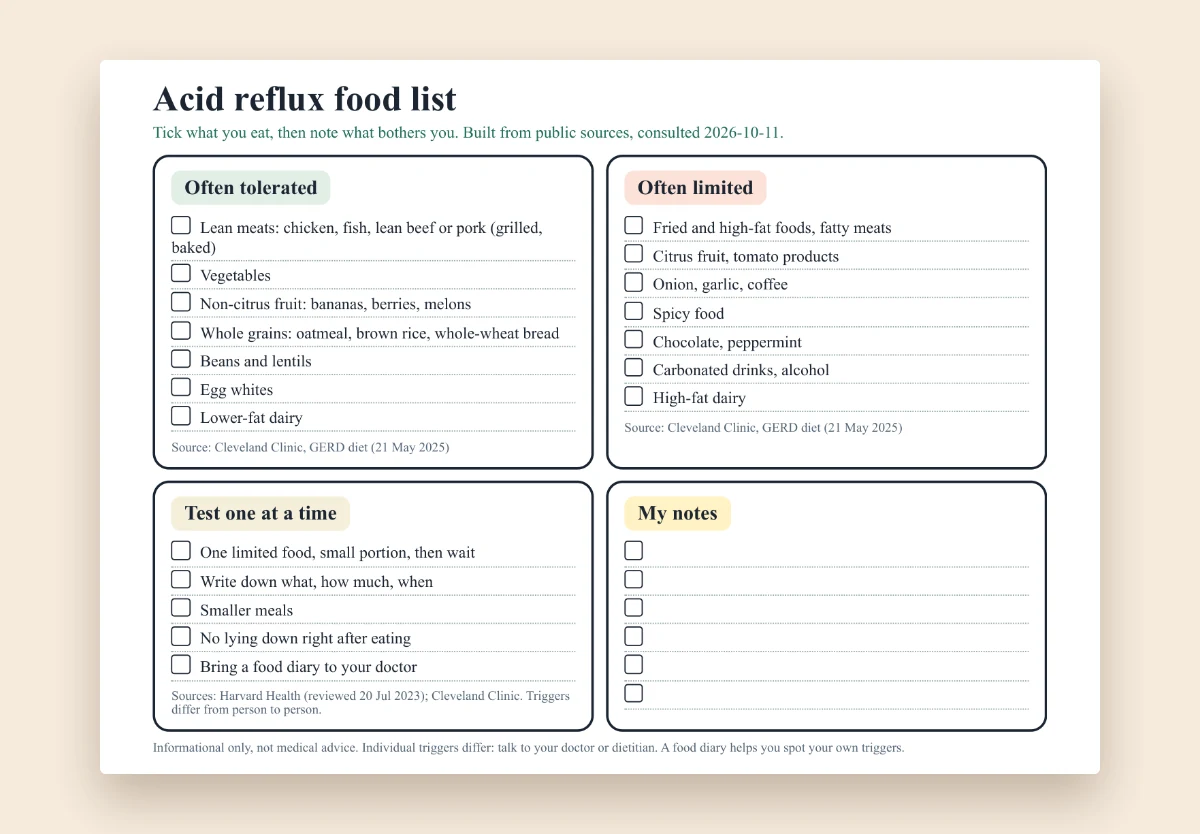
Download the one-page acid reflux food list in the paper size you use:
Print at 100% (choose “Actual size”, not “Fit to page”), in black and white if you like: the groups are named in words, so no colour is needed. A standard home printer and plain paper are enough.
US Letter or A4: which file to print
US Letter and A4 are two standard paper sizes. A mismatched size can clip the edges: Letter is 215.9 x 279.4 mm and A4 is 210 x 297 mm, so A4 is about 6 mm narrower and 17.6 mm taller.
Paper sizes are standard Letter (ANSI) and A4 (ISO) dimensions, not from the health sources above.
If you are unsure, print the size your paper tray holds and check that the notes box at the bottom is not cut off. Printing a Letter file on A4 paper (or the reverse) at “Fit to page” shrinks the text a little instead.
Where the sheet is useful (our suggestions)
These uses are our own ideas, not claims from the health sources:
- On the fridge or inside a cupboard door, so the groups are visible when you plan a meal.
- Before an appointment, with the notes box filled in, so you can show a doctor or dietitian what you tried and when.
- For a household or carer, so everyone cooking for you works from the same short list.
- When eating out, as a reminder of which items to test in a small portion (see our GERD meal ideas for sourced meals).
Keep reading
- GERD diet food list: the full lists, drinks, habits and a day of meals, each with its source.
- GERD meal ideas: breakfast, lunch and dinner ideas built from the same sources.
- All food lists: the other printable lists on the site.
How to use it
The sheet works as a five-step test, one food at a time (our suggestion, not a method from the health sources):
- Tick what you already eat in the first group.
- Pick one food from the limited group and eat a small portion at a normal time, not late at night.
- Write the amount, the time and how you felt in the notes box.
- Wait a few days before the next food, so you can tell them apart.
- Bring the sheet to your next appointment.
For more than a few foods, a day-by-day log is easier than one sheet: use our 14-day meal and symptom journal, which also prints. Both Cleveland Clinic and Harvard Health suggest keeping a food diary.
Habits beyond the chart
Cleveland Clinic suggests smaller meals and not lying down after eating (May 21, 2025), and the NHS says not to eat within 3 or 4 hours before bed (reviewed 20 November 2023, UK advice). Both pages are more than 12 months old.
The NHS page is due for review on 20 November 2026, so re-check this advice after that date.
Who’s behind Done Enough?
Done Enough is a small independent shop. These guides are written by The Done Enough Team, the site’s editorial team, which compiles published sources and has no doctors or dietitians. How we compile guides has the method.
How we wrote this guide
No medical reviewer. Sources: the four pages below, read on October 11, 2026 (the NHS for when to see a GP, the bedtime gap and the pharmacist advice; NIDDK only for the commonly linked foods; Harvard Health for the food diary and the vinegar and onion triggers). All four are more than 12 months old. The steps for using the sheet are our own suggestion.
Sources
- Cleveland Clinic. “GERD diet: foods to eat and avoid”, with Beth Czerwony, RD, LD, May 21, 2025 (link). Read October 11, 2026. Older than 12 months.
- Harvard Health Publishing. “What to eat when you have chronic heartburn”, reviewed July 20, 2023 (link). Read October 11, 2026. More than 12 months old: used for the food diary point and for the vinegar and onion triggers.
- NIDDK. “Eating, Diet, & Nutrition for GER & GERD”, last reviewed July 2020 (link). Read October 11, 2026. More than 12 months old.
- NHS. “Heartburn and acid reflux”, page last reviewed 20 November 2023, next review due 20 November 2026 (link). Read October 11, 2026. More than 12 months old: used for the advice on when to see a GP (UK), the bedtime gap and the pharmacist advice on antacids and alginates.
- Questions in the FAQ: Google US “People also ask” for the search “foods to avoid with acid reflux”, collected through DataForSEO on October 11, 2026. The answers are ours, from the sources above.
FAQ
What foods should I avoid when reflux?
Cleveland Clinic names fried and high-fat foods, citrus, tomato, onion and garlic, coffee, spicy food, chocolate and peppermint among common triggers, and calls triggers 'very individualized', so test foods one at a time (May 21, 2025, more than 12 months old).
What are the 5 worst foods to eat if you have acid reflux?
No source ranks the five worst foods, because triggers are individual. Fried and high-fat foods, citrus, tomato products, coffee and alcohol are all on the Cleveland Clinic list of common triggers, so they are the first ones to test. (Cleveland Clinic list, May 21, 2025, more than 12 months old)
What settles acid reflux immediately?
We found no food that settles reflux for everyone. The NHS says a pharmacist may recommend antacids or alginates, which help symptoms in the short term but will not cure the problem, and that you should see a GP if you have heartburn most days or lifestyle changes and pharmacy medicines do not help (page reviewed 20 November 2023, UK advice). Cleveland Clinic suggests smaller meals and not lying down after eating (May 21, 2025).
Can I eat a grilled cheese sandwich with acid reflux?
Neither Cleveland Clinic nor Harvard Health names grilled cheese. It combines bread and cheese cooked in fat, and Cleveland Clinic lists high-fat dairy and fried foods among common triggers, so treat it as our inference. Try a small portion, note how you feel, and keep what works for you. (Cleveland Clinic, May 21, 2025; Harvard Health, July 20, 2023)