Kids routines
After school routine chart: a simple plan from the door to dinner
Updated · Written by the Done Enough team · Sources linked below
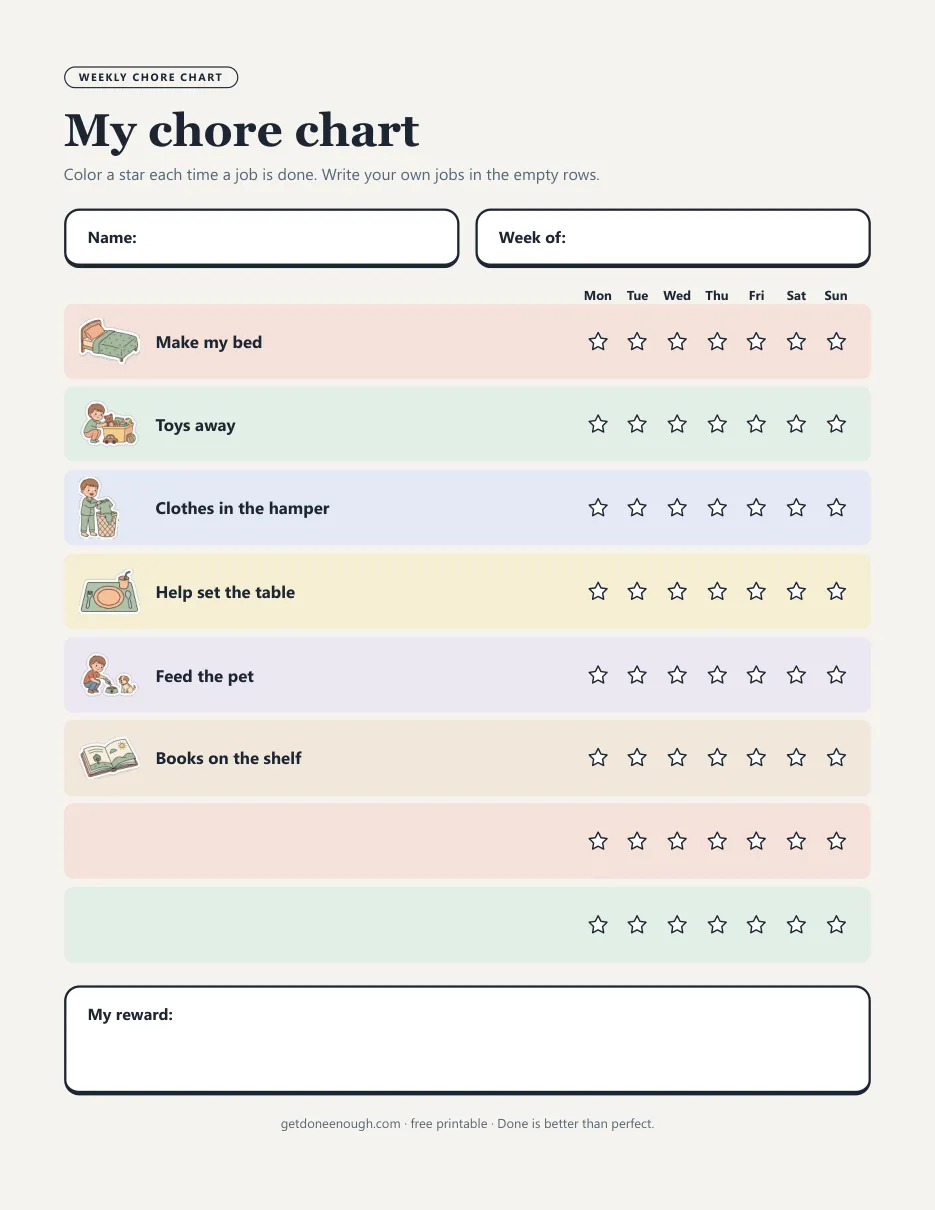
Free PDF: A weekly chore chart with picture icons, one row per job.
Get the free PDFSee the planner on Etsy
The planner is sold in our own Etsy shop.
In this guide (12 parts)
- Make your after school routine chart (free)
- What are the usual after school routine steps?
- What does the research say about after-school time?
- Example: a filled-in afternoon for an 8-year-old
- What should an after school routine look like by age?
- One chart per type of day
- How do you make an after school chart work?
- After school charts for kids with ADHD
- Common problems
- Who’s behind Done Enough?
- How we wrote this guide
- Sources
An after school routine chart lists what your child does between walking in the door and dinner, in the same order every day. A common order is: bag and shoes away, snack, move or play, homework, one small chore, free time. Keep it to 5 or 6 steps.
It is part of our kids routines guide.
Make your after school routine chart (free)
2. Your schedule 0/5 done · tap a card when it's done
3. Add picture cards
Wake & wash
Dress
Eat
Go
Home
Potty
Wind down
Saved on this device only. No account, no email. Print, cut along the dashed lines, and tape the strip where the routine happens.
Prefer illustrated cards to emoji? See our printable routine cards on Etsy (that’s our shop).
What are the usual after school routine steps?
A common order is shoes, coat and bag in their spot, lunchbox to the kitchen, snack, move or play outside, homework, one small chore, and free time. The order is a suggestion. Snack helps because many kids come home hungry and tired, and free time gives them something to look forward to.
| Step | Why it is there |
|---|---|
| Shoes, coat and bag in their spot | Nothing to hunt for tomorrow morning |
| Lunchbox to the kitchen | One less job at night |
| Snack | Many kids come home hungry and tired |
| Move or play outside | A break before sitting down again |
| Homework | Done before evening energy drops |
| One small chore | Keeps the chore chart moving |
| Free time | Something to look forward to |
Our suggested order; adapt it to your child.
What does the research say about after-school time?
The CDC says ages 6 to 17 need 60 minutes or more of moderate-to-vigorous activity each day. A meta-analysis of 25 trials linked short classroom activity breaks to better attention, with varied results. A US study of 46,149 children found inconsistent bedtimes went with lower homework completion, an association only.
| Source | What it says | Date |
|---|---|---|
| CDC, Child Activity: An Overview | Ages 6 to 17 need 60 minutes or more of moderate-to-vigorous activity each day, mostly aerobic (walking, running). | Reviewed Dec 2025 |
| Li et al., Eur J Pediatr (meta-analysis, PMID 42635812) | Across 25 randomized trials, short classroom activity breaks were linked to better attention and executive function. Results varied a lot between studies. | 2026 |
| Knowlden & Flora, J Sch Health (PMID 42141510) | In 46,149 US children aged 6 to 11, inconsistent bedtimes went with lower homework completion and task persistence. An association, not proof of cause. | 2026 |
How we use this: the “move or play” step before homework is a practical way to get part of the CDC’s daily 60 minutes. The Li meta-analysis studied breaks during class, not at home, so a play break before homework is our tip, not a tested result.
Example: a filled-in afternoon for an 8-year-old
The example starts at 3:30 with shoes, bag and lunchbox, then a snack at 3:40, outside play at 4:00, and homework at 4:30. At 5:15 the child feeds the dog, and free time runs from 5:20 until dinner. Use first-then order for kids who cannot read a clock.
| Time | Step |
|---|---|
| 3:30 | Shoes, bag, lunchbox |
| 3:40 | Snack at the table |
| 4:00 | Play outside or bike |
| 4:30 | Homework (timer on, short breaks) |
| 5:15 | Feed the dog |
| 5:20 | Free time until dinner |
Times are an example. Use “first, then” order instead of clock times for kids who can’t read a clock yet.
What should an after school routine look like by age?
At ages 4 to 6, use bag away, snack, play and one small job in 4 pictures. At 7 to 9, add homework, a chore and free time, with pictures plus words. At 10 to 12, use a written list with times. At 13 and up, use their own plan.
| Age | Steps | Format |
|---|---|---|
| 4 to 6 | Bag away, snack, play, one small job | 4 pictures, first-then order |
| 7 to 9 | Bag and lunchbox, snack, play, homework, chore, free time | Pictures plus words |
| 10 to 12 | Same, plus checking tomorrow’s needs and practicing an instrument | Written list with times |
| 13+ | Their own plan, with a few fixed points (homework done by, chore by) | Checklist or phone |
One chart per type of day
Most families don’t have one afternoon, they have three or four. Make a short version for each:
| Day | Version |
|---|---|
| Plain day | Full chart, as above |
| Activity day (soccer, piano) | Bag away, snack, change, go; homework after dinner |
| Home alone or with a sitter | Shorter checklist, with what to do if something goes wrong |
| Early-release day | Snack, play, chore, extra free time |
Color-code them, or clip the right one to the board each morning.
How do you make an after school chart work?
- Put the chart by the door where they drop their bag.
- Use pictures for younger kids. See how to make a visual schedule.
- Make one version per day type if Tuesdays have soccer and Thursdays have piano.
- Let them tick or flip each step, so they see what’s left.
- Prep the night before what you can, like the snack, so the afternoon starts smoothly.
After school charts for kids with ADHD
After school, many kids with ADHD have used up a lot of focus, so the chart should ask for less, in smaller pieces. Put a picture strip at the door, start with snack and movement, use short homework blocks with a visible timer, free time after the last box, and one chore.
Home tips, not medical advice:
- Visual cues at the door. A picture strip right where the bag lands. Our kids visual routine cards are printable picture cards you can mix into a strip like this.
- Snack and movement first, before anything that needs sitting still.
- Short homework blocks with a visible timer and a break card between them.
- Immediate rewards. Free time starts as soon as the last box is ticked, not “after dinner if…”. For one hard step, a first-then board works too.
- One chore only, the same one all week.
More ideas: ADHD routine for kids.
Common problems
For a meltdown right after school, move snack and quiet time first and homework later. For homework that drags, use shorter timed blocks with a break between. If they ignore the chart, use fewer steps and put it where the routine happens. Screens work as the free-time step, after the rest is ticked.
| Problem | Try this |
|---|---|
| Meltdown right after school | Move snack and quiet time first, homework later |
| Homework drags all evening | Shorter blocks with a timer and a break between |
| They ignore the chart | Fewer steps, and put it where the routine happens |
| Chores never get done | One tiny chore only, the same one all week |
| Screens take over | Screens are the free-time step, after the rest is ticked |
The afternoon sits between the morning routine chart and the bedtime routine chart. Write your plain-day version tonight and tape it by the door. Can’t agree on which free-time activity comes first? Spin the task wheel.
Who’s behind Done Enough?
Done Enough is a small independent shop, not a clinic. We build free planning tools and sell printables on Etsy. We are not doctors or therapists: each guide links its sources so you can check every claim, and our own tips are marked as suggestions.
How we wrote this guide
We read the CDC’s physical activity page for children and the PubMed abstracts of Li et al. 2026 and Knowlden & Flora 2026, in October 2026. The 60-minute figure comes from the CDC; the steps, sample times and age tables are our own practical suggestions, not findings from a study. Adapt them to your child. No organization listed here endorses our shop.
Sources
Three sources, read October 2026:
- CDC, “Child Activity: An Overview”, Physical Activity Basics, reviewed 4 December 2025.
- Li C et al. “Effects of active breaks on attention and executive function in children and adolescents: A meta-analysis.” Eur J Pediatr, 2026;185(9):690. PMID 42635812.
- Knowlden AP, Flora SM. “Bedtime Consistency in Middle Childhood: Associations With School Engagement and Family Context in a National US Sample.” J Sch Health, 2026;96(6):e70163. PMID 42141510.
For picture-based steps, see the sourced visual schedule guide.
FAQ
What kinds of after school activities are there?
At home: snack, outdoor play, reading, homework, a small chore, free play, and helping with dinner. Outside the home: sports, music, clubs, or time at a friend's or relative's house. The chart should leave room for whatever your child does on each day.
Is it okay to leave a 10 year old home alone for 10 minutes?
It depends on your child, your local laws, and your situation. Some US states set a minimum age; many do not. Check your state's guidance and judge your own child's readiness. A clear after-school checklist can help on the days they are alone.
What should a 7 year old schedule look like?
After school, a 7-year-old's schedule can be short: bag and lunchbox away, snack, play outside, a short homework block, one small chore, then free time until dinner. Use pictures plus a word for each step, and a separate version for activity days.
How to create a daily routine chart?
Write the steps in the order they happen, keep only what your child does themselves, add a picture or a time to each, and hang it where the routine happens. For after school, that's usually by the door where the bag lands. Review it after a week.