Kids routines
First-then board: a free printable, 10 examples for home, and what makes it work
Updated · Written by the Done Enough team · Sources linked below
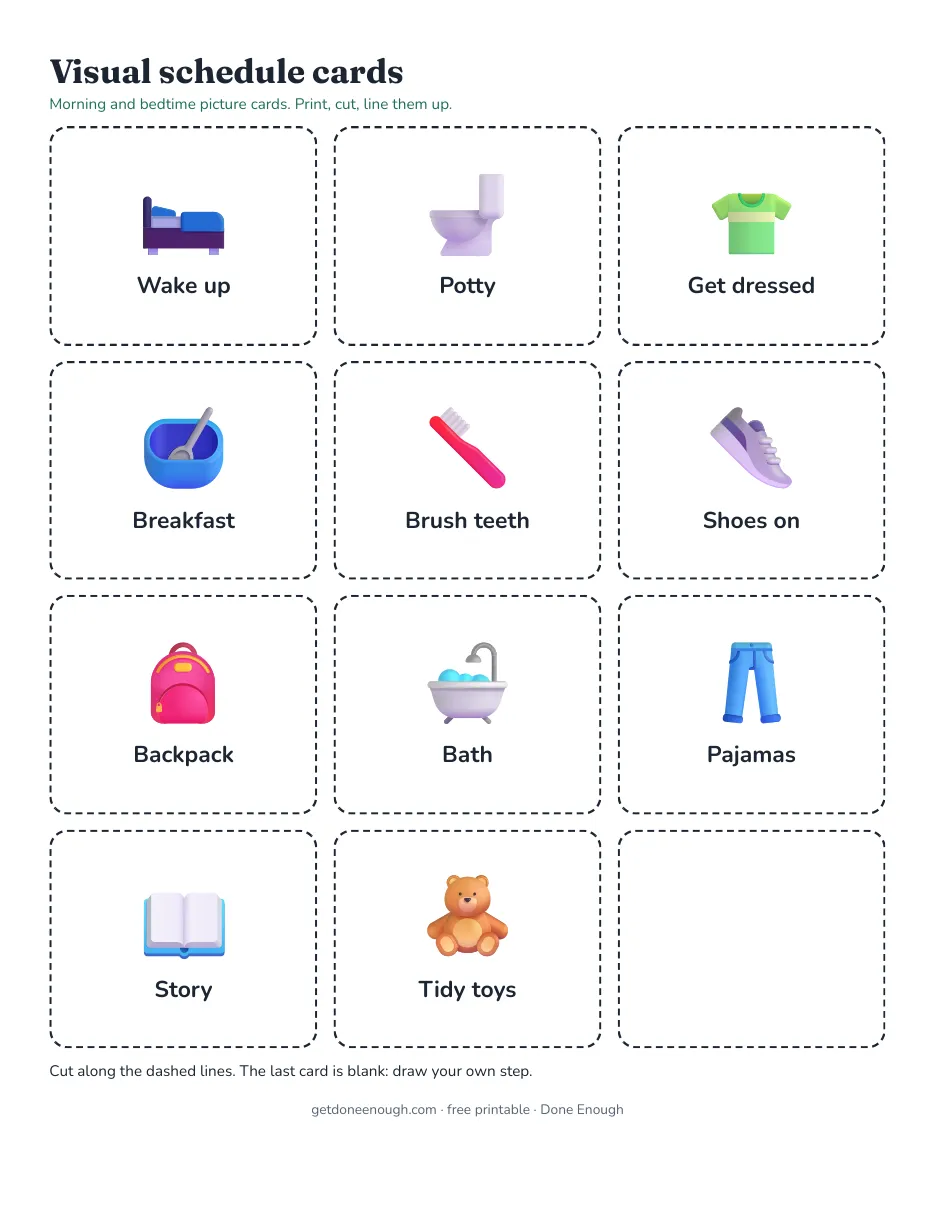
Free PDF: 11 picture cards to use as your first and then. Print and cut.
Get the free PDFSee the planner on Etsy
The planner is sold in our own Etsy shop.
In this guide (12 parts)
- “Put your shoes on.” Silence. “Shoes!” Meltdown.
- Make your first-then board (free)
- What is a first-then board, and why does it work?
- What are good first-then examples for home?
- How do you use a first-then board? 6 rules
- What real parents report
- What are common first-then board mistakes?
- What’s the difference between a first-then board and a visual schedule?
- Want illustrated cards?
- Who’s behind Done Enough?
- How we wrote this guide
- Sources
A first-then board is a two-picture visual support: first the task your child needs to do, then the thing they want next. It turns “no” into “not yet”. It works when the then is real and comes right away. Build and print a free one below in a minute.
“Put your shoes on.” Silence. “Shoes!” Meltdown.
Asking for one small thing can turn into a negotiation, and the more you talk, the less your child hears. One parent on r/toddlers was given the phrase first we eat, then we walk by a behavior analyst, and it became their most useful tool. A picture stays visible; a sentence is gone once said.
You ask for one small thing. Your child wants the park, the tablet, the snack.
One parent on r/toddlers had a 2-year-old close to being asked to leave daycare. A behavior analyst suggested one phrase: “first we eat, then we walk.” It took time. It became the parents’ most useful tool (r/toddlers, April 2024, older than 12 months).
Why add a picture? In the same thread, a parent suggests flashcards or a visual board for kids who don’t get it from words alone. A picture of the park stays on the fridge while the shoes go on; a sentence is gone once you’ve said it.
Make your first-then board (free)
Pick the two cards: the First (the task) and the Then (what comes next). Print it, or show it on your phone.
2. Your first–then board 0/2 done · tap a card when it's done
- First
- Then
3. Add picture cards (max 2: keep it short)
Wake & wash
Dress
Eat
Go
Home
Potty
Wind down
Saved on this device only. No account, no email. Print, cut along the dashed lines, and tape the strip where the routine happens.
No account, no email. It saves on your device so the same board is there tomorrow. Print gives one page with two big cards, easy to point at from across the room.
Prefer illustrated cards to emoji? See our printable routine cards on Etsy (that’s our shop).
What is a first-then board, and why does it work?
A first-then board shows two activities in order: a less-preferred task first, then a preferred activity. This follows the Premack principle, where an activity a child likes can motivate one they like less. AFIRM lists visual supports as evidence-based, though a 2023 review noted little hard evidence for applying the principle exactly.
A first-then board shows two activities in order: a less-preferred task first, then a preferred activity. Behavior psychologists call this the Premack principle: an activity a child likes can motivate one they like less.
The evidence, with dates:
| Source | What it says | Date |
|---|---|---|
| AFIRM, UNC Chapel Hill | Visual supports, including first/then boards, are an evidence-based practice; “Parents and family members also can use Visual Supports in the home.” | 2024, older |
| Augustine et al. | A video-enhanced activity schedule with a built-in first-then step increased task engagement and independence in 4 preschoolers. Effect on problem behavior was unclear. | June 2026, small study |
| Herrod et al., University of Georgia | Review of the Premack principle, the idea behind first-then. Notes earlier authors found little hard evidence for applying it exactly as theorised. | 2023, older |
| Rutherford et al., Autism | Scoping review of 34 studies: visual supports “can reduce anxiety, increase predictability”, but evidence at home is limited. | 2019, older |
| Rutherford et al. | 29 families got home visual supports: parent-reported quality of life improved, and parents felt more confident using them. | 2023, older, pilot |
| Jimenez-Gomez et al. | Picture prompts on a watch helped young children (not only autistic ones) do a morning routine more independently. | 2020, older |
| McGuire et al. | Low-tech (paper) and high-tech (tablet) schedules both worked. | Nov 2025, small study |
What this means at home: pictures help a child see what’s next, but the “then” is what makes them move. A board with no real then is just a schedule. And paper is enough: in McGuire’s 2025 study, a printed schedule worked as well as a tablet.
What are good first-then examples for home?
Use your child’s words and keep both sides concrete. Examples include first shoes, then park; first teeth, then story; first dinner, then bath toys; first potty, then sticker; and first tidy toys, then TV. The list in the article has ten examples.
- “First shoes, then park.”
- “First teeth, then story.”
- “First dinner, then bath toys.”
- “First pajamas, then song.”
- “First potty, then sticker.” (see the potty training chart)
- “First tidy toys, then TV.”
- “First car seat, then snack.”
- “First homework, then play outside.”
- “First bath, then bubbles.”
- “First get dressed, then pick the music.”
Number 9 comes from a parent in a thread about a 3-year-old who may be autistic: bath first, bubbles then (r/Autism_Parenting, April 2026). Number 10 comes from a parent whose child picks a song on the smart speaker if dressed in time, then watches that music video during hair-brushing (r/ADHDparenting, August 2026).
How do you use a first-then board? 6 rules
- Follow through immediately: the then comes right after the first, not “later”. One parent’s rule: only say it when you’re actually willing to follow through (2024 thread, older).
- Start tiny: the first task should take a minute at the start. One parent taught “wait” first, from 3 seconds up, for a toddler who didn’t get “later” yet (same thread).
- Add a cue for the end: one parent says “Last one!” with one finger raised, so the switch doesn’t come as a surprise (2024 thread, older).
- Keep it visible: on the fridge, by the door, on your phone. Point to it instead of repeating yourself.
- Warn before the switch: a parent of a 3-year-old announces what’s next 10 to 20 minutes ahead and lets the phone timer be “the bad guy” (r/NewParents, October 2026).
- Use the normal day: the best then is often something that happens anyway. Dinner then park. Teeth then story.
What real parents report
Parents describe families using the board for a whole routine. One rule let a 3-year-old watch TV once the morning routine was done. One 8-year-old could watch TV until leaving once the jobs were done and shoes were on. In another family, earn TV backfired, and earning it became a daily fight.
A whole morning as one “first”. A family drew their child’s morning and bedtime routines by hand. The rule: once the whole morning routine is done, you can watch TV. For their 3-year-old, it works. Source: r/NewParents, October 2026
Shoes on, then TV until we leave. In a thread about hard mornings with an 8-year-old, one family writes and draws the jobs on a board. Only when all are done, and their son is ready to walk out with shoes on, can he watch TV until it’s time to go. Another family in the thread gives TV minutes per task done alone. Source: r/ADHDparenting, September 2026
When “earn TV” backfired. A family rule said TV only after dressing, teeth and breakfast. Their 7-year-old turned the TV on himself on waking, and earning it became a daily fight. Another parent dropped screens-after-tasks entirely, because turning the screen off to leave caused meltdowns. Source: r/ADHDparenting, October 2026
Our take from that last story: pick a then that ends on its own (a song, a story, a sticker) rather than one you’ll have to take away.
What are common first-then board mistakes?
Common mistakes are a then that is later, a new treat every time to stop a meltdown, saying it without meaning it, a first task that is too big, using it when your child is exhausted, and always using a screen as the then.
| Mistake | Better |
|---|---|
| The then is “later” or “this weekend” | The then happens right after |
| A new treat every time to stop a meltdown | Use what comes next in the day anyway |
| Saying it without meaning it | Only use it when you’ll follow through |
| A first task that’s too big | A 1-minute task, then grow it |
| Using it when your child is exhausted | Parents report it fails when kids are tired (2024, older). Rest first |
| A screen as the then, every time | Screens are hard to end. Try a song or a story |
When it stops working: in the 2024 thread, one parent said it stopped around age 3 and a half, when the child replied “I want to do Y but not X”. That’s the moment to move to a full visual schedule or a reward chart, where your child sees the whole routine.
What’s the difference between a first-then board and a visual schedule?
A first-then board shows 2 steps and suits one hard moment, like first shoes, then park. A visual schedule shows the whole routine, such as wake, potty, dress, breakfast, teeth, shoes, and suits a daily routine. One parent’s bedtime board had about 5 pictures.
| What changes | First-then board | Visual schedule |
|---|---|---|
| Steps shown | 2 | The whole routine (one parent’s bedtime board: about 5) |
| Best for | One hard moment | A daily routine |
| Example | First shoes, then park | Wake, potty, dress, breakfast, teeth, shoes |
Many families use both (our observation from the threads above): a morning routine chart for the routine, and a first-then card for the step that always gets stuck.
Want illustrated cards?
The builder is free and uses emoji. Our own Etsy shop, Done Enough, sells printable kids visual routine cards for morning and bedtime routines, which you can also pair as first-then cards. Full disclosure: that’s us. More charts for every part of the day are in the kids routines hub.
Who’s behind Done Enough?
Done Enough is a small independent shop, not a clinic. We build free planning tools and sell printables on Etsy. We are not doctors or therapists: each guide is built from parents’ own threads and published research, linked so you can check every claim.
How we wrote this guide
We read first-then and routine threads on Reddit (dates checked on each post, October 2026), the AFIRM visual supports packet from UNC Chapel Hill, and the research abstracts listed below on PubMed. Parent stories are paraphrased, with short quotes and a link to the original. Anything older than 12 months is marked as such. No organization listed here endorses our shop.
Sources
- Sam, A., & AFIRM Team (2024). Visual Supports, EBP Brief Packet, updated 2024. UNC Frank Porter Graham Child Development Institute. Older than 12 months.
- Augustine JJ et al. (2026). Journal of Autism and Developmental Disorders, online 19 June 2026. Single-case study, 4 children.
- Herrod JL et al. (2023). Behavior Modification 47(1). Older than 12 months.
- Rutherford M et al. (2019, issue 2020). Autism 24(2). Older.
- Rutherford M et al. (2023). Int J Environ Res Public Health 20(5). Older.
- Jimenez-Gomez C et al. (2020, issue 2021). Journal of Applied Behavior Analysis 54(1). Older.
- McGuire SN et al. (2025). Journal of Autism and Developmental Disorders, online 1 Nov 2025.
- Parent experiences: Reddit threads linked above, dates taken from each post, read October 2026.
FAQ
What is a first-then board?
A first-then board is a two-picture visual support: on the left the task your child needs to do first, on the right the thing they want next. It shows the order of two activities at a glance. Autism support programs such as AFIRM (UNC, 2024) list it as a type of visual support parents can use at home.
What age is a first-then board for?
Parents in an r/toddlers thread (April 2024, older) describe using it from about age 2, and parents of older autistic or ADHD children use it too. The research on visual supports reviewed by AFIRM covers ages 0 to 22 (2024, older). One parent in the same 2024 thread said it worked less well once their child started to bargain, around 3 and a half.
What is the difference between a first-then board and a visual schedule?
A first-then board shows only two steps: now and next. A visual schedule shows a whole routine (one parent's bedtime board had about 5 pictures). Use first-then for one hard moment, like leaving the park, and a visual schedule for a routine you repeat every day.
Is a first-then board bribery?
Not when the "then" is part of the normal day: dinner then park, shoes then car. It shows the order things happen. It slides toward bribery when you invent a new treat each time to stop a meltdown. Keep the then simple and follow through every time.
Can I make a first-then board at home?
Yes. Fold a sheet of paper in half, write First and Then at the top, and draw or tape a photo on each side. Or use the free builder on this page: pick two cards, print, and stick it on the fridge.