Kids routines
Bedtime routine chart for kids: simple steps and a sample evening
Updated · Written by the Done Enough team · Sources linked below
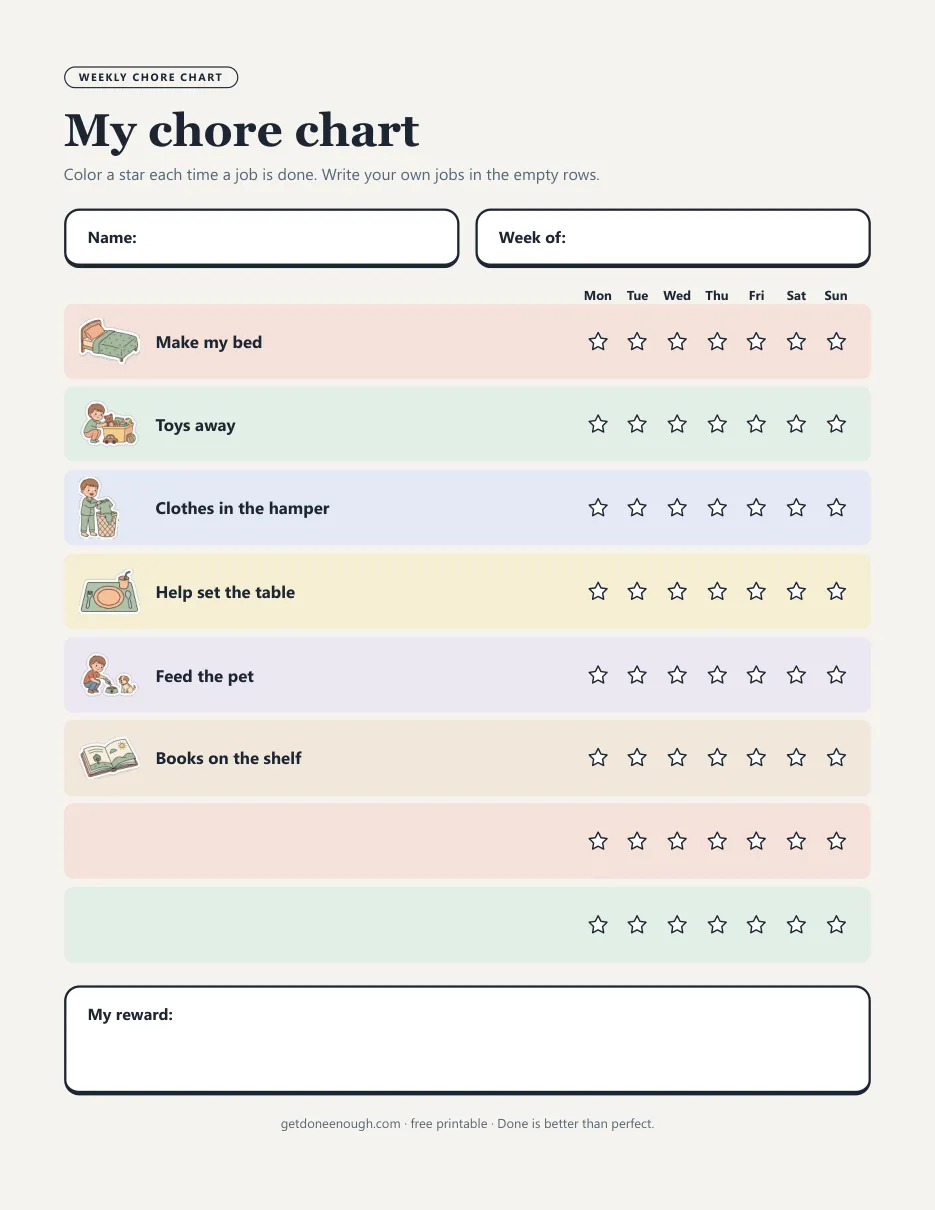
Free PDF: A weekly chore chart with picture icons, one row per job.
Get the free PDFSee the planner on Etsy
The planner is sold in our own Etsy shop.
In this guide (13 parts)
- Make your bedtime routine chart (free)
- What are common bedtime routine steps?
- Bedtime routine chart by age
- Sample evening (lights out at 8:00)
- What does the research say about bedtime routines?
- How do you set a bedtime?
- Toddler version (2 to 3 steps)
- Bedtime charts for kids with ADHD
- When bedtime keeps stretching
- Making the chart
- Who’s behind Done Enough?
- How we wrote this guide
- Sources
A bedtime routine chart shows your child the steps from dinner to lights out, in the same order every night. A short, predictable list means fewer “one more thing” negotiations. Keep it to 5 to 7 steps, with pictures for younger kids.
It is part of our kids routines guide. This page shares practical tips for routines; for questions about your child’s sleep, talk to your pediatrician.
Make your bedtime routine chart (free)
2. Your schedule 0/6 done · tap a card when it's done
3. Add picture cards
Wake & wash
Dress
Eat
Go
Home
Potty
Wind down
Saved on this device only. No account, no email. Print, cut along the dashed lines, and tape the strip where the routine happens.
Prefer illustrated cards to emoji? See our printable routine cards on Etsy (that’s our shop).
What are common bedtime routine steps?
Common steps are tidying toys for 5 minutes, bath or wash up, pajamas, brushing teeth and toilet, getting ready for tomorrow with clothes and bag out, book or quiet time, and lights out. Pick the ones that fit your family and put them in a fixed order.
- Tidy toys (5 minutes)
- Bath or wash up
- Pajamas
- Brush teeth, toilet
- Get ready for tomorrow (clothes and bag out)
- Book or quiet time
- Lights out
Pick the ones that fit your family and put them in a fixed order.
Bedtime routine chart by age
Our suggestions, not a clinical standard:
| Age | Steps | Format |
|---|---|---|
| 2 to 3 | Bath, pajamas, book | 3 real photos |
| 4 to 5 | Tidy, bath, pajamas, teeth, toilet, book | 5 to 6 pictures |
| 6 to 8 | Tidy, wash, pajamas, teeth, clothes for tomorrow, read | Pictures plus words, tick boxes |
| 9 to 12 | Shower, bag packed, devices charging outside the room, read | Written list with times |
Sample evening (lights out at 8:00)
For lights out at 8:00, start at 7:00 with tidying toys, then bath or wash up at 7:10. At 7:30 do pajamas, teeth and toilet, at 7:40 get clothes and backpack ready, and at 7:45 have a book or quiet time. Start at the same time each night.
| Time | Step |
|---|---|
| 7:00 | Tidy toys |
| 7:10 | Bath or wash up |
| 7:30 | Pajamas, teeth, toilet |
| 7:40 | Clothes and backpack ready for tomorrow |
| 7:45 | Book or quiet time |
| 8:00 | Lights out |
Start the routine at the same time each night. Change the times to match your child’s actual bedtime.
What does the research say about bedtime routines?
A 2018 review links a nightly bedtime routine to healthier sleep and wider benefits such as language, emotional regulation and family functioning. The AASM consensus lists 9 to 12 hours of sleep at ages 6 to 12. The AAP advises the same waking time on weekdays and weekends.
| Source | What it says | Date |
|---|---|---|
| Mindell & Williamson, Sleep Medicine Reviews (review, PMID 29195725) | A nightly bedtime routine is linked to healthier sleep and to wider benefits such as language, emotional regulation and family functioning. Common parts: hygiene (bath, teeth), reading or singing, cuddles, a healthy snack. | 2018 (older) |
| American Academy of Sleep Medicine consensus, J Clin Sleep Med (PMID 27250809) | Sleep per 24 hours: 11 to 14 h at 1 to 2 years, 10 to 13 h at 3 to 5 (naps included), 9 to 12 h at 6 to 12, 8 to 10 h at 13 to 18. | 2016 (older) |
| AAP, HealthyChildren.org: Healthy Sleep Habits | The AAP supports the AASM numbers. It advises the same waking time on weekdays and weekends, and a simple routine such as “brush, book, bed”. | Updated Aug 2026 |
| Knowlden & Flora, J Sch Health (PMID 42141510) | In 46,149 US children aged 6 to 11, inconsistent bedtimes went with lower self-regulation, task persistence and homework completion. This is an association, not proof of cause. | 2026 |
According to the AAP, “all children thrive on a regular bedtime routine.” The steps on our chart (bath, teeth, book) match the routine parts the Mindell review describes; the order and times are our suggestions.
How do you set a bedtime?
- Start from wake-up time. If school means up at 6:45, that’s fixed.
- Count back the sleep your child needs. According to the AASM consensus, that’s 9 to 12 hours a night at ages 6 to 12, and 10 to 13 hours (naps included) at ages 3 to 5. Your pediatrician can tell you what fits your child.
- Start the routine 30 to 60 minutes before lights out, depending on how many steps it has.
- Keep it close on weekends if you can, so Monday isn’t a shock. The AAP advises the same waking time on weekdays and weekends.
Toddler version (2 to 3 steps)
The toddler version has three steps: bath, pajamas and book. Real photos of your child’s own bath, pajamas and book work well at this age. For more on picture steps, see how to make a visual schedule.
| Step | Picture |
|---|---|
| 1 | Bath |
| 2 | Pajamas |
| 3 | Book |
Real photos of your child’s own bath, pajamas, and book work well at this age. See how to make a visual schedule for more on picture steps.
Bedtime charts for kids with ADHD
Evenings can be the hardest stretch for kids with ADHD. Try visual cues at each spot, short steps like pajamas, teeth and toilet, a visible timer for slow steps, a warning before the routine, and the book or song right after the last step.
Practical adaptations (home tips, not medical or sleep advice):
- Visual cues at each spot. Teeth card on the bathroom mirror, pajamas card on the bed. Our kids visual routine cards include bedtime picture cards you can print and place.
- Short steps. “Get ready for bed” is too big; “pajamas”, “teeth”, “toilet” are three wins.
- Immediate rewards. The book or a song comes right after the last step, every night, as the built-in payoff, like a first-then board.
- A visible timer for the slow steps, like the bath.
- Warn before the routine starts: “5 minutes, then tidy time.”
- Screens end before the first step.
More whole-day ideas: ADHD routine for kids. For concerns about sleep, talk to your child’s doctor.
When bedtime keeps stretching
For one more requests, put water, toilet and a second hug on the chart so they are already done. Use a visible timer for dawdling in the bath, and let the chart decide arguments about order. End screens before the first step, and add a get-ready-for-tomorrow step to prevent morning chaos.
| What happens | Try this |
|---|---|
| “One more” requests | Put water, toilet and a second hug on the chart, so they’re already done |
| Dawdling in the bath | Fixed bath length with a timer they can see |
| Arguing about order | The chart decides, not you: “What does the chart say?” |
| Screens run late | Screens end before the first step, not during |
| Tomorrow-morning chaos | Add one “get ready for tomorrow” step (see the morning routine chart) |
| Siblings at different times | Shared steps together, then the younger one goes first |
Still toilet training? Add the potty step and see the potty training chart.
Making the chart
- One page, steps top to bottom.
- Pictures for pre-readers, words plus pictures for early readers.
- A way to mark done: tick box, sticker, or flip card.
- Place it where the routine starts, like the bathroom door.
- Review after a week. Drop steps that never happen.
Pick five steps tonight and tape them to the bathroom door. The tidy-toys step goes faster as a game: put three toy zones on the task wheel and let your child spin for the first one.
Who’s behind Done Enough?
Done Enough is a small independent shop, not a clinic. We build free planning tools and sell printables on Etsy. We are not doctors or therapists: each guide links its sources so you can check every claim, and our own tips are marked as suggestions.
How we wrote this guide
We read the abstracts of the two PubMed papers below (Mindell & Williamson 2018; Knowlden & Flora 2026), the full AASM 2016 consensus statement (free on PubMed Central), and the AAP’s HealthyChildren.org sleep page, in October 2026. The sleep hours come from the AASM; the steps, sample times and age tables are our own practical suggestions, not findings from a study. For sleep questions, your pediatrician is the right source. No organization listed here endorses our shop.
Sources
Four sources, read October 2026:
- Mindell JA, Williamson AA. “Benefits of a bedtime routine in young children: Sleep, development, and beyond.” Sleep Med Rev, 2018;40:93-108. PMID 29195725. Older than 12 months.
- Paruthi S et al. “Recommended Amount of Sleep for Pediatric Populations: A Consensus Statement of the American Academy of Sleep Medicine.” J Clin Sleep Med, 2016;12(6):785-786. PMID 27250809. Older than 12 months.
- American Academy of Pediatrics, HealthyChildren.org, “Healthy Sleep Habits: How Many Hours Does Your Child Need?”, last updated 7 August 2026.
- Knowlden AP, Flora SM. “Bedtime Consistency in Middle Childhood: Associations With School Engagement and Family Context in a National US Sample.” J Sch Health, 2026;96(6):e70163. PMID 42141510.
FAQ
What is a good visual schedule for a 2-year-old?
Two or three photos for one routine, for example bath, pajamas, book. Real photos of your child's own things are easiest to recognize. Use the same order every night.
Is 9pm too late for a 3 year old bedtime?
It depends on when your child wakes up, whether they nap, and how much sleep they need. Your pediatrician can tell you what fits your child. Whatever the time, a predictable routine leading up to it helps the evening run smoother.
What should bedtime be for each age?
It depends on your child's wake-up time and how much sleep they need, which your pediatrician can advise on. A practical approach: start from the time they must wake up, count back the sleep they need, then start the routine 30 to 60 minutes before that.
How do I write my daily routine?
List what happens from waking to sleeping, group it into blocks (morning, school or day, afternoon, evening), and pick the routines with the most friction. Turn those into short step charts, and leave the rest flexible.
What is a bedtime routine checklist?
It is the list of steps from dinner to lights out, done in the same order every night. Common steps are tidying toys, bath or wash up, pajamas, brushing teeth and toilet, getting clothes and bag ready for tomorrow, then a book or quiet time before lights out. Keep it to 5 to 7 steps, with pictures for younger kids.