Kids routines
Visual schedule: how to make one that kids actually use
Updated · Done Enough
In this guide (12 parts)
- Types of visual schedules
- Why use a visual schedule at home?
- How to make a visual schedule in 6 steps
- What you need to make one
- Visual schedule examples by age
- Example: getting dressed
- Example: a school-day schedule for a 7-year-old
- First-then boards: the simplest visual schedule
- Visual schedules for kids with ADHD
- Using the schedule day to day
- Paper or app?
- Common problems
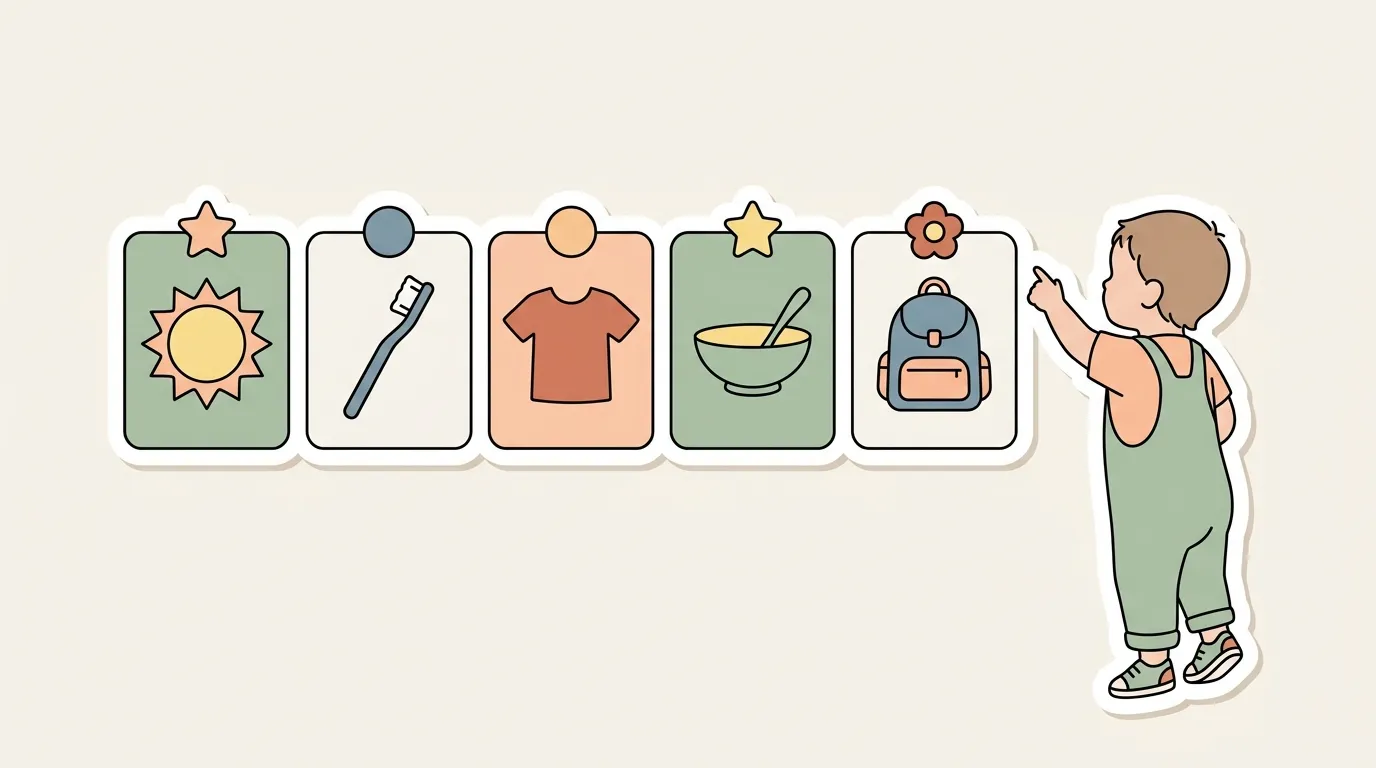
A visual schedule shows the steps of a routine or a day as pictures in order, so a child can see what comes next without being told. At home, start with one routine, 4 to 6 pictures, and a way for your child to mark each step done.
This page shares practical tips for home routines. It is not medical, therapy, or educational advice. If your child has an autism, ADHD, or other diagnosis, or an IEP, ask their care or school team how they use visual supports so home and school match.
It is part of our kids routines guide. For ready-made examples, see the morning routine chart and the bedtime routine chart.
Types of visual schedules
| Type | What it shows | Good for |
|---|---|---|
| First-then board | Two pictures: “first this, then that” | Younger kids, one hard task followed by something they like |
| Routine strip | 4 to 6 steps of one routine | Morning, bedtime, getting dressed |
| Daily schedule | The main blocks of the day | Weekends, school breaks, days with changes |
| Checklist with pictures | Steps with tick boxes | Kids who can read a little, or older kids |
Start with the smallest one that fits. You can always add more later.
Why use a visual schedule at home?
Spoken instructions disappear as soon as they’re said. A picture stays on the wall. That changes a few things in a normal day:
- Fewer repeated reminders. You point to the next picture instead of saying it a fifth time.
- Less negotiation. The order is already decided: “What does the schedule say?”
- More independence. A child who can’t read yet can still follow the steps alone.
- Smoother changes. Swapping a card ahead of time warns about a dentist visit or a cancelled practice.
Visual schedules are used a lot with kids who have autism or ADHD, but many families use them with any young child who isn’t reading yet.
How to make a visual schedule in 6 steps
- Pick one routine. The one with the most daily friction is a good choice. Usually morning or bedtime.
- Write the steps down exactly as they happen now, then cut to 4 to 6.
- Choose one picture per step. Photos of your child’s real things (their toothbrush, their shoes) are often easiest to recognize. Simple drawings work too.
- Order them top to bottom or left to right, the same direction every time.
- Add a way to mark “done”: flip the card, move it to a “done” pocket, or tick a box.
- Put it at your child’s eye level, where the routine happens. Bathroom steps by the sink, dressing steps by the closet.
What you need to make one
| Item | Cheap option | Sturdier option |
|---|---|---|
| Pictures | Phone photos, printed small | Printed picture cards |
| Backing | Paper strip taped to the wall | Card or foam board |
| Protection | Clear packing tape | Laminator or sheet protectors |
| “Done” action | Pen tick | Velcro dots, a “done” envelope |
If you’d rather not make the pictures yourself, our kids visual routine cards are printable picture cards for morning and bedtime steps.
Visual schedule examples by age
| Age | What works | Example |
|---|---|---|
| 2 to 3 | 2 or 3 real photos, one routine | Bath → pajamas → book |
| 3 to 5 | First-then board, or a 4 to 5 step strip | Toilet → dress → breakfast → teeth → shoes |
| 5 to 7 | 5 to 6 steps, pictures plus one word | Morning strip with ticks |
| 7 to 10 | Daily blocks plus short step lists | Morning / school / after school / bedtime |
| 10+ | Written checklist, small icons optional | Weekly planner page |
The younger the child, the shorter the schedule and the more real the pictures.
Example: getting dressed
| Step | Picture idea |
|---|---|
| 1 | Pajamas in the hamper |
| 2 | Underwear and socks |
| 3 | Pants or skirt |
| 4 | Shirt |
| 5 | Shoes by the door |
Example: a school-day schedule for a 7-year-old
| Block | Picture | Detail chart |
|---|---|---|
| Morning | Sun | Morning routine chart |
| School | School building | Changes (field trip, early pickup) shown with a swapped card |
| After school | Backpack | After school routine chart |
| Dinner | Plate | Helps set the table |
| Bedtime | Moon | Bedtime routine chart |
The day schedule stays simple. The step-by-step detail lives on each routine chart.
First-then boards: the simplest visual schedule
A first-then board has just two spaces. “First” holds the task, “then” holds something the child likes.
| First | Then |
|---|---|
| Shoes on | Go to the park |
| Brush teeth | Story |
| Homework page | 10 minutes of Lego |
Keep the “then” small and immediate. If the reward is hours away, it stops working as a “then”.
Visual schedules for kids with ADHD
For kids with ADHD, the gap between “knowing the routine” and “doing the next step” is often where things fall apart. A visual schedule can bridge that gap if it is built for quick action. These are home ideas, not therapy advice:
- One routine per strip. A whole-day board with 20 pictures is easy to tune out.
- Very short steps. “Get dressed” can split into 3 cards. Each card should take a minute or two.
- Put the cue where the action is. The teeth card goes on the bathroom mirror, not the kitchen wall.
- Mark it done right away. Flipping or moving a card is a small, immediate win.
- A first-then card for the hardest step. Pair the step that always stalls with something your child likes right after.
- Change the look when it goes stale. New pictures or colors can bring back attention.
More full-day examples are in ADHD routine for kids.
Using the schedule day to day
- Walk through it together the first few times. Point, then let them point.
- Use the same words each time (“Next is shoes”).
- Praise the step, not the speed.
- Warn about changes by moving or swapping a card ahead of time.
- Keep the old version if you change it, in case the new one does not stick.
Paper or app?
| Format | Good for | Watch out |
|---|---|---|
| Paper strip or cards | Young kids, touching and moving steps | Cards get lost; laminate or use a single strip |
| Whiteboard | Days that change often | Pictures need to be drawn or stuck on |
| Tablet app | Kids already using a device at school | Out of sight when the screen is off |
Common problems
| Problem | Try this |
|---|---|
| They ignore it | Make it smaller (fewer steps) and move it to where the routine happens |
| They fight one step | Put something they enjoy right after it (first-then) |
| Cards go missing | Laminate, use Velcro, or switch to a single printed strip |
| It gets boring | Let them pick a sticker or a picture for one step |
| Siblings want one too | Same layout, their own color and photos |
Start tonight with one routine and three pictures. For full morning and bedtime examples, see the morning routine chart and the bedtime routine chart. For older kids who argue about which chore to do first, the task wheel lets them spin instead.
FAQ
How can I create a visual schedule for my child?
Pick one routine, list 4 to 6 steps, choose one picture per step (a photo of your child's own toothbrush works well), and put them in order on a strip at their eye level. Walk through it together and let them move or tick each step.
Where can I find free printable visual schedules for kids?
You can make one free with photos from your phone and a printer, or by drawing simple icons. Ask your child's school or therapist too, since many use their own picture sets and matching them at home keeps things consistent.
What is the best visual schedule app for kids?
It depends on your child and how they use screens. Many families find paper easier: it is always visible, needs no battery, and the child can touch and move the steps. Try paper first and switch only if it does not work.
What is a good visual schedule for a 2-year-old?
Very short: 2 or 3 pictures, real photos rather than drawings, for one routine like bedtime (bath, pajamas, book). A first-then board with just two pictures is often enough at that age.
What should a 7 year old schedule look like?
On a school day, a 7-year-old's visual schedule usually has a few big blocks: morning routine, school, after school (snack, play, homework), dinner, and bedtime routine. Each block can link to its own short step chart. Weekends need their own version.