Kids routines
Chore chart for kids: a free printable and how to make it stick
Updated · Done Enough
In this guide (13 parts)
- Get the free printable chore chart
- Make your chore chart online
- What is a chore chart, and what is it for?
- How to set up a chore chart in 15 minutes
- What to put on the chart
- Example: one week, one child (age 7)
- How to make a chore chart for several kids
- Daily and weekly chores: what goes where?
- Should chores be linked to allowance or rewards?
- Chore charts for kids with ADHD
- Keeping it going past week two
- Paper, whiteboard or app?
- Chore chart vs routine chart
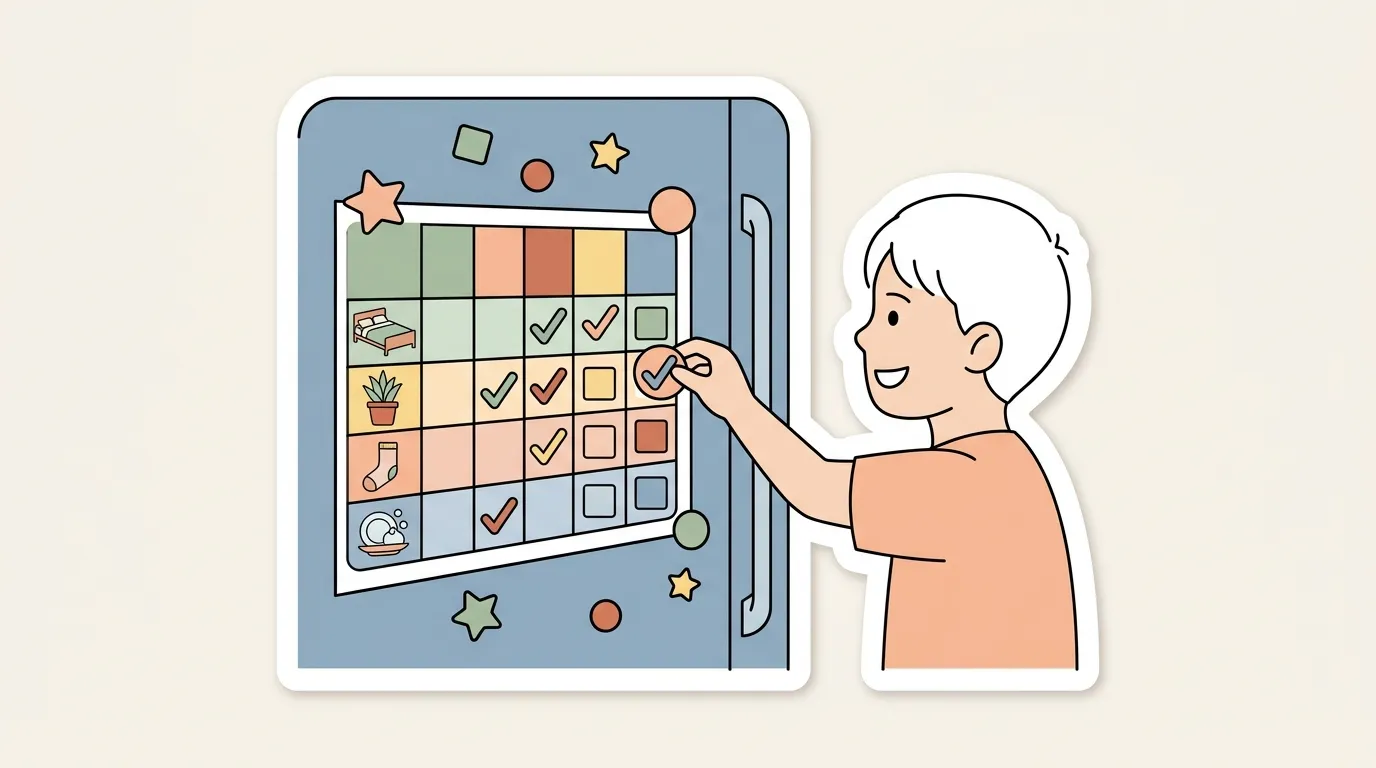
A chore chart for kids lists a few household jobs, the days they happen, and a box to tick or sticker when each is done. Start with 3 or 4 daily chores your child can do alone, add pictures for non-readers, hang it at eye level, and review it every Sunday.
Practical tips for home routines, not medical or behavioral advice. Every child is different.
It is part of our kids routines guide. This page is the full how-to. If you only want blank grids to copy, go to the chore chart template layouts. For long lists of jobs per age, see chore chart ideas by age.
Get the free printable chore chart
Our free printable chore chart (US Letter PDF) has picture icons and one row per job, so kids who can’t read yet can use it too. Print it, write in the chores, and tape it where your child will see it every day.
Make your chore chart online
Edit the chores, tap a box to add a star, then print it.
This week's chore chart 0/35 done
| Task | Mon | Tue | Wed | Thu | Fri | Sat | Sun | Remove |
|---|---|---|---|---|---|---|---|---|
| Make bed | ||||||||
| Feed the pet | ||||||||
| Set the table | ||||||||
| Pick up toys | ||||||||
| Put clothes in hamper |
Saved on this device only. No account.
What is a chore chart, and what is it for?
A chore chart is a visible list of household jobs with a place to mark each one done. It does three things for a family:
- It says what’s expected without a parent repeating it.
- It shows progress, so a child can see what they’ve already done this week.
- It settles “whose turn”, because the names are written down in advance.
It is not a behavior score. A chart full of empty boxes is information (“this job is too hard, or in the wrong place”), not a verdict on your child.
How to set up a chore chart in 15 minutes
- Pick 3 or 4 daily chores your child can finish without help. Daily jobs build the habit; more than four tends to get skipped.
- Add 1 or 2 weekly jobs on fixed days (for example, sheets on Saturday). A fixed day stops weekly jobs from turning into daily arguments.
- Use words they use: “toys in the bin”, not “tidy up”. A vague chore can’t be checked.
- Add a picture next to each chore for younger kids. Real photos of your own hamper or pet bowl are easiest to recognize.
- Hang it at their eye level, near where the chores happen. The fridge or the back of the bedroom door both work.
- Show them once how each chore looks when it’s done, then let them try while you’re nearby.
- Review on Sunday: too hard, too many, always skipped? Change it. A chart that changes is a chart that still gets used.
What to put on the chart
| Age | Daily chores (pick 3 or 4) | Weekly job |
|---|---|---|
| 3 to 5 | Toys in the bin, clothes in the hamper, feed the pet | Match socks |
| 6 to 8 | Make bed, set or clear the table, tidy room | Sort laundry |
| 9 to 12 | Load the dishwasher, pack school bag, wipe the sink | Vacuum one room |
| 13+ | Own laundry, cook one simple meal, take out trash | Clean a bathroom |
Longer lists and a filled-in kindergarten chart: chore chart ideas by age. For teens, see the printable chore chart for teens.
A good chore has three features
| Feature | Good example | Too vague |
|---|---|---|
| A clear finish | “Plate in the sink” | “Help in the kitchen” |
| Takes a few minutes | “Feed the cat” | “Clean your room” (for a 5-year-old) |
| Done mostly alone | “Clothes in the hamper” | “Do the laundry” (before age 9 or so) |
If a chore fails one of these, split it. “Clean your room” becomes “toys in the bin” plus “clothes in the hamper”.
Example: one week, one child (age 7)
| Chore | Mon | Tue | Wed | Thu | Fri | Sat | Sun |
|---|---|---|---|---|---|---|---|
| Make bed | ☑ | ☑ | ☐ | ☑ | ☑ | ☑ | ☐ |
| Clothes in hamper | ☑ | ☑ | ☑ | ☑ | ☐ | ☑ | ☑ |
| Clear own plate | ☑ | ☐ | ☑ | ☑ | ☑ | ☑ | ☑ |
| Feed the cat | ☑ | ☑ | ☑ | ☐ | ☑ | ☑ | ☑ |
| Sort laundry (weekly) | ☑ |
Empty boxes are normal. The chart is a record, not a scorecard. Here the Wednesday bed and the Friday hamper were missed; if the same box stays empty for two weeks, that’s the chore to change.
How to make a chore chart for several kids
Three common layouts, from simplest to most flexible:
| Layout | How it works | Best for |
|---|---|---|
| One chart per child | Each child has their own sheet, ideally in their own color | Kids of very different ages |
| One shared chart | Chores as rows, one column per child | 2 or 3 kids close in age |
| Rotation chart | Jobs as rows, names move down one line each week | Jobs nobody wants (trash, dishes) |
To rotate fairly, write the names in a fixed order and move each one down a line every Sunday. Copy-ready versions of all three are in the chore chart template guide. If kids still argue about who picks first, let them spin the task wheel.
Daily and weekly chores: what goes where?
Daily chores are short and personal: they look after the child’s own things. Weekly chores are bigger and shared: they look after the home.
| Daily (every day, a few minutes) | Weekly (one fixed day) |
|---|---|
| Make bed | Change bed sheets |
| Clothes in the hamper | Sort or fold laundry |
| Clear own plate | Vacuum one room |
| Feed a pet | Wipe the bathroom sink |
| Toys away before bed | Take out recycling |
| Pack school bag | Water plants |
Put each weekly job on one day only. If every weekly job lands on Saturday morning, spread them out: sheets Saturday, recycling Tuesday.
Should chores be linked to allowance or rewards?
There is no single right answer, and families do it in three main ways:
- Paid per chore. Each job has a price. Clear, but some kids then refuse unpaid help.
- Fixed allowance, chores expected anyway. Money teaches budgeting; chores are part of living in the house.
- Basics unpaid, extras paid. Daily chores are expected; bigger or optional jobs earn money.
Whichever you pick, write the rule on the chart and keep it steady for a few months. If you want stickers or points instead of money, the reward chart guide covers how to set a near goal and pick rewards that aren’t screens or candy.
Chore charts for kids with ADHD
Some kids, including many with ADHD, find a standard weekly grid hard to follow: too many boxes, too far from the moment, too easy to forget. These adaptations make the chart easier to act on. They are practical home ideas, not medical advice.
- Visual cues next to every chore. A picture card at the spot where the chore happens (the hamper, the pet bowl) works better than a list across the house. Our kids visual routine cards are printable picture cards made for exactly this.
- Short steps. “Feed the cat” can become “scoop food” plus “fill water”. Two small ticks feel more doable than one big one.
- Fewer chores per day. Two daily chores done is better than five half done.
- Immediate marks. Tick, sticker or flip the card right after the job, not at the end of the day.
- Same time, same place. Tie each chore to something that already happens: hamper after pajamas, plate after dinner.
- Refresh the design often. If interest fades after a couple of weeks, change the colors or pictures rather than adding pressure.
More full-day ideas are in ADHD routine for kids.
Keeping it going past week two
| Problem | Try this |
|---|---|
| The chart gets ignored | Move it to where the chore happens, or tick it together at dinner |
| Arguments over who does what | Rotate jobs weekly by name, or spin the task wheel |
| Too many chores | Cut back to 3 daily and add one later |
| Interest fades | Add stickers or a small goal with a reward chart |
| Your child can’t read yet | Use picture cards, see visual schedule |
| Chores done badly | Show “done” once more and write the standard on the chart |
| You stop checking it | Tie your check to something you already do, like dinner cleanup |
Paper, whiteboard or app?
| Format | Pros | Cons |
|---|---|---|
| Printed paper | Free, always visible, easy to redesign | Wears out; slip it in a sheet protector |
| Dry-erase board | Reusable, easy to rotate names | Ticks get wiped by accident |
| Spreadsheet (Excel, Google Sheets) | Clean print, easy to edit | Only useful once printed for younger kids |
| Phone app | Teens, reminders | Out of sight for kids without phones |
For most families with kids under 10, a printed chart on the fridge is the place to start. Switch formats only if paper clearly doesn’t stick.
Chore chart vs routine chart
A chore chart covers household jobs (help with the home). A routine chart covers the child’s own steps (get dressed, brush teeth). Many families use both: the morning routine chart and bedtime routine chart for routines, and this chart for chores. Keep them on separate sheets so neither gets too long.
Ready to start? Print the free chore chart, fill in three chores tonight, and review it together on Sunday.
FAQ
Where can I find a free template for a chore schedule?
You can download our free printable chore chart (a US Letter PDF with picture icons) from this page, or copy one of the weekly layouts in our chore chart template guide onto paper or into a spreadsheet.
What chores should kids do by age?
Toddlers can put toys in a bin and clothes in the hamper. Kids aged 4 to 5 can set napkins and match socks. From 6 to 8 they can set and clear the table and tidy their room, and from 9 to 12 load the dishwasher and fold laundry. Adjust to your own child.
How to make a chore chart for 3 people?
Use one row per chore and one column per person, or one chart per person in a different color. Rotate the jobs nobody wants each week by writing names in a fixed order and moving them down one line every Sunday.
What are some examples of weekly chores?
Vacuuming one room, cleaning the bathroom sink, changing bed sheets, taking out recycling, watering plants and sorting the laundry. Put each one on a single fixed day so it doesn't land on everyone at once.
What are normal daily chores?
For kids: making the bed, putting dirty clothes in the hamper, clearing their own plate, feeding a pet and tidying toys before bed. Each one should take a few minutes and have an obvious finish.
Should allowance be linked to chores?
Families do it both ways. Some pay for every chore, some give a fixed allowance and expect basic chores anyway, and some pay only for extra jobs beyond the basics. Pick one rule, write it on the chart, and keep it the same for a few months.