Kids routines
Potty training chart: free sticker chart, picture steps, and what real parents say works
Updated · Written by the Done Enough team · Sources linked below
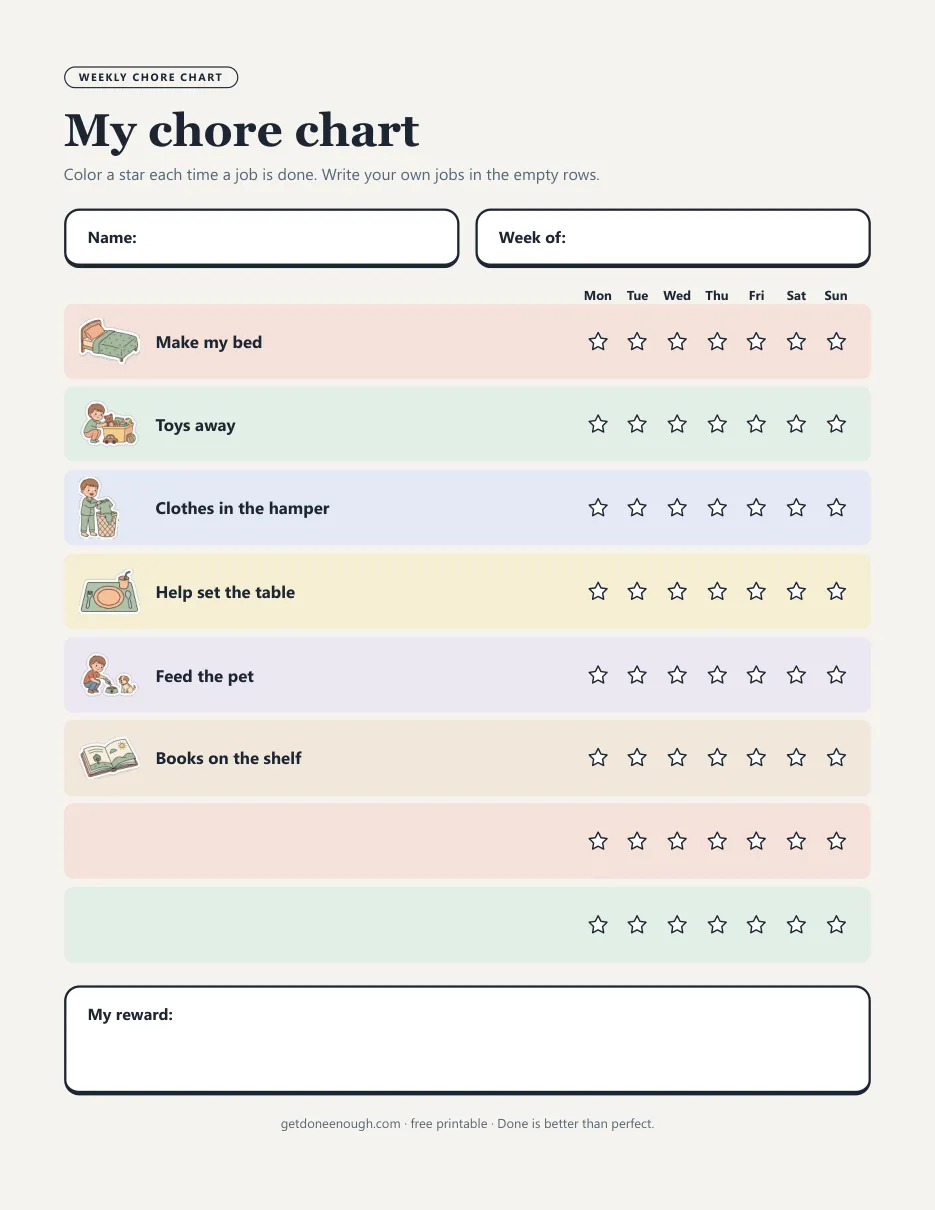
Free PDF: A weekly chore chart with picture icons, one row per job.
Get the free PDFSee the planner on Etsy
The planner is sold in our own Etsy shop.
In this guide (16 parts)
- The sticker chart that stopped working on day two
- Make your potty sticker chart (free)
- The 8 picture steps for every potty sit
- What real parents say worked (and what didn’t)
- What are the best rewards for potty training?
- What are some creative reward chart ideas for toddlers?
- What should a potty training schedule look like?
- Is your child ready? Signs and ages
- Is it normal for a 3 year old to not be potty trained?
- How to potty train an unwilling 3 year old
- Potty training visual schedule for autism
- What about accidents and nights?
- Want illustrated cards?
- Who’s behind Done Enough?
- How we wrote this guide
- Sources
A potty training chart is a simple visual tool that shows your child the toilet steps and rewards each try with a sticker. Parents who made it work report keeping it short (5 to 7 squares), paired with praise for trying and a small reward given right away. Make both parts free below: a sticker chart and an 8-step picture routine.
The sticker chart that stopped working on day two
You bought the chart. Your toddler loved it for one day. Then, as one parent put it, “all she wanted to do was take the stickers off” (r/toddlers, April 2022, older than 12 months).
So you push a little harder. One parent added strict timer reminders to a sticker chart that was working. Their 4-year-old went to crying and screaming, then refused to sit or even talk about the potty. Her occupational therapist called the routine “too intense” (r/Autism_Parenting, June 2026).
That’s the trap: the chart isn’t the problem, the pressure around it is. What works for most families is less exciting. The same short picture steps every time, praise for trying, and a reward small enough to give today.
Make your potty sticker chart (free)
Pick 5, 7 or 10 squares, a sticker your child loves, and a reward. Tap Wee +1 or Poo +2 after each try, which is the builder’s default. Start with 5 squares because a toddler can’t wait a week for a prize. Once your child fills charts easily, move to 7, then 10.
Tap Wee +1 or Poo +2 after each try on the potty (our builder’s default, change it if you like).
My potty chart
- 1
- 2
- 3
- 4
- 5
0/5 · 5 to go
Saved on this device only. No account, no email. Undo is for mistakes: never take a sticker away as a punishment.
Why start with 5 squares? A toddler can’t wait a week for a prize. Parents who made it work kept charts short: one used 7 squares with a small toy truck at the end, another cut off a strip of 5 stars and handed it over as the prize (r/toddlers, July 2025, older than 12 months). Once your child fills charts easily, move to 7, then 10.
The 8 picture steps for every potty sit
A sticker chart rewards the try, while a visual schedule teaches what to do. The 8 steps are go to the potty, pants down, sit, try, wipe, flush, pants up and wash hands, with a sticker at the end. Print it and tape it at your child’s eye level next to the potty.
The American Academy of Pediatrics notes the steps can be “illustrated with pictures, or listed on a chart” (2022). Here are the 8 steps, plus the sticker at the end:
Go to the potty → pants down → sit → try → wipe → flush → pants up → wash hands → sticker.
2. Your schedule 0/9 done · tap a card when it's done
3. Add picture cards
Wake & wash
Dress
Eat
Go
Home
Potty
Wind down
Saved on this device only. No account, no email. Print, cut along the dashed lines, and tape the strip where the routine happens.
Print it and tape it at your child’s eye level, next to the potty. Tap each step together the first few times. If the full strip is too much, tick One step at a time to show only the current step, big.
Prefer illustrated cards to emoji? See our printable routine cards on Etsy (that’s our shop).
Practical tips, not medical advice. If your child has pain, constipation, withholds, or goes backwards after being trained, talk to your doctor.
What real parents say worked (and what didn’t)
The article read 14 Reddit threads and shares 6 single-family stories, not rules. Charts helped when they were short, fun and low-pressure. They failed when the real issue was fear, a body worry or withholding. Smaller steps, a story book, a countdown, play coins or a parent chart helped in some stories.
Each one is a single family, not a rule.
“He liked the stickers”, but nothing changed. A boy who had only pooed in a diaper for 6 months got a sticker chart with a prize box. He enjoyed the stickers, and kept using the diaper. What finally worked: a child psychologist explained that small kids may feel their poo is part of their body. The family took small steps and used a story book starring their son. His words when it clicked: “just like the book mama.” Source: r/pottytraining, July 2026
A 14-day countdown for a scared 3-year-old. After a failed try at 2.5, the family waited 7 months. Then they made a 14-day visual countdown to “no more diapers day” and ticked off each day together. On the potty, he sat a few seconds, then 30 seconds, then longer. Very gradual, and it worked. Source: r/toddlers, April 2026
Play coins when stickers failed. For a child nearly 5 who refused to poo on the potty, prizes and sticker charts had failed. One reply that worked for another family: 2 play coins per poo, 10 coins buy a toy. In the same thread, a parent warned that taking diapers away caused withholding that ended in hospital. The original poster later updated: it finally clicked. Source: r/pottytraining, September 2026
A new baby, then a setback. A girl close to 3 went backwards when a sibling arrived. A sticker chart with a small surprise each time a chart was full made her far more consistent. Her parent’s summary: “she loves this.” Source: r/Parenting, April 2026
The parent who got a chart too. After months of battles, one mother stopped prompting completely. The chart stayed up, and she added one for herself, with a sticker each time she used the potty in front of her daughter. A little after 4, the girl used the potty and stuck her own sticker. Source: r/Autism_Parenting, June 2026
“He doesn’t care about stickers.” A family doing child-led training found their son wanted one thing: to use the potty like his parent. No chart needed. Source: r/toddlers, April 2026
What these stories have in common: the chart helped when it was short, fun and low-pressure. It failed when the real issue was fear, a body worry or withholding. A chart can’t fix those, but smaller steps can.
What are the best rewards for potty training?
The best potty training rewards are small, immediate and non-food: a sticker, a play coin, a short game, or a story together. Here’s what health sources say:
| Source | What it says | Date |
|---|---|---|
| American Academy of Pediatrics | Praise progress, with “perhaps even a small tangible reward”. | 2022, older guidance still online |
| American Academy of Pediatrics | “Avoid treats and punishments.” | 2022, older guidance still online |
| Raising Children Network | “Remind your child to go, and praise your child for trying.” | May 2026 |
| Mayo Clinic | Suggests a sticker or star chart with rewards like playtime or reading together. | Nov 2024, older |
Reward rules (our summary of the sources and threads above):
- Reward the try: sitting counts, even when nothing happens.
- Give it now: a sticker today beats a toy “this weekend”.
- Never take a sticker away: the chart only goes forward.
- Rotate: one parent’s advice was simply “novelty is key” (2022, older than 12 months).
- Phase it out: once your child goes without asking, let the chart fade.
What are some creative reward chart ideas for toddlers?
Parents on Reddit suggest a magnet chart where pulling off the magnets is the prize, an advent calendar with one door per poo, and a drawn toilet with stickers your child picks. Others use a parent versus child treat chart, sprinkles on the poo, or letting the child press the flush.
All of these come from parents on Reddit, dates checked:
- Magnet chart: the prize is getting to pull all the magnets off (2022, older).
- Advent calendar: one door per poo (2025, older).
- Draw-a-toilet chart: a toilet drawn on paper, with stickers your child picks (same thread).
- Parent vs child: a treat chart turned into a friendly competition (September 2026).
- Sprinkles on the poo: yes, really, as a silly potty reward (February 2026).
- Flushing as the prize: one child’s favorite reward was pressing the flush (2025, older).
Want a chart for other goals, like teeth or bedtime? See the reward chart guide.
What should a potty training schedule look like?
A good potty training schedule ties potty sits to moments in the day, not to a strict timer.
| Moment | Why |
|---|---|
| On waking | Bladder is full after the night |
| After breakfast, lunch, dinner | Poos often come about 30 minutes after a meal (Raising Children, 2026) |
| Before leaving the house | Fewer accidents in the car |
| Before bath and bed | Part of the bedtime routine |
| When they show signs | Wriggling, going quiet, holding |
Every 15 or 30 minutes? Some families use intervals for the first days. But a mother of three autistic boys said sitting every 15 minutes failed for her family (r/pottytraining, August 2025, older than 12 months), and strict timers backfired in the June 2026 story above. Daily moments are gentler.
For the whole morning, add “Potty” to a morning routine chart or a full visual schedule.
Is your child ready? Signs and ages
There is no single test. Raising Children Network says not all signs need to be present. Common signs include staying dry for 2 hours or more, noticing, disliking a dirty diaper, pulling pants up and down with help, following simple instructions, and curiosity about the toilet.
There’s no single test. Raising Children Network says “Not all these signs need to be present when your child is ready” (May 2026). Common signs (our summary, not an official checklist):
- Stays dry for 2 hours or more, for example after a nap.
- Notices: hides, goes quiet, or says “poo” before or after.
- Dislikes a dirty diaper and asks to be changed.
- Can pull pants up and down, with a little help.
- Follows simple instructions like “get your shoes”.
- Is curious about the toilet, follows you in, wants “big kid” underwear.
Experts don’t fully agree. The UK’s NHS says “You do not need to wait for your child to show signs” (NHS, no date shown). And a review for family doctors puts it plainly: “no training method is superior to another” (Baird et al., 2019, older, context only). So pick the approach that fits your child and keep it calm.
Is it normal for a 3 year old to not be potty trained?
Yes, it can be. According to the American Academy of Pediatrics (2022), children show signs of bladder and bowel control between 18 and 24 months, the average US start is between 2 and 3, and most children are trained by 4. So a 3-year-old still in diapers is within the usual range. Talk to your doctor if there’s pain, constipation, withholding, or a child who goes backwards after being trained.
How to potty train an unwilling 3 year old
Other families used a countdown to no more diapers day, then sitting for seconds, then longer. Smaller steps and a story book starring the child helped one family. Rotate rewards or switch to play coins when stickers lose their magic. Pausing is not failing.
| Problem | What helped other families |
|---|---|
| Scared of the potty | A countdown to “no more diapers day”, then sitting for seconds, then longer (April 2026) |
| Only poos in a diaper | Smaller steps and a story book starring the child (July 2026) |
| Sticker chart lost its magic | Rotate rewards, switch to play coins, or use a 5-square strip |
| Only wants to peel the stickers | A magnet chart where pulling the magnets off is the prize (2022, older) |
| Holding after one hard poo | Most parents in this thread (Feb 2026) advised pausing and trying again in a few months. Ask your doctor about constipation |
| Every prompt is a fight | Stop prompting, leave the chart up, and model it yourself (the parent-chart story above) |
Pausing is not failing. In several of the stories above, the turning point came after a break of weeks or months.
Potty training visual schedule for autism
The AAP’s page on children with special needs recommends “a formal routine containing a series of simple and predictable steps”, shown in pictures, and notes that for some children, small tangible rewards “may prove more effective than praise” (2022). That’s what the 8-step strip above does.
One parent of an autistic child said visual schedules, rewards and timers all fell apart because of sensory issues. In the replies, another had success with a step-by-step routine using first/then visuals (r/pottytraining, July 2025, older than 12 months). A mother of three autistic boys found that repeated verbal reminders “weren’t effective”, and a reward her sons truly cared about worked (August 2025, older than 12 months). Your child’s OT or pediatrician can help with sensory and medical causes.
For two-step prompts like “first potty, then park”, see the first-then board.
What about accidents and nights?
Accidents don’t go on the chart, so it only goes forward. Clean up calmly and briefly, then move on. Keep nights separate, since many families keep a diaper or pull-up at night. Ask your doctor if accidents come with pain, constipation, or start again after months of being dry.
Our tips, not medical advice:
- Accidents don’t go on the chart. The chart only records tries and successes, so it never goes backwards.
- Clean up calmly and briefly, then move on. The AAP’s advice to avoid punishments (2022) applies here too.
- Keep nights separate. Many families keep a diaper or pull-up at night while working on days; our chart has no square for a dry night.
- Ask your doctor if accidents come with pain, constipation, or start again after months of being dry.
Want illustrated cards?
The builder is free and uses emoji. For every other chart, see the kids routines hub. Our own Etsy shop, Done Enough, sells printable kids visual routine cards for morning and bedtime routines, including the potty step. Full disclosure: that’s us.
Who’s behind Done Enough?
Done Enough is a small independent shop, not a clinic. We build free planning tools and sell printables on Etsy. We are not doctors or nurses: each guide is built from parents’ own threads and published guidance, linked so you can check every claim.
How we wrote this guide
We read 14 potty training threads on Reddit and 5 expert sources (AAP, Raising Children Network, NHS, Mayo Clinic, and one medical review by Baird et al.), and recorded the date of each. Parent stories are paraphrased, with short quotes and a link to the original. Anything older than 12 months is marked as such. No organization listed here endorses our shop.
Sources
- American Academy of Pediatrics, HealthyChildren.org: “The Right Age to Potty Train” (updated 24 May 2022), “Create a Potty Training Plan” (25 May 2022), “Potty Training Children with Special Needs” (26 May 2022). Older than 12 months, still published.
- Raising Children Network, “Toilet training: when and how to do it”, reviewed 22 May 2026.
- NHS Best Start in Life, “Potty training your child”, no date displayed (checked October 2026).
- Mayo Clinic Staff, “Potty training: How to get the job done”, 7 November 2024. Older than 12 months.
- Baird, Bybel & Kowalski (2019), American Family Physician. Older.
- Parent experiences: Reddit threads linked above, dates taken from each post, read October 2026.
FAQ
What are the best rewards for potty training?
Small and immediate: a sticker, a stamp, a play coin, or a short fun activity right after trying. The American Academy of Pediatrics suggests praise and "perhaps even a small tangible reward", and advises against treats and punishments (2022). Our free chart gives 1 sticker for a wee and 2 for a poo (our builder's choice, not an expert rule), with a small toy when a short chart is full.
How often should I offer potty during potty training?
Tie it to the day rather than the clock: on waking, after meals, before going out, and before bed. Raising Children Network (May 2026) notes poos often come about 30 minutes after a meal. Avoid strict, frequent timers if they upset your child: parents report they can turn the potty into a fight.
What should a potty training schedule look like?
Two parts. The same 8 picture steps for every sit (go to the potty, pants down, sit, try, wipe, flush, pants up, wash hands), and fixed moments in the day: wake-up, after meals, before leaving the house, before bath and bed.
Is it normal for a 3 year old to not be potty trained?
Yes, it can be. According to the American Academy of Pediatrics, the average age toilet training begins in the US is between 2 and 3, and most children are bowel and bladder trained by 4 (2022). If your child has pain, constipation or goes backwards after being trained, check in with your doctor.
How to potty train an unwilling 3 year old?
Lower the pressure and shrink the steps: sit dressed first, then for a few seconds, then longer. Use a picture book or a countdown to a "no more diapers" day, praise trying, and avoid punishments. If fear or withholding builds, pausing for a few weeks or months is a common choice.
What are some creative reward chart ideas for toddlers?
Hidden stickers to find in the bathroom, a short 5 to 7 square chart cut off and handed over when full, a magnet chart where pulling the magnets off is the prize, play coins toward a small toy, an advent calendar with one door per poo, or letting the child flush.