Planning
To-do list ideas: 112 examples for every kind of day
Updated · Written by the Done Enough team · Sources linked below
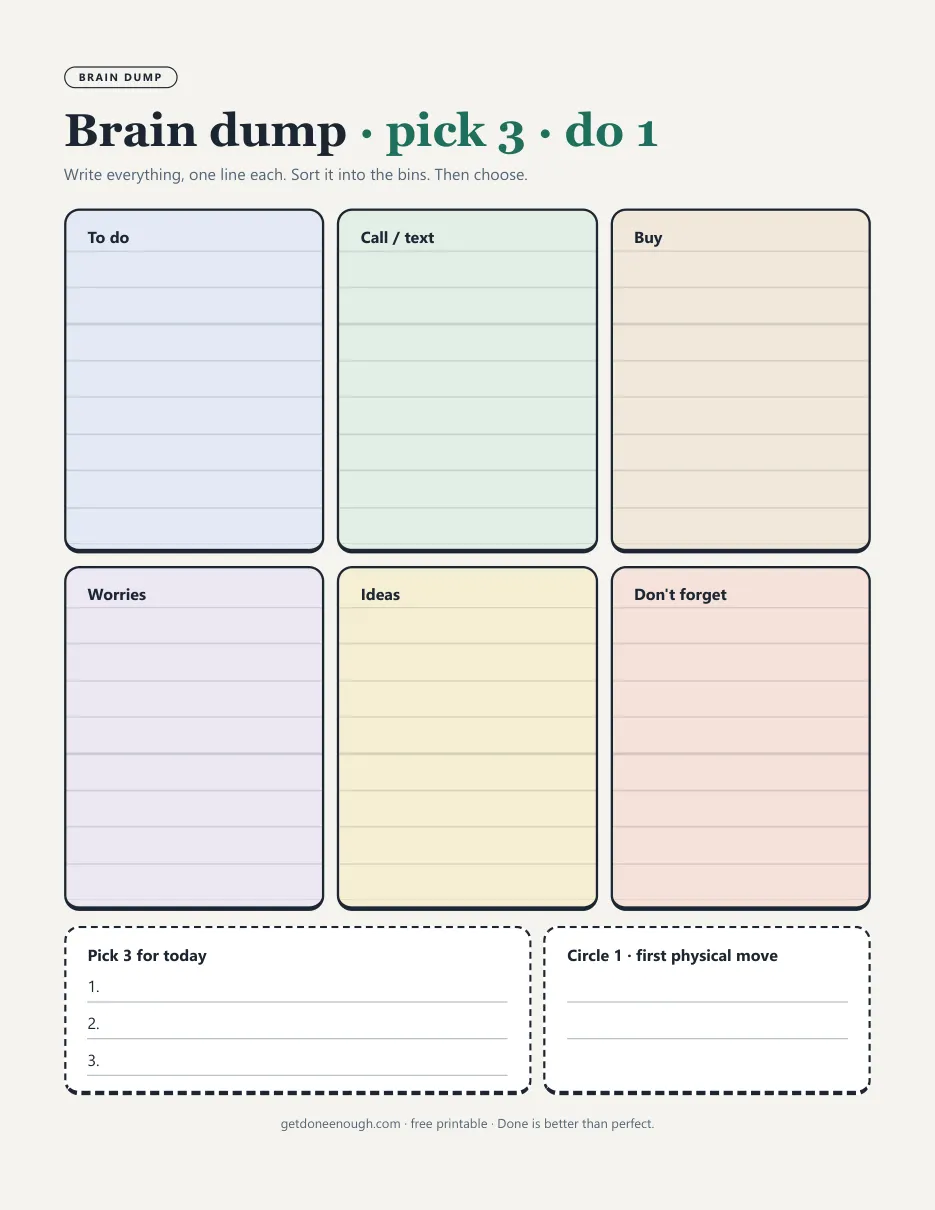
Free PDF: One page to empty your head, sort it, pick 3 and circle 1.
Get the free PDFSee the planner on Etsy
The planner is sold in our own Etsy shop.
In this guide (27 parts)
- What should you put on a to-do list?
- Daily ideas and examples
- Weekly tasks
- Monthly tasks
- Every 3 to 6 months
- Yearly tasks
- Home and errands
- Work tasks
- Student tasks
- ADHD-friendly ideas
- Weekend jobs and rest
- Before a vacation
- Self-care and growth ideas
- Special event lists: wedding, moving, party, launch
- Picture lists for kids
- Layout ideas: two columns, categories and priority
- Prioritization methods: MIT, eat the frog, Ivy Lee and Daily Big 3
- Paper formats: notebook, journal, planner or legal pad
- Cute and aesthetic to-do list ideas
- Sharing a list with a partner, family or team
- How to keep a master list
- What is a to-do list? Definition and other names
- Are to-do lists effective?
- How to check if your list works
- Who’s behind Done Enough?
- How we wrote this guide
- Sources
Good to-do list ideas are small, specific tasks that start with a verb and fit the kind of day you’re planning. This page gives 112 examples in 14 lists of 8 (daily, weekly, monthly, yearly, every 3 to 6 months, home, work, business, student, ADHD-friendly, weekend, before vacation, self-care and special events), most with a first step or a suggested time, so you can copy 3 onto today’s list and start.
It is part of our free brain dump template and guide. If you have never kept a list before, start with our step-by-step guide. Each list comes with the research behind it where research exists: a 2025 meta-analysis of 642 tests on if-then plans, a 2022 memory study on writing intentions down, US time-use data from 2025, and the myths that did not survive replication.
Today's 3 (edit me) 0/3 done
| Task | Done | Remove |
|---|---|---|
| Reply to the email you keep skipping | ||
| Clear the kitchen counter | ||
| Write tomorrow's 3 tasks |
Saved on this device only. No account.
What should you put on a to-do list?
Put on it the tasks you plan to do soon: must-dos with a deadline, upkeep that keeps the house or the inbox from piling up, and one small thing you want to do, so the list isn’t only chores (our tip). Routines you already do without thinking, like brushing your teeth, can stay off.
Big goals and projects go on a master list, with only their next step on today’s list. For how to word each task so it’s easy to start, see the writing section of our how-to guide.
Pick the list type below that matches today, copy the tasks that apply, and rewrite them with your own names, dates and places. The sizes in the table are our suggestions.
| List type | Use it when | Suggested size (our tip) |
|---|---|---|
| Daily | Any normal day | 3 tasks |
| Weekly | Sunday or Monday planning | 1 to 3 per day |
| Monthly | The first weekend of the month | 3 to 5 for the month |
| Every 3 to 6 months | A set weekend each season | 2 or 3 per season |
| Yearly | January, or a set month each year | 1 or 2 per month |
| Home and errands | Chores and trips are piling up | 5 to 8, batched |
| Work | A workday with meetings and deep work | 1 big + 2 small |
| Business or project | Customers, invoices or deadlines need attention | 1 big + 2 small |
| Student | Class, homework and exams | 3 study blocks |
| ADHD-friendly | Starting feels hard | 3, each with a tiny first step |
| Weekend | Rest plus a few catch-up jobs | 2 jobs + 1 fun thing |
| Before vacation | The last 7 days before a trip | Spread over the week |
| Self-care and growth | You keep putting yourself last | 1 per day |
| Special events | A wedding, a move, a party or a launch | 3 starter tasks per event |
Daily ideas and examples
These are the small tasks that keep an ordinary day running. Pick 3 of them for today.
| Task | First step |
|---|---|
| Reply to the email you keep skipping | Open it and write one sentence |
| Plan tonight’s dinner | Check what’s in the fridge |
| Pay one bill that’s due this week | Log in to the account |
| Take a 10-minute walk | Put your shoes by the door |
| Clear the kitchen counter | Fill the dishwasher first |
| Text one friend back | Open the last message |
| Refill your water bottle | Leave it on your desk |
| Write tomorrow’s 3 tasks | Grab a sticky note at bedtime |
The 10-minute walk has some research behind it. A 2022 meta-analysis in PLoS One pooled 22 samples (2,335 people) on micro-breaks, defined as pauses of 10 minutes or less. Breaks raised vigor (d = .36) and lowered fatigue (d = .35), both small but significant effects; the boost to performance (d = .16) was not significant overall, and it reached significance only for less demanding tasks, not for cognitively demanding ones. So a break belongs on the list mainly as an energy boost; the evidence for better output is weaker.
To-do list example: one filled-in day
Here is one weekday written out the way we would do it: three tasks for today, each with its first step, and one line for later.
| Today | First step | Done |
|---|---|---|
| Pay the electric bill | Log in to the account | ☑ |
| Clear the kitchen counter | Fill the dishwasher first | ☐ |
| Text Maya back about Saturday | Open her last message | ☐ |
Later: plan the weekend trip, sort the mail pile, book the oil change.
Weekly tasks
A to-do list for the week holds what doesn’t need to happen today but can’t slide past Sunday. Give each item a day so it doesn’t all land on Friday (our tip).
| Task | Suggested day (our tip) |
|---|---|
| Plan meals and write the grocery list | Sunday |
| Check the bank account and upcoming bills | Monday |
| Wash sheets and towels | Tuesday |
| Take out recycling | Collection day |
| Clean out the car | Wednesday |
| Call or visit a relative | Thursday |
| Clear the downloads folder and desktop | Friday |
| Review next week’s calendar | Saturday or Sunday |
One kitchen job is worth adding to the weekly list. A 2017 study in Scientific Reports sequenced 14 used kitchen sponges and found local bacterial densities up to 5.4 x 10^10 cells per cubic centimeter in the most heavily colonized spots. Sponges their owners regularly sanitized did not hold significantly fewer bacteria than the others, so the authors suggest replacing sponges “for example, on a weekly basis.” Our kitchen cleaning checklist covers the rest of the kitchen.
For a layout of 7 days with 3 rows each, copy the weekly template from our template guide into a document or a notebook.
Monthly tasks
Monthly to-do list ideas are the jobs that come back every few weeks and slip because they are never due today. Give them a fixed day, such as the first Saturday of the month, and write each one on that date (our tip). A notes box on a wall calendar keeps them in view.
Smoke alarms make a good first line: the US Fire Administration advises testing them once a month (USFA, smoke alarms).
| Task | First step |
|---|---|
| Test the smoke alarms | Press the test button on each one |
| Check the furnace or AC filter | Find the size printed on its edge |
| Review subscriptions | Open last month’s bank statement |
| Back up phone photos | Plug the phone in and start the backup |
| Clear out the fridge | Take out everything past its date |
| Pay or schedule this month’s bills | List each due date on one page |
| Buy cards for this month’s birthdays | Check the calendar for names |
| Pick one goal for next month | Write it at the top of next month’s page |
Every 3 to 6 months
Recurring tasks at 3 and 6 month intervals are the ones a monthly list makes too frequent and a yearly list makes too rare. Put each one on a calendar date as a repeating event, so it comes back without you having to remember it. The intervals in the table are our suggestions.
The dryer lines come from the US Fire Administration’s clothes dryer flyer (USFA flyer, 2017 file date), which says the risk of a dryer fire is higher when the lint filter and vents are not cleaned. It advises cleaning the lint filter before and after each cycle, cleaning the back of the dryer where lint builds up, checking that the vent behind it is not “damaged, crushed or restricted”, and making sure the outdoor vent cover opens while the dryer runs. The flyer gives no interval for the vent check, so the 3 months below is ours.
| Task | Interval (our tip) |
|---|---|
| Clean behind the dryer and check the vent isn’t crushed or blocked | Every 3 months |
| Check the outdoor dryer vent cover opens while the dryer runs | Every 3 months |
| Pull out the fridge shelves and drawers and wash them | Every 3 months |
| Review recurring payments and your phone plan | Every 3 months |
| Delete or split master list tasks untouched for a season | Every 3 months |
| Wash pillows and the shower curtain liner | Every 6 months |
| Clear out a closet and donate what you didn’t wear | Every 6 months |
| Check the first aid kit and medicine cabinet for expired items | Every 6 months |
Yearly tasks
A yearly to-do list holds the tasks that come around once a year: paperwork, checkups, renewals and the big clean. Give each one a month so they don’t all land in January. The months below are our suggestions.
The smoke alarm line follows the US Fire Administration, which advises replacing 9-volt or backup batteries at least once a year and replacing the alarm itself every 10 years (USFA, smoke alarms).
| Task | Suggested month (our tip) |
|---|---|
| Replace smoke alarm batteries | November |
| Gather tax documents | February |
| Book a yearly checkup | Your birthday month |
| Check passport and ID expiration dates | January |
| Review insurance before it renews | The month before renewal |
| Deep clean the house | Spring, with our spring cleaning checklist |
| Clear out closets and donate | When the seasons change |
| Plan next year’s vacation days and big dates | December |
Home and errands
Home tasks fill a real share of the day for most people, which is why they deserve their own list. The 2025 American Time Use Survey from the US Bureau of Labor Statistics, released June 25, 2026, found that 81% of people did some household activity on an average day (BLS, American Time Use Survey 2025).
| Measure (BLS, 2025 data) | Result |
|---|---|
| People doing household activities on an average day | 81% |
| Women doing household activities, and hours on days they did | 87%, 2.8 hours |
| Men doing household activities, and hours on days they did | 75%, 2.1 hours |
| People doing housework: weekend days vs weekdays | 40% vs 35% |
| Food preparation and cleanup: weekdays vs weekend days | 66% vs 63% |
| Hours worked by full-time employed people, on days worked | 8.1 hours |
| Employed people who did some or all work at home, on days worked | 35% |
| Leisure and sports per day: men vs women | 5.6 vs 4.8 hours |
BLS notes that the October 1 to November 12, 2025 federal shutdown may have affected its estimates and that the effect can’t be measured. Read the table as one year’s averages, not as targets.
Our tip: batch home tasks, with all the calls at once and all the stops in one trip. Since more people do housework on weekend days, a short weekday batch can take some of that load off Saturday.
| Batch | Task ideas |
|---|---|
| Calls | Book the dentist, call the insurance company, schedule a plumber |
| Errands | Return the package, pick up the prescription, drop off dry cleaning |
| Buy | Light bulbs, batteries, dog food, birthday card |
| Fix | Tighten the loose cabinet handle, replace the furnace filter |
| Paperwork | File last month’s receipts, renew the car registration |
| Kids | Sign the field trip form, wash the soccer uniform |
| Pets | Order flea medicine, book the vet checkup |
| Car | Check tire pressure, book the oil change online |
Route the errands in one loop (our tip): list the stops in the order you’ll drive past them.
Work tasks
Our tip for a work list: mix one task that needs focus with a few quick ones, and put the focus task first, before the inbox.
| Task | Size |
|---|---|
| Draft the first section of the report | Big (60 to 90 min) |
| Prepare 3 points for tomorrow’s meeting | Medium |
| Follow up with the client who went quiet | Small |
| Update the project tracker | Small |
| Clear 10 emails, oldest first | Small |
| Book time for next week’s 1:1 | Small |
| Send the invoice or expense report | Small |
| Write a 3-line end-of-day note for tomorrow | Small |
If several work tasks feel urgent at once, sort them in the free Eisenhower matrix tool.
The focus-first tip is a preference. The popular idea that self-control runs out like fuel during the day did not hold up in a 2021 preregistered test across 36 labs with 3,531 participants: the confirmatory effect was d = 0.06 and not significant, and the data were about 4 times more likely under no effect. Putting the hard task first simply protects it from the inbox.
For business owners and project managers
A business to-do list is mostly about money and customers, and a project manager’s is mostly about dates and people (our tip). The eight ideas below are split between the two. If you manage a project, tie each task to one deliverable or one person, so you can tell when it’s done.
| Task | Who it fits |
|---|---|
| Send this week’s invoices | Owner |
| Follow up on one overdue payment | Owner |
| Reply to new customer inquiries | Owner |
| Log this week’s receipts for the bookkeeping | Owner |
| Compare the timeline with this week’s deadlines | Project manager |
| Get a status update from each task owner | Project manager |
| Add new risks or blockers to the risk list | Project manager |
| Send the weekly status summary | Project manager |
Student tasks
Our tip for a student list: turn “study” into named blocks, each with a clear output.
| Vague | Clear task |
|---|---|
| Study bio | Make 20 flashcards for chapter 6 |
| Essay | Write the outline with 3 main points |
| Math | Do problems 1 to 10 from section 4.2 |
| Read | Read pages 40 to 62 and note 3 questions |
| Exam prep | Take last year’s practice test, timed |
| Group project | Message the group with a meeting time |
| Admin | Check the syllabus for next week’s due dates |
| Library | Return the overdue book |
Fixed study blocks or your own breaks?
Fixed study blocks with set breaks (the Pomodoro style) and breaks taken whenever you feel like it have been compared in two recent studies with university students, and the results are mixed. Neither study found a difference in how much work got done.
| Study | Who and how | What differed | What didn’t |
|---|---|---|---|
| Biwer et al., 2023 | 87 students: free breaks, 6 min after 24 min, or 3 min after 12 min | Free-break group: higher fatigue and distraction, lower concentration and motivation, longer sessions | Task completion and mental effort |
| Smits, Wenzel and de Bruin, June 2025 | 94 students: free breaks, 5 min every 25 min, or Flowtime | Compared with free breaks, Pomodoro: fatigue rose faster; Pomodoro and Flowtime: motivation fell faster | Overall fatigue, motivation, productivity and task completion |
In the 2023 study, the fixed-break groups reached the same task completion in less time. In practice: write study blocks on the list with a length, try fixed breaks for a week, and keep them only if they help you keep going.
ADHD-friendly ideas
When starting is the hard part, build a to-do list for ADHD from tasks small enough that the first step is obvious (our tip). These ideas are suggestions, not a treatment.
The audience is large. A 2024 CDC report estimated from a 2023 survey that 6.0% of US adults, about 15.5 million people, had a current ADHD diagnosis (self-reported), and 55.9% of them were diagnosed at age 18 or older. The National Institute of Mental Health (page reviewed August 2026) describes inattention in ADHD as including difficulty “keeping on task, or staying organized.”
| Task | Tiny first step |
|---|---|
| Laundry | Carry the basket to the machine |
| Answer emails | Answer one, the shortest |
| Tidy the bedroom | Pick up 5 things from the floor |
| Make a phone call | Find the number and write it down |
| Cook dinner | Put a pot of water on the stove |
| Pay a bill | Open the bill, nothing else |
| Start the work task | Open the file and write the title |
| Get ready to leave | Put keys, wallet and phone by the door |
Why write it all down? In a 2022 memory study of 268 adults, people with lower working memory capacity remembered fewer delayed intentions when relying on memory alone, and that gap disappeared when they were allowed to set reminders. The study used a lab task and did not test people with ADHD, so treat it as a reason to try a written list, not as proof it fixes anything.
Our guide for ADHD explains the full layout: a short today list, a first move for each task, a later list and a stuck-day list.
Weekend jobs and rest
Our tip for a weekend list: leave room to rest, with 2 jobs and 1 thing you enjoy.
| Jobs | Fun or rest |
|---|---|
| Grocery run for the week | Coffee at a new place |
| Change the bed sheets | Read one chapter of a book |
| Meal prep 2 lunches | Walk at a park or trail |
| Mow the lawn or water the plants | Call a friend |
| Sort the mail pile | Try a new recipe |
| Fill the gas tank | Movie night |
| Laundry, start to finish | Nap with no alarm |
| Pay any bill due Monday | Visit a farmers market |
Before a vacation
Our tip: spread the pre-trip work over the week so the last night isn’t a scramble.
| When | Task |
|---|---|
| 7 days before | Check passports or IDs and the booking confirmations |
| 7 days before | Book a pet sitter or boarding |
| 5 days before | Pause mail and package deliveries |
| 3 days before | Do the laundry you want to pack |
| 3 days before | Refill prescriptions you’ll need on the trip |
| 2 days before | Set your out-of-office reply and hand off work |
| 1 day before | Pack, charge devices, download maps and tickets |
| Day you leave | Empty the fridge of what will spoil, take out trash, lock up |
Self-care and growth ideas
Self-care and growth tasks are the ones that never become urgent, so they only happen when they get a line on the list. Pick one per day. Two of the lines below have research behind them; the rest are our suggestions.
| Task | Why it’s here |
|---|---|
| Take a break of 10 minutes or less after a long task | Micro-breaks raised vigor and lowered fatigue in a 2022 meta-analysis |
| Move for 20 minutes: walk, bike or dance | Our tip |
| Read 10 pages of a book | Our tip |
| Write 3 lines in a journal | Our tip |
| Put the phone in another room an hour before bed | Our tip |
| Write down what’s still on your mind before bed | Bedtime to-do lists went with falling asleep faster in a 2018 lab study |
| Spend 15 minutes learning one new skill | Our tip |
| Pay for or hand off one chore you dread | See the delegating research under task statuses below |
Special event lists: wedding, moving, party, launch
An event to-do list starts with three tasks that unlock everything else, usually a date, a budget or a headcount. Write those first, then build the rest of the list once they’re fixed. The starter tasks below are our suggestions.
| Event | 3 starter tasks |
|---|---|
| Wedding | Set the budget, draft the guest list, pick 3 possible dates |
| Moving house | Book movers or a truck, change your address, plan the move-out clean with our move-out cleaning checklist |
| Birthday party | Pick the date and guest count, send invites, plan the cake |
| Hosting a holiday dinner | Count guests and food needs, plan the menu, write the shopping list (our Thanksgiving checklist has a full plan) |
| Website launch | Proofread every page, test forms and links on a phone, write the announcement |
| Starting a new job | Plan the commute, gather documents for HR, start a first-week notes page |
| Back to school | Check the supply list, label bags and clothes, set the morning routine |
| Garage sale | Pick a date, price items, put up signs |
Picture lists for kids
A photo to-do list swaps words for pictures, so a child who can’t read yet can still follow it (our tip). Take a photo of each real step in your own home: the toothbrush, their shoes, the backpack by the door.
Print the photos small, line them up in order on the fridge or the bedroom door, and put a clip, magnet or checkbox under each one so your child can mark the step as done. Keep one routine per row, such as getting ready for school, so the row stays short, and swap a photo when the step changes, for example after new shoes. For layouts and printables, see our visual schedule guide; for which jobs suit which age, see chore chart ideas by age.
Layout ideas: two columns, categories and priority
A layout is the way you split the page: by column, by category or by priority. Pick the one that matches what you sort by most often (our tip).
| Layout | How it looks | Good for |
|---|---|---|
| Two columns: must and could | Must-do tasks on the left, could-do on the right | Days with a few fixed deadlines |
| Two columns: home and work | One column for each side of life | Planning both on one page |
| Categories | A short box per category: calls, errands, home, work, money | Days full of small mixed tasks |
| Prioritized list | Tasks numbered 1, 2, 3 in the order you’ll do them | Days with one clear order |
| A, B, C labels | A for must today, B for should, C for could | Long lists you can’t shorten yet |
| Kanban board | Three columns: to do, in progress, done; tasks move left to right | Projects with steps, or a shared household list |
| Time-blocked list | Each task written next to the hour you’ll do it | Days built around meetings or appointments |
For a to-do list in two columns, fold a sheet down the middle or draw one line. If you sort by category, start with calls, errands, home, work and money; about 5 is plenty for one page (our tip). Our template guide has a ready version with 4 columns.
A priority to-do list, numbered 1, 2, 3, works when you already know the order. When you don’t, label tasks A, B and C first, then number only the A tasks. For help choosing what goes first, read how to prioritize tasks or sort the list in the Eisenhower matrix.
A Kanban board on paper is three columns on a sheet or three zones on a door, with one sticky note per task. Keep the “in progress” column short, two or three notes, so you finish before you start something new (our tip).
Time blocking: linking the list to a calendar
Time blocking means giving each task on the list a slot in your calendar, so the list says what and the calendar says when. It turns “pay the bill” into “pay the bill at 8:15 after coffee”, which is close to the if-then format that research on planning supports.
A 2025 meta-analysis by Sheeran, Listrom and Gollwitzer pooled 642 independent tests of if-then plans (implementation intentions). The plans improved cognitive, emotional and behavioral outcomes, with effects from d = .27 to .66, and effects were larger when the plan used an if-then format, when people were highly motivated, and when they rehearsed the plan. A time block is our reading of that research, not something the meta-analysis tested: block only the tasks that matter most, leave gaps for interruptions, and move a missed block to a new slot instead of dropping it.
Task statuses beyond done and not done
Task statuses are short marks that say what happened to a task when it wasn’t finished. A list with only “done” and “not done” hides the difference between a task you moved, a task you handed off and a task that no longer matters. Bullet journal users often mark these with symbols; the marks below are our suggestions.
| Status | Mark (our tip) | Meaning | What to do next |
|---|---|---|---|
| Done | ☑ | Finished | Nothing |
| Deferred | → | Moved to a set day | Write it on that day’s page |
| Delegated | @ + name | Someone else is doing it | Check back on a set date |
| Waiting | ⏳ | Blocked until something arrives | Note what you’re waiting for |
| Deleted | A line through it | No longer matters | Nothing; crossing it out is a decision |
Delegating, or paying for a task you dread, has some evidence on well-being. A 2017 study in PNAS surveyed 6,271 people in the US, Canada, Denmark and the Netherlands about spending money to save time. In a small field experiment, 60 working adults in Vancouver were given $40 on two weekends and reported a better mood at the end of the day (more positive and less negative feeling, less time stress) after a time-saving purchase than after a material one. It’s one study with a small experiment, so read it as a nudge to hand off one chore when you can afford to.
Prioritization methods: MIT, eat the frog, Ivy Lee and Daily Big 3
Named prioritization methods are rules for choosing which few tasks go at the top of today’s list. Most of them do the same thing in different words: they cap today at a small number and force you to rank. None of these named methods has been tested head to head in a study we could find, so pick the one whose rule you’ll actually follow.
| Method | The rule | Where to read more |
|---|---|---|
| MIT (most important tasks) | Pick 1 to 3 tasks that matter most today and do them before anything else | Our how-to guide |
| Eat the frog | Do the hardest, most important task first | Our eat the frog guide |
| Ivy Lee method | At the end of each day, write tomorrow’s most important tasks in order, then work down them one at a time | This page |
| Daily Big 3 | Three key tasks per day, written at the top of the page | This page |
| 1-3-5 rule | 1 big, 3 medium, 5 small tasks | Our 1-3-5 rule guide |
| 3-3-3 method | About 3 hours on one project, 3 shorter tasks, 3 upkeep tasks | Our 3-3-3 method guide |
Paper formats: notebook, journal, planner or legal pad
The right paper to-do list depends on how long the list needs to last: a day, a week or a whole year. Here is how the common formats compare (our tips).
| Format | Good for | Watch out for |
|---|---|---|
| Sticky notes | Today’s list, stuck where you’ll see it | Notes fall off and pile up |
| Legal pad | Long lists at a desk, one page per day | Pages tear off and scatter |
| Notebook | One dated page per day | Old tasks get buried in back pages |
| Journal or bound book | A year of lists in one place | Finding today’s page takes a moment |
| Planner | A daily to-do list next to the hours, for days run by appointments | Little room on busy days |
| Bullet journal | Lists, calendar and notes in one dotted notebook | Setup can take longer than the tasks |
| Printable | A fresh, fixed layout each day or week | You need a printer or a stack of copies |
Paper can stay on the desk in plain sight, and crossing a task off takes one stroke of the pen. If you want every list in one place, keep your to-do list in a book: one bound notebook, dated, with today’s page marked by a clip or a ribbon (our tip). It also keeps the old pages, which helps when you need to check when you last did something.
Bullet journal to-do list ideas can come straight from this page (our tip): turn the list types into collection pages, such as a monthly page, a yearly page, a weekend page and a before vacation page, with a box beside every line. Our brain dump journal guide covers keeping a notebook for everything on your mind.
Paper, app or calendar: where to keep the list
Where you keep a to-do list matters less than keeping one list in one place you look at every day. The 2022 memory study above found the benefit came from offloading the intention at all, with reminders allowed, not from any one tool. Each option has a trade-off (our comparison).
| Where | Strong at | Weak at |
|---|---|---|
| Paper | Always visible, nothing to open, quick to cross off | No reminders, hard to share at a distance |
| To-do app | Reminders, repeating tasks, sharing | Easy to ignore once the notification is swiped away |
| Calendar | Tasks with a set time, time blocks | Gets crowded; tasks with no time don’t fit |
| Paper + calendar | Paper for today, calendar for timed and repeating tasks | Two places to check |
Legal pad to-do lists: what Reddit says
On r/productivity, a poster who keeps lists, daily thoughts and notes on legal pads at work and in a home office asked how others pull together notes spread over several pads (thread posted October 7, 2025, older). One reply rereads each page, copies what still matters to where it belongs and crosses out the rest: “Most of my notes are irrelevant a few days after I take them.” In a newer thread where people say what they actually use for their lists, one reply was simply mini legal pads (thread posted August 5, 2026). These are personal accounts, and nobody measured anything.
Cute and aesthetic to-do list ideas
A cute to-do list comes from a few small choices on the page, and none of them needs drawing skills. These are our tips. Pick two or three and repeat them every day, so the list stays quick to write.
- Use one pen color for tasks and another for check marks.
- Draw round boxes, hearts or stars in place of square checkboxes.
- Put a strip of washi tape across the top as a header.
- Write the date large, with the weekday in small letters under it.
- Mark the main task with a pastel highlighter.
- Add a sticker for each finished task.
- Leave white space between lines so the page doesn’t look crowded.
For a cute week, copy the weekly template into a notebook and color the header of each day. Keep an aesthetic touch only while it makes you want to open the list, and drop any that slow you down (our tip).
Sharing a list with a partner, family or team
To share a to-do list, keep it in one place everyone can see and edit, put one name next to each task, and agree on when you’ll look at it together (our tip).
| Where | Works for | Tip |
|---|---|---|
| Paper on the fridge | A household | Write a name next to each task in pen |
| A shared document or spreadsheet | Partners or a small team | Add a Who column and a Done column |
| A group chat | Quick one-off jobs | Move anything bigger than a day onto the list |
For couples, our tip is that each person owns whole areas, such as bills or the car, so nobody has to split single tasks. Families with kids can turn the same list into a chore chart. Review the shared list once a week at a set time, so tasks don’t sit unclaimed.
How to keep a master list
A master to-do list is the one place where every task lives, from today’s errands to next month’s projects. You don’t work from it directly: each morning you pull a few tasks onto today’s list, and a weekly review keeps it from turning into a pile.
Our suggested routine takes about 10 minutes every Sunday:
- Add anything new from notes, email and your head.
- Cross out what’s done or no longer matters.
- Write a date next to anything with a deadline.
- Move 3 to 5 tasks to the top for the coming week.
- Split or delete any task that has sat untouched for a month.
The 1-3-5 rule helps you decide how many tasks to pull onto each day. To sort the master list by type, date or place, see the organizing section of our how-to guide.
Daily review: morning plan, afternoon wrap-up and a daily win
A daily review is two short check-ins with today’s list: a few quiet minutes in the morning to pick the tasks, and a wrap-up in the afternoon to see what’s left. Our suggested version:
| When | What to do (our tip) |
|---|---|
| Morning, before email | Pull 3 tasks from the master list and write the first step of each |
| Afternoon wrap-up | Cross off what’s done, mark the rest as deferred, delegated or waiting |
| Afternoon wrap-up | Write one daily win: the best thing you finished, at work or at home |
| Before you stop | For any task you were interrupted on, write the very next step |
That last line ties to a 2025 finding. A 2025 meta-analysis by Ghibellini and Meier found “no memory advantage for unfinished tasks”, the popular Zeigarnik effect, but did find a general tendency to go back to interrupted tasks (the Ovsiankina effect). An unfinished task won’t reliably stay in your memory; a written next step makes it easier to pick up again (our reading).
What is a to-do list? Definition and other names
A to-do list is a list of tasks you plan to do, written as short actions that you cross off as you finish them. The Merriam-Webster definition is simply “a list of things to do” (Merriam-Webster). Cambridge Dictionary adds that it can hold things you want to do as well as tasks you have to do (Cambridge Dictionary).
Another name for a to-do list is task list, and you’ll also see action list. Checklist is close: Cambridge describes a checklist as a list of things you must remember to do or think about doing (Cambridge Dictionary). In our guides we keep the word checklist for a list you run through the same way each time, like packing or cleaning.
To-do list title and name ideas
A name at the top of the page says what the list is for, which helps once you keep more than one. Some creative names we like:
- Today’s 3
- Next up
- Small wins
- The short list
- Before 5 p.m.
- Weekend jobs
- Things for future me
- Brain dump
- Get it done
- One thing at a time
Are to-do lists effective?
To-do lists are supported by research in specific ways, with limits: writing intentions down helps memory, if-then plans help people act, and a bedtime list went with faster sleep in one lab study. No study has tested “to-do list ideas” as such, and several popular claims about lists did not replicate. The evidence, newest first:
| Study | Year | Design and size | Main finding |
|---|---|---|---|
| Sheeran, Listrom and Gollwitzer | 2025 | Meta-analysis, 642 tests | If-then plans improved outcomes, d = .27 to .66 |
| Ghibellini and Meier | 2025 | Meta-analysis | No memory advantage for unfinished tasks; people do tend to resume them |
| Ball et al. | 2022 | Lab study, 268 adults | Allowing reminders erased the memory gap linked to working memory |
| Albulescu et al. | 2022 | Meta-analysis, 2,335 people | Breaks of 10 minutes or less raised vigor, lowered fatigue |
| Vohs et al. | 2021 | 36 labs, 3,531 people | No preregistered evidence that self-control runs out |
| Wang, Wang and Gai | 2021 | Meta-analysis, 21 studies, 15,907 people | Goal, obstacle and if-then plan: small to moderate effect |
| Aeon, Faber and Panaccio | 2021 | Meta-analysis | Time management linked with performance and well-being |
| Scullin et al. | 2018 | Sleep lab, 57 adults | Writing a to-do list before bed: faster sleep onset |
Each row shows the publication year. Every paper in the table was published in 2025 or earlier, so read the older ones as background rather than the latest word.
Writing a task down frees memory
Writing a task down is a form of cognitive offloading: the paper holds the intention so your memory doesn’t have to. In the 2022 study by Ball and colleagues, 268 adults did a computer task where they had to remember to act on certain items later. With memory alone, people with higher working memory capacity carried out more of those delayed intentions. When reminders were allowed, “this difference was eliminated when offloading was permitted”, in the authors’ words. People with lower working memory also chose to offload more often. The task was a computer game in the lab, not a real to-do list, so the link to daily life is a reasonable reading, not a tested result. It is still the clearest recent evidence for the most basic advice on this page: if a task matters, write it down somewhere outside your head.
If-then plans: the strongest evidence
If-then plans, which researchers call implementation intentions, link a task to a moment: “if it’s 8 a.m. Monday, then I call the dentist.” The 2025 meta-analysis by Sheeran, Listrom and Gollwitzer pooled 642 independent tests and found if-then plans improved cognitive, emotional and behavioral outcomes, with effect sizes from d = .27 to .66. Effects were larger with a true if-then format, with high motivation, and when people rehearsed the plan. An earlier 2021 meta-analysis of 21 studies with 15,907 participants tested a related routine: picture the outcome you want, then the obstacle in the way, then make an if-then plan for that obstacle. Used together, these steps had a small to moderate effect on reaching goals, which may be smaller in reality because of publication bias. For a to-do list, the practical step is adding a “when” to the tasks that keep slipping.
Bedtime lists and sleep
In a 2018 sleep lab study, 57 adults aged 18 to 30 spent 5 minutes writing before bed, either about tasks they still had to do or about tasks they had already completed. The to-do group fell asleep faster (Scullin et al., 2018, older).
In the same study, people who wrote their list more specifically fell asleep faster, a correlation rather than a separate test of specific lists.
A 2021 meta-analysis of time management found moderate links with job performance, academic achievement and well-being, and a moderate negative link with distress (PLoS One, 2021, older). Those links are correlations, and time management covers more than lists, so they don’t show that a list causes the result.
Myths that did not hold up
Two claims often used to sell to-do lists are weaker than they sound. The first is that unfinished tasks nag at your memory until you write them down, the Zeigarnik effect; the 2025 meta-analysis found no memory advantage for unfinished tasks and concluded the effect “lacks universal validity.” The second is that every decision drains a limited store of willpower; the 2021 test across 36 labs found no preregistered evidence for it. Neither result says lists are useless. The reasons that still hold are practical ones: a list offloads memory and supports planning.
What this means in practice:
| Finding | What to try (our tip) |
|---|---|
| Writing tomorrow’s tasks at bedtime helped people fall asleep faster in one lab study | Write tomorrow’s tasks before bed, with names and times |
| Picturing the goal and the obstacle, plus an if-then plan, helped people reach goals | Name what could get in the way, then plan for it: “if I get home tired, I’ll pay the bill before I sit down” |
| If-then plans worked best when rehearsed (2025 meta-analysis) | Read the “when” of your top task aloud in the morning |
| Reminders erased a memory gap in a lab task (2022) | Write every task down, including small ones, the moment it comes up |
| People tend to resume interrupted tasks (2025 meta-analysis) | Write the next step on any task you stop halfway |
| Short breaks lifted energy more than output (2022 meta-analysis) | Add one break of 10 minutes or less after each big task |
| Time management went with better well-being | Keep today’s list short enough to finish |
How to check if your list works
Check the ideas you copied against five points: they carry your own names and dates, they match the kind of day, their number fits the suggested size, at least one is something you want to do, and the list gets a review on Sunday.
These checks are our suggestions, not a tested scale; only the idea of writing specific tasks connects to the research above. For mistakes in how each task is worded, such as a whole project written as one task, see the common mistakes in our how-to guide.
| Check | Fails when | Fix |
|---|---|---|
| Your own details | “Pay one bill that’s due this week” copied as is | “Pay the electric bill by Friday” |
| Right list type | Yearly jobs squeezed into a busy Tuesday | Give them a month on the yearly list |
| Size fits the type | 8 tasks on a workday | 1 big + 2 small, as in the table at the top |
| A mix | Only chores | Add one small thing you want to do |
| Reviewed | Never looked at after Monday | 10 minutes every Sunday |
Who’s behind Done Enough?
Done Enough is a small independent shop, not a clinic. We build free planning tools and sell digital downloads on Etsy. We are not doctors or therapists: each guide links its sources so you can check every claim, and our own tips are marked as suggestions.
The Stuck-day printable workbook shown on this page is sold in our own Etsy shop, Done Enough. Full disclosure: that’s us.
How we wrote this guide
On October 24, 2026 we checked US search data in Semrush for the questions people ask on this topic, and read the top Google US results for “to do list ideas” to see what they cover. None of the top results we read cited a study or a statistic, which is why this page leans on research.
The research section is based on the three PubMed abstracts listed below and the full text of the 2021 meta-analysis on mental contrasting, read October 24, 2026. On October 25, 2026 we read the BLS American Time Use Survey release, the abstracts or summaries of the 2025 meta-analyses on if-then plans and on the Zeigarnik effect, the 2021 multisite ego depletion test, the 2022 micro-breaks meta-analysis, the two Pomodoro studies, the 2017 PNAS study on buying time, the 2017 sponge study, the first pages of the 2022 intention offloading study, the 2024 CDC report on adult ADHD, the NIMH ADHD page and the USFA clothes dryer flyer. Also on October 24, 2026 we read the US Fire Administration page on smoke alarms, the Merriam-Webster and Cambridge Dictionary entries, and two r/productivity threads where people describe their paper lists; the Reddit posts are personal accounts. The 112 ideas, first steps, sizes, suggested days, months and intervals, layouts, status marks and list names are our own suggestions, not findings from a study. Anything older than 12 months is marked as such.
Sources
- Sheeran P, Listrom O, Gollwitzer PM (2025). Meta-analysis of implementation intentions, 642 independent tests. European Review of Social Psychology 36(1):162-194 (link). Read October 25, 2026.
- Ghibellini R, Meier B (2025). Meta-analysis of the Zeigarnik and Ovsiankina effects. Humanities and Social Sciences Communications 12(1):1-13 (link). Read October 25, 2026.
- U.S. Bureau of Labor Statistics. American Time Use Survey, 2025 results. News release, June 25, 2026 (link). Read October 25, 2026.
- Smits, Wenzel and de Bruin (2025). Self-regulated, Pomodoro and Flowtime breaks in students. Behavioral Sciences 15(7):861, published June 25, 2025 (link). Read October 25, 2026. Older than 12 months.
- Centers for Disease Control and Prevention (2024). Report on ADHD diagnosis in US adults. Morbidity and Mortality Weekly Report, published October 10, 2024 (link). Read October 25, 2026. Older than 12 months.
- National Institute of Mental Health. Attention-Deficit/Hyperactivity Disorder. Last reviewed August 2026 (link). Read October 25, 2026.
- Biwer et al. (2023). Understanding effort regulation: Comparing ‘Pomodoro’ breaks and self-regulated breaks. British Journal of Educational Psychology 93(S2):353-367 (link). Read October 25, 2026. Older than 12 months.
- Ball H, Peper P, Alakbarova D, Brewer G, Gilbert SJ (2022). Individual differences in working memory capacity predict benefits to memory from intention offloading. Memory 30(2):77-91. DOI 10.1080/09658211.2021.1991380, PMID 34665690 (link). Read October 25, 2026. Older than 12 months.
- Albulescu et al. (2022). Systematic review and meta-analysis of micro-breaks, well-being and performance. PLoS One 17(8):e0272460 (link). Read October 25, 2026. Older than 12 months.
- Vohs KD et al. (2021). A multisite preregistered paradigmatic test of the ego-depletion effect. Psychological Science 32(10):1566-1581 (link). Read October 25, 2026. Older than 12 months.
- Scullin MK, Krueger ML, Ballard HK, Pruett N, Bliwise DL (2018). The effects of bedtime writing on difficulty falling asleep: A polysomnographic study comparing to-do lists and completed activity lists. Journal of Experimental Psychology: General 147(1):139-146. PMID 29058942 (link). Older than 12 months.
- Wang G, Wang Y, Gai X (2021). A Meta-Analysis of the Effects of Mental Contrasting With Implementation Intentions on Goal Attainment. Frontiers in Psychology 12:565202. PMID 34054628 (link, full text). Older than 12 months.
- Aeon B, Faber A, Panaccio A (2021). Does time management work? A meta-analysis. PLoS One 16(1):e0245066. PMID 33428644 (link). Older than 12 months.
- Whillans et al. (2017). Buying time promotes happiness. PNAS (link). Read October 25, 2026. Older than 12 months.
- Cardinale et al. (2017). Microbiome analysis of used kitchen sponges. Scientific Reports 7:5791 (link). Read October 25, 2026. Older than 12 months.
- U.S. Fire Administration (FEMA). Clothes Dryer Fire Safety flyer. No date printed; file dated July 2017 (link). Read October 25, 2026. Older than 12 months.
- U.S. Fire Administration (FEMA). Smoke alarms. Last reviewed October 13, 2026 (link). Read October 24, 2026.
- Merriam-Webster. To-do list (noun). Merriam-Webster.com Dictionary, last updated July 2, 2026 (link). Read October 24, 2026.
- Cambridge Dictionary. To-do list (link) and checklist (link). Cambridge University Press, no date shown. Read October 24, 2026.
- Reddit, r/productivity, thread posted October 7, 2025 (link). Read October 24, 2026. Older than 12 months.
- Reddit, r/productivity, thread posted August 5, 2026 (link). Read October 24, 2026.
FAQ
How do you keep track of a to-do list at work?
Our tip: keep one work list in one place, such as a notebook on your desk or a single note on your computer, and add tasks the moment they come up in meetings or email, with a name and a due date. Before you leave, cross off what's done and circle tomorrow's first task.
What to use instead of to-do lists?
Our tip: put tasks with a set time in your calendar, keep a checklist for routines you repeat the same way, such as packing, and use a brain dump page when your head is full and you're not ready to pick tasks yet.
How many items should be on a to-do list?
There's no set number. Our tip: about 3 tasks for today, or up to 9 with the 1-3-5 rule (1 big, 3 medium, 5 small). Everything else waits on a master list, so today's list stays short enough to finish.