Cleaning
Move out cleaning checklist: what to clean to get your deposit back
Updated · Written by the Done Enough team · Sources linked below
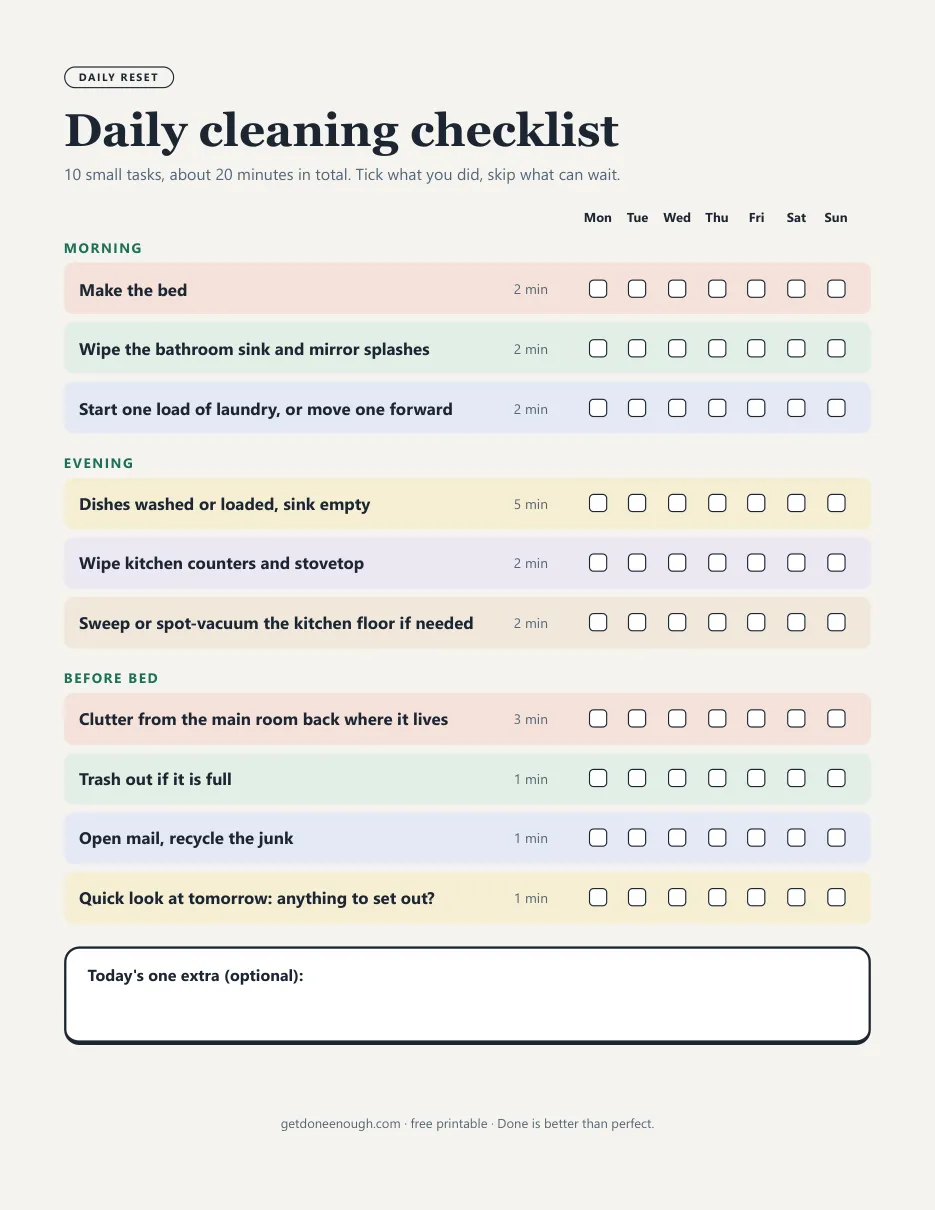
Free PDF: A one-page daily cleaning checklist with a checkbox for each day of the week.
Get the free PDFSee the planner on Etsy
The planner is sold in our own Etsy shop.
In this guide (25 parts)
- How much deposit money is lost to cleaning?
- What does your move in/out cleaning include?
- Why clean top to bottom and do floors last?
- The move out house cleaning list, room by room
- Where dirt hides once the furniture is gone
- What do landlords look at first?
- Apartment move out cleaning checklist for tenants
- Pet hair, stains and odors
- What cleaning supplies do I need when moving out?
- Cleaning vs disinfecting: what a move out needs
- Never mix cleaning products
- Air in a closed, empty unit: ventilation, VOCs and scented products
- Mold and humidity check before you leave
- Lead dust in homes built before 1978
- What California and New York say about cleaning and deposits
- How to document the clean with before and after photos
- How long does a move out clean take?
- A 2-day cleaning plan
- Last minute move out cleaning: what to do first
- Do you need professional move out cleaning?
- How to deep clean a house before moving in
- If you can’t get started
- Who’s behind Done Enough?
- How we wrote this guide
- Sources
A move out cleaning checklist lists everything to clean in an empty home before you hand back the keys, so you can return the place as clean as you found it. Work room by room, top to bottom: kitchen appliances and cabinets, bathrooms, bedrooms and closets, living areas, then floors last. Photograph each room when you finish, and keep the photos with your lease.
This guide is part of our cleaning schedule and checklist guide. It works as a move in move out cleaning checklist: the full list for the place you are leaving first, then a shorter clean for the day you get the keys to your next place. For regular weekly cleaning in a home you are staying in, use the house cleaning checklist instead.
Below the checklist, each section explains why the method works: why floors come last, when disinfecting is worth it, what happens to the air in a closed, empty unit while you spray, and what older homes need. Every figure links to the page it came from, with its year.
Move-out day 0/8 done
| Task | Done | Remove |
|---|---|---|
| Empty every room, trash out | ||
| Kitchen: oven, fridge, cabinets | ||
| Bathrooms: toilet, shower, sink | ||
| Closets and shelves wiped | ||
| Walls: holes patched, scuffs off | ||
| Baseboards, sills, switches | ||
| Floors last, toward the door | ||
| Photos of every room |
Saved on this device only. No account.
How much deposit money is lost to cleaning?
Cleaning is a common reason for deposit deductions, at least in the one renter survey we found. A 2024 UK survey by the flatshare site SpareRoom reported that 63% of UK renters had faced cleaning-related deposit deductions, with an average deduction of £250. In the same data, 29% lost more than £500 and 16% more than £750 (Property Reporter, June 2024).
Of the renters who were charged, only 34% contested the deduction, and 41% of those who did got it reduced or cancelled, according to the same report. Two limits apply: the survey is from the UK, and the report does not give a sample size. We found no US survey of the same question, so treat these figures as a rough sign of scale for other countries. Wherever you rent, a documented clean gives you something to contest with.
| SpareRoom figure (UK, 2024) | Value |
|---|---|
| Renters with a cleaning-related deduction | 63% |
| Average deduction | £250 |
| Deductions above £500 | 29% |
| Deductions above £750 | 16% |
| Charged renters who contested | 34% |
| Contested charges reduced or cancelled | 41% |
What does your move in/out cleaning include?
A move-in/out cleaning includes the inside of every appliance, cabinet and closet, plus the usual surfaces, done while the home is empty. A weekly clean skips those spots because your things are in them. After you leave, a landlord or the next occupant sees all of it.
| Area | What it covers |
|---|---|
| Kitchen | Inside oven, fridge, freezer, microwave and dishwasher; stovetop and range hood; inside cabinets and drawers; counters, backsplash, sink |
| Bathrooms | Toilet inside and out; tub, shower walls, glass and grout; sink, faucet, mirror; inside the vanity and medicine cabinet; exhaust fan cover |
| Bedrooms | Closet shelves, rods and floor; window sills and blinds; ceiling fan; light fixtures |
| Living areas | Shelves and built-ins; windows and tracks; vents; fireplace if there is one |
| Whole home | Doors, frames, handles, light switches and outlet covers; baseboards; nail holes and scuffs; floors; all trash removed |
| Often forgotten | Laundry machines, garage or storage unit, attic and basement storage, balcony or patio, burnt-out bulbs, front door and mailbox |
Move out deep cleaning also covers small fixes that show at an inspection, like nail holes, scuffs on walls and dead light bulbs. Most of the work comes down to order: start high and finish low, clean dry before wet, and do floors last while you back out toward the front door. Plan a full day for a small apartment and a weekend for a family house (our estimate, not a measurement).
Why clean top to bottom and do floors last?
Top-to-bottom cleaning works because dust and crumbs knocked loose from fans, shelves and counters fall onto whatever is below them. If you mop first and dust the ceiling fan later, the floor gets dirty again. Cleaning high surfaces first, then counters, then floors, means each pass catches what the last one dropped (our reasoning from how dust settles, not a measured result).
Household dust carries more than dirt. A 2017 review in the Journal of Epidemiology and Community Health, summarizing a 2016 meta-analysis, counted 45 consumer product chemicals measured in US indoor dust, and found some phthalates, a fragrance chemical, flame retardants and phenols in at least 90% of dust samples across studies (Zota et al., 2017).
The same review gives the method. It says “Using a damp cloth to wipe down surfaces can reduce dust loading,” and that floors cleaned often with damp mops or vacuums with high-efficiency particulate (HEPA) filters can also reduce dust levels. The review gives no figure for how much, so we do not claim one. That is the case for three rules in this checklist: dust with a damp cloth rather than a dry duster, vacuum before you mop, and leave both for the very end.
| Step | What it removes | Why it goes here |
|---|---|---|
| 1. High: fans, light fixtures, vent covers, cabinet tops | Settled dust | Anything that falls lands on surfaces not cleaned yet |
| 2. Middle: counters, shelves, inside cabinets, appliances | Crumbs, grease, dust | Crumbs go to the floor, which is still dirty |
| 3. Walls and baseboards | Scuffs, dust lines | Drips run down to the floor |
| 4. Vacuum, HEPA filter if you have one | Loose dust and grit | Mopping first turns dry grit into mud |
| 5. Damp mop toward the exit | Fine dust and residue | You never walk on a clean floor |
The move out house cleaning list, room by room
This move out cleaning list works for a house or an apartment. Start with the kitchen, because the oven and fridge take the longest. While the oven cleaner works, do the bathrooms. Finish the rooms that have only floors and surfaces, then do every floor in the home last.
Kitchen (about 2 to 3 hours, our estimate)
- ☐ Fridge and freezer emptied, unplugged if the landlord allows, shelves and drawers washed, door seals wiped
- ☐ Oven cleaner applied, left for the time on the label, racks soaked
- ☐ Stovetop, knobs, drip pans and range hood degreased
- ☐ Range hood filter washed or replaced
- ☐ Microwave inside and out
- ☐ Dishwasher filter cleared, door edges wiped
- ☐ Cabinets and drawers emptied, crumbs vacuumed, inside wiped, liners removed
- ☐ Counters, backsplash and sink scrubbed
- ☐ Behind and beside the fridge and stove if they move safely
- ☐ Floor swept and mopped
Our full kitchen cleaning checklist breaks the appliances down step by step. If you still have a full kitchen to pack, the guide on how to declutter a kitchen helps you empty it faster before the clean starts.
Bathrooms (about 1 hour each, our estimate)
- ☐ Toilet, sink and shower sprayed so the cleaner can sit
- ☐ Fan cover and light fixture dusted
- ☐ Mirror and medicine cabinet, inside and out
- ☐ Vanity drawers and cabinet emptied and wiped
- ☐ Shower walls, glass, grout and caulk scrubbed, fixtures descaled
- ☐ Drain hair removed
- ☐ Toilet outside, base, behind, then bowl
- ☐ Towel bars, hooks and toilet paper holder wiped
- ☐ Under the sink checked for leaks and mold
- ☐ Floor last, corners included
The bathroom cleaning checklist has the order to clean in and what to do with stubborn mold.
Bedrooms and closets (about 30 to 45 minutes each, our estimate)
- ☐ Ceiling fan blades and light fixtures dusted
- ☐ Blinds dusted, window sills and tracks wiped
- ☐ Closet shelves, rod and floor wiped
- ☐ Nails, hooks, and adhesive hooks and strips removed, small holes filled
- ☐ Scuffs spot-cleaned on walls and doors
- ☐ Baseboards and outlet covers wiped
- ☐ Floor where the bed and dressers stood, dust lines and dents included
- ☐ Carpet vacuumed, spots treated, or hard floor mopped
Living areas, entry and hallways
- ☐ Shelves, built-ins and window ledges dusted
- ☐ Windows, glass doors and tracks cleaned
- ☐ Air vents and return grilles dusted
- ☐ Fireplace cleaned out, if there is one
- ☐ Front door, both sides, plus the handle and doorbell
- ☐ Light switches and door handles in every room
- ☐ Wall behind the sofa and TV, and hallway walls at hand and shoulder height
- ☐ Hall closet emptied and wiped
Laundry, garage, attic, basement and outdoor space
- ☐ Washer drum, door seal and detergent drawer wiped
- ☐ Dryer lint trap cleared
- ☐ Garage or storage unit emptied and swept
- ☐ Attic and basement storage emptied, swept, checked for damp spots
- ☐ Balcony or patio swept, nothing left behind
- ☐ Burnt-out bulbs replaced
Last hour
- ☐ Every floor vacuumed, then mopped toward the exit
- ☐ All trash and recycling out of the unit
- ☐ Photos and a short video of every room
- ☐ Keys, garage remotes and mailbox key ready to return
Where dirt hides once the furniture is gone
Furniture hides the spots that look worst in an empty room: the floor under the bed and sofa, the wall behind the couch and TV stand, and the baseboard behind dressers. Dust lines, lost items, carpet dents and pet hair collect there for years, and the next person to see them is the landlord at the walk-through (our observation, not a measured finding).
High-traffic walls are the second blind spot. Hallway walls at shoulder height, the strip beside light switches, door edges and the area around door handles pick up marks from hands, bags and moving boxes. Check them in daylight or with every light on, because scuffs that vanish under one ceiling light show clearly in a photo with a flash.
A short sweep for hidden spots, in our order:
- Move each piece of furniture before the movers do, or right after, and vacuum the footprint.
- Wipe the wall behind it at baseboard height and at plug height.
- Spot-clean scuffs along hallways and around switches, starting with plain water and a cloth.
- Look up: tops of door frames, cabinet tops and the top of the fridge hold dust you never see while standing.
- Open every cabinet, closet and appliance door one last time before the photos.
What do landlords look at first?
Landlords and property managers usually open the places a weekly clean skips: the oven, the inside of the fridge and freezer, the bathroom (toilet base, tub, grout, mirror), the inside of kitchen cabinets and drawers, baseboards and the range hood filter. These are the spots most move-out checklists name, so we suggest putting your best effort there (our suggestion, based on those checklists, not on inspection data).
Some states also let you find out in advance. New York lets tenants in non-rent-regulated units ask for an inspection before move-out and be told what needs fixing or cleaning, and California lets you ask for an initial inspection near the end of the term (see the state table below). When you can get that list, it beats any general checklist, including this one, because it names what that landlord will check.
| Spot | Why it gets checked | What to do |
|---|---|---|
| Oven | Baked-on grease is easy to see and slow to fix | Oven cleaner on early, label time respected |
| Fridge and freezer | Spills, smells, ice | Empty, wash, dry, leave the door as the landlord asks |
| Bathroom | Grout, toilet base, soap scum, mold | Spray first, let it sit, scrub, run the fan |
| Inside cabinets and drawers | Crumbs, sticky shelves, old liner | Vacuum, wipe, dry, liners out |
| Baseboards | Dust lines show in every photo | Damp cloth, room by room |
| Range hood filter | Grease builds up out of sight | Soak in hot soapy water or replace |
Apartment move out cleaning checklist for tenants
For an apartment, use the room-by-room list above, plus a few items that come from the lease and the building. Ask the landlord or property manager early whether they have their own checklist, and clean against it line by line.
The lease decides details like carpet cleaning, air filters and whether you may patch nail holes yourself, so read it before you buy supplies. If it requires a professional carpet clean, book it for after the furniture is out and keep the receipt with your photos.
Apartment extras 0/7 done
| Task | Done | Remove |
|---|---|---|
| Landlord move-out list, line by line | ||
| Balcony or patio swept, railing wiped | ||
| Storage locker and parking spot emptied | ||
| Lease extras done (air filter, carpet) | ||
| Adhesive hooks off, holes filled if allowed | ||
| Trash to the building bins, not the hallway | ||
| Keys, fobs and parking tags returned |
Saved on this device only. No account.
Our tip: take adhesive hooks and strips off slowly, following the removal steps on their package, so the paint stays on the wall.
What does “broom clean” mean in a lease?
“Broom clean” is wording some leases and sale contracts use for the condition a home should be left in. We found no official, dated definition from a state or court source, so we do not define it as a legal standard. In everyday use it suggests the home is empty and swept, which is less than the full list on this page.
Because the meaning is not fixed, ask the landlord in writing what “broom clean” covers in your lease, for example whether it includes the oven and fridge, and keep the reply with your photos. If you rent in California, the courts’ guide already limits cleaning charges to the move-in level, whatever word the lease uses (see the state table).
Pet hair, stains and odors
Pets leave three problems in an empty home: hair in carpets and corners, stains on carpet and floors, and odor. The EPA lists pet allergens among the indoor triggers of asthma and allergies, and its advice is to “Routinely vacuum carpets and fabric-covered furniture,” dust hard surfaces with a damp cloth and damp-mop floors (EPA, Biological Pollutants, updated April 2026).
That matters for the next tenant, who may have allergies, and for the landlord, who may charge for carpet cleaning if the lease says so. Our order for a pet move-out (our suggestions, not from the EPA page):
- Pull hair off carpet edges, stairs and fabric with a damp rubber glove, then vacuum slowly in two directions.
- Clean the vent covers and baseboards near where the pet slept.
- Treat urine or vomit stains with a pet stain cleaner, following its label, and test it on a hidden spot first.
- Wash or wipe the floor where food and water bowls stood.
- Open the windows while you work rather than covering odor with a scented spray (see the air section below).
- Check the lease for a required professional carpet clean after pets, and keep the receipt.
What cleaning supplies do I need when moving out?
Pack one box of cleaning supplies and keep it out of the moving truck. The table below lists what goes in it, and most of it is probably already under your sink.
| Supply | What it is for |
|---|---|
| All-purpose cleaner | Counters, cabinets, doors, switches, baseboards |
| Degreaser or oven cleaner | Oven, stovetop, range hood, drip pans |
| Bathroom cleaner | Tub, shower, sink, toilet |
| Glass cleaner | Mirrors, windows, glass shower doors |
| Microfiber cloths (a stack) | Most surfaces; keep a separate one for the toilet |
| Non-scratch sponge and stiff brush | Grout, drip pans, shower floor |
| Melamine sponge (small piece) | Stubborn scuffs on walls, doors and switch plates, after plain water fails |
| Old toothbrush | Window tracks, faucet bases, stove knobs |
| Rubber gloves | Oven and bathroom work |
| Vacuum with crevice tool, HEPA filter if you have one | Cabinets, closets, vents, floors |
| Mop and bucket | Hard floors, done last |
| Step stool | Fans, top shelves, cabinet tops |
| Trash bags | Last bags of trash and old cleaning cloths |
| Spackle and putty knife | Small nail holes |
The CDC says household cleaners with soap or detergent remove germs and dirt from surfaces, and that disinfecting is likely not needed unless someone in the home is sick or at higher risk of getting sick. Its page also says not to mix products and to keep the room well ventilated (CDC, January 2025, older). Follow the label on every product.
Why a HEPA vacuum helps
A HEPA vacuum is a vacuum with a high-efficiency particulate air filter, which holds fine dust in the machine instead of blowing part of it back into the room. The 2017 review cited above names vacuums with these filters, along with damp mops, as ways to reduce dust levels on floors (Zota et al., 2017). In older homes with visible paint chips, the EPA says to use a HEPA vacuum and not to dry sweep (see the lead section).
The melamine sponge caveat
Melamine sponges, often sold as “magic erasers,” work by abrasion, and that wear releases fibers. A 2024 study in Environmental Science & Technology estimated about 6.5 million microplastic fibers per gram of worn sponge, and, using one online retailer’s August 2023 sales, about 1.55 trillion fibers a month (phys.org, June 2024). The figures come from lab abrasion, not measured release in homes.
Our way to use one with that in mind: try water and a cloth first, cut a small piece for the stubborn marks only, and wipe the crumbs into the trash rather than rinsing them down the sink (the last tip is ours, not the study’s).
Cleaning vs disinfecting: what a move out needs
Cleaning removes dirt and most germs from a surface; disinfecting uses a chemical to kill germs that remain. For a move out, cleaning is the main job. The CDC (January 2025) says sanitizing or disinfecting at home is likely not needed in general, and it recommends disinfecting when someone is sick or has a weakened immune system (CDC, 2025).
When you do disinfect, the order matters. The CDC says to “clean first, and then sanitize or disinfect if needed,” because dirt can block a disinfectant from reaching germs. It also says to leave the disinfectant on long enough to kill germs, with the surface kept wet for the contact time in the product directions. That contact time is why the bathroom list above starts by spraying: the product works while you dust the fan and wipe the mirror.
| Product type | Contact time | Source |
|---|---|---|
| Cleaner with soap or detergent | No kill time; it removes germs and dirt as you wipe | CDC, January 2025 |
| Diluted household bleach (5 tablespoons, or 1/3 cup, per gallon of room-temperature water) | At least 1 minute, surface visibly wet, unless the bottle says otherwise | CDC bleach page, April 2024 |
| Registered disinfectant spray or wipe | The time printed on the label, surface kept wet the whole time | CDC, January 2025 |
The 2024 CDC bleach page also says to use regular unscented bleach with 5% to 9% sodium hypochlorite and to make a fresh dilution daily, since it loses strength after 24 hours.
Never mix cleaning products
Mixing cleaning products can release dangerous gases. The CDC (January 2025) says “Do not mix products or chemicals with each other,” and its 2024 bleach page warns that bleach mixed with other cleaners or disinfectants can release dangerous vapors. The EPA’s mold guide says never to mix chlorine bleach with cleaners or detergents containing ammonia, because the mixture can release toxic fumes (EPA, February 2026).
Risky habits are common. In a 2020 CDC survey of 502 US adults (an opt-in online panel, taken in May 2020 during the pandemic), 39% said they had intentionally done at least one high-risk practice with cleaners, and 25% reported at least one health effect in the previous month they linked to cleaners or disinfectants. Only 35% knew bleach should not be mixed with vinegar, and 58% knew it should not be mixed with ammonia (CDC MMWR, June 2020).
| Known bad pair | What the official page says |
|---|---|
| Bleach and ammonia cleaners | Can release toxic fumes (EPA, 2026) |
| Bleach and any other cleaner or disinfectant | Can release dangerous vapors (CDC, 2024) |
| Bleach and vinegar | Only 35% of surveyed adults knew not to mix them (CDC, 2020) |
On a move-out day you often use several products in one small bathroom, in a hurry. Our rule is one product per surface, rinsed off before the next.
Air in a closed, empty unit: ventilation, VOCs and scented products
An empty apartment with the windows shut is a small box of still air, and a full day of spraying adds to it. The EPA lists cleansers and disinfectants among household sources of volatile organic compounds (VOCs), says concentrations of many VOCs are often up to ten times higher indoors than outdoors, and advises: “Increase ventilation when using products that emit VOCs” (EPA, updated June 2026).
Scent adds a second effect. Purdue University researchers led by Brandon Boor, presenting at the American Chemical Society’s fall 2026 meeting, reported that mopping, spraying and wiping with scented products formed billions to trillions of particles, mostly 1 to 30 nanometers wide, within minutes. Airborne terpenes reached “tens to hundreds of times those found in a forest” (ACS release via Newswise, August 2026).
That work was a conference presentation, and the release does not point to a peer-reviewed paper for these new results. It describes health effects as a concern rather than a proven harm. The advice it gives is simple and matches the EPA’s:
- Open windows and run the bathroom and kitchen exhaust fans while you clean.
- Choose fragrance-free or low-fragrance products where you can.
- Avoid stacking several scented products in one session.
- Do not use a scented spray to cover odors at the end; air the unit out instead (our tip).
Mold and humidity check before you leave
Mold needs moisture, so the last bathroom and basement check is about water. The EPA advises keeping indoor humidity below 60%, ideally between 30% and 50%, and drying wet areas within 24 to 48 hours after a leak or spill so mold does not grow. It says a homeowner can usually handle mold under about 10 square feet, roughly a 3 ft by 3 ft patch (EPA, A Brief Guide to Mold, February 2026).
As a tenant, the 10 square foot line is a guide to size, not permission to repair the landlord’s property. Our suggestions:
- Run the bathroom fan during and after the last shower clean, and leave the shower door or curtain open to dry.
- Look under every sink, behind the toilet and around the water heater for leaks or damp spots.
- Wipe small surface mold on tile or caulk with your normal bathroom cleaner, one product only.
- Photograph any mold, water stain or leak, and report it to the landlord in writing before you hand back the keys.
- For mold larger than about 10 square feet, or after water damage, do not scrub it; report it, since the EPA points to more extensive remediation guidance for larger areas.
Lead dust in homes built before 1978
Homes built before 1978 are more likely to have lead-based paint, according to the EPA, because the federal government banned the sale of lead-based paint for use in homes in 1978. Paint in good condition is usually not a problem, but worn paint on high-friction surfaces like doors and window sills can create chips and dust. The CDC states that “No safe blood lead level in children has been identified” (CDC, reviewed August 2026).
The cleaning rules change in these homes. The EPA says to mop floors and wipe window sills and door jambs with water and a damp cloth, and avoid steel wool, scouring pads and abrasive cleaners. Where there is visible dust or debris from chipping or flaking paint, it says to use only HEPA vacuums and “do not dry sweep” (EPA, updated October 2026). It also warns against scrubber strips, power buffers and vacuums with beater bars, which may wear away painted surfaces.
An October 2024 EPA rule tightened the dust standards. It made any lead level a recognized lab reports in dust count as a hazard, and lowered the clearance levels after professional abatement to 5 µg/ft² for floors, 40 µg/ft² for window sills and 100 µg/ft² for window troughs (EPA hazard standards page, December 2025). Those levels apply to professional lead work, not to a tenant’s clean. For you, the takeaways are wet methods, no sanding or scraping, and peeling paint reported in writing.
What California and New York say about cleaning and deposits
Both states give the landlord a deadline to return the deposit or itemize deductions: 21 days after move-out in California, 14 days in New York. Both let you ask for an inspection before you leave. California also limits cleaning charges to making the unit as clean as it was when you moved in.
The table has the details and links. Deposit rules come from state law, so if you rent somewhere else, look for the tenant guide on your state attorney general’s or housing agency’s website. We are not lawyers, and this is not legal advice.
| State | What the official page says | Source |
|---|---|---|
| California | The landlord has 21 days after you move out to return the deposit or send an itemized statement of deductions. | California Courts Self-Help Guide, CA Department of Real Estate |
| California | Cleaning charges are limited to making the unit as clean as when you moved in. | California Courts Self-Help Guide |
| California | You can ask for an initial inspection in the last two weeks of the tenancy, attend it, and get a written list of repairs or cleaning to do before you leave. The landlord gives at least 48 hours’ written notice of the time. | CA Department of Real Estate |
| California | Since April 1, 2025, landlords must photograph the unit after move-out and before repairs or cleaning, and again after that work; since July 1, 2025, also at the start of a tenancy. | CA Department of Real Estate |
| New York (non-rent-regulated units) | The landlord must return the deposit, or an itemized statement of damage and its cost, within 14 days of move-out. Without that statement, the full deposit must be returned. | New York Attorney General, Residential Tenants’ Rights Guide |
| New York (non-rent-regulated units) | You can ask for an inspection before move-out, attend it, and be told what needs fixing or cleaning, then fix it before you leave. | Same page |
Our tip: ask for that inspection early, clean against the list you are given, and photograph the result.
If you think a deduction is wrong, the California courts’ page suggests writing to the landlord first. The New York page says to try to resolve it with the landlord, then contact the nearest local office of the Attorney General.
How to document the clean with before and after photos
Photos are your record if a deduction comes up later. The California Department of Real Estate guide tells tenants to take date-stamped photos at move-in, to ask for copies of the landlord’s photos, and not to schedule the initial inspection on their last day in the unit. The habit is useful anywhere you rent.
- Find your move-in photos or checklist. They show how clean the place was when you arrived.
- Shoot each room from the doorway, then close-ups of the oven, fridge, inside cabinets, bathtub, toilet, carpet and any wall marks.
- Turn on every light so the photos show the true condition.
- Record a slow walk-through video with the date visible on your phone.
- Back the files up to email or cloud storage the same day, with the lease and any messages with the landlord.
- Keep receipts for any cleaning or repairs you paid for.
How long does a move out clean take?
A move out clean takes far longer than a normal cleaning day. The US Bureau of Labor Statistics found that people 15 and over spent an average of 0.33 hours a day on interior cleaning in 2025, about 20 minutes (0.45 hours for women, 0.20 for men), out of 1.99 hours on all household activities (BLS American Time Use Survey chart, 2025 data).
Set that next to our rough room estimates. A kitchen at 2 to 3 hours equals 6 to 9 days of average interior cleaning time (2 ÷ 0.33 is about 6; 3 ÷ 0.33 is about 9). The BLS 2025 release adds that on days they did household activities, women averaged 2.8 hours and men 2.1 hours (BLS, June 2026), so a full move-out clean is several of those days packed into one weekend.
| Area | Our time estimate | Days of average interior cleaning (0.33 h/day, BLS 2025) |
|---|---|---|
| Kitchen | 2 to 3 hours | about 6 to 9 |
| Each bathroom | about 1 hour | about 3 |
| Each bedroom and closet | 30 to 45 minutes | about 1.5 to 2.3 |
| Move-in clean, whole home | 2 to 4 hours | about 6 to 12 |
The time estimates are ours, not measurements; only the 0.33 hours comes from the BLS. The point of the comparison is planning: block the hours on a calendar instead of hoping a normal evening will cover it.
A 2-day cleaning plan
Splitting the work keeps you from doing the oven at midnight after the truck leaves. The days below are our suggestion.
| When | Tasks |
|---|---|
| 1 to 2 weeks before | Ask for the inspection, buy supplies, block out the two days |
| Day 1, packed rooms | Closets, bedrooms, bathrooms you no longer use, walls patched, light fixtures, blinds |
| Day 1, evening | Fridge emptied and cleaned; oven cleaner on overnight if the label allows |
| Day 2, after the movers | Oven wiped out, rest of the kitchen, last bathroom, laundry, outdoor space |
| Day 2, last hour | All floors toward the door, trash out, photos and video, keys ready |
Short on time? The speed cleaning method keeps one task type going through every room. For a full room-by-room deep clean in a home you are staying in, see how to deep clean a house, and for a seasonal version with a similar scope, the spring cleaning checklist.
Turn the plan into if-then plans
An if-then plan names the moment and the action together: “If it is 9 a.m. Saturday, then I spray the oven.” Psychologists call these implementation intentions. A 2025 meta-analysis of 642 tests found them effective across cognitive, emotional and behavioral outcomes, with effect sizes from d = .27 to .66, and larger effects when plans used an if-then format, when motivation was strong and when people rehearsed the plan (Sheeran, Listrom and Gollwitzer, 2025).
Examples you can copy for a move-out:
| If | Then |
|---|---|
| The movers carry out the last bedroom box | I wipe that closet and vacuum the floor |
| The oven cleaner goes on | I start the bathroom while it works |
| I finish a room | I take its photos before I leave it |
| It is the last hour before the keys are due | I stop scrubbing and start the floors |
Last minute move out cleaning: what to do first
With only a few hours left, spend them on what a landlord or the next tenant opens first: the oven, the fridge, the bathroom and the floors. This order is our suggestion.
- Get the trash and anything left behind out of the unit, so you can see what still needs cleaning.
- Spray the oven, then empty and wipe the fridge while the cleaner works.
- Clean the bathroom: toilet, sink, tub or shower, mirror.
- Vacuum crumbs out of the kitchen cabinets and drawers and give them a quick wipe.
- Wipe the oven out, then the stovetop and counters.
- Vacuum and mop every floor, working toward the front door.
- Take photos and a walk-through video before you hand back the keys.
If you are cleaning on the same day the movers are still working, start each room the moment it is empty and close its door when you finish, so nobody tracks dirt back in. Open a window in each room you spray, even in a rush.
Do you need professional move out cleaning?
Hire a cleaner when your lease requires it or when you will not have the hours before the keys are due. Otherwise, doing it yourself costs the least: most of the supplies in the table above are already in your home, and the rest is your time.
If you ask a cleaner for a quote, send this checklist with the request and ask in writing which lines the price covers, especially the inside of the oven, fridge and cabinets, the windows and the carpets. Then you can compare quotes for the same list of work. We did not find an official or recent survey of what these cleans cost, so we do not give a price.
How to deep clean a house before moving in
Do it the day you get the keys, before any furniture arrives, even if the last occupant cleaned. Work top to bottom, clean dry before wet, and finish with the floors. It is the shorter half of move in and move out cleaning: about 2 to 4 hours (our estimate, not a measurement).
Our order for a move in deep cleaning:
- Photograph every room and any damage before you clean, so your record shows the condition you found.
- Open windows and turn on the exhaust fans before the first spray.
- Dust ceiling fans, light fixtures, vents and the tops of door frames.
- Vacuum, then wipe the inside of every cabinet, drawer and closet, shelves and rods included. Let the shelves dry before you add liner or put anything away.
- Clean the fridge, freezer, oven, microwave and dishwasher inside.
- Scrub the bathroom you will use the first night, vanity and medicine cabinet included, then any others.
- Wipe switches, door handles, cabinet pulls, baseboards, window sills and tracks.
- Vacuum, then mop every floor, starting at the room farthest from the front door.
If the home was built before 1978, the EPA says it is more likely to have lead-based paint. For dust in such a home, the EPA advises wet mopping floors and wet wiping surfaces like window sills, with no dry sweeping where paint debris is visible (EPA, updated October 5, 2026). The same page says not to attempt lead paint removal yourself, so our tip is to report peeling or chipped paint to the landlord in writing. If young children will live there, the lead section above explains why the CDC treats any blood lead level in children as a concern.
If you can’t get started
Move out cleans feel huge because the whole empty home looks like one task. Give yourself one room at a time with a door you can close. Set a 20-minute timer and do only the fridge.
Make the first move small, like “put on gloves and spray the oven.” Starting has a pull of its own: a 2025 meta-analysis found a general tendency to resume interrupted tasks, though it found “no memory advantage for unfinished tasks” (Ghibellini and Meier, 2025). A sprayed oven is an interrupted task you are likely to come back to.
A friend on a video call while you scrub counts as company. The ADHD cleaning checklist splits rooms into short steps like these, the cleaning motivation guide has more ways to begin, and how to stop procrastinating covers if-then plans in more depth.
The cleaning planner mentioned on this page is sold in our own Etsy shop, Done Enough. Full disclosure: that’s us.
Who’s behind Done Enough?
Done Enough is a small independent shop, not a clinic. We build free planning tools and sell printables on Etsy. We are not professional cleaners or clinicians: each guide links its sources so you can check every claim, and our own tips are marked as suggestions.
How we wrote this guide
On October 24, 2026 we pulled US keyword and question data on move-out and move-in cleaning from Semrush, and the Google US results for “move out cleaning checklist,” with their People Also Ask questions, through DataForSEO. On October 25, 2026 we added the science sections, reading each health, safety, air quality and time-use source listed below and copying figures only as they appear on those pages.
Deposit rules are summarized only from the California and New York tenant pages listed under Sources, and the cleaning safety, air, mold, lead and disposal notes from the CDC and EPA pages there. The UK deposit survey is labeled as UK data. Times marked “our estimate” are rough estimates, not measurements, and tips without a source are our suggestions. Anything older than 12 months is marked with its year. No organization listed here endorses our shop.
Sources
Twenty-one sources, read October 24 and 25, 2026.
- California Courts Self-Help Guide. Guide to security deposits in California. No publication date shown on the page. https://selfhelp.courts.ca.gov/guide-security-deposits-california
- California Department of Real Estate. California Tenants guide, moving out section. No publication date shown; cites rules in effect from April 1 and July 1, 2025. https://www.dre.ca.gov/publications/ResourceGuidebook/gb10_movingout.html
- New York State Attorney General. Residential Tenants’ Rights Guide. No publication date shown on the page. https://ag.ny.gov/publications/residential-tenants-rights-guide
- CDC (2025). When and How to Clean and Disinfect Your Home. Page dated January 31, 2025. https://www.cdc.gov/hygiene/about/when-and-how-to-clean-and-disinfect-your-home.html Older than 12 months.
- CDC (2024). Cleaning and Disinfecting with Bleach. Page dated April 24, 2024. https://www.cdc.gov/hygiene/about/cleaning-and-disinfecting-with-bleach.html Older than 12 months.
- Gharpure R. et al. (2020). Knowledge and Practices Regarding Safe Household Cleaning and Disinfection for COVID-19 Prevention. CDC MMWR 69(23):705 to 709, June 12, 2020. https://www.cdc.gov/mmwr/volumes/69/wr/mm6923e2.htm Older than 12 months.
- EPA (2026). A Brief Guide to Mold, Moisture and Your Home. Page last updated February 18, 2026. https://www.epa.gov/mold/brief-guide-mold-moisture-and-your-home
- EPA (2026). Volatile Organic Compounds’ Impact on Indoor Air Quality. Page last updated June 23, 2026. https://www.epa.gov/indoor-air-quality-iaq/volatile-organic-compounds-impact-indoor-air-quality
- EPA (2026). Biological Pollutants’ Impact on Indoor Air Quality. Page last updated April 1, 2026. https://www.epa.gov/indoor-air-quality-iaq/biological-pollutants-impact-indoor-air-quality
- American Chemical Society news release via Newswise (2026). Scented cleaning products create invisible air pollution (research by Brandon Boor, Purdue University, ACS Fall 2026). August 27, 2026. Conference presentation; the release cites no peer-reviewed paper for these results. https://www.newswise.com/articles/scented-cleaning-products-create-invisible-air-pollution/?sc=c144
- Su et al. (2024). Mechanochemical Formation of Poly(melamine-formaldehyde) Microplastic Fibers During Abrasion of Cleaning Sponges. Environmental Science & Technology, DOI 10.1021/acs.est.4c00846, as reported by phys.org on June 21, 2024. https://phys.org/news/2024-06-melamine-sponges-microplastics.html Older than 12 months.
- Zota A. R. et al. (2017). Reducing chemical exposures at home: opportunities for action. Journal of Epidemiology and Community Health 71(9). Summarizes Mitro et al. (2016), Environmental Science & Technology 50(19). https://pmc.ncbi.nlm.nih.gov/articles/PMC5561392 Older than 12 months.
- EPA (2026). Reduce the Risk of Lead Exposure at Home. Page last updated October 5, 2026. https://www.epa.gov/lead/reduce-risk-lead-exposure-home
- EPA (2025). Hazard Standards and Clearance Levels for Lead in Paint, Dust and Soil (October 2024 final rule). Page last updated December 19, 2025. https://www.epa.gov/lead/hazard-standards-and-clearance-levels-lead-paint-dust-and-soil-tsca-sections-402-and-403
- CDC (2026). All Children Can Be Exposed to Lead. Last reviewed August 25, 2026. https://cdc.gov/lead-prevention/communication-resources/all-children-can-be-exposed-to-lead.html
- EPA (2026). Household Hazardous Waste (HHW). Page last updated June 1, 2026. https://www.epa.gov/hw/household-hazardous-waste-hhw
- US Bureau of Labor Statistics (2026). American Time Use Survey, 2025 Results. Released June 25, 2026. https://www.bls.gov/news.release/atus.nr0.htm
- US Bureau of Labor Statistics (2026). Average hours per day spent in selected household activities, 2025 annual averages (chart). https://www.bls.gov/charts/american-time-use/activity-by-hldh.htm
- Sheeran P., Listrom O. and Gollwitzer P. M. (2025). The when and how of planning: Meta-analysis of the scope and components of implementation intentions in 642 tests. European Review of Social Psychology 36(1):162 to 194. https://kops.uni-konstanz.de/handle/123456789/69905
- Ghibellini R. and Meier B. (2025). Interruption, recall and resumption: a meta-analysis of the Zeigarnik and Ovsiankina effects. Humanities and Social Sciences Communications 12. https://ideas.repec.org/a/pal/palcom/v12y2025i1d10.1057_s41599-025-05000-w.html
- Property Reporter (2024). Majority of UK renters hit with cleaning-related deposit deductions (SpareRoom data). June 20, 2024. UK data, sample size not stated. https://www.propertyreporter.co.uk/majority-of-uk-renters-hit-with-cleaning-related-deposit-deductions.html Older than 12 months.
FAQ
What should I do with leftover cleaning products when I move?
Use up what you can before moving day (our tip). The EPA counts some cleaners as household hazardous waste and says pouring them down the drain or putting them in regular trash can be improper disposal. Keep leftovers in their original containers, never mix them, and check your local collection program.
What is the 5-5-5 rule for cleaning?
We found no official definition, so here is the version we suggest for a move out: set a 5-minute timer, clear or wipe 5 things in one room, then repeat in the next room until you have done 5 rooms. That is about 25 minutes of work, a good warm-up before the oven and fridge.
Can a landlord charge for normal wear and tear?
Not in California: the state courts' self-help guide says a landlord may deduct for repairing damage caused by the tenant or guests, other than normal wear and tear. Other states set their own rules. Dated move-in and move-out photos help show which marks were already there (our tip).
How clean does an apartment have to be when you move out?
In California, the state courts' self-help guide limits cleaning charges to what it takes to make the unit as clean as it was when you moved in. Other states set their own rules, and your lease may add items such as carpet cleaning, so read both and compare against your move-in photos.
Should I disinfect when moving out?
Usually not. The CDC (January 2025) says cleaning with soap or detergent removes most germs and that disinfecting at home is likely not needed unless someone is sick or has a weakened immune system. If you do disinfect, clean first and keep the surface wet for the full contact time on the label.
Is it safe to mix cleaning products?
No. The CDC says not to mix products or chemicals with each other, and the EPA warns that chlorine bleach mixed with ammonia cleaners can release toxic fumes. A 2020 CDC survey found only 35% of US adults knew bleach should not be mixed with vinegar. Use one product at a time and rinse between them.