Cleaning
Spring cleaning checklist: room by room, in 4 weekends
Updated · Written by the Done Enough team · Sources linked below
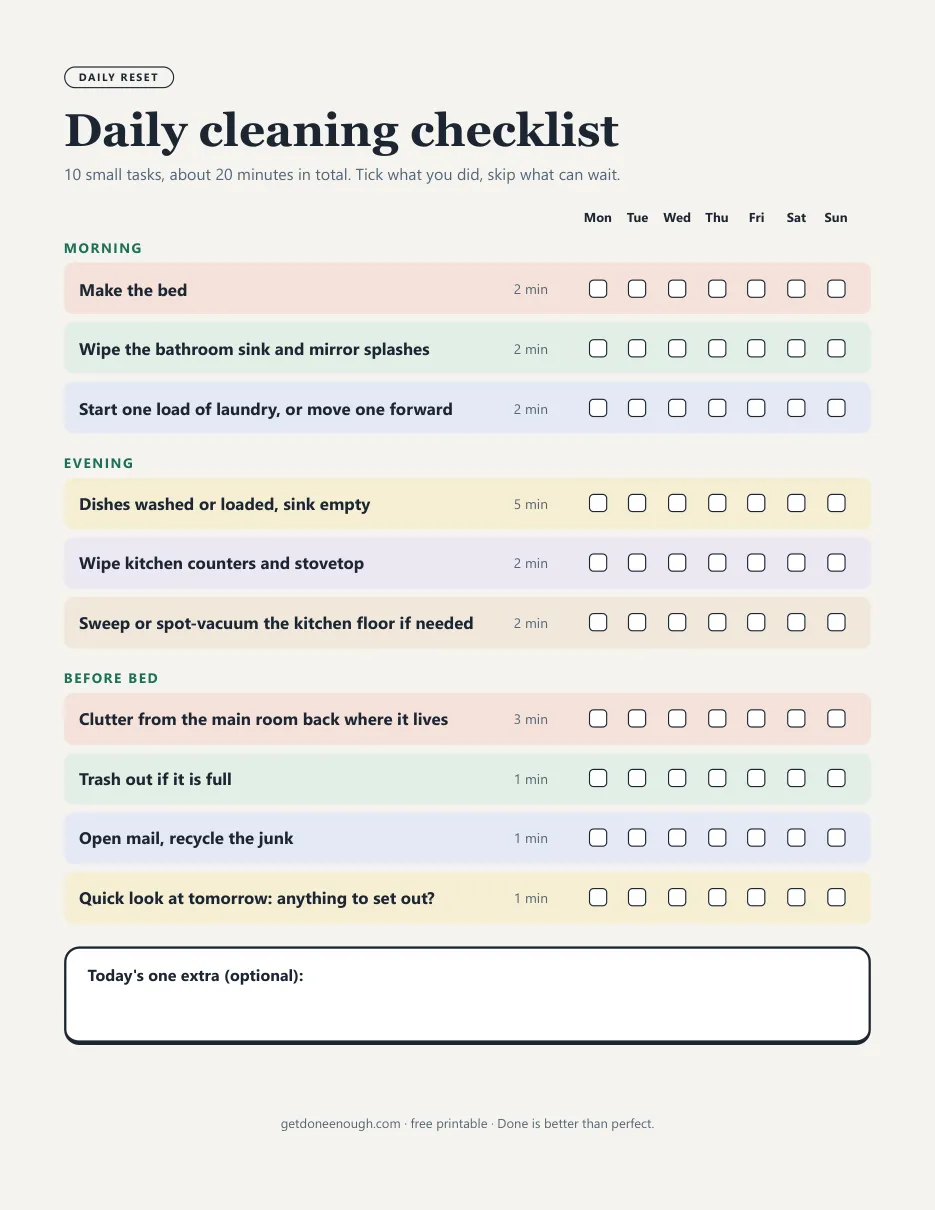
Free PDF: A one-page daily cleaning checklist with a checkbox for each day of the week.
Get the free PDFSee the planner on Etsy
The planner is sold in our own Etsy shop.
In this guide (17 parts)
- What should be on a spring cleaning list?
- Why spring cleaning matters: winter dust, allergens and indoor air
- Room-by-room checklist
- Cleaning, sanitizing, disinfecting: what is the difference?
- Which cleaning products should you never mix?
- Does spring cleaning affect indoor air and breathing?
- Which seasonal checks belong on the list?
- How do you split the work over 4 weekends?
- How to spring clean a house, step by step
- Spring yard clean up checklist
- What are the top 10 tips for spring cleaning?
- What is the 80/20 rule for house cleaning?
- Supplies to have on hand
- If you stall halfway through
- Who’s behind Done Enough?
- How we wrote this guide
- Sources
A spring cleaning list covers the jobs a weekly clean skips: inside the oven and fridge, windows and tracks, baseboards, light fixtures, curtains, closets and under the furniture. Start with a decluttering pass, add three seasonal checks (smoke alarms, HVAC filter, signs of mold), and split the house over 4 weekends so no single day runs long.
This spring cleaning checklist is part of our cleaning schedule and checklist guide. For the regular weekly routine, see the house cleaning checklist.
This weekend 0/7 done
| Task | Done | Remove |
|---|---|---|
| Declutter one room: keep, donate, toss | ||
| Test the smoke alarms | ||
| Check the HVAC filter | ||
| Dust high spots: fans, lights, vents | ||
| Wash curtains or bedding | ||
| Windows, sills and tracks | ||
| Floors last |
Saved on this device only. No account.
What should be on a spring cleaning list?
A spring cleaning list has five layers: a decluttering pass, the deep tasks a weekly clean skips, the fabrics that held dust all winter, a short set of safety and air checks, and the swap to warm-weather gear. The table gives examples for each.
| Layer | What it covers | Example tasks |
|---|---|---|
| Declutter | Everything you will have to clean around | Closets, drawers, pantry, bathroom cabinet, kids’ toys, garage shelves |
| Deep clean | Spots the weekly routine misses | Inside oven and fridge, fridge coils, dishwasher filter, baseboards, window tracks, light fixtures, under furniture |
| Fabrics | Things that hold dust over winter | Curtains, duvets, pillows, throw blankets, table linens, chair cushions, rugs, pet beds (if the labels allow) |
| Seasonal checks | Safety and air | Smoke alarms, HVAC filter, humidity, mold on hard surfaces, caulk lines, dryer lint screen |
| Swap | Getting the house ready for warm weather | Winter coats and boots stored, window screens on, patio furniture out |
The decluttering layer comes first for a practical reason: every item you donate or toss is one less thing to dust, wipe and put back. To spring clean and declutter in one pass, carry a trash bag and two boxes into each room, one to donate and one for things that live elsewhere, and empty them before you start wiping (our tip).
Why spring cleaning matters: winter dust, allergens and indoor air
Spring cleaning targets what builds up during a closed-up winter: dust mite allergens in bedding, moisture that feeds mold, and chemical vapors from products used indoors. The checklist on this page is built around those three mechanisms, which is why fabrics, humidity and ventilation each get their own step.
Dust mites live in bedding, upholstery and carpet, and they cannot be fully eliminated, only reduced. The National Institute of Environmental Health Sciences (NIEHS) advises keeping indoor humidity “at, or below, 50 percent” and washing bedding and blankets weekly in hot water, 130 to 140 degrees Fahrenheit, to kill the mites (NIEHS, reviewed March 2026). NIEHS also recommends dusting with a damp cloth, because dry dusting spreads allergens, and a vacuum with a HEPA filter or a double-layered microfilter bag. The EPA adds dust-proof covers on pillows and mattresses (EPA asthma triggers, updated July 2026).
Mold grows where water sits. The EPA’s mold guide sets the target at relative humidity below 60 percent, ideally 30 to 50 percent, and says to dry wet areas within 24 to 48 hours (EPA, updated February 2026).
The EPA’s indoor air page reports that levels of several organic compounds average 2 to 5 times higher indoors than outdoors, and lists “cleansers and disinfectants” and air fresheners among the sources (EPA, updated June 2026). That figure comes from EPA studies summarized on its current page, not from a new measurement.
| Indoor factor | Target or rule | Source |
|---|---|---|
| Humidity for dust mites | At or below 50% | NIEHS, 2026 |
| Humidity for mold | Below 60%, ideally 30 to 50% | EPA, 2026 |
| Bedding wash | Weekly, hot water, 130 to 140°F | NIEHS, 2026 |
| Pillows and mattresses | Dust-proof covers | EPA, 2026 |
| Water damage | Dry within 24 to 48 hours | EPA, 2026 |
| Products that emit VOCs | Increase ventilation while using them | EPA, 2026 |
If anyone in the house has asthma or allergies, their clinician’s advice comes first; the table summarizes general public health guidance, not a treatment plan.
Room-by-room checklist
Each room list is on top of your normal weekly clean. Pick the tasks that fit your home and skip the rest.
Kitchen
To spring clean the kitchen, empty before you wipe: the pantry and fridge first, then the range hood and cabinet tops, and the floor behind the appliances last. The kitchen cleaning checklist has the full order.
- ☐ Toss spoiled or stale food from the pantry, fridge door and spice rack (the kitchen decluttering guide explains what date labels mean)
- ☐ Empty and wipe the inside of the fridge and freezer
- ☐ Vacuum the refrigerator coils (behind the bottom grille or on the back), unplugged and following the owner’s manual
- ☐ Clean inside the oven and microwave
- ☐ Wash or soak the range hood filter
- ☐ Pull and rinse the dishwasher filter, wipe the door seal, and clear the spray arm holes
- ☐ Clean the garbage disposal, power off, using the method in its manual
- ☐ Replace the kitchen sponge (see below)
- ☐ Wipe cabinet fronts, handles and the tops of cabinets
- ☐ Clean the backsplash and behind the small appliances
- ☐ Clear and wipe under the sink, and check for slow leaks while it is empty
- ☐ Pull the fridge or stove out if it moves, and clean the floor behind it
The coils, dishwasher filter and disposal steps are maintenance tasks that appear on several top-ranking spring lists but not on most weekly routines. Methods vary by model, so the manual is the authority for each (our suggestion).
Why replace the kitchen sponge instead of sanitizing it?
A used kitchen sponge can hold very dense bacterial populations, and in one study sanitizing it did not lower them. A 2017 study in Scientific Reports analyzed 14 used kitchen sponges and measured local densities of up to 54 billion bacterial cells per cubic centimeter in the most colonized spots (Cardinale et al., 2017). The same study found that sponges their owners regularly sanitized did not contain fewer bacteria than uncleaned ones, and that this “special cleaning” raised the share of two groups related to potential pathogens. The authors suggest regular, cheap replacement, for example weekly. The sample was small (the sanitized group was a subset of the 14) and the authors say they know of no reported infection from these bacteria in a home, so the result shows how much a sponge can hold, not that a sponge made anyone sick. For spring cleaning, the practical step is simple: throw the old sponge out with the pantry clear-out and start the season with a new one.
Bathrooms
- ☐ Sort the cabinet and toss old products and medicines past their date
- ☐ Scrub grout and caulk lines
- ☐ Check the caulk around the tub, shower and sink for gaps, peeling or mold that will not scrub off
- ☐ Soak or wipe the shower head
- ☐ Wash the shower curtain, liner and bath mat
- ☐ Dust the exhaust fan cover and light fixture
- ☐ Clean behind and around the toilet base
Checking caulk is different from scrubbing it. A gap lets water behind the tile, and the EPA warns against caulking or painting over moldy surfaces: clean and dry them first, because paint applied over mold is likely to peel (EPA, 2026). If the mold sits under the caulk, the old bead usually has to come out before new caulk goes on (our suggestion).
The bathroom cleaning checklist has the order to clean in and what to do when mold keeps coming back.
Bedrooms
- ☐ Sort closets: winter clothes out, warm-weather clothes in, a donate bag ready
- ☐ Wash pillows, duvets and mattress pads if the care labels allow
- ☐ Wash sheets and blankets in hot water (130 to 140°F per NIEHS), if the fabric allows
- ☐ Add dust-proof covers to pillows and mattresses if allergies are a concern (EPA)
- ☐ Vacuum the mattress and flip or rotate it if the maker says so
- ☐ Vacuum under the bed and the closet floor
- ☐ Dust ceiling fan blades, lamps and the tops of dressers with a damp cloth
- ☐ Wipe window sills and blinds
Living and dining areas
- ☐ Brush cobwebs from ceiling corners and the tops of window frames
- ☐ Vacuum under sofa cushions and behind furniture
- ☐ Wash or vacuum curtains and wipe curtain rods
- ☐ Wash table linens and placemats; vacuum or wash chair cushions if the covers come off
- ☐ Dust baseboards, door frames, vents and picture frames
- ☐ Clean lampshades and light fixtures
- ☐ Deep clean rugs or shampoo carpets
- ☐ Wipe light switches, door handles and remotes
Entry, laundry and home office
- ☐ Store winter coats, boots and gloves; wash them first if needed
- ☐ Shake out or wash the doormat
- ☐ Clean the washer gasket and detergent drawer
- ☐ Clean the dryer lint screen and the area behind the machines
- ☐ Sort papers and wipe the desk, keyboard and monitor
Windows, outside and garage
- ☐ Wash windows inside, plus outside where you can reach safely from the ground
- ☐ Vacuum window tracks and wipe sills
- ☐ Put screens back on, after a rinse
- ☐ Sweep the porch, entry steps and patio
- ☐ Wash outdoor furniture and cushions
- ☐ Clear garage shelves and sweep the floor
The lawn, flower beds and the rest of the outdoor work have their own list in the yard section further down.
Cleaning, sanitizing, disinfecting: what is the difference?
Cleaning, sanitizing and disinfecting are three different jobs, and in our view most spring cleaning tasks only need the first. The CDC defines cleaning as removing “most germs, dirt, and impurities from surfaces,” sanitizing as reducing germs to levels public health codes consider safe, and disinfecting as killing most germs on surfaces and objects (CDC, January 2025, older).
| Job | What it does (CDC) | Typical spring use |
|---|---|---|
| Cleaning | Removes most germs, dirt and impurities | Shelves, baseboards, windows, cabinet fronts, floors |
| Sanitizing | Reduces germs to levels codes consider safe | Food-contact surfaces, per the product label |
| Disinfecting | Kills most germs on surfaces | When someone in the house is sick, or after raw meat spills, per the label |
The EPA’s six-step guide, a 2020 one-pager, starts with order: wash a surface with soap and water first if it is visibly dirty (EPA, 2020). The second step is contact time: the product needs time on the surface to work, and the EPA says the surface should stay wet for the whole contact time printed in the directions. Wiping right after spraying ends the contact time early (our note). The same EPA guide ends with storage: keep lids tightly closed and store products out of reach of children.
Which cleaning products should you never mix?
Never mix cleaning products with each other. The CDC states it plainly: “Do not mix products or chemicals with each other” (CDC, 2025). Spring cleaning can raise the odds of a mistake (our note), because many products come out of the cabinet at once and get used in small, closed rooms like bathrooms.
In a May 2020 CDC survey of 502 US adults, run early in the COVID-19 pandemic (an opt-in online panel that may not represent everyone), 39% reported intentionally doing at least one high-risk practice, such as applying bleach to food, and 25% reported at least one health effect they linked to cleaners or disinfectants (CDC MMWR, June 2020). Only 35% knew bleach should not be mixed with vinegar, and 58% knew it should not be mixed with ammonia.
The 2024 national poison center report counted household cleaning substances in 87,031 exposures among children 5 and under, 10.1% of the substances in that age group, and cleaning substances in 74,838 exposures among adults 20 and older (Poison Control, 2024 data). A 2020 CDC report found poison center calls about cleaners and disinfectants rose from 37,822 in January to March 2019 to 45,550 in the same months of 2020, a 20.4% increase, while noting a causal link to pandemic cleaning could not be shown (CDC MMWR, April 2020).
| Data point | Figure | Source |
|---|---|---|
| Cleaning substance exposures, children 5 and under | 87,031 (10.1% of substances) | Poison Control, 2024 data |
| Cleaning substance exposures, adults 20 and older | 74,838 (5.9% of substances) | Poison Control, 2024 data |
| Adults reporting a high-risk cleaning practice | 39% of 502 | CDC survey, 2020 |
| Adults who knew not to mix bleach and vinegar | 35% | CDC survey, 2020 |
| Cleaner and disinfectant calls, Jan to Mar 2020 vs 2019 | 45,550 vs 37,822 (+20.4%) | CDC report, 2020 |
Does spring cleaning affect indoor air and breathing?
Cleaning products can affect indoor air, and the research points to ventilation and fewer sprays rather than to skipping the clean. Two studies frame the question, and both have limits.
A 2016 nationally representative online survey of 1,136 US adults found 34.7% reported at least one health problem from fragranced products, and 19.7% reported problems from being in a room after it was cleaned with scented products (Steinemann, 2016). Those are self-reports, not measured effects.
A 2018 study in the American Journal of Respiratory and Critical Care Medicine followed 6,235 adults from 22 centers in the European Community Respiratory Health Survey over 20 years (Svanes et al., 2018). Lung function (FEV1) declined by 22.1 ml per year in women who cleaned at home and 22.4 ml per year in occupational cleaners, against 18.5 ml per year in women who did not clean. In men, cleaning was not significantly linked to decline. The study shows an association over regular, long-term cleaning, not proof that cleaning caused the decline, and it says nothing about one spring clean.
The practical takeaway matches EPA advice: “Increase ventilation when using products that emit VOCs,” and use products outdoors or with an exhaust fan when the label calls for good ventilation (EPA, 2026). Open a window, run the bathroom fan, and use plain soap and water on jobs that do not need more.
Which seasonal checks belong on the list?
Spring cleaning is a good moment for safety and air checks because you are already moving furniture and climbing the step stool. Three checks belong on the list: smoke alarms, the HVAC filter and signs of mold.
The U.S. Fire Administration says to test every smoke alarm monthly, replace 9-volt batteries at least once a year, replace the backup battery in hardwired alarms yearly, and replace the whole alarm 10 years from its manufacture date (USFA, page reviewed October 13, 2026). The reason the test matters: USFA warns that when an alarm sounds, you may have less than 2 minutes to get everyone outside. For furnace and HVAC filters, the EPA says to follow the manufacturer’s recommendation, which is typically every 60 to 90 days, and to change filters more often if they look heavily soiled when you replace them (EPA, updated October 1, 2026). The same EPA page recommends a filter rated at least MERV 13, or as high as your system will accommodate. If you find mold while moving furniture or clearing under a sink, the EPA’s advice is to scrub it off hard surfaces with detergent and water and dry them completely (EPA, updated February 18, 2026). The EPA says a moldy area of less than about 10 square feet is usually a do-it-yourself job; larger areas call for professional guidance.
| Check | How often | Source |
|---|---|---|
| Test each smoke alarm | Monthly | USFA, 2026 |
| Replace 9-volt or hardwired backup batteries | At least once a year | USFA, 2026 |
| Replace the smoke alarm itself | 10 years from the manufacture date on the alarm | USFA, 2026 |
| Check or replace the HVAC filter | Follow the manufacturer; typically every 60 to 90 days; MERV 13 or the highest your system takes | EPA, 2026 |
| Look for mold on hard surfaces | When you clean; scrub, then dry completely; over about 10 sq ft, get professional advice | EPA, 2026 |
| Check indoor humidity | During the clean, with a cheap hygrometer; aim for 30 to 50% | EPA, 2026 |
| Clean the dryer lint screen and behind the dryer | Every load for the screen; behind the machine during spring cleaning | Our tip |
Write the date on the new filter and the smoke alarm batteries with a marker. Next spring, you will know at a glance (our tip).
How do you split the work over 4 weekends?
A 4-weekend spring cleaning schedule splits the house into one theme per weekend, so a big spring clean becomes a few hours per session instead of a full day. Weekend 1 clears clutter and does the safety checks, because both make the later weekends faster.
Weekend 2 takes the two hardest rooms, the kitchen and bathrooms, while energy is still high. Weekend 3 covers the bedrooms and living areas, including fabrics and windows. Weekend 4 handles the entry, laundry, outdoor spaces and garage, plus anything that slipped. On weekdays, a 15-minute reset keeps the clean rooms from sliding back while you work on the rest. If a weekend is lost to plans or bad weather, shift the plan by a week instead of doubling up. Five weekends still gets the house done. Times below are our estimates for an average home and vary a lot with size and how much clutter there is.
| Weekend | Focus | Tasks | Time (our estimate) |
|---|---|---|---|
| 1 | Declutter + safety | Closets, drawers, pantry, cabinets; donate run; smoke alarms; HVAC filter | 3-4 hours |
| 2 | Kitchen + bathrooms | Inside appliances, fridge coils, dishwasher filter, disposal, under sinks, grout and caulk, shower head, fan covers | 4-5 hours |
| 3 | Bedrooms + living areas | Bedding, curtains and table linens washed, cobwebs, under furniture, baseboards, fans, inside windows | 4-5 hours |
| 4 | Entry, laundry, outside | Winter gear stored, washer and dryer area, outside windows from the ground, patio, garage | 3-4 hours |
How long do people actually spend on housework?
US time-use data show why a full spring clean rarely fits in one day. In the Bureau of Labor Statistics’ American Time Use Survey, 2025 annual averages, 36.1% of people did housework on an average day, and those who did spent 1.55 hours on it (BLS, released June 2026). The share was 47.9% for women and 23.8% for men. Lawn and garden care reached 10.0% of people per day, at 1.90 hours for those who did it. The BLS release notes that all survey operations were suspended from October 1 through November 12, 2025, during the federal shutdown (BLS news release, June 2026).
| Activity (2025 averages) | Share doing it per day | Hours for those who did it |
|---|---|---|
| Household activities, all | 80.9% | 2.46 |
| Housework (cleaning, laundry) | 36.1% | 1.55 |
| Housework, women | 47.9% | 1.69 |
| Housework, men | 23.8% | 1.25 |
| Lawn and garden care | 10.0% | 1.90 |
People who do housework on a given day spend about an hour and a half on it; our weekend blocks run 3 to 5 hours. These figures do not prove our time estimates, but they show that a weekend block is already two to three times that daily average, which is the case for splitting the work.
Prefer to do the whole spring deep clean in one push? The how to deep clean a house guide covers a faster, room-per-day version.
How to spring clean a house, step by step
Finish one room at a time and follow the same seven steps in each, from clutter to floors.
- Declutter the room. Keep, donate, toss. Bags go to the car right away.
- Start the laundry. Curtains, bedding or rugs go in the wash first so they finish while you clean.
- Dust high spots. Cobwebs in ceiling corners, ceiling fans, light fixtures, tops of cabinets and door frames.
- Windows and walls. Glass, sills, switches, handles.
- Furniture and surfaces. Wipe, polish, vacuum upholstery.
- Baseboards and vents.
- Floors last, working toward the door.
Top to bottom keeps dust off a floor you already cleaned, and dry before wet keeps dust from turning into streaks. Follow the label on every product and never mix them; the CDC says not to mix products or chemicals with each other (CDC, January 2025, older). The CDC also advises good ventilation when using products indoors, such as an open window or a fan.
Spring yard clean up checklist
A spring yard clean up clears what winter left outside: fallen branches and leaves, last year’s dead stems, weeds in the beds, a grimy patio and a garage full of winter gear.
We suggest doing the yard a few weeks after the indoor cleaning, once the ground has dried and the nights have warmed (timing below).
Spring yard clean up list 0/11 done
| Task | Done | Remove |
|---|---|---|
| Pick up fallen branches and debris | ||
| Rake the lawn lightly once it is dry | ||
| Sweep and wash the patio and paths | ||
| Wash outdoor furniture and cushions | ||
| Clear gutters you can reach safely | ||
| Check hoses and the outdoor faucet | ||
| Clean the mower and garden tools | ||
| Sort the garage, store winter gear | ||
| Cut back dead stems, leave tall stubs | ||
| Weed and edge the flower beds | ||
| Add mulch once the beds are clean |
Saved on this device only. No account.
You can edit this list: delete the rows your yard does not need and add your own. Your edits stay saved in this browser.
What does a spring clean up include?
A spring clean up includes five areas: the lawn, the garden beds, hard surfaces such as the patio and paths, outdoor furniture and tools, and the garage. These are the usual DIY tasks for each.
| Area | DIY tasks |
|---|---|
| Lawn | Pick up branches and trash; rake leaves and matted grass lightly once the ground is dry |
| Garden beds | Cut back dead stems, clear leaves once nights are warm, weed, edge, then mulch |
| Patio, deck and paths | Sweep, then scrub or rinse; pull weeds from the cracks |
| Furniture and tools | Wash furniture and cushions; check the hose and sprinkler; clean the mower and hand tools |
| Gutters and garage | Clear gutters you can reach safely; sort the garage; put away shovels and winter gear |
Some towns help with spring clean ups through a curbside pickup week, and the rules vary from town to town. Winnetka, Illinois, for example, does not collect yard waste or paint during its clean-up week (Village of Winnetka), so check your city’s page before you bag everything.
When to start on the yard
Do the yard in two passes: the lawn, patio and paths once you can walk on the ground without sinking in (our tip), and the flower beds later, once the nights are warm.
For the beds, University of Illinois Extension suggests waiting until low temperatures are reliably in the 50s (Fahrenheit), or until it is time to plant tomatoes, because insects overwinter in leaves and old stalks. For northern and Midwestern yards, it advises holding off through March and early April (Illinois Extension, March 2023, older guidance).
Yard clean up, step by step
Work from the big debris down to the details, so the rake and broom do not keep catching on branches (our tip).
- Walk the yard first. Pick up branches, trash and anything the wind moved.
- Rake the lawn lightly to lift leaves and matted grass, once the ground is dry.
- Clean the hard surfaces. Sweep the patio, deck and paths, then scrub or rinse.
- Wash the outdoor furniture and cushions and let them dry in the sun.
- Clear the gutters and downspouts only if you can reach them safely; otherwise leave them for someone with the right ladder.
- Check the hose, sprinkler and outdoor faucet for winter damage before the first hot day.
- Clean the mower and hand tools. For the blade, oil and fuel, follow the mower’s manual.
- Sort the garage. Put away shovels and winter gear, sweep, and set the garden tools near the door.
- Do the flower beds last, once the nights are warm (next section).
How to clean up flower beds in the spring
A spring garden clean up in the flower beds runs in this order: cut back, clear, weed, edge, then mulch.
Before you dig or turn the soil in a bed, squeeze a handful. If it crumbles easily, it is ready to work; if it stays in a lump or water drips out, give it a few more days. Writing about getting soil ready for planting, Cornell horticulture professor Steve Reiners warns that working soil while it is too wet can ruin its structure, often for years (Cornell CALS, April 2020, older guidance).
- Cut back last year’s dead stems, but leave stubs. Illinois Extension suggests keeping 8 to 24 inches of stalk on plants such as coneflower, bee balm and goldenrod, because bees nest in them.
- Lift the leaves off the beds once the nights stay warm.
- Pile the cuttings loosely in a corner of the yard. Illinois Extension suggests waiting until the overwintering insects have emerged (mid-May in its region) before you compost or bag them.
- Pull weeds while the soil is moist but not soggy, when the roots come out more easily (our tip).
- Edge the beds with a spade or an edger.
- Mulch last, on clean beds (our tip).
If you prefer to tidy stems before spring, NC State Extension researchers found that dead stems are not occupied in their first winter, while bees move into last year’s stems in spring. Their advice is to trim stems in their first winter, after the first frost and before the last frost, then leave them alone (NC State Extension, February 2025, older guidance).
What are the top 10 tips for spring cleaning?
The ten tips below follow the order of a spring clean, from clutter to safety checks to pacing. Tips 6, 8 and 9 rest on the sources cited above; the others are our suggestions.
- Declutter before you clean. Less stuff, less to wipe.
- Check what you already own, then gather supplies. A trip to the store halfway through is an easy way to lose the afternoon.
- One room at a time. Finish it before you open the next door.
- Top to bottom. Fans and shelves before floors.
- Dry before wet. Dust and vacuum first, then wipe and mop.
- Let the product sit. Spray, do something else, come back. The label gives the contact time, and the EPA says the surface should stay wet for all of it.
- Run the washer while you work. Curtains and bedding finish while you clean.
- Open the windows. The EPA advises more ventilation when using products that emit VOCs, if the weather allows.
- Do the safety checks. Smoke alarms and HVAC filter, as in the table above.
- Split it up. Four weekends beats one exhausting Saturday.
What is the 80/20 rule for house cleaning?
The 80/20 rule for house cleaning borrows the Pareto idea that a small share of the effort produces most of the visible result. For spring cleaning, it means starting with the few tasks that change how the home looks and feels the most, then adding detail work only if you have time and energy left.
Our pick for the high-impact tasks: clearing clutter off surfaces, the kitchen, the bathrooms, the floors and the windows that get the most light. Low-impact tasks, such as polishing the tops of door frames or sorting a drawer nobody opens, can wait or drop off the list. It is a rule of thumb for setting priorities, and the split itself is not a measured figure for housework. It works well with the 4-weekend plan: if a weekend gets cut short, finish the high-impact column and move on.
| High impact (do first) | Lower impact (if there is time) |
|---|---|
| Clear counters and tables | Tops of door frames |
| Kitchen: fridge, oven, counters | Inside rarely used drawers |
| Bathrooms: grout, shower, toilet base | Behind heavy furniture that never moves |
| Windows in the main rooms | Garage shelves |
| Floors and rugs | Light switch plates |
For a quick reset before guests, speed cleaning uses the same idea in 15 to 30 minutes.
Supplies to have on hand
Check the cabinet before you shop, and cross off what you already own. The EPA advises buying only as much of a chemical product as you will use right away, and throwing away old or unneeded chemicals safely, since gases can leak even from closed containers (EPA, 2026). Look for a household hazardous waste collection day instead of putting them in the trash. For the indoor lists on this page, keep these supplies in one bucket or box you can carry from room to room (our tip).
- All-purpose cleaner and dish soap
- Glass cleaner or a squeegee
- Microfiber cloths, a few more than you think
- Vacuum with a crevice tool and an upholstery brush (HEPA filter if allergies are a concern, per NIEHS)
- A long-handled duster for ceiling corners and fan blades
- Mop and bucket
- Step stool for fans and the tops of cabinets
- Scrub brush and an old toothbrush for grout and tracks
- Rubber gloves
- A new kitchen sponge
- Trash bags plus two boxes: donate and put away elsewhere
- A replacement HVAC filter in the right size, and batteries for the smoke alarms
Keep lids closed and the bucket out of children’s reach between rooms, as the EPA’s disinfectant guide advises for storage.
If you stall halfway through
Spring cleaning is long, and stopping in the middle of the kitchen happens. Set a 20-minute timer and finish one shelf or one cabinet, then decide whether to keep going. Put the next task on a visible list so starting again tomorrow takes no thinking.
Two findings from recent research support this approach. An if-then plan, also called an implementation intention, links a cue to an action: “If it is Saturday at 9 a.m., then I start Weekend 1 in the hall closet.” A 2025 meta-analysis of 642 tests by Sheeran, Listrom and Gollwitzer found small to medium-to-large effects (d from .27 to .66) across cognitive, emotional and behavioral outcomes, with larger effects when the plan used the if-then format, people were strongly committed to the goal, and the plan was practiced beforehand (European Review of Social Psychology, 2025). A separate 2025 meta-analysis by Ghibellini and Meier found no memory advantage for unfinished tasks, the popular “Zeigarnik effect,” but did find a general tendency to resume interrupted tasks (Humanities and Social Sciences Communications, 2025). An unfinished cabinet will not nag at your memory, but a visible note makes going back to it easier.
The cleaning motivation guide has more ways to restart when you stall.
The cleaning planner mentioned on this page is sold in our own Etsy shop, Done Enough. Full disclosure: that’s us.
Who’s behind Done Enough?
Done Enough is a small independent shop. We build free planning tools and sell printables on Etsy. We are not professional cleaners or clinicians: each guide links its sources so you can check every claim, and our own tips are marked as suggestions.
How we wrote this guide
On October 24, 2026 we pulled US keyword and question data from Semrush, and the Google US results for “spring cleaning list,” with their People Also Ask questions, through DataForSEO. On October 25, 2026 we compared the page with the top Google results for “spring cleaning checklist” and added the tasks they cover that we had missed (fridge coils, garbage disposal, dishwasher filter, caulk checks, ceiling cobwebs, table linens and chair cushions, checking supplies first).
The seasonal checks come from the U.S. Fire Administration’s smoke alarm page, the EPA’s guides to air cleaners, mold, VOCs, asthma triggers and disinfectant use, NIEHS guidance on dust mites, and the CDC’s home cleaning guidance. The science sections draw on peer-reviewed studies (kitchen sponges, fragranced products, lung function, planning and task resumption), poison center data, two CDC reports and the BLS American Time Use Survey. The yard section draws on University of Illinois Extension, NC State Extension and Cornell, and the curbside example is the Village of Winnetka’s clean-up page. All 21 are listed under Sources, and nothing published before 2016 is used as evidence. Times marked “our estimate” are rough estimates, not measurements, and tips without a source are our suggestions. Anything older than 12 months is marked with its year. No organization listed here endorses our shop.
Sources
Twenty-one sources. The first eight were read on October 24, 2026; the rest on October 25, 2026.
- U.S. Fire Administration (2026). Smoke Alarms. Page last reviewed October 13, 2026. https://www.usfa.fema.gov/prevention/home-fires/prepare-for-fire/smoke-alarms/
- EPA (2026). Guide to Air Cleaners in the Home. Page last updated October 1, 2026. https://www.epa.gov/indoor-air-quality-iaq/guide-air-cleaners-home
- EPA (2026). A Brief Guide to Mold, Moisture and Your Home. Page last updated February 18, 2026. https://www.epa.gov/mold/brief-guide-mold-moisture-and-your-home
- CDC (2025). When and How to Clean and Disinfect Your Home. Page dated January 31, 2025. https://www.cdc.gov/hygiene/about/when-and-how-to-clean-and-disinfect-your-home.html Older than 12 months.
- NC State Extension (2025). Winter Is a Great Time to Tidy Up Perennial Stems for Pollinator Habitat, by Elsa Youngsteadt. Published February 25, 2025. https://pollinators.ces.ncsu.edu/news/winter-is-a-great-time-to-tidy-up-perennial-stems-for-pollinator-habitat/ Older than 12 months.
- University of Illinois Extension (2023). When should I start cleaning up my garden?, by Ken Johnson. Published March 2, 2023. https://extension.illinois.edu/blogs/good-growing/2023-03-02-when-should-i-start-cleaning-my-garden Older than 12 months.
- Cornell CALS (2020). Get Ready for Planting, by Steve Reiners. Dated April 17, 2020. https://cals.cornell.edu/school-integrative-plant-science/school-sections/horticulture-section/outreach-and-extension/pandemic-vegetable-gardening/pandemic-vegetable-gardening-2020-archive/get-ready-for-planting Older than 12 months.
- Village of Winnetka, Illinois. Spring Clean-Up Week (2026 dates April 13 to 16). No update date shown on the page. https://villageofwinnetka.org/213/Spring-Clean-Up-Week
- EPA (2026). Volatile Organic Compounds’ Impact on Indoor Air Quality (indoor air quality page). Page last updated June 23, 2026. https://www.epa.gov/indoor-air-quality-iaq/volatile-organic-compounds-impact-indoor-air-quality
- EPA (2026). Asthma Triggers: Gain Control. Page last updated July 6, 2026. https://www.epa.gov/asthma/asthma-triggers-gain-control
- EPA (2020). 6 Steps for Safe and Effective Disinfectant Use (one-page guide), April 2020. https://www.epa.gov/sites/default/files/2020-04/documents/disinfectants-onepager.pdf Older than 12 months.
- NIEHS (2026). Dust Mites and Cockroaches. Page last reviewed March 6, 2026. https://www.niehs.nih.gov/health/topics/agents/allergens/dustmites
- Cardinale M, et al. (2017). Study of 14 used kitchen sponges (microbiome analysis and microscopy). Scientific Reports 7:5791, published July 19, 2017. https://pmc.ncbi.nlm.nih.gov/articles/PMC5517580 Older than 12 months.
- Poison Control, National Capital Poison Center (2024 data). Poison Statistics: National Data 2024. https://www.poison.org/poison-statistics-national
- CDC (2020). Survey of 502 US adults on household cleaning and disinfection knowledge and practices. MMWR 69(23), June 12, 2020. https://www.cdc.gov/mmwr/volumes/69/wr/mm6923e2.htm Older than 12 months.
- CDC (2020). Cleaning and Disinfectant Chemical Exposures and Temporal Associations with COVID-19 (poison center data, January 1 to March 31, 2020). MMWR 69(16), April 24, 2020. https://www.cdc.gov/mmwr/volumes/69/wr/mm6916e1.htm Older than 12 months.
- Steinemann A (2016). Survey of 1,136 US adults on fragranced consumer products. Air Quality, Atmosphere and Health 9(8):861 to 866, published online October 20, 2016. https://pmc.ncbi.nlm.nih.gov/articles/PMC5093181 Older than 12 months.
- Svanes Ø, Bertelsen RJ, et al. (2018). Cleaning at Home and at Work in Relation to Lung Function Decline and Airway Obstruction. American Journal of Respiratory and Critical Care Medicine 197(9):1157 to 1163. https://epub.ub.uni-muenchen.de/63148/ Older than 12 months.
- U.S. Bureau of Labor Statistics (2026). American Time Use Survey, 2025 annual averages, Table 1 and news release. Released June 25, 2026. https://www.bls.gov/news.release/atus.t01.htm and https://www.bls.gov/news.release/atus.nr0.htm
- Sheeran P, Listrom O, Gollwitzer PM (2025). The when and how of planning: Meta-analysis of the scope and components of implementation intentions in 642 tests. European Review of Social Psychology 36(1):162 to 194. https://kops.uni-konstanz.de/handle/123456789/69905
- Ghibellini R, Meier B (2025). Interruption, recall and resumption: a meta-analysis of the Zeigarnik and Ovsiankina effects. Humanities and Social Sciences Communications 12. https://ideas.repec.org/a/pal/palcom/v12y2025i1d10.1057_s41599-025-05000-w.html
FAQ
What is the 5-5-5 rule for cleaning?
We found no official definition. Our spring version: set a 5-minute timer, clear or wipe 5 things, and repeat in 5 spots around the house. That is about 25 minutes of work, a useful start on a day when the full weekend plan feels like too much.
How often should you spring clean?
Once a year is enough for the deep tasks a weekly clean skips (our suggestion). A few items on the list run on shorter schedules, such as the monthly smoke alarm test the U.S. Fire Administration recommends, so the seasonal checks table shows how often each one is due.
What are 75 things I can throw away for quick decluttering?
We do not keep a fixed list of 75. The fastest wins are categories with many small items: empty containers, dried-out pens, old receipts and mail, single socks, worn-out towels, broken toys and spare tote bags. Check your local rules before you toss batteries, paint or leftover cleaners (our suggestion).