Cleaning
Kitchen deep cleaning checklist: daily, weekly, monthly and deep
Updated · Written by the Done Enough team · Sources linked below
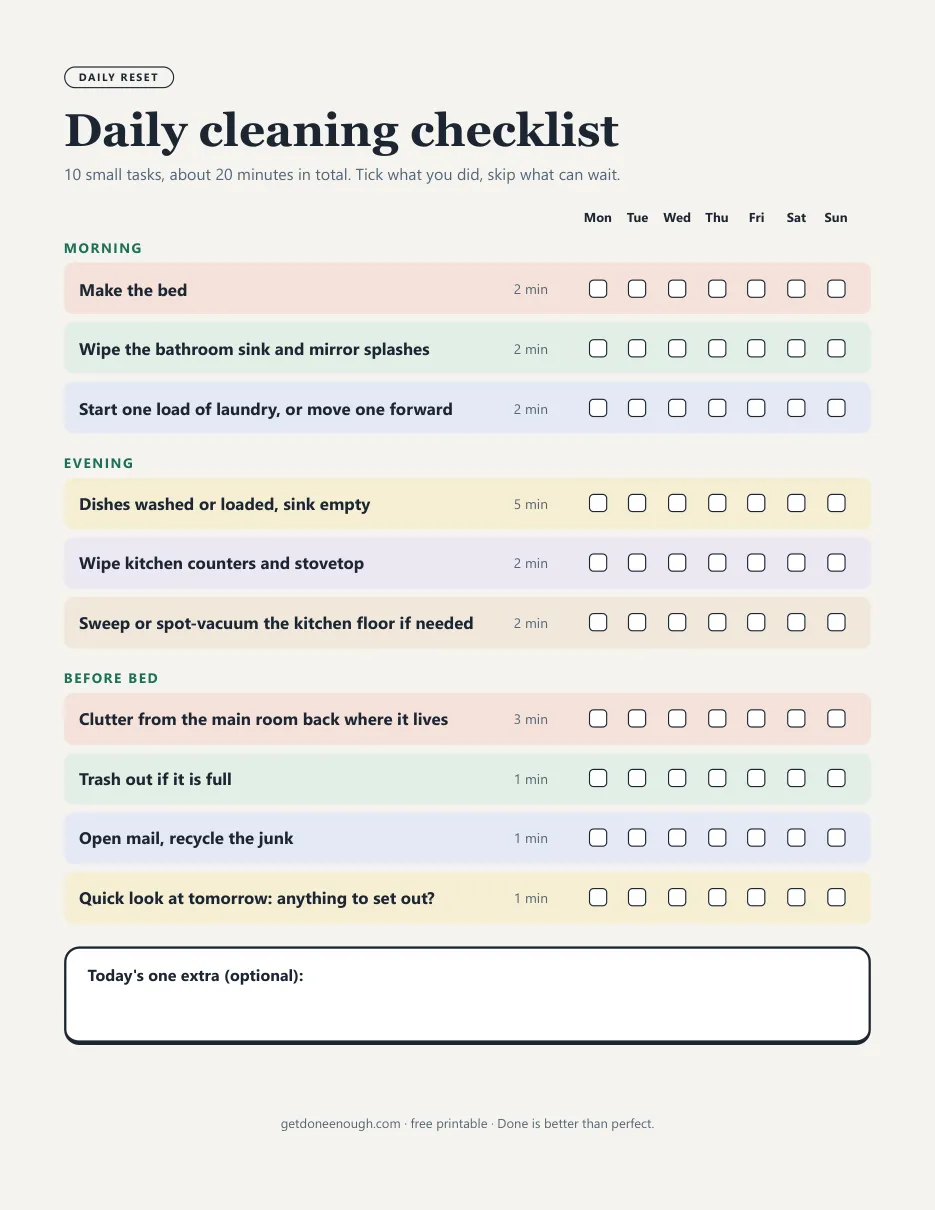
Free PDF: A one-page daily cleaning checklist with a checkbox for each day of the week.
Get the free PDFSee the planner on Etsy
The planner is sold in our own Etsy shop.
In this guide (21 parts)
- What goes on a kitchen cleaning checklist?
- How often should you clean your kitchen?
- Cleaning vs sanitizing vs disinfecting in the kitchen
- The checklist by frequency
- In what order should you clean a kitchen?
- How do you deep clean the kitchen?
- What is the best cleaner for kitchen counters?
- How do you clean a kitchen sink?
- How do you clean kitchen cabinets?
- Cleaning kitchen floors and grout
- Food safety: sponges, cutting boards and the fridge
- Kitchen air: range hood, humidity and cleaning sprays
- Supplies to keep on hand
- Hacks worth using
- How do you keep a kitchen clean every day?
- Quick vs. weekly vs. deep kitchen clean
- If your brain stalls on the kitchen
- How the kitchen fits your week
- Who’s behind Done Enough?
- How we wrote this guide
- Sources
A kitchen deep cleaning checklist splits the kitchen into four layers. Daily: dishes, counters, stovetop and spills. Weekly: microwave, sink, fridge clear-out, appliance fronts and the floor. Monthly: inside the fridge, range hood filter, cabinet fronts and the dishwasher filter. Deep clean, every few months: inside the oven, behind appliances, inside cabinets and the walls.
This checklist for cleaning the kitchen is part of our cleaning schedule and checklist hub. It covers one room in detail: what to clean, how often, in what order, what to clean each surface with, and the food safety steps for sponges, cutting boards and the fridge.
It also explains why each step works, using public health guidance and peer-reviewed studies: the difference between cleaning, sanitizing and disinfecting, how long a disinfectant has to stay wet, what researchers found living in sponges and dishwasher seals, and what the range hood does to the air you breathe. Every number on this page links to the page where we read it.
Tonight's kitchen 0/8 done
| Task | Done | Remove |
|---|---|---|
| Dishes washed or loaded | ||
| Grates and pans soaking | ||
| Counters cleared and wiped | ||
| Stovetop wiped | ||
| Sink scrubbed and dried | ||
| Sponge squeezed and left to dry | ||
| Trash out if full | ||
| Floor swept last |
Saved on this device only. No account.
Use the Print button under the tracker for a paper copy of tonight’s list. For a printable PDF, the free one-page daily checklist (US Letter and A4) is on the weekly cleaning schedule’s free PDF section. There is no separate kitchen-only PDF yet, so the lists below are written to copy or print as they are.
What goes on a kitchen cleaning checklist?
A kitchen cleaning checklist has four layers, each with its own rhythm. Daily tasks stop food from drying on. Weekly tasks reset the appliances, the hand-touched spots and the floor. Monthly tasks catch slow build-up like grease on the hood filter and biofilm on the dishwasher seal. The deep clean, every few months, handles everything you have to empty or move.
| How often | Area | Task |
|---|---|---|
| Daily | Dishes | Wash or load, empty the drying rack |
| Daily | Counters | Clear, then wipe with hot, soapy water |
| Daily | Stovetop | Wipe spills before they bake on |
| Daily | Range hood | Fan on while you cook, vented outdoors if yours is |
| Daily | Table | Clear and wipe after meals |
| Daily | Sink | Rinse, scrub, leave it empty |
| Daily | Sponge | Rinse, squeeze out, stand it up to dry |
| Daily | Floor | Spot-sweep where food fell |
| After raw meat | Board, counter, sink | Clean, then sanitize |
| Weekly | Microwave | Wipe inside and the turntable |
| Weekly | Fridge | Toss old leftovers, wipe spills, check it is at 40°F or below |
| Weekly | Appliances | Wipe fronts and handles |
| Weekly | Touch points | Light switches, knobs, cabinet and drawer pulls, chair backs and seats |
| Weekly | Sink | Scrub basin, faucet and drain area |
| Weekly | Disposal and drain | Strainer or stopper out and scrubbed, splash guard wiped |
| Weekly | Drying rack | Wash the rack and its tray, let it dry empty |
| Weekly | Sponge | Replace it |
| Weekly | Towels and rags | Dish towels, hand towels and cleaning rags into a hot wash |
| Weekly | Floor | Sweep or vacuum, then mop |
| Weekly | Trash | Empty, wipe the lid |
| Monthly | Fridge | Shelves and drawers out, washed, dried |
| Monthly | Range hood | Degrease the filter |
| Monthly | Cabinets | Wipe fronts, handles and knobs |
| Monthly | Small appliances | Toaster crumbs, coffee maker, kettle |
| Monthly | Dishwasher | Clean the filter, wipe the rubber door seal, run a cleaning cycle |
| Monthly | Trash can | Wash the inside |
| Monthly | Tile grout | Scrub the backsplash and floor grout lines |
| Quarterly or seasonal | Windows | Glass, sills and tracks |
| Quarterly or seasonal | Coffee maker | Descale as the maker’s manual says |
| Quarterly or seasonal | Pantry | Check expiry dates, wipe shelves |
| Quarterly or seasonal | Light fixtures | Dust and wipe the fixtures and bulbs, with the power off |
| Every few months | Oven | Clean the inside and racks |
| Every few months | Behind | Pull out the fridge and stove if they move |
| Every few months | Cabinets | Empty, wipe inside, toss expired food |
| Every few months | Walls | Backsplash, walls, light fixtures, vents |
The frequencies are our suggestions for a home kitchen used every day, except the rows that come from a source and are explained in the sections below: cleaning after each food, sanitizing after raw meat, the fridge temperature, the weekly sponge, the hood fan and the dishwasher seal. A kitchen you cook in twice a week can stretch the weekly list to every two weeks. Appliances follow the same split: fronts, handles and the microwave weekly, the fridge and dishwasher insides monthly, the oven every few months.
How often should you clean your kitchen?
How often you clean your kitchen depends on the surface. Counters, cutting boards and utensils get a wash after each food you prepare, which makes them a daily job on any day you cook. The rest follows how fast mess builds up: the floor and microwave weekly, the hood filter monthly.
The CDC advises washing utensils, cutting boards and countertops with hot, soapy water “after preparing each food item” (CDC, November 24, 2025). The CDC also says cleaning alone removes most harmful germs from surfaces, and that disinfecting is mainly needed when someone at home is sick or has a weakened immune system (CDC, January 31, 2025, older). The exception is anything raw meat, poultry or their juices touched, including the inside of the sink: clean it, then sanitize it with a bleach solution or a sanitizing product.
Cleaning vs sanitizing vs disinfecting in the kitchen
Cleaning, sanitizing and disinfecting are three different steps, and a home kitchen needs mostly the first one. The CDC defines them this way: “Cleaning removes most germs, dirt, and impurities from surfaces,” sanitizing “reduces germs to levels public health codes or regulations consider safe,” and “Disinfecting kills most germs” (CDC, January 31, 2025, older). The order matters too: the CDC says to clean surfaces before you sanitize them, and to clean with soap and water before you disinfect, so soap and scrubbing always come first. After raw meat, poultry or their juices, the CDC adds the sanitizing step for the counter, the board and the inner sink. Disinfecting, with an EPA-registered disinfectant or a stronger bleach solution, is mainly for when someone at home is sick or has a weakened immune system.
| Step | What it does (CDC wording) | When a home kitchen needs it | Product | Contact time |
|---|---|---|---|---|
| Cleaning | Removes most germs, dirt and impurities | Counters, boards and utensils after each food | Hot, soapy water and scrubbing | None: scrub, rinse, dry |
| Sanitizing | Reduces germs to levels codes consider safe | After raw meat, poultry or their juices, including the inner sink | Weaker bleach solution or a sanitizing spray | The time on the label |
| Disinfecting | Kills most germs | Someone at home is sick or has a weakened immune system | EPA-registered disinfectant or stronger bleach solution | The time on the label; at least 1 minute for the CDC’s bleach recipe |
Why contact time is the step people skip
Contact time is how long a sanitizer or disinfectant must stay wet on a surface to work, and it is printed in the label’s directions. The CDC tells you to keep the surface wet for that full time (CDC, January 31, 2025, older). For a diluted bleach solution, the CDC says to leave it on “for at least 1 minute before removing or wiping,” with the surface visibly wet the whole time (CDC, April 24, 2024). Spraying and wiping straight away cuts that time short. Our tip: spray the board or counter first, rinse the sink or put the meat away, then come back and wipe. For sanitized items, the CDC says to let them air dry on a clean towel or paper towel rather than rubbing or patting them with a dish towel.
Bleach dilution, and what never to mix with bleach
The CDC’s bleach recipe, for when the bottle gives no directions, is 5 tablespoons (1/3 cup) of bleach per gallon of room temperature water, or 4 teaspoons per quart (CDC, April 24, 2024). The same page says most household bleach contains 5% to 9% sodium hypochlorite, that a mixed solution loses strength after 24 hours so you make a fresh one each day, and to “Never mix household bleach” with any other cleaners or disinfectants, because mixing can release dangerous vapors. That includes vinegar and ammonia: UF/IFAS Extension lists both, along with rubbing alcohol, as things never to mix with bleach (UF/IFAS, page copyright 2024, older).
A 2020 CDC report counted 45,550 calls to US poison centers about cleaners (28,158) and disinfectants (17,392) from January to March 2020, up 20.4% from the same months of 2019, with bleaches making up 62.1% of the rise in cleaner calls (Chang et al., CDC MMWR, April 24, 2020, older). One case in that report happened at a kitchen sink: an adult filled it with a 10% bleach solution, vinegar and hot water to soak groceries, noticed a chlorine-like smell and had trouble breathing, coughing and wheezing.
| Bleach rule | What the CDC says |
|---|---|
| Strength | Household bleach with 5% to 9% sodium hypochlorite |
| Recipe without label directions | 5 tablespoons (1/3 cup) per gallon, or 4 teaspoons per quart, room temperature water |
| Contact time | At least 1 minute, surface visibly wet |
| Shelf life of the mix | Make a new solution daily |
| Mixing | Never with other cleaners or disinfectants, including vinegar or ammonia (UF/IFAS) |
| After use | Wash your hands, store the bottle out of reach of children and pets (CDC, older) |
The 2020 report’s advice matches: read and follow the label, avoid mixing chemical products, use eye and skin protection, ventilate, and store chemicals out of children’s reach. Our tip: keep the bleach bottle and the vinegar bottle on different shelves, so neither ends up in the same sink by accident.
The checklist by frequency
Here is the same kitchen cleaning list, grouped by how often. Times are our estimates for one person in an average home kitchen. Copy them into a note or a spreadsheet if you want to keep them.
Daily kitchen cleaning checklist (about 10-15 min, our estimate)
- ☐ Dishes washed or loaded
- ☐ Counters cleared and wiped
- ☐ Stovetop wiped
- ☐ Table cleared and wiped
- ☐ Sink rinsed and empty
- ☐ Sponge rinsed, squeezed and standing up to dry
- ☐ Range hood fan run while cooking
- ☐ Spills on the floor swept or wiped
Weekly (about 30-40 min, our estimate)
- ☐ Microwave inside and turntable
- ☐ Old leftovers out of the fridge, spills wiped, thermometer at 40°F or below
- ☐ Fridge, dishwasher and oven fronts and handles
- ☐ Light switches, knobs, drawer pulls, chair backs and seats
- ☐ Sink, faucet and drain area scrubbed
- ☐ Garbage disposal splash guard and drain strainer cleaned
- ☐ Drying rack and tray washed
- ☐ New sponge
- ☐ Dish towels, hand towels and rags swapped and washed hot
- ☐ Trash and recycling out, lid wiped
- ☐ Floor swept or vacuumed, then mopped
Monthly (about 45-60 min, our estimate)
- ☐ Fridge shelves and drawers washed and dried
- ☐ Range hood filter degreased
- ☐ Cabinet fronts, handles and knobs
- ☐ Toaster crumbs, coffee maker, kettle
- ☐ Dishwasher filter, rubber door seal wiped, cleaning cycle run
- ☐ Trash can washed inside
- ☐ Tile grout on the backsplash and floor scrubbed
Quarterly or seasonal (about 60 min, our estimate)
- ☐ Windows, sills and tracks
- ☐ Coffee maker descaled, as its manual says
- ☐ Pantry and spice shelf: expired food out, shelves wiped
- ☐ Light fixtures dusted, power off
- ☐ Under the sink: check for drips, wipe the cabinet floor
For the rest of the house, use the daily cleaning checklist.
How long kitchen cleaning really takes
The times above are our estimates. The closest measured number comes from the American Time Use Survey: in 2025, people in the US spent an average of 0.71 hours a day on food preparation and cleanup, and 0.33 hours a day on interior cleaning (BLS, released June 25, 2026). The survey groups cooking and kitchen cleanup together, so it cannot tell you how much of the 0.71 hours is wiping and washing up. The BLS release adds that 66% of people did some food preparation and cleanup on an average weekday and 63% on a weekend day.
| 2025 average, hours per day | All | Men | Women |
|---|---|---|---|
| Food preparation and cleanup | 0.71 (about 43 min) | 0.51 (about 31 min) | 0.91 (about 55 min) |
| Interior cleaning | 0.33 (about 20 min) | 0.20 (about 12 min) | 0.45 (about 27 min) |
Minutes are our conversion of the BLS hours. The gap between women and men is the survey’s own figure, not ours.
In what order should you clean a kitchen?
Clear the room and start things soaking, then work from top to bottom and finish with the floor:
- Clear. Trash out, stray items back to their rooms, counters empty.
- Soak. Burner grates, drip pans and crusted pots go in hot, soapy water.
- Dishes. Load the dishwasher or wash by hand so the sink is free.
- High spots. Top of the fridge and cabinets, hood, light fixture.
- Fronts. Cabinet doors, handles, appliance fronts.
- Counters and stovetop. Wipe, then put back only what lives there.
- Sink. Scrub it last of the surfaces, since everything else drains into it.
- Floor. Sweep or vacuum, then mop toward the door.
Clear and soak come first because soaking does the scrubbing while you work. Top to bottom keeps crumbs off the counters you just wiped, and the floor goes last because everything above it drips or falls onto it.
How do you deep clean the kitchen?
Deep cleaning the kitchen is the full reset you do every few months, or when a weekly clean no longer makes it look clean. Plan on a few hours, or split it across two evenings. The order stays the same as above. The difference is that you empty things before you clean them. Use this table:
| Zone | Deep clean tasks |
|---|---|
| Fridge and freezer | Empty, toss old food, wash shelves and drawers, wipe the door seals, vacuum the coils if you can reach them |
| Oven and stove | Oven interior and racks, under the burners, knobs, the gap beside the stove |
| Range hood | Filter degreased, hood wiped inside and out |
| Cabinets and pantry | Empty one shelf at a time, wipe inside, toss expired food |
| Small appliances | Microwave, toaster, coffee maker, blender base, under each one |
| Dishwasher | Filter, spray arms, door seal, the edge under the door |
| Sink and disposal | Basin, faucet base, drain stopper, under-sink cabinet |
| Walls and fixtures | Backsplash, light switches, light fixtures, vents |
| Floor | Pull out what moves, then sweep, scrub corners and mop |
Follow the label on every product, keep oven cleaner off counters and other surfaces it is not made for, open a window, and never mix products. The CDC’s rule is short: “Do not mix products or chemicals with each other” (CDC, January 31, 2025, older). The same page tells you to ventilate with a fan or open windows and doors, and to wear gloves or goggles when a label calls for them.
To split it into two shorter sessions, our suggestion:
| Session | Tasks | Time (our estimate) |
|---|---|---|
| Evening 1 | Fridge and freezer, cabinets and pantry, small appliances | about 75 min |
| Evening 2 | Oven, hood, dishwasher, sink, walls, floor | about 75 min |
How long does it take to deep clean a kitchen? About 2 to 3 hours for one person in our estimate, more if the oven has not been cleaned in a long time or the cabinets are full. The whole-house deep clean guide puts the kitchen into a room-by-room weekend plan.
The fastest way to deep clean a kitchen is to start the slow jobs first and let them work while you do the rest: grates and drip pans soaking, an oven cleaner or self-clean cycle running if your oven’s manual allows it, and the dishwasher running its cleaning cycle. Then go top to bottom, floor last, so nothing falls on a surface you already cleaned. Contact time is the one step you cannot rush: a sanitizer that is wiped off early has not had its labeled time on the surface (see the contact time section above). For a quick reset instead of a full deep clean, the speed cleaning guide has a timed routine.
What is the best cleaner for kitchen counters?
The best kitchen counter cleaner for everyday use is hot, soapy water, which is what the CDC advises for countertops after preparing each food item (CDC, November 24, 2025). Wiping with it, then drying, covers most days.
After raw meat, poultry or their juices, clean first, then sanitize with a product suitable for that surface, used the way its label says (CDC, January 31, 2025, older). When cleaning kitchen counters made of natural stone, the wrong cleaner can leave marks.
| Countertop | Everyday clean | Avoid | Source |
|---|---|---|---|
| Granite | Neutral cleaner, stone soap or mild dish detergent with warm water | Acidic cleaners such as vinegar or lemon, scouring powders | Natural Stone Institute |
| Marble, limestone, travertine | Neutral cleaner, stone soap or mild dish detergent with warm water | Lemon, vinegar and other acids, which can dull or etch these stones; scouring powders | Natural Stone Institute |
| Laminate, quartz, solid surface, wood | Warm, soapy water on a soft cloth | Whatever the maker’s care guide rules out | Our tip |
The institute’s consumer site adds that daily wipes on granite should use a neutral cleaner, that soap can leave a film that dulls or streaks the surface, and that most granites should be sealed (Use Natural Stone, February 26, 2018, older).
For a kitchen cleaner spray, our tip is a bottle of warm water with a few drops of dish soap. If you mix your own, UF/IFAS Extension advises labeling the bottle, never storing a cleaner in a food container, and keeping it out of children’s reach (UF/IFAS, page copyright 2024, older). A store-bought spray works too if its label lists your counter material.
How do you clean a kitchen sink?
To clean a kitchen sink, wash it with dish soap or a mild detergent on the soft side of a sponge, rinse it, and dry it with a cloth. Whether you need a stronger kitchen sink cleaner depends on what the sink is made of, and the makers’ care guides differ mostly on what to avoid.
| Sink | Everyday clean | Avoid | Source |
|---|---|---|---|
| Stainless steel | Damp soft cloth and detergent, rinse, dry after each use | Bleach, silver cleaners, acids, chlorine, the rough side of a sponge | Franke |
| Porcelain enamel, enameled cast iron | A non-abrasive cleaner on a soft cloth (our tip); for metal marks, a soft cloth or cork with a cast iron cleaner | Abrasive cleaners; rubber dish mats, which can let bacteria permanently discolor the enamel | Kohler |
| Granite composite | Dish soap on the soft side of a sponge in small circles, rinse, dry with microfiber (Blanco) | Concentrated bleach and chlorine products, acids such as kettle descalers, oven cleaners, caustic drain cleaners (Franke) | Blanco, Franke |
A special stainless steel kitchen sink cleaner is optional. Franke says most stains on stainless steel are water deposits, and that drying the sink after each use prevents them. If you buy a porcelain kitchen sink cleaner, check the label for anything gritty: Kohler’s page says “Abrasive cleaners are not recommended.” When cleaning granite composite kitchen sinks with limescale, Franke suggests 1 part vinegar to 3 parts water, left for several hours or overnight, then cleaned off with a sponge. Before you buy a cleaner for a composite sink, read your own sink maker’s guide, since composite materials differ from brand to brand (our tip). If raw meat or its juices touched the sink, clean it, then sanitize it, as in the CDC guidance above.
Cleaning a kitchen drain
Cleaning a kitchen sink drain starts with keeping grease out of it. Clemson Cooperative Extension says never to pour cooking oil or grease down the drain, because it cools and hardens in the pipes and can cause backups, and running hot water with soap after it does not stop it from hardening further down (Clemson Extension, June 3, 2020, older). Pour it into a can or jar, cap it, let it cool and put it in the trash. Wipe greasy pans with a paper towel before you wash them.
Each week, our tip: lift out the strainer basket or stopper, scrub it and the drain opening with dish soap and an old brush, and rinse. If the sink still drains slowly after that, the clog is further down the pipe and a plumber is the next step. Franke lists caustic drain cleaners among the products that damage its composite sinks, so check your sink’s care guide before you pour one in.
Garbage disposal, drying rack and trash bin
Three items sit around the sink and rarely make a checklist, so we gave each its own line on the weekly or monthly list. Our tips:
| Item | How to clean it | How often |
|---|---|---|
| Garbage disposal | Power off at the switch first, never put a hand inside; scrub the rubber splash guard with dish soap and a brush, rinse; follow the maker’s manual for anything more | Weekly |
| Drying rack and tray | Empty it, wash the rack and the drip tray in hot, soapy water, let them dry before dishes go back | Weekly |
| Trash bin | Lid wiped weekly; inside washed with hot, soapy water monthly, dried before a new bag goes in | Weekly lid, monthly inside |
Grease is the one rule here that comes from a source: it goes in a can, not down the drain, as Clemson Extension explains above. The disposal empties into that same drain, so the rule covers it too (our note).
How do you clean kitchen cabinets?
To clean kitchen cabinets, wipe spills with a damp cloth and dry them right away with a lint-free cotton cloth. For residue, KraftMaid’s care guide suggests warm water with a non-detergent, non-abrasive household cleaner (KraftMaid, December 9, 2021, older).
The guide also suggests a weekly wipe-down in a busy kitchen, with extra attention to cabinets exposed to grease and moisture. On our lists above, cabinet doors and handles are a monthly task. Move the doors beside the stove to the weekly list if they get greasy (our suggestion).
The same guide lists what to keep off cabinet finishes: harsh detergents, abrasive or powdered cleaners, scouring pads, wax polishes, petroleum solvents and silicones. It also says not to drape damp dish towels over the sink-base doors.
| Cabinet finish | Clean with | Skip | Source |
|---|---|---|---|
| Wood | Damp cloth for spills; warm water and a non-detergent, non-abrasive cleaner for residue; dry with a lint-free cotton cloth | Wax polishes, silicones, petroleum solvents, scouring pads | KraftMaid (older) |
| Painted | The same gentle routine, dried right after | Harsh detergents, abrasive or powdered cleaners | KraftMaid (older), our tip |
| White | Same as painted, with handles and doors near the stove wiped more often | Same as painted | Our tip |
Going by KraftMaid’s guide, the best cleaner for wood kitchen cabinets is that gentle routine. It adds that the topcoat on its own cabinets means they never need polishing, so skip any kitchen cabinet cleaner and polish that lists wax or silicone. Test any new product inside a door first (our tip).
Cleaning grease off kitchen cabinets
Work from mild to strong. Start with warm water and the non-detergent cleaner above, and wipe a second time before reaching for anything harsher. If the film stays, pick a degreaser whose label says it is safe for your finish, test it inside a door, follow the label, then wipe with clean water and dry (our tip). In our view, the best cleaner for greasy kitchen cabinets is the mildest one that lifts the film, since KraftMaid warns against harsh detergents and abrasive cleaners on cabinet finishes.
On the backsplash, the stovetop and the outside of the range hood, hot, soapy water works best while the grease is fresh (our tip). Used cooking oil goes in a can and then the trash, never down the drain (see Cleaning a kitchen drain above).
Cleaning kitchen cabinets with TSP (and before painting)
TSP (trisodium phosphate) is a heavy-duty cleaner. Savogran, which makes one, says its TSP is preferred by painting and cleaning professionals for removing heavy deposits of greasy grime, smoke and soot from walls, woodwork and floors (Savogran, page undated). In our view, that makes TSP cleaner for kitchen cabinets mainly a step before a paint job. Mix and rinse exactly as the box says. Our tip: test it inside a door first, and let the doors dry fully before you sand or prime.
For routine cleaning, the gentle routine above is the better choice (our tip). Savogran’s safety data sheet lists TSP as an eye and skin irritant that may cause burns, calls for protective gloves and eye protection, and notes that it reacts with acids (Savogran safety data sheet, revision date not legible in our copy). Our tip: never mix it with vinegar or another acid, and keep the powder and the bucket away from children and pets.
Cleaning kitchen floors and grout
Floors take two steps: sweep or vacuum first to pick up crumbs and grit, then mop with a cleaner that suits the floor. UF/IFAS Extension’s guide to homemade household cleaners gives these mixes (UF/IFAS, page copyright 2024, older), and the Natural Stone Institute covers stone.
| Floor | Mop with | Watch out for | Source |
|---|---|---|---|
| Vinyl | 1 cup white vinegar in 1 gallon of warm water | UF/IFAS (older) | |
| Ceramic tile | 1/4 cup white vinegar in 1 gallon of water | UF/IFAS (older) | |
| Wood | A barely damp mop, with the cleaner on the mop | Wood floors should never get overly wet; never pour cleaner straight onto the floor | UF/IFAS (older) |
| Natural stone | Neutral cleaner or stone soap | Vinegar, lemon and other acids, which can dull or etch stone | Natural Stone Institute |
For cleaning grout on kitchen floor tiles, our tip is a paste of baking soda and water scrubbed in with a stiff brush, then a rinse with plain water and a dry towel. On a stone floor, check the stone’s care guidance before you scrub anything into the grout. Mop toward the door so you never stand on the wet part.
Touch points: switches, knobs, handles and chairs
Light switches, stove knobs, fridge and drawer handles and the backs of chairs get touched with hands that were just handling food, which is why they get their own weekly line (our reasoning). The CDC says to clean high-touch surfaces regularly and after visitors, with soap or detergent and scrubbing, using a product that suits the surface (CDC, January 31, 2025, older). Our tips: spray the cloth, not the switch plate, so liquid never runs into the wiring; pull stove knobs off if they come off, and wash them in the sink; wipe chair seats and backs with the same soapy cloth, then dry. Light fixtures go on the quarterly list, with the power off and the bulb cool.
Food safety: sponges, cutting boards and the fridge
The sponge, the dishwasher, the cutting boards and the fridge each get their own rule, drawn from the CDC, the FDA, the USDA or a published study. This table sums up what researchers measured in four kitchen items; the sections below explain each one and what it changes on the checklist.
| Kitchen item | What was studied | Finding | What it changes |
|---|---|---|---|
| Used kitchen sponges | 14 sponges, Germany, DNA and microscopy | Bacteria at local densities up to 5.4 × 10¹⁰ cells per cm³ (2017 study) | Replace weekly, let it dry daily |
| Dishwasher rubber seals | 24 home dishwashers, Slovenia | Candida yeasts in 100%, Escherichia/Shigella in 62% (2018 study) | Wipe the seal monthly |
| Plastic cutting boards | Microplastics released by chopping | An estimated 7.4 to 50.7 g a year per person from a polyethylene board (2023 study) | Replace deeply scarred boards |
| Washing raw chicken | Participants in a USDA study | 26% of those who washed raw poultry got its bacteria into their salad (USDA, 2019) | Do not wash raw poultry; sanitize the sink after raw meat |
None of these findings means that people got sick. Finding a germ group, or particles, measures what is present, not who falls ill (our reading of the methods). Treat them as reasons for the habits in the last column.
Sponges and dish cloths
A 2017 study in Scientific Reports, by researchers in Germany, analyzed 14 used kitchen sponges. Five of the ten most common bacteria groups they found were closely related to “risk group 2” species, which the authors say suggests some pathogenic potential, while noting that this relatedness is only a weak indicator. Under the microscope, bacteria were spread through the whole sponge, reaching local densities of up to 5.4 × 10¹⁰ cells per cubic centimeter. The authors also found that two of the dominant bacteria made up a larger share in sponges their users said they regularly sanitized, which led them to question sanitizing as a long-term fix, a point they called careful speculation that needs controlled experiments. They called kitchen sponges microbiological hot spots that can collect and spread bacteria, and suggested replacing them regularly, “for example, on a weekly basis” (Cardinale et al., 2017, older).
Our tips:
- Replace the sponge weekly, as the study suggests.
- Keep one sponge for dishes only, and use a separate cloth or paper towel for raw meat juices and the floor.
- Squeeze it out and stand it upright to dry, out of the puddle by the sink.
- Swap dish towels for clean ones each week, as on the weekly list, and wash them hot.
Some checklists tell you to disinfect the sponge every day. The 2017 study is the reason we lean on replacing it instead: the two dominant bacteria it found made up a larger share in sponges their users said they regularly sanitized, and the authors questioned sanitizing as a long-term fix. A daily rinse, squeeze and dry costs nothing, and a weekly new sponge is the step with evidence behind it.
Dish towels, hand towels and rags
Dish towels, hand towels and cleaning rags are three different jobs, and the checklist treats them as their own item. Our tips: one towel for drying clean dishes, one for drying hands, and rags or paper towels for spills, raw meat juices and the floor, each washed hot and swapped weekly or sooner when damp or dirty. The CDC gives one rule that backs this split: after you sanitize an item, let it air dry on a clean towel or paper towel, and do not rub or pat it dry with a dish towel (CDC, January 31, 2025, older). KraftMaid adds a cabinet reason: do not leave damp towels draped over the sink-base doors (see the cabinet section).
The dishwasher door seal
A dishwasher is hot and wet, yet a 2018 study in Applied and Environmental Microbiology sampled the rubber seals of 24 household dishwashers in Slovenia, 21 of which gave sequence data. Candida yeasts were in 100% of the dishwashers, Rhodotorula in 90%, Cryptococcus in 86%, Pseudomonas in 67% and Escherichia/Shigella in 62% (Raghupathi et al., 2018, older). The seal is where the study sampled, because it stays damp between cycles while the rest of the machine drains. The communities differed with the dishwasher’s age, how often it ran and the hardness of the incoming tap water, and several genera include known opportunistic pathogens. Presence is not proof of risk: the study measured what lives on the seal, not whether it reached dishes or people. On the monthly list, that becomes three steps: pull and rinse the filter, wipe the rubber door seal and the edge under the door with a soapy cloth, and run the cleaning cycle or cleaner your dishwasher’s manual names (our tips).
Cutting boards and utensils
The CDC advises one cutting board or plate for raw meat, poultry and seafood, and a different one for produce, bread and other foods that won’t be cooked (CDC, November 24, 2025). Wash both with hot, soapy water after each food. After raw meat, clean the board, then sanitize it with a bleach solution or a sanitizing product, as the CDC recommends for any surface raw meat juices touched (CDC, January 31, 2025, older). Our tip: when a board has deep grooves you can’t scrub clean, replace it.
Utensils follow the same rule: hot, soapy water after each food item, and a wash before a knife or spoon that touched raw meat goes near anything else. The same CDC page notes that a dishwasher’s sanitizing cycle can sanitize some items.
Plastic boards also shed plastic as you cut. A 2023 study in Environmental Science & Technology estimated that one person could release 7.4 to 50.7 grams of microplastics a year from a polyethylene board, or 14.5 to 71.9 million particles, and 49.5 grams (79.4 million particles) from a polypropylene board (Yadav et al., 2023, older). Polypropylene released 5% to 60% more mass and 14% to 71% more particles than polyethylene. In a preliminary test in the same study, the polyethylene particles did not reduce the viability of mouse cells over 72 hours, so this is a measure of what wears off, not proof of harm. Our tip: a deeply scored plastic board is one more reason to replace it.
Do not wash raw chicken in the sink. In a 2019 USDA study, 26% of participants who washed raw poultry then transferred its bacteria to their salads, and the USDA’s advice was plain: “Not washing meat and poultry reduces your risk of cross-contamination” (The Poultry Site, reporting the USDA study, August 22, 2019, older). Cooking it to a safe temperature is what kills the bacteria.
The fridge
The FDA says to keep the refrigerator at or below 40°F (4°C) and the freezer at 0°F (-18°C), to “clean the refrigerator regularly and wipe spills immediately,” and to throw out anything that looks or smells suspicious (FDA, January 18, 2023, older). The CDC adds that perishable food and cooked leftovers go in the fridge within 2 hours, or within 1 hour above 90°F (CDC, November 24, 2025).
| Fridge task | When | Source |
|---|---|---|
| Wipe spills, such as drips from thawing meat | Right away | FDA (older) |
| Check the fridge is at 40°F or below | At least once a week, with an appliance thermometer | FDA (older) |
| Toss food that looks or smells off | Whenever you find it; weekly clear-out on our lists (our suggestion) | FDA (older) |
| Wash shelves and drawers | Monthly | Our suggestion |
| Leftovers into the fridge | Within 2 hours (1 hour above 90°F) | CDC |
Kitchen air: range hood, humidity and cleaning sprays
Running the range hood while you cook is the air-quality habit with the clearest evidence on this page. A 2026 Lawrence Berkeley National Laboratory study of 4,184 cooking events found nitrogen dioxide (NO2) about 45 percent higher when no range hood was used, and the lowest pollutant levels when the hood ran for more than half of the cooking time (Fang et al., LBNL, 2026). Fine particles (PM2.5) were about the same with or without the hood in that data; the authors say this may reflect limited hood effect on particles, or hoods being switched on mainly for heavier cooking. A 2024 Stanford study in Science Advances measured gas stoves in more than 100 homes and estimated they raise long-term NO2 exposure by about 4 parts per billion, three-quarters of the WHO outdoor guideline, with bedroom levels passing health benchmarks within an hour of stove use (ScienceDaily, May 3, 2024, older). Homes under 800 square feet got about twice the national average exposure. Those are modeled estimates. The researchers found that burn rate mattered most, followed by whether the home had an effective hood and whether it was used, and that hoods did not fully prevent spikes.
| Air habit | What the source found | Source |
|---|---|---|
| Hood on for most of the cooking | NO2 about 45% higher with no hood; lowest levels with the hood on for more than half the cooking time | LBNL, 2026 |
| Hood on with a gas stove | About 4 ppb more long-term NO2; twice the average in homes under 800 sq ft (modeled) | Stanford, 2024 (older) |
| Vent steam outside | Cooking and washing dishes raise humidity; keep it below 60%, ideally 30% to 50% | EPA, 2026 |
| Fewer, fragrance-free sprays | 30 products emitted 530 VOCs, 193 of them hazardous | Temkin et al., 2023 (older) |
| Microfiber and water for routine wipes | Women who cleaned regularly lost lung function faster | Svanes et al., 2018 (older) |
Humidity, mold and the hood filter
Kitchen humidity matters because damp surfaces feed mold. The EPA says cooking and washing dishes can raise indoor humidity, recommends using the stove’s exhaust hood and venting moisture outside, and advises keeping indoor humidity below 60%, ideally between 30% and 50% (EPA, Mold House Tour, updated September 8, 2026). A hood can only pull air through a clean filter, which is why the hood filter sits on the monthly list. Our tip: leave the hood running a few minutes after you turn off the burners, while steam is still in the air.
Cleaning sprays and your lungs
Cleaning sprays add their own chemicals to kitchen air. A 2023 study in Chemosphere tested 30 cleaning products and found 530 volatile organic compounds (VOCs), 193 of which are classed as hazardous; green, fragrance-free products emitted nearly eight times fewer VOCs than conventional ones (Technology Networks, September 14, 2023, older). A 2018 study in the American Journal of Respiratory and Critical Care Medicine followed 6,235 people for more than 20 years: women who cleaned at home lost lung function 3.6 ml a year faster than women who did not, and professional cleaners 3.9 ml faster (ScienceDaily, February 16, 2018, older). The study was observational and found no link in men, so it shows an association, not proof that sprays caused the decline. One of its authors said “microfiber cloths and water are more than enough for most purposes.” Our suggestion: keep a spray for raw-meat surfaces, and use soap, water and a cloth for the rest.
Supplies to keep on hand
The kitchen cleaning supplies list can stay short, because dish soap and hot water handle most of the daily work. Here is what the sources on this page call for, and what each item is for.
| Supply | Used for | Source |
|---|---|---|
| Dish soap | Dishes, counters, sinks, stovetop grease | CDC; Franke, Blanco |
| Sponges, soft cloths, microfiber | Dishes (sponge, swapped weekly), counters, drying sinks | Cardinale et al. (older); Blanco |
| Sanitizer (a sanitizing product or bleach solution) | Boards, counters and sink after raw meat, used as the label says | CDC (older) |
| Baking soda | Inside the fridge, dried-on spots | UF/IFAS (older) |
| White vinegar | Vinyl and ceramic tile floors, limescale on composite sinks, never on stone | UF/IFAS (older), Franke, Natural Stone Institute |
| Neutral stone cleaner | Granite and marble counters or floors | Natural Stone Institute |
| Non-detergent, non-abrasive household cleaner | Cabinet residue | KraftMaid (older) |
| Degreaser | Range hood filter, greasy cabinet doors, as the label says | Our tip |
| Broom or vacuum, mop, scrub brush | Floor, grout, drain strainer | Our tip |
| Gloves and eye protection | Strong products such as TSP | Savogran safety data sheet |
| Fridge thermometer | Checking the fridge stays at 40°F or below | FDA (older) |
One all-purpose kitchen and bathroom cleaner can cover both rooms if its label lists the surfaces in each. Keep separate cloths for each room, so a cloth that wiped the toilet never touches a counter (our tip). Whatever cleaner you use, UF/IFAS Extension’s rule holds: never mix bleach with ammonia, vinegar, rubbing alcohol or any other cleaner. The bathroom cleaning checklist covers the other room.
Hacks worth using
The kitchen cleaning hacks worth keeping are small habits that stop mess from setting in. Each one below comes from a source on this page or is marked as our tip.
| Hack | Why it helps | Source |
|---|---|---|
| Soak grates, drip pans and crusted pots first | The water loosens food while you clean everything else | Our tip |
| Wipe greasy pans with a paper towel before washing | The grease ends up in the trash instead of the drain | Clemson Extension (older) |
| Dry a stainless steel sink after use | Most marks on stainless steel are dried water deposits | Franke |
| Keep damp dish towels off the sink-base doors | KraftMaid lists damp towels draped there as a don’t | KraftMaid (older) |
| Wash the inside of the fridge with baking soda and warm water | UF/IFAS gives this recipe for fridge shelves and walls | UF/IFAS (older) |
| Label every spray bottle you mix yourself | Nobody grabs the wrong bottle, and it stays out of food containers | UF/IFAS (older) |
Where baking soda helps
Baking soda for kitchen cleaning is most useful inside the fridge and on dried-on spots. UF/IFAS Extension’s recipe for the fridge is 2 tablespoons of baking soda dissolved in 1 quart of warm water, with a little dry baking soda rubbed on any hard spots (UF/IFAS, page copyright 2024, older). The same guide says to wash with soap and rinse before you sanitize with diluted bleach, keeping the soap and the bleach as separate steps.
How do you keep a kitchen clean every day?
Keeping a kitchen clean is mostly a matter of a short reset after the last meal, so food never has a night to dry on. The daily cleaning checklist puts this reset in the evening slot of a whole-house routine. For the kitchen itself, these habits do most of the work:
- Clean as you cook: wipe a spill while the pan heats, rinse bowls while something simmers.
- Leave the sink empty before bed, so the morning starts with a clear sink.
- Wipe the stovetop while it is still a little warm (not hot), when splatters come off with less scrubbing. Our tip.
- Give mail and bags a landing spot away from the counter.
- Keep fewer things on the counter, since less to move means you actually wipe. The kitchen decluttering guide covers what to clear out first.
- Take the trash out when it is full, before it overflows.
The 5-5-5 version for a tired night, our suggestion: set a 5-minute timer, put 5 things away, wipe 5 surfaces (counter, stovetop, table, sink, one appliance front). Stop when the timer rings.
Quick vs. weekly vs. deep kitchen clean
The three cleans differ in how long they take and how much they reach:
| Compare | Quick reset | Weekly clean | Deep clean |
|---|---|---|---|
| Time (our estimate) | about 10-15 min | about 30 min | a few hours |
| When | After the last meal | Once a week | Every few months |
| Tasks | Dishes, counters, stovetop, sink | Microwave, fridge clear-out, fronts, floor | Inside oven, fridge, cabinets, behind appliances |
| Goal | No food left out | Appliances and floor reset | Build-up removed |
If your brain stalls on the kitchen
Start with one physical move, like running hot water into the sink, then set a 10-minute timer for dishes only (our tip). The ADHD cleaning checklist breaks every room into short steps, and the daily checklist’s ADHD section has more tips.
Two research findings back the one-small-move start, though neither study was about ADHD or kitchens. A 2025 review of 642 tests found that “if-then” plans, such as “if I finish dinner, then I run hot water into the sink,” had small to medium effects on reaching goals (d = .27 to .66), with larger effects when people were motivated and rehearsed the plan (Sheeran, Listrom and Gollwitzer, 2025). A 2025 study found no memory advantage for unfinished tasks, but a general tendency to resume a task once started (Ghibellini and Meier, 2025).
How the kitchen fits your week
Each list is easier to keep when it has a fixed slot (our tip). Copy this kitchen cleaning schedule template, or move the days to fit your week:
| When | Kitchen tasks | List on this page |
|---|---|---|
| Every day you cook | Dishes, counters, stovetop, sink, spills | Daily |
| Once a week (Monday on our schedule) | Microwave, fridge clear-out, fronts, sink scrub, floor | Weekly |
| Week 1 of each month | Fridge shelves, hood filter, cabinet fronts, small appliances, dishwasher filter | Monthly |
| Every few months | Inside the oven, behind appliances, inside cabinets, walls | How do you deep clean the kitchen? |
To make a slot stick, write it as an if-then plan, the format the 2025 review above found most effective: “If it is Monday after dinner, then I do the weekly kitchen list.” On the weekly cleaning schedule, the kitchen gets Monday. The inside of the fridge and the hood filter also sit in week 1 of the monthly cleaning schedule. For how the kitchen fits with every other room, see the house cleaning checklist. Running a commercial kitchen? See the restaurant kitchen cleaning checklist.
The cleaning planner mentioned on this page is sold in our own Etsy shop, Done Enough. Full disclosure: that’s us.
Who’s behind Done Enough?
Done Enough is a small independent shop, not a clinic. We build free planning tools and sell printables on Etsy. We are not professional cleaners or clinicians: each guide links its sources so you can check every claim, and our own tips are marked as suggestions.
How we wrote this guide
On October 24, 2026 we checked US search data in Semrush for the questions people ask about cleaning a kitchen, read the Google US results for “kitchen deep cleaning checklist” and “kitchen cleaning checklist,” and read two of the ranking checklists to see what they covered.
We then read the CDC and FDA pages and the sponge study listed below, the Clemson and UF/IFAS extension pages on grease and homemade cleaners, the Natural Stone Institute’s care pages, the care guides of the sink and cabinet makers listed, and the maker’s product page and safety data sheet for a TSP product. Frequencies and times marked “our estimate” or “our suggestion” are ours, not measurements. Sources older than 12 months are marked “older,” and pages that show no date are marked “page undated.” No organization or brand listed here endorses our shop.
On October 25, 2026 we added the science layer: the CDC’s bleach and disinfection pages, the CDC’s 2020 report on poison center calls, the Bureau of Labor Statistics time-use survey, studies on dishwasher seals, cutting-board microplastics, range hoods, gas stoves, cleaning-product emissions and cleaners’ lung function, the EPA’s mold guidance, a USDA study on washing raw chicken, and two 2025 papers on planning and resuming tasks. Where we read a study through a news summary or a database record rather than the full paper, the source line says so. We could not verify a current extension source on kitchen pest prevention, so this page does not give pest advice.
Sources
Twenty-nine sources, read October 24 and 25, 2026.
- CDC (2025). Food Safety: Prevention. Page dated November 24, 2025. https://www.cdc.gov/food-safety/prevention/index.html
- CDC (2025). When and How to Clean and Disinfect Your Home. Page dated January 31, 2025. https://www.cdc.gov/hygiene/about/when-and-how-to-clean-and-disinfect-your-home.html Older than 12 months.
- FDA (2023). Are You Storing Food Safely? Content current as of January 18, 2023. https://www.fda.gov/consumers/consumer-updates/are-you-storing-food-safely Older than 12 months.
- Cardinale M, Kaiser D, Lueders T, Schnell S, Egert M (2017). Microbiome analysis and confocal microscopy of used kitchen sponges reveal massive colonization by Acinetobacter, Moraxella and Chryseobacterium species. Scientific Reports 7:5791. https://pubmed.ncbi.nlm.nih.gov/28725026/ Older than 12 months.
- O’Shields SM (2020). Kitchen Fats, Oils, and Grease: Pour It, Cap It, Cool It, Trash It. Clemson Cooperative Extension, Home and Garden Information Center. Page dated June 3, 2020. https://hgic.clemson.edu/kitchen-fats-oils-and-grease-pour-it-cap-it-cool-it-trash-it/ Older than 12 months.
- Griffin and Cantrell. Homemade Household Cleaners (FCS3319). UF/IFAS Extension. The page shows no revision date, only a 2024 copyright. https://ask.ifas.ufl.edu/publication/FY1449 Older than 12 months.
- Natural Stone Institute. Care and cleaning for consumers. Page undated. https://www.naturalstoneinstitute.org/consumers/care/
- Vozza S (2018). How to Care For Your Granite Countertops. Use Natural Stone (Natural Stone Institute). Page dated February 26, 2018. https://usenaturalstone.org/caring-for-granite/ Older than 12 months.
- Kohler. Enameled Cast Iron Sink Care. Page undated. https://assist.kohler.com/en/sinks/Enameled-Cast-Iron-Sink-Care
- Franke. How to clean stainless steel. Page undated. https://www.franke.com/us/en/home-solutions/support/resources/how-to-clean/how-to-clean-stainless-steel.html
- Franke. How to clean Fragranite. Page undated. https://www.franke.com/us/en/home-solutions/support/resources/how-to-clean/how-to-clean-fragranite.html
- Blanco. SILGRANIT sink care. Page undated. https://www.blanco.com/us/sinks/cleaning-and-care/silgranit-sink-care/
- KraftMaid (2021). Dos and Don’ts of Kitchen Cabinet Cleaning and Care. Posted December 9, 2021. https://www.kraftmaid.com/kraftmaid/dos-and-donts-of-kitchen-cabinet-cleaning Older than 12 months.
- Savogran. Trisodium Phosphate (TSP) Safety Data Sheet. Revision date not legible in the copy we read. https://www.savogran.com/pdfs/TSP_MS.pdf
- Savogran. Heavy Duty Cleaners: Trisodium Phosphate TSP. Page undated. https://www.savogran.com/heavy-duty-cleaning.html
- CDC (2024). Cleaning and Disinfecting with Bleach. Page dated April 24, 2024. https://www.cdc.gov/hygiene/about/cleaning-and-disinfecting-with-bleach.html Older than 12 months.
- CDC (2020). Report on cleaner and disinfectant exposure calls to US poison centers. MMWR 69(16). https://www.cdc.gov/mmwr/volumes/69/wr/mm6916e1.htm Older than 12 months.
- US Food and Drug Administration. Food Code 2026. Content current as of September 30, 2026. https://www.fda.gov/food/fda-food-code/food-code-2026
- Bureau of Labor Statistics (2026). American Time Use Survey, 2025 results. Released June 25, 2026. https://www.bls.gov/news.release/atus.nr0.htm
- Raghupathi et al. (2018). Study of fungal and bacterial communities on household dishwasher rubber seals. Applied and Environmental Microbiology. https://pmc.ncbi.nlm.nih.gov/articles/PMC5812945/ Older than 12 months.
- Yadav et al. (2023). Study of microplastics released by plastic cutting boards. Environmental Science & Technology 57(22):8225-8235. https://doi.org/10.1021/acs.est.3c00924 Older than 12 months.
- The Poultry Site (2019). Report on a USDA study of washing raw poultry. August 22, 2019. https://www.thepoultrysite.com/news/2019/08/how-26-percent-of-participants-transferred-bacteria-from-raw-chicken-to-their-salads Older than 12 months.
- Fang et al. (2026). Range hood use and effectiveness. Lawrence Berkeley National Laboratory, E3S Web of Conferences vol. 716. Listed as 06/09/2026. https://eta-publications.lbl.gov/publications/range-hood-use-and-effectiveness
- ScienceDaily (2024). Report on a Stanford study of gas stoves and nitrogen dioxide, Science Advances. May 3, 2024. https://www.sciencedaily.com/releases/2024/05/240503172624.htm Older than 12 months.
- EPA. Mold House Tour (text version). Updated September 8, 2026. https://www.epa.gov/mold/text-version-mold-house-tour
- Technology Networks (2023). Report on Temkin et al., Chemosphere, DOI 10.1016/j.chemosphere.2023.139570. September 14, 2023. https://www.technologynetworks.com/applied-sciences/news/cleaning-products-emit-hundreds-of-hazardous-volatile-chemicals-378814 Older than 12 months.
- ScienceDaily (2018). Report on Svanes et al., American Journal of Respiratory and Critical Care Medicine. February 16, 2018. https://www.sciencedaily.com/releases/2018/02/180216084912.htm Older than 12 months.
- Sheeran P, Listrom O, Gollwitzer PM (2025). Meta-analysis of if-then planning (implementation intentions). European Review of Social Psychology 36(1):162-194. https://kops.uni-konstanz.de/handle/123456789/69905
- Ghibellini and Meier (2025). Study of unfinished tasks, memory and task resumption. Humanities and Social Sciences Communications 12. https://ideas.repec.org/a/pal/palcom/v12y2025i1d10.1057_s41599-025-05000-w.html
FAQ
What are the five steps in cleaning kitchen premises?
A five-step order built from CDC and UF/IFAS Extension guidance: 1) clear food scraps and clutter, 2) wash with hot, soapy water, 3) rinse off the soap, 4) sanitize surfaces raw meat, poultry or their juices touched, keeping them wet for the contact time on the label (at least 1 minute for the CDC's bleach recipe), 5) let sanitized items air dry instead of rubbing them with a dish towel.
What is the fastest way to deep clean a kitchen?
Start the slow jobs first and let them run while you work: grates and drip pans soaking, the dishwasher running. Then go top to bottom and finish with the floor, so nothing falls on a surface you already cleaned. Splitting the deep clean into two evenings of about 75 minutes each is our suggestion when one long session will not happen.
How do professionals clean kitchens?
US commercial kitchens follow the FDA Food Code, whose current edition is the 2026 Food Code, and work from a written cleaning schedule. For a home kitchen, the CDC's guidance uses the same basic logic: clean with soap first, sanitize after raw meat, keep the surface wet for the label's contact time, and never mix products. Our restaurant kitchen checklist covers the commercial rules.
What are the 7 steps to cleaning a kitchen?
To get seven from the eight steps on this page, fold soaking into the dishes step, since both start at the sink (our suggestion). That leaves clear, dishes, high spots, fronts, counters and stovetop, sink, floor. Whatever the count, keep the logic: start the soak early, work top to bottom, floor last.
What is the 5-5-5 rule for cleaning?
On this page, the 5-5-5 rule is a short kitchen reset we suggest: set a 5-minute timer, put 5 things away and wipe 5 surfaces, such as the counter, stovetop, table, sink and one appliance front. Stop when the timer rings.
What should be cleaned monthly in a kitchen?
Monthly kitchen tasks are the ones that build up slowly: inside the fridge, the range hood filter, cabinet fronts and handles, small appliances, the dishwasher filter and the trash can itself. Inside the oven and behind the fridge can wait for a deep clean every few months.
What is the best cleaner for kitchen cabinets?
Your cabinet maker's care guide comes first, since finishes differ (our tip). Without one, use the mildest option that works: warm water with a non-detergent, non-abrasive household cleaner, then dry. KraftMaid says its topcoated cabinets never need polishing, so a wax or silicone polish adds nothing there.
How do you clean a kitchen sink drain?
Keep grease out first: Clemson Cooperative Extension says never to pour cooking oil or grease down the drain, since it hardens in the pipes. Each week, lift out the strainer or stopper, scrub it and the drain opening with dish soap and a brush, and rinse. A drain that still runs slow needs a plumber.