Cleaning
A cleaning schedule for working parents that fits around the job
Updated · Written by the Done Enough team · Sources linked below
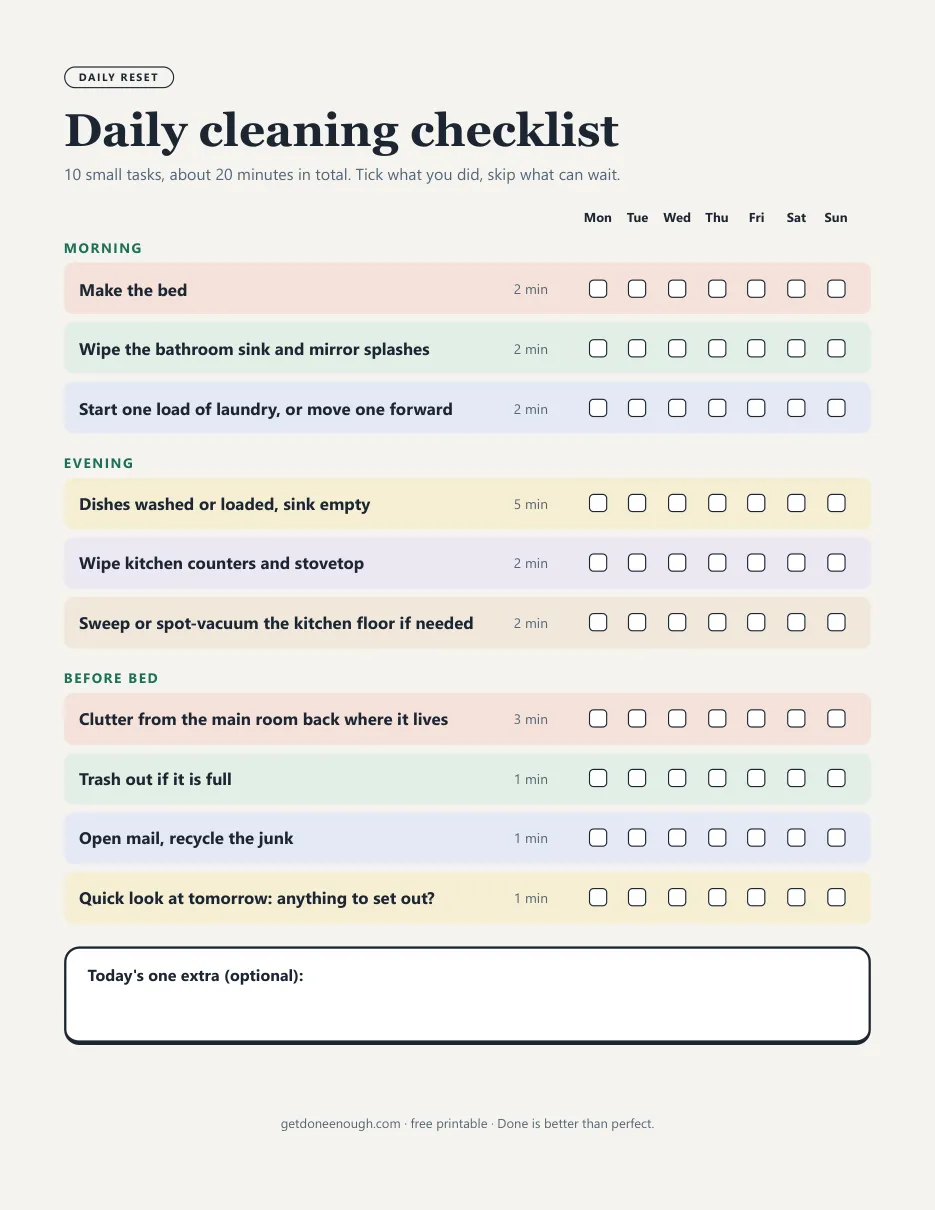
Free PDF: A one-page daily cleaning checklist with a checkbox for each day of the week.
Get the free PDFSee the planner on Etsy
The planner is sold in our own Etsy shop.
In this guide (20 parts)
- How much time do working parents spend on housework?
- What is a good weekly cleaning schedule for working parents?
- Daily, weekly and monthly: the three cleaning tiers
- Pick the version that matches your hours
- Before work, after work, bedtime: three short slots
- Working from home: build slack for unpredictable days
- If one parent stays home
- Why a fixed schedule sticks: the science of if-then plans
- How to keep your house clean: the daily chores that matter most
- Clean, sanitize or disinfect? What the agencies say
- Safety: cleaning products, indoor air and kids
- Moisture, mold and dust: why bathrooms and floors get a weekly slot
- How do you do house chores quickly?
- What is the 20/10 rule for cleaning?
- Kids’ jobs by age
- How do two working parents split the cleaning?
- When the week falls apart
- Who’s behind Done Enough?
- How we wrote this guide
- Sources
A cleaning schedule for working parents works best when it is built around the time you actually have: a 15 to 20 minute reset on weeknights, one longer block on the weekend, and jobs handed to the kids by age. Weeknights cover dishes, counters, a quick pickup and one small zone. The weekend covers laundry, floors, bathrooms and whatever got skipped.
It is part of our cleaning schedule and checklist guide. If you want every daily task listed room by room, see the daily cleaning checklist.
Tonight's 20 minutes 0/7 done
| Task | Done | Remove |
|---|---|---|
| Dishes loaded or washed | ||
| Kitchen counters and table wiped | ||
| 10-minute pickup of the main room | ||
| One laundry load moved forward | ||
| Zone: Mon kitchen, Tue bathrooms, Wed floors, Thu bedrooms | ||
| Kids: their own job done | ||
| Lunch bags and backpacks ready |
Saved on this device only. No account.
How much time do working parents spend on housework?
In the 2025 American Time Use Survey, adults living with children under 18 who were employed spent 1.7 hours a day on household activities, against 3.1 hours for those who were not employed. The survey, published by the Bureau of Labor Statistics on June 25, 2026, covers people age 15 and over in the US.
Household activities in the survey include housework, cooking, lawn care and household management, so the 1.7 hours covers more than cleaning. Across everyone surveyed, 81 percent did some household activity on an average day. More people did housework on weekend days than on weekdays (40 percent against 35 percent), which matches the plan below: short weeknights, a longer weekend block. The BLS notes that survey operations were suspended from October 1 to November 12, 2025, during a federal shutdown, and says it is not possible to quantify the effect on the estimates (BLS, June 2026).
| What the 2025 American Time Use Survey found | Figure |
|---|---|
| Employed adults living with children under 18, household activities per day | 1.7 hours |
| Not-employed adults living with children under 18, household activities per day | 3.1 hours |
| People age 15 and over doing some household activity on an average day | 81% |
| Women / men doing some household activity on an average day | 87% / 75% |
| Time on household activities, on days they did them: women / men | 2.8 / 2.1 hours |
| People doing housework on weekend days / weekdays | 40% / 35% |
| Adults with children under 6, primary childcare per day | 2.3 hours |
| Adults with children under 6 caring for and helping household children per day: not employed / employed | 3.3 / 1.7 hours |
Source for every row: BLS American Time Use Survey, 2025 results, released June 25, 2026.
Housework versus kitchen work: where the minutes go
The American Time Use Survey splits cleaning into two lines, and the split explains why this schedule protects the kitchen first. In 2025, “housework” took 0.56 hours a day averaged over all Americans age 15 and over, but only 36.1 percent did any on a given day. “Food preparation and cleanup” took 0.71 hours a day, and 65.2 percent did it daily. Kitchen work is the job that comes back every day for most homes, while the rest of the house can wait for its turn (BLS ATUS Table 1, 2026).
| 2025 ATUS, people age 15 and over | Total | Women | Men |
|---|---|---|---|
| Housework, hours per day (everyone) | 0.56 | 0.81 | 0.30 |
| Share doing housework on an average day | 36.1% | 47.9% | 23.8% |
| Housework, hours on days people did it | 1.55 | 1.69 | 1.25 |
| Food preparation and cleanup, hours per day | 0.71 | 0.91 | 0.51 |
| Share doing food preparation and cleanup on an average day | 65.2% | 72.2% | 57.9% |
Source: BLS American Time Use Survey, Table 1, 2025 annual averages.
The gap holds even when both partners earn the same. A 2023 Pew Research Center analysis found that in marriages where husband and wife earn about the same, wives spent 4.6 hours a week on housework against about 2 hours for husbands, and 6.9 hours on caregiving against about 5 (Pew Research Center, 2023). A written split, covered further down, is one way to make the load visible.
What is a good weekly cleaning schedule for working parents?
A good weekly cleaning schedule for working parents keeps every weeknight to one small zone of about 10 minutes, added to a 10-minute daily reset, and moves the bigger jobs to one weekend block. Monday to Thursday each get one zone, and Friday is left light.
Saturday gets about an hour of laundry, bathrooms and floors, and Sunday is a 20-minute reset for the week ahead. The weeknight total stays near 20 minutes, which fits after dinner or after the kids are in bed. Times here are our estimates for a home that is already fairly tidy, so expect more during the first two weeks. A skipped zone waits for Saturday instead of doubling the next evening, so one late meeting or a sick kid does not wreck the week.
| Day | Daily reset (about 10 min) | Zone (about 10 min) | Who can help |
|---|---|---|---|
| Monday | Dishes, counters, pickup | Kitchen: stovetop, microwave, old fridge food out | Kids clear and wipe the table |
| Tuesday | Dishes, counters, pickup | Bathrooms: toilet, sink, mirror | Older kids wipe their sink |
| Wednesday | Dishes, counters, pickup | Floors: vacuum the main rooms | Kids clear the floor first |
| Thursday | Dishes, counters, pickup | Bedrooms: clothes away, nightstands cleared | Kids do their own room |
| Friday | Dishes and trash only | Nothing. Rest night | Everyone off |
| Saturday | Dishes, counters | About 60 min: sheets and towels washed, showers scrubbed, kitchen and bathroom floors mopped, catch-up | Whole family, one job each |
| Sunday | Dishes, counters | About 20 min: trash out, laundry folded, look at next week’s calendar | Kids pack bags for Monday |
Minutes are our estimates. For a version that gives every day of the week its own zone with no weekend block, see the weekly cleaning schedule.
Why a weekend cleaning block frees weeknights
A weekend cleaning block works for working parents because the slow, wet jobs (mopping, scrubbing showers, washing sheets) need drying time and a free afternoon, which weeknights rarely have. The 2025 American Time Use Survey shows the same pattern in real homes: 40 percent of people did housework on weekend days against 35 percent on weekdays (BLS, June 2026). Putting those jobs in one Saturday slot keeps each weeknight to a reset and one dry zone. It also gives the plan a built-in buffer: anything skipped during the week has a fixed place to land, so there is no reason to double up on a tired Wednesday. If Saturday mornings are taken by sports or errands, the block can move to Sunday or split into two 30-minute halves; what matters is having one fixed weekend slot, whichever day it falls on (our suggestion).
Daily, weekly and monthly: the three cleaning tiers
A cleaning schedule for working parents has three tiers: daily tasks that stop mess from piling up, weekly zones that rotate through the house, and a short monthly list for the jobs that only need doing about 12 times a year. Most free schedules stop at weekly, which is why the oven and the fridge shelves end up as a weekend-long project.
| Tier | What goes in it | When it happens |
|---|---|---|
| Daily (10 min) | Dishes, counters and table, a pickup, one laundry load moved forward | Every evening reset |
| Weekly (10 min a zone) | Kitchen surfaces, bathrooms, floors, bedrooms, sheets and towels | One zone per weeknight, the rest on Saturday |
| Monthly (about 30 min, one item per week) | See the list below | The first Saturday of each week in the month takes one item |
The monthly list, one item per Saturday so the block never grows past an hour (our suggestions):
- Week 1: wipe the inside of the fridge and toss old condiments; wipe the microwave inside.
- Week 2: declutter one hot spot (the entry, the kitchen counter or one closet).
- Week 3: dust blinds, vents and ceiling fan blades; wash the bathroom fan cover.
- Week 4: vacuum under the sofa and beds; wash pillows or throw blankets.
For the full room-by-room version of these bigger jobs, use the deep cleaning guide for the whole house once or twice a year and let the monthly list keep it from slipping.
Pick the version that matches your hours
Not every job leaves the same evenings free. Choose the row closest to your week and ignore the rest.
| Your situation | Weeknights | Weekend | Total per week (our estimate) |
|---|---|---|---|
| Office hours, kids at home | 15-20 min after dinner | 60 min Saturday, 20 min Sunday | About 2.5 to 3 hours |
| Long commute, very little evening time | 10 min (dishes and counters only) | 90 min Saturday, split in 20-minute rounds | About 2.5 hours |
| Working from home | 5 min at lunch + 10 min in the evening | 45 min Saturday | About 2.5 hours |
| Shift work or rotating schedule | Daily reset only on work days | Two zones on each day off | Varies; aim for 2 to 3 hours |
| Two working adults | 10 min each, split by zone | 30 min each on Saturday | About 2.5 to 3 hours, shared |
| One parent at home full time | 30-45 min Monday to Thursday, in daytime slots (see the stay-at-home mom cleaning schedule below) | 60 min Saturday, shared if there is a second adult | About 3 to 4 hours |
If even the shortest row feels like too much this month, keep only dishes and counters on weeknights. A clean kitchen changes how the whole house feels in the morning (our tip).
Before work, after work, bedtime: three short slots
These slots work the same for a working mom or a working dad. Split the day into three windows of 5 to 10 minutes each and give each one a fixed job, so cleaning fits into the gaps you already have instead of needing a free evening.
Before work (5 minutes):
- Unload the dishwasher or the drying rack while breakfast cooks.
- Start a laundry load, or set the washer’s delay timer the night before.
- Make the beds, or let kids old enough do their own.
Right after work (5 minutes):
- Shoes, bags and coats go to one landing spot by the door.
- Mail sorted over the recycling bin.
- Lunch boxes emptied into the sink.
After dinner or after bedtime (10 to 15 minutes):
- Dishes loaded, counters and table wiped.
- Tonight’s zone from the weekly table.
- A 10-minute pickup of the main room, with the kids if they are still up.
If the morning slot gets skipped, the evening reset catches what was missed (our tip).
Working from home: build slack for unpredictable days
A cleaning schedule for a work-from-home parent needs slack, because remote days are less predictable than office days: a call runs over, a sick child stays home, or lunch disappears. The fix is to plan less than the hours seem to allow and keep a fallback for each slot (our suggestions).
| Slot | Plan A (normal day) | Plan B (bad day) |
|---|---|---|
| Before the first call | Unload the dishwasher, start laundry | Start laundry only |
| Lunch break | 5 minutes: wipe the kitchen counter, move laundry forward | Skip; laundry waits for the evening |
| End of the workday | Close the laptop, 5-minute pickup of the work corner | Close the laptop |
| Evening | Daily reset plus tonight’s zone | Dishes and counters only |
Two habits help here. First, keep cleaning out of paid work hours unless you are on a real break, so the house never competes with a deadline. Second, leave one weeknight a week empty on purpose; when a day goes wrong, that zone moves to the empty night rather than to Saturday (our tips).
If one parent stays home
A stay-at-home mom house cleaning schedule uses the same weekly zones as the table above and moves them into daytime slots that follow the kids’ day: a short reset after breakfast, the day’s zone during nap or quiet time, and a pickup before dinner. The same plan works for a stay-at-home dad.
A day at home fills up with childcare as well as housework. In the 2025 American Time Use Survey, adults living with children under 18 who were not employed spent 3.1 hours a day on household activities, a total that also counts cooking, lawn care and household management. Among adults living with a child under 6, those who were not employed spent 3.3 hours a day caring for and helping household children (BLS, June 2026). The plan below keeps cleaning to about 30 to 45 minutes a day from Monday to Thursday (our estimate), so it leaves room for meals, errands and the kids.
| Slot | What to do | About how long (our estimate) |
|---|---|---|
| After breakfast | Dishes, counters, beds made, a laundry load started | 10-15 min |
| Nap or quiet time | Today’s zone from the weekly table | 10-20 min |
| Before dinner | 10-minute pickup with the kids, laundry moved forward | 10 min |
| Friday | Dishes and trash only | 5 min |
| Saturday | Sheets, showers and mopping, shared with the other adult if there is one | About 60 min |
If the kids no longer nap, give the zone the first half hour after school drop-off or a set screen-time slot. Keep Friday as the light day from the main plan too (our tips).
Why a fixed schedule sticks: the science of if-then plans
A fixed cleaning schedule works because it turns a vague intention (“clean more”) into an if-then plan: “If it is Monday after dinner, then I wipe the stovetop.” Psychologists call this an implementation intention. A 2025 meta-analysis by Sheeran, Listrom and Gollwitzer pooled 642 independent tests and found effects from d = .27 to .66, with larger effects when plans used the if-then format, when people were highly motivated, and when plans were rehearsed (Sheeran et al., European Review of Social Psychology, 2025). A day-and-zone table is an if-then plan written down for the whole family.
The same approach works with children. A 2026 meta-analysis of 42 studies and 12,957 children found a “small-to-medium effect” (Hedges’ g = 0.31), stronger in younger children and, in some analyses, in children with ADHD (Breitwieser and Reinelt, British Journal of Psychology, 2026). That is a finding about plans in general, not a cleaning study or a treatment, but it supports giving each child one job tied to one moment, such as “after dinner, I clear my plate.”
| Vague goal | If-then version for this schedule |
|---|---|
| Keep the kitchen clean | If the dishwasher finishes, then I unload it before breakfast |
| Do more laundry | If it is my laundry day, then a load starts before I leave for work |
| Kids help more | If dinner is over, then each child does their one job before screens |
| Catch up on mess | If a zone gets skipped, then it moves to Saturday |
Why stopping at the timer is fine
Stopping a zone when the timer rings, with the job half done, sounds like it would nag at you all evening. A 2025 meta-analysis by Ghibellini and Meier “found no memory advantage for unfinished tasks” (the Zeigarnik effect), but did find a general tendency to resume interrupted tasks, known as the Ovsiankina effect (Ghibellini and Meier, Humanities and Social Sciences Communications, 2025). In practice: stop when the time is up, write the leftover on the Saturday line, and trust that people tend to come back to what they started.
How to keep your house clean: the daily chores that matter most
Some daily chores stop mess from compounding and others can wait. When time is short, do the first group and drop the second without guilt.
| Do daily | Can wait for its weekly day |
|---|---|
| Dishes done or loaded | Dusting |
| Kitchen counters and table wiped | Mopping |
| Food spills wiped while fresh | Changing sheets |
| One laundry load moved forward | Scrubbing the shower |
| 10-minute pickup of the main room | Wiping cabinet fronts and appliances |
| Trash out when full | Sorting the fridge |
You can skip disinfecting most days. The CDC says “cleaning alone removes most harmful viruses or bacteria from surfaces,” and it points to disinfecting when someone at home is sick or has a weakened immune system (CDC, January 2025, older). The same page says to clean countertops with hot, soapy water and to sanitize surfaces that raw meat, poultry or their juices have touched. Always follow product labels and never mix cleaners.
Lower the bar: choose what matters most
A working parent’s cleaning schedule has to lower the standard on purpose. With employed parents averaging 1.7 hours a day on all household activities, including cooking and household management (BLS, June 2026), something has to give. Pick the two or three things that change how your home feels to you, often the kitchen counter, a clear entry and clean sheets, and hold those to a high standard. Everything else gets “good enough”: a quick vacuum of the paths people walk instead of under every chair, towels folded once instead of perfectly. Agree on a written minimum for bad nights (dishes and counters, for example) so nobody has to argue about it at 9 pm (our suggestions).
Clean, sanitize or disinfect? What the agencies say
Cleaning, sanitizing and disinfecting are three different jobs, and a weeknight schedule mostly needs the first one. The EPA defines cleaning as removing dirt and organic matter with soap or detergent, sanitizing as using chemicals to kill bacteria on surfaces (it is not intended to kill viruses), and disinfecting as killing both viruses and bacteria. For sanitizers and disinfectants, the EPA says to watch the contact time, “how long the surface must remain wet” for the product to work, which is printed on the label (EPA, updated October 2026). A disinfectant sprayed and wiped dry straight away may not reach its label claim. That is why the speed tip below says to spray first and wipe last.
| Job | What it does (EPA) | When this schedule uses it |
|---|---|---|
| Clean | Removes dirt and organic matter with soap or detergent | Every evening reset, every zone |
| Sanitize | Kills bacteria on surfaces; not for viruses | Boards and counters after raw meat, poultry or seafood |
| Disinfect | Kills viruses and bacteria; surface stays wet for the label contact time | When someone at home is sick (CDC guidance) |
Sources: EPA, 2026; CDC, 2025.
The CDC’s food safety page adds the kitchen rules that fit the daily reset: wash utensils, cutting boards and countertops with hot, soapy water after preparing each food item, keep one cutting board or plate for raw meat, poultry and seafood, and wash hands “for at least 20 seconds with soap and warm or cold water” (CDC, November 2025).
The kitchen sponge problem
The kitchen sponge is one of the most crowded places in a home, and cleaning it does not seem to fix that. A 2017 study in Scientific Reports analyzed 14 used kitchen sponges and measured local bacterial densities of up to 54 billion cells per cubic centimeter. Sponges that their owners regularly sanitized did not contain fewer bacteria than uncleaned ones, and two groups of bacteria related to potential pathogens were relatively more common in the sanitized sponges; the authors call their explanation for this speculative. They suggest “a regular (and easily affordable) replacement of kitchen sponges,” for example weekly, and say this needs controlled testing (Cardinale et al., Scientific Reports, 2017). For this schedule, that means a fresh sponge on a fixed day, such as Sunday’s reset, rather than microwaving the old one.
Safety: cleaning products, indoor air and kids
Household cleaning products are a real safety issue in homes with young children, so where they are stored matters as much as how often you clean. In the 2024 report of the National Poison Data System, household cleaning substances were the top exposure category for children age 5 and under, at 9.96 percent of exposures in that age group, and second across all ages at 6.94 percent, out of 2,092,689 human exposures reported to US poison centers (Clinical Toxicology, December 2025). Earlier, a 2020 CDC report counted 45,550 calls to poison centers about cleaners and disinfectants from January to March 2020, up 20.4 percent from the same months of 2019, with bleach accounting for 62.1 percent of the rise in cleaner calls (CDC MMWR, 2020).
| Safety rule | Source |
|---|---|
| Do not mix products or chemicals with each other | CDC, 2025 |
| Never mix household care products unless the label says so | EPA, 2026 |
| Increase ventilation when using products that release VOCs | EPA, 2026 |
| Keep products out of reach of children and pets | CDC, 2025; EPA, 2026 |
| Follow label instructions carefully | EPA, 2026 |
The 2020 CDC report includes a case that shows why the mixing rule exists: a woman soaked groceries in a mix of a bleach solution, vinegar and hot water, then had trouble breathing and was treated in an emergency department (CDC MMWR, 2020).
Cleaning sprays and breathing
Frequent use of cleaning sprays has been linked to poorer lung health in observational studies, which is one more reason to keep weeknight cleaning light on products. A 2018 study of 6,235 people followed for about 20 years in the European Community Respiratory Health Survey found that lung function (FEV1) fell by 22.1 ml a year in women who cleaned at home, against 18.5 ml a year in women who did not clean, close to the 22.4 ml seen in occupational cleaners (Svanes et al., American Journal of Respiratory and Critical Care Medicine, 2018). A 2026 cross-sectional study of 318 adults in Melbourne found that heavy users of many products each week, “especially bleach, sprays, polish, solvents, acids,” had higher odds of current asthma than minimal users (odds ratio 3.24) and lower lung function scores (Dai et al., Environmental Science and Pollution Research, 2026). Both studies show links, not proof that cleaning causes lung damage, and neither is advice for anyone with a lung condition; talk to a clinician about your own case. For this schedule, our practical take is fewer products: hot soapy water for most jobs, a disinfectant only when needed, a window open or fan on, and cleaner sprayed onto the cloth instead of into the air (our suggestions, not tested in these studies).
Moisture, mold and dust: why bathrooms and floors get a weekly slot
Bathrooms and floors get their own weekly zones because moisture and dust build up on a weekly timescale, not a monthly one. The EPA advises keeping indoor relative humidity below 60 percent, ideally between 30 and 50 percent, running the bathroom fan or opening a window while showering, and drying water-damaged areas and items within 24 to 48 hours to prevent mold growth (EPA mold guide, updated February 2026). That fits the Tuesday bathroom zone: wipe the shower walls, hang the bath mat to dry, and check that the fan runs.
Household dust also carries chemicals. A 2016 meta-analysis of US indoor dust studies pooled 45 chemicals from consumer products across five classes, including phthalates, flame retardants and fragrances, and found that phthalates “occurred in the highest concentrations” (Mitro et al., Environmental Science and Technology, 2016). The study measured what is in dust, not how cleaning changes exposure, but it is a reasonable argument for the Wednesday floors zone and for dusting with a damp cloth so dust is picked up rather than moved around (our suggestion).
| Zone | What the evidence says | What to do in 10 minutes |
|---|---|---|
| Kitchen (Monday) | Sponges hold dense bacteria; wash boards and counters with hot soapy water after each food (Cardinale 2017; CDC 2025) | Wipe the stovetop and counters, swap the sponge on its day |
| Bathrooms (Tuesday) | Keep humidity below 60%, ventilate while showering (EPA 2026) | Wipe the sink and toilet, dry the shower, run the fan |
| Floors (Wednesday) | Dust carries consumer product chemicals (Mitro 2016) | Vacuum the main rooms, damp-dust one surface |
| Bedrooms (Thursday) | No source used here; the zone is for clutter, not germs | Clothes away, nightstands cleared |
How do you do house chores quickly?
To do house chores quickly, cut the walking and set a time limit. Keep one caddy with a spray cleaner, cloths, a scrub brush and trash bags, and carry it from room to room so you never walk back for supplies.
Spray the bathroom or stovetop first and let the product sit while you tidy, because a soaked surface needs less scrubbing. Work top to bottom and dry before wet, so dust never lands on a floor you already cleaned. Batch the same motion across rooms, such as wiping every counter in a row. Set a timer for the slot you have and stop when it rings, even if a task is half done; the rest waits for Saturday or for that zone’s next turn. For the guests-in-30-minutes version of this, our speed cleaning plan has a room-by-room order and a caddy list.
Small habits that save evening minutes (our tips):
- Clean as you cook: wipe the counter while the pan heats.
- Keep one basket per floor for things that live somewhere else. Empty it once a day.
- Leave fewer things out, since a clear counter takes seconds to wipe.
- Give each person a fixed laundry day so it never becomes a mountain.
Group tasks by day or by zone
Grouping cleaning tasks by day or by zone saves time because each evening has one place and one set of supplies. A zone schedule (kitchen Monday, bathrooms Tuesday) suits homes where one adult cleans most nights. A task schedule (all wiping Monday, all vacuuming Wednesday) suits homes where two adults split by job type. Pick one and keep it for a month before judging it (our suggestion).
Laundry day per person
A laundry day per person means each member of the house, or each child’s room, has one fixed day when their load is washed, dried and put away. It turns a weekend pile into one load a day. A family of four can cover Monday to Thursday, with sheets and towels on Saturday. Teens can run their own day from start to finish (our suggestions).
Declutter once to clean faster every night
Decluttering saves cleaning time because every object on a surface has to be lifted, moved and put back before that surface can be wiped. Clearing the kitchen counter down to what you use daily turns a 5-minute wipe into a 1-minute one (our estimate). Put one declutter item on the monthly list, and start with the kitchen, using our kitchen decluttering guide if the counters are the problem.
What is the 20/10 rule for cleaning?
The 20/10 rule is a timer method: 20 minutes of cleaning, then a 10-minute break, repeated as many rounds as the job needs. It works well for working parents on the weekend, when the Saturday block looks long. Three rounds cover the 60-minute Saturday plan above with two real breaks in between.
On weeknights, one 20-minute round is the whole evening. The break is part of the rule: sit down, drink something, and start the next round when the timer ends. The 20/10 rule is a rule of thumb, and we found no study behind it; how it fits this plan is our suggestion.
Kids’ jobs by age
A house cleaning schedule for family homes gives each child one daily job in the evening reset and one weekly job in the Saturday block, matched to their age, while the adults split the zones between them (see the next section).
The full lists by age are in our guide to chore chart ideas by age; here is how they plug into this plan.
| Age | Daily job in the evening reset | Weekly job in the Saturday block |
|---|---|---|
| 2 to 3 | Toys into one bin, with you | Hand you socks to pair |
| 4 to 5 | Clear their plate, shoes to the door spot | Dust low shelves with a sock on the hand |
| 6 to 8 | Set or clear the table, pack their lunch box | Match socks, sort recycling |
| 9 to 12 | Load or unload the dishwasher, wipe the table | Vacuum one room, wipe their bathroom sink |
| 13 and up | Dishes start to finish on their night | Their own laundry, one bathroom |
These pairings are our suggestions. Start with one job per child and add a second only when the first is happening most days without reminders. Keep cleaning products themselves with the adults for young children, given the poison center figures above.
There is some evidence that chores help children beyond the clean kitchen. A 2022 study of 207 parents of children aged 5 to 13 found that self-care chores (such as making a meal for oneself) and family-care chores (such as making a meal for someone else) predicted better working memory and inhibition, after allowing for age, gender and disability, while pet-care chores showed no link (Tepper, Howell and Bennett, Australian Occupational Therapy Journal, 2022). It is a parent-report study that shows an association, not proof that chores build these skills.
How do two working parents split the cleaning?
Our tip is to split by zone. One adult owns the kitchen and floors, the other owns bathrooms and laundry, and each does their zone on its night. Ownership means nobody has to ask or remind; the person who owns a zone also decides when it is clean enough.
Owning a zone also means doing the planning for it. In a 2019 study in the American Sociological Review, sociologist Daminger interviewed 70 people in 35 couples and described four types of cognitive labor in running a home: anticipation, identification, decision-making and monitoring. Women did more of this work in 26 of the 32 heterosexual couples (JSTOR Daily summary of Daminger, 2019 study). Applied to this schedule, the adult who owns bathrooms also notices when the cleaner runs low, decides when the shower needs more than a wipe, and checks the kids’ sink job.
| Cognitive step (Daminger 2019) | What it looks like for the bathroom zone |
|---|---|
| Anticipation | Knowing guests come Saturday, so the bathroom gets done Friday |
| Identification | Listing what is needed: new sponge, toilet cleaner |
| Decision-making | Choosing the product and the day |
| Monitoring | Checking the job got done, including the kids’ part |
Put the schedule where everyone can see it
A visible schedule on the fridge or a whiteboard by the door does part of the monitoring for you, because nobody has to remember whose night it is. Write the weekly table, each child’s job and the laundry days in one place, and tick boxes as jobs get done (our suggestion). A printable or a whiteboard both work; what matters is that it sits where the family passes every day.
Questions worth settling once, so they do not come up every night:
- Who does dishes on nights one adult works late?
- Does the person who cooks also clean up, or the other one?
- What is the minimum that counts as done on a bad night?
Swap zones every month or two if one side ends up heavier.
When the week falls apart
Some weeks a late meeting or a sick child takes out two or three evenings. Plan for that instead of starting over each Monday. These are our suggestions:
- Spend a few minutes on tonight’s zone rather than none. A short version still counts.
- Move a skipped zone to Saturday. Never put two zones on one weeknight.
- On the worst nights, do dishes and counters only.
- On Sunday, look at the calendar, mark the nights that are already lost, and move those zones to Saturday ahead of time.
- If someone at home is sick, this is the week to disinfect the shared surfaces they touch, following the label contact time (CDC, 2025).
If you stall before you even start, put tonight’s zone on the task wheel with two easier options and do what it lands on.
Who’s behind Done Enough?
Done Enough is a small independent shop, not a clinic. We build free planning tools and sell printables on Etsy. We are not professional cleaners or clinicians: each guide links its sources so you can check every claim, and our own tips are marked as suggestions.
How we wrote this guide
On October 24, 2026, we checked US search questions in Semrush and read the Google US results for “cleaning schedule for working parents”, including three of the top-ranking pages, to see what they cover and what they leave out. On October 25, 2026, we read the Bureau of Labor Statistics time-use tables, EPA and CDC guidance pages, the 2024 National Poison Data System report, and the peer-reviewed studies listed below, using the abstracts or full text of each.
Times and splits marked “our estimate” or “our tip” are our own suggestions, not measurements. Studies older than 12 months carry their year in the text. Observational studies are described as links, not causes. No organization listed here endorses our shop.
Sources
Nineteen sources are cited on this page.
- U.S. Bureau of Labor Statistics (2026). American Time Use Survey, 2025 Results. Released June 25, 2026. https://www.bls.gov/news.release/atus.nr0.htm Read October 24, 2026.
- U.S. Bureau of Labor Statistics (2026). American Time Use Survey, Table 1: Time spent in primary activities, 2025 annual averages. https://www.bls.gov/news.release/atus.t01.htm Read October 25, 2026.
- Pew Research Center (2023). In a growing share of U.S. marriages, husbands and wives earn about the same. April 13, 2023. https://www.pewresearch.org/social-trends/2023/04/13/in-a-growing-share-of-u-s-marriages-husbands-and-wives-earn-about-the-same/ Older than 12 months.
- Daminger (2019). Study of cognitive household labor, American Sociological Review 84(4). Summary read at JSTOR Daily: https://daily.jstor.org/the-gendered-labor-of-noticing-and-anticipating Older than 12 months.
- CDC (2025). When and How to Clean and Disinfect Your Home. Page dated January 31, 2025. https://www.cdc.gov/hygiene/about/when-and-how-to-clean-and-disinfect-your-home.html Older than 12 months. Read October 24, 2026.
- CDC (2025). Preventing Food Poisoning. Page dated November 24, 2025. https://www.cdc.gov/food-safety/prevention/index.html
- U.S. EPA (2026). What’s the difference between products that disinfect, sanitize, and clean surfaces? Updated October 8, 2026. https://www.epa.gov/coronavirus/whats-difference-between-products-disinfect-sanitize-and-clean-surfaces
- U.S. EPA (2026). Volatile Organic Compounds’ Impact on Indoor Air Quality. Updated June 23, 2026. https://www.epa.gov/indoor-air-quality-iaq/volatile-organic-compounds-impact-indoor-air-quality
- U.S. EPA (2026). A Brief Guide to Mold, Moisture and Your Home. Updated February 18, 2026. https://www.epa.gov/mold/brief-guide-mold-moisture-and-your-home
- Cardinale et al. (2017). Study of 14 used kitchen sponges. Scientific Reports 7:5791. https://pmc.ncbi.nlm.nih.gov/articles/PMC5517580 Older than 12 months.
- America’s Poison Centers (2025). 2024 Annual Report of the National Poison Data System: 42nd annual report. Clinical Toxicology 63(12). https://doi.org/10.1080/15563650.2025.2571299
- CDC (2020). Report on cleaner and disinfectant exposure calls to poison centers, January to March 2020. MMWR 69(16). https://www.cdc.gov/mmwr/volumes/69/wr/mm6916e1.htm Older than 12 months.
- Svanes et al. (2018). Study of cleaning and lung function decline, European Community Respiratory Health Survey. American Journal of Respiratory and Critical Care Medicine. PMID 29451393. https://doi.org/10.1164/rccm.201706-1311OC Older than 12 months.
- Dai et al. (2026). Cleaning products and classes associated with poor respiratory health. Environmental Science and Pollution Research 33(12). PMID 41870713. https://pmc.ncbi.nlm.nih.gov/articles/PMC13091884/
- Mitro et al. (2016). Consumer Product Chemicals in Indoor Dust: A Quantitative Meta-analysis of U.S. Studies. Environmental Science and Technology 50(19). https://doi.org/10.1021/acs.est.6b02023 Older than 12 months.
- Tepper, Howell, Bennett (2022). Study of household chores and executive function in children aged 5 to 13. Australian Occupational Therapy Journal 69(5). https://doi.org/10.1111/1440-1630.12822 Older than 12 months.
- Sheeran, Listrom, Gollwitzer (2025). Meta-analysis of implementation intentions, 642 tests. European Review of Social Psychology 36(1). https://kops.uni-konstanz.de/handle/123456789/69905 Older than 12 months (online 2024).
- Breitwieser, Reinelt (2026). The effectiveness of implementation intentions in children: A systematic review and meta-analysis. British Journal of Psychology. PMID 41784001. https://pmc.ncbi.nlm.nih.gov/articles/PMC13655945/
- Ghibellini, Meier (2025). Meta-analysis of the Zeigarnik and Ovsiankina effects. Humanities and Social Sciences Communications 12. https://ideas.repec.org/a/pal/palcom/v12y2025i1d10.1057_s41599-025-05000-w.html
FAQ
What if one parent works nights?
Leave the evening reset to the parent who is home at night. The parent on nights takes zones that fit their waking hours, such as laundry, on a day off, the way the shift-work row in our table puts two zones on each day off. Keep vacuuming away from the hours they sleep (our suggestions).
Can you clean the house only on weekends?
Mostly, yes. Keep dishes and counters on weeknights, because they come back every day, and move every zone to a Saturday block of about 90 minutes split into 20-minute rounds. That is the long-commute row in our table, and the times are our estimates.
How do you keep the routine going over summer break?
Keep the evening reset as it is and move each child's weekly job to a weekday morning, since they are home. Older kids can take one extra zone. When school starts again, go back to the normal week, and anything skipped waits for Saturday as usual (our suggestions).
How often should you replace a kitchen sponge?
A 2017 study in Scientific Reports found that sponges people sanitized at home did not hold fewer bacteria than uncleaned ones, and its authors suggested replacing sponges regularly, for example weekly. They add that this idea still needs controlled testing, so treat weekly as a reasonable habit, not a proven rule.
Is it safe to mix bleach and vinegar?
No. The CDC and the EPA both say not to mix household cleaning products unless the label tells you to. A 2020 CDC report describes a woman who had trouble breathing and went to the emergency department after mixing a bleach solution with vinegar and hot water.