Cleaning
Daily cleaning checklist: 10 tasks that keep a house under control
Updated · Written by the Done Enough team · Sources linked below
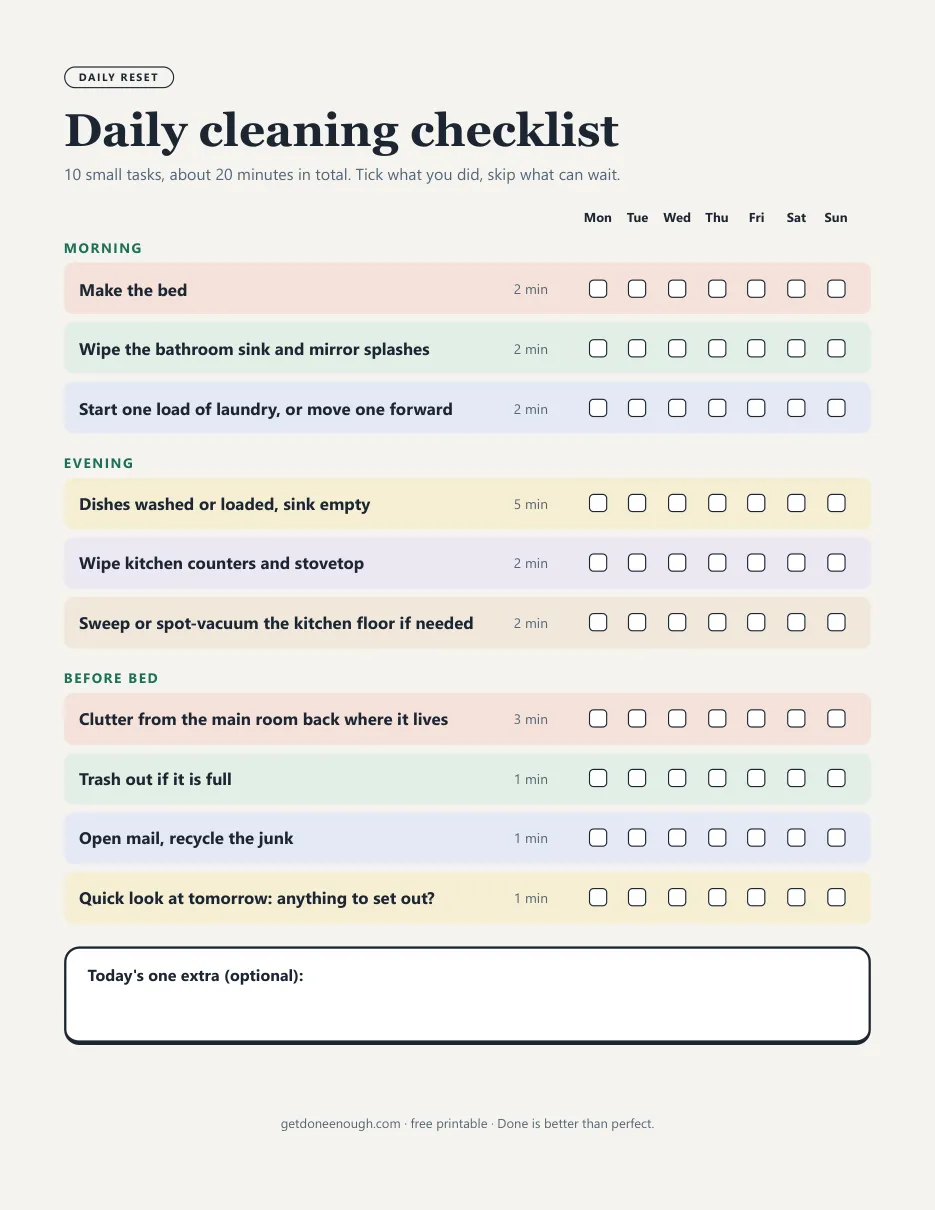
Free PDF: A one-page daily cleaning checklist with a checkbox for each day of the week.
Get the free PDFSee the planner on Etsy
The planner is sold in our own Etsy shop.
In this guide (23 parts)
- The daily cleaning checklist
- Why are these cleaning tasks daily? The science behind the list
- Daily cleaning checklist by room
- Clean, sanitize or disinfect: what does a daily list need?
- Is it safe to mix cleaning products?
- Do cleaning sprays affect indoor air?
- What is a good daily cleaning routine for a house?
- What’s the best time of day to clean?
- Daily cleaning schedule: a sample day
- How much time do people really spend on housework?
- How to make a daily list stick
- Why do daily cleaning lists fail?
- What happens if you skip a few days?
- Weekly cleaning schedule: one zone a day
- Monthly cleaning schedule: one deeper task a week
- Daily vs. weekly vs. monthly: what goes where?
- Cleaning schedule template (blank)
- Daily tasks for different homes
- If you have ADHD
- When even 20 minutes feels like too much
- Who’s behind Done Enough?
- How we wrote this guide
- Sources
A daily cleaning checklist covers what piles up in a single day: dishes, counters, clutter, one laundry step and the bathroom sink. Ours has about 10 small tasks in three short slots, around 20 minutes in all (our estimate). Scrubbing, mopping and a full vacuum wait for the weekly list.
It is part of our cleaning schedule and checklist guide. For a full clean, room by room, use the house cleaning checklist. Start with the daily list here. Add the weekly schedule once it runs, then the monthly rotation.
Each task on the list has a reason behind it: wet sponges and towels grow bacteria, food left out spoils within hours, crumbs feed pests and standing water feeds mold. The sections below show the research for each one, what soap and water can do on their own, and when a disinfectant is worth it.
Today's list 0/10 done
| Task | Done | Remove |
|---|---|---|
| Make the bed | ||
| Wipe the bathroom sink | ||
| One laundry step | ||
| Dishes done, sink empty | ||
| Wipe counters and stovetop | ||
| Sweep the kitchen floor if needed | ||
| Clutter back where it lives | ||
| Trash out if full | ||
| Open mail, recycle the junk | ||
| Quick look at tomorrow |
Saved on this device only. No account.
The daily cleaning checklist
The daily list has 10 tasks. In the morning, make the bed, wipe the bathroom sink and start one load of laundry. In the evening, wash or load dishes, wipe counters and stovetop, and sweep the kitchen floor if needed. Before bed covers clutter, trash, mail and a quick look at tomorrow.
For the counters, the CDC’s food safety advice is hot, soapy water after preparing each food item (CDC, November 24, 2025).
| When | Task | Time |
|---|---|---|
| Morning | Make the bed | 2 min |
| Morning | Wipe the bathroom sink and mirror splashes | 2 min |
| Morning | Start one load of laundry, or move one forward | 2 min |
| Evening | Dishes washed or loaded, sink empty | 5 min |
| Evening | Wipe kitchen counters and stovetop | 2 min |
| Evening | Sweep or spot-vacuum the kitchen floor if needed | 2 min |
| Before bed | Clutter from the main room back where it lives | 3 min |
| Before bed | Trash out if it is full | 1 min |
| Before bed | Open mail, recycle the junk | 1 min |
| Before bed | Quick look at tomorrow: anything to set out? | 1 min |
Times are rough guides for a small or medium home, and yours will differ.
Why are these cleaning tasks daily? The science behind the list
The daily cleaning tasks target four things that change within hours: bacteria in wet sponges and towels, perishable food at room temperature, crumbs that attract cockroaches, and moisture that lets mold grow. Each one has a public health or research source behind it, summarized in the table and explained below.
| Daily task | What builds up | What the evidence says |
|---|---|---|
| Dishes done, sink empty | Food residue, pests | AAAAI: wash dishes after use, sweep after meals (AAAAI, 2026) |
| Leftovers away before the dishes | Bacteria in perishable food | CDC: perishables out no more than 2 hours (CDC, 2025) |
| Wipe counters | Raw food residue | CDC: hot, soapy water after each food item |
| Hang the dish towel to dry | Bacteria in damp cloth | 49% of 100 used towels grew bacteria (2018 conference study) |
| Trash out if full | Food for pests | AAAAI: take out garbage promptly, use a lidded bin |
| Bathroom fan, towels hung | Moisture, mold | EPA: run the fan or open a window during showers (EPA, 2026) |
Kitchen sponges: why replacing beats “sanitizing”
Kitchen sponges are among the most heavily colonized objects in a home. A 2017 study in Scientific Reports sequenced 14 used kitchen sponges and found bacterial densities up to 5.4 x 10^10 cells per cubic centimeter in the most contaminated spots (Cardinale et al., 2017). The authors report that sponges their users said were regularly sanitized “did not contain less bacteria than uncleaned ones,” and they suggest replacing sponges about once a week instead.
Microwaving is a popular fix, but a 2020 study gives a mixed picture. Ten people microwaved their sponge for one minute two to three times a week for about four weeks, and ten did not (Jacksch et al., 2020). Microwaved sponges had lower bacterial richness, yet the share of Acinetobacter was 34.6% in microwaved sponges versus 8.4% in untreated ones.
Both studies are small and counted bacteria, not infections. The practical takeaway (our suggestion): squeeze the sponge dry after the evening dishes, and put a fresh one on the weekly shopping list.
Dish towels: dry beats damp
A damp dish towel is a second sponge. In a 2018 study presented at the ASM Microbe meeting (press release, not a full paper), researchers cultured 100 kitchen towels after one month of use: 49% had bacterial growth (ScienceDaily, 2018). Growth was higher in larger families, in homes with children, with multipurpose use, and in humid towels. In the release, “humid towels showed higher bacterial count than the dry ones.”
What that means for the daily list (our suggestions): hang the towel open to dry after the evening dishes, keep one towel for hands and another for dishes, and use a paper towel or a separate cloth for raw meat spills.
Food, crumbs and pests: why the kitchen is an evening job
Food left out sets the timing for the evening slot. The CDC advises: “Never leave perishable food out for more than 2 hours,” or 1 hour above 90°F, and to keep the fridge at 40°F or below (CDC, 2025). Putting leftovers away first, then doing dishes, keeps the 2-hour rule without a separate task.
Crumbs and garbage are also pest food. For cockroach allergen control, the American Academy of Allergy, Asthma and Immunology lists washing dishes after use, vacuuming and sweeping after meals, taking out garbage promptly, using lidded kitchen bins, and putting pet food dishes away after meals (AAAAI, page dated July 16, 2026). Most of that list matches the evening slot here.
Bathroom moisture: the 2-minute morning task that prevents mold
Mold needs water to grow. The EPA’s guide says “The key to mold control is moisture control” and recommends indoor humidity below 60%, ideally 30% to 50% (EPA, updated February 18, 2026). It advises running the bathroom fan or opening a window during showers, using exhaust fans while cooking or running the dishwasher, and drying wet areas within 24 to 48 hours.
The morning bathroom slot does this in practice (our suggestions): fan on during the shower and for a while after, towels hung open, and a quick wipe of standing water around the sink.
Daily cleaning checklist by room
The room version splits the same routine by room. In the kitchen, wash dishes, wipe counters and stovetop, clear the table and sweep where food fell. In the bathroom, wipe the sink and faucet, wipe the mirror and hang towels. Also make the bed and do one laundry step.
Check off what you did; skip what doesn’t apply. For deeper room lists, see the kitchen cleaning checklist and the bathroom cleaning checklist.
Kitchen
- ☐ Dishes washed or loaded, sink empty
- ☐ Counters and stovetop wiped
- ☐ Table cleared and wiped after the last meal
- ☐ Floor swept or spot-vacuumed where food fell
Bathroom
- ☐ Sink and faucet wiped
- ☐ Toothpaste splashes off the mirror
- ☐ Towels hung up to dry
Living room
- ☐ Cups, plates and wrappers back to the kitchen
- ☐ Toys, shoes and bags back where they live
- ☐ Cushions and throws straightened
Bedroom
- ☐ Bed made
- ☐ Clothes in the hamper or put away
Whole home
- ☐ One laundry step (start, move, fold or put away)
- ☐ Trash and recycling out if full
- ☐ Mail opened, junk recycled
Clean, sanitize or disinfect: what does a daily list need?
A daily cleaning list needs cleaning, meaning soap or detergent and water, not daily disinfecting. The CDC states that “Cleaning alone removes most harmful viruses or bacteria from surfaces,” and advises disinfecting when someone in the home is sick or has a weakened immune system (CDC, page dated January 31, 2025).
The EPA defines the three levels this way (EPA, updated October 8, 2026):
| Level | What it does (EPA) | Kills viruses? | When it fits a home routine |
|---|---|---|---|
| Cleaning | Removes dirt and organic matter with soap or detergents | Removes many, does not kill | Every day: counters, sink, table |
| Sanitizing | Kills bacteria on surfaces with chemicals | “Not intended to kill viruses” | Optional, per label |
| Disinfecting | Kills viruses and bacteria on surfaces with chemicals | Yes, per label claim | Sick days, vomit or diarrhea cleanup |
The detail most people skip is contact time: the EPA describes it as “how long the surface must remain wet.” Spraying and wiping straight away can leave a disinfectant short of its label claim. The time varies by product, so read the label.
The CDC also asks you to clean high-touch surfaces such as light switches, doorknobs and countertops “regularly” and after visitors. A weekly wipe of switches and handles fits the weekly cleaning schedule well (our suggestion).
Sick-day version: when someone has a stomach bug
When someone in the home has vomiting or diarrhea, the daily list gets one temporary add-on. For norovirus, the CDC recommends a bleach solution of 1,000 to 5,000 ppm, which is 5 to 25 tablespoons of household bleach (5% to 8%) per gallon of water, left on the surface for at least 5 minutes, or an EPA-registered disinfectant with a norovirus claim (CDC, page dated January 13, 2025). Afterward, the CDC says to clean the area again with soap and hot water.
For soiled laundry, the same page advises gloves, not shaking the items, detergent and hot water on the longest cycle, and the highest dryer heat. Once nobody is sick, go back to the normal list.
Is it safe to mix cleaning products?
Mixing cleaning products is not safe: the CDC says “Never mix bleach with ammonia or any other cleaner,” and to open windows and doors when using products indoors (CDC, reviewed August 26, 2026). The American Lung Association warns that bleach and ammonia gases can cause breathing problems and even death (American Lung Association, updated June 11, 2026).
Many people do not know these rules. Survey and poison center data:
| Finding | Number | Source |
|---|---|---|
| US adults who knew not to mix bleach with ammonia | 58% | 2020 CDC survey of 502 adults |
| Knew not to mix bleach with vinegar | 35% | Same survey |
| Knew to dilute bleach with room-temperature water only | 23% | Same survey |
| Did at least one high-risk practice | 39% | Same survey |
| Reported at least one adverse health effect | 25% | Same survey |
| Poison center calls about cleaners and disinfectants, January to March 2020 | 45,550 (up 20.4% on 2019) | 2020 CDC poison center report |
| Rank of household cleaning substances in poison exposures, children 5 and under | 1st (87,031 cases, 10.1%) | America’s Poison Centers, 2024 data |
| Same rank for adults 20 and over | 5th (74,838 cases, 5.9%) | Same source |
The 2020 figures come from the first months of the COVID-19 pandemic, when cleaning was unusually heavy. In the 2020 poison center report, bleaches made up 62.1% of the rise in calls about cleaners.
For a daily routine, the safe pattern is simple (our suggestions, built on the sources above): one product per job, never two in the same bucket or toilet bowl, store cleaners out of children’s reach, and keep warm water and dish soap as the default for counters. The American Lung Association notes that warm water and soap often work well at home, and that a “green” label does not guarantee a product is safer.
Do cleaning sprays affect indoor air?
Cleaning sprays do add pollutants to indoor air. The EPA notes that concentrations of many volatile organic compounds (VOCs) are “consistently higher indoors (up to ten times higher) than outdoors,” and lists cleansers, disinfectants, aerosol sprays and air fresheners among the sources (EPA, updated June 23, 2026). Its advice: “Increase ventilation when using products that emit VOCs.”
A 2025 study in ACS Earth and Space Chemistry measured surface cleaning in real buildings (Souza et al., 2025):
| Measure after surface cleaning | Result |
|---|---|
| Rise in fine particles (PM2.5) | 0.7 to 14.5 μg/m3 |
| Rise in total VOCs | 10 to 104 ppbv (no rise with a thymol product) |
| Fine particle loadings at poorly ventilated sites | 146% to 346% higher than better-ventilated sites |
| Main particle source | Direct emission from the spray bottle |
The authors flag limits: low-cost sensors, high variability between repeats, and small cleaned areas. Over the long term, a 2018 study of 6,235 adults followed for 20 years found faster lung function decline in women who cleaned at home (FEV1 down 22.1 ml a year) than in women who did not clean (18.5 ml a year), with no significant link in men (Svanes et al., 2018). That study is observational and shows an association, not a cause.
What to do with that (our suggestions): spray onto the cloth instead of into the air, open a window or run the fan while you clean, skip air fresheners, and use soap and water for the daily wipe.
What is a good daily cleaning routine for a house?
A good routine is short enough to happen on your worst weekday, so we suggest three small slots instead of one long session: about 6 minutes in the morning, 9 after dinner and 6 before bed (our estimates).
- Morning6 minBed, bathroom sink, start the laundry
- After dinner9 minDishes, counters and stovetop, kitchen floor if needed
- Before bed6 minClutter sweep, trash, mail, set out things for tomorrow
Each slot follows something you already do: waking up, eating dinner, getting ready for bed. Our tip is to keep that link, so the task has a moment that reminds you of it.
What’s the best time of day to clean?
The best time to clean is when you have a little energy and the mess actually matters, which differs by task (our suggestions):
| Time | Good for | Watch out for |
|---|---|---|
| Morning | Bed, bathroom, laundry start | Rushed mornings with kids or a commute |
| After dinner | Dishes and kitchen | Tired, so keep it to 10 minutes |
| Before bed | Clutter, trash, setting up tomorrow | Easy to skip when you’re on the couch |
| Weekend morning | Weekly zone and catch-up | Turning into an all-day clean |
The kitchen is best done right after the last meal, while food hasn’t dried on and within the CDC’s 2-hour window for perishables. Clutter is easiest before bed, so you wake up to a clear room.
Daily cleaning schedule: a sample day
A daily cleaning schedule ties each task to a time when you are already in that room. Here is a sample weekday we wrote for a parent with a job and two kids, to show how the list fits around a real schedule:
- 7:10 am. Bed made while the coffee brews. Sink wiped after brushing teeth, bathroom fan on for the shower.
- 7:30 am. Towels in the washer on a delay timer.
- 6:45 pm. Leftovers in the fridge, dishwasher loaded during cleanup, counters wiped, kids carry their own plates.
- 8:30 pm. Five-minute toy and clutter sweep with a basket, towels moved to the dryer.
- 9:00 pm. Trash out, mail sorted, school bags by the door.
That day has no separate cleaning session: each task rides on something already happening.
The free PDF at the end of this page is a daily cleaning schedule printable: the daily list on one page.
How much time do people really spend on housework?
People in the US spend more time on housework and kitchen cleanup than a 20-minute daily list. In the 2025 American Time Use Survey, 87% of women and 75% of men did some household activities on an average day, and on those days women averaged 2.8 hours and men 2.1 hours (BLS, released June 25, 2026). Housework alone and food preparation with cleanup look like this (BLS table A-1, 2025):
| Activity (2025) | Share doing it on an average day | Average per person, everyone | Average for those who did it |
|---|---|---|---|
| Housework, all | 36.1% | 0.56 h (about 34 min) | 1.55 h |
| Housework, men | 23.8% | 0.30 h | 1.25 h |
| Housework, women | 47.9% | 0.81 h | 1.69 h |
| Food preparation and cleanup, all | 65.2% | 0.71 h (about 43 min) | 1.09 h |
Two cautions. The BLS “food preparation and cleanup” category includes cooking, so it is not a pure cleaning figure. And these are averages, not targets. BLS also reports that 40% of people did housework on weekend days versus 35% on weekdays.
The gap between men and women (23.8% versus 47.9% doing housework on a given day) is one reason a list with names on it helps in a shared home.
How to make a daily list stick
A daily list sticks more easily when each task rides on a habit you already have and the list stays short. Our five suggestions:
- Attach each task to a habit you already have. Wipe the counter while the kettle boils, do the dishes right after dinner, pick up the floor before you brush your teeth.
- Keep it short. If your list has more than 10 lines, the extra ones belong on the weekly schedule.
- Use a timer. Ten minutes, then stop. A timer makes it easier to start.
- Share the list. Write a name next to each task if you live with others.
- Allow a minimum version. On a bad day, only dishes and trash. That still counts.
Why “after dinner, I do the dishes” works: if-then plans
The first tip has a name in psychology: an implementation intention, a plan written as “if situation X, then I do Y.” A 2025 meta-analysis of 642 tests found these plans helped across cognitive, emotional and behavioral outcomes, with effect sizes from d = .27 to .66 (Sheeran, Listrom and Gollwitzer, 2025). The authors write that “Effect sizes were larger when plans had a contingent (if-then) format,” and also when people were highly motivated and rehearsed the plan.
None of those tests were about cleaning, so treat this as a reason to try the format, not a promise. In practice: write each slot as “If I finish dinner, then I clear the sink” and read it once a day for the first week (our suggestion).
How long until a routine feels automatic?
A 2024 systematic review pooled 20 studies and 2,601 participants on health habits (Singh et al., 2024). Only four of those studies measured how long a habit took to form, and the time varied widely from person to person. The habits were mostly diet, exercise and flossing; the only kitchen one was microwaving dishcloths or sponges. Household cleaning routines were not studied, so our suggestion: give a new routine several weeks before judging it, and expect it to take longer for some people than others.
Short slots and stopping when the timer rings
Short slots with stops are easier to defend than one long session. A 2022 meta-analysis of 22 samples (2,335 people) found that micro-breaks slightly raised vigor (d = .36) and lowered fatigue (d = .35), while the effect on performance was not significant (d = .16) (Albulescu et al., 2022). Those studies were on work and lab tasks, not housework, so this supports the feel of three short slots, not a claim that they clean better.
Why do daily cleaning lists fail?
A daily list tends to fail when it is too long, too vague, done in one block, owned by one person, or dropped after one missed day. Fixes for each (our suggestions):
- The list is too long. Twenty daily tasks can easily turn into an hour, and an hour doesn’t fit a weeknight. Move anything that can wait a few days to the weekly schedule.
- The tasks are vague. “Tidy the kitchen” has no finish line. “Sink empty, counters wiped” does.
- Everything happens in one block. A single 30-minute session is easy to skip. Three short slots tied to meals and bedtime are harder to forget.
- One person does it all. In a shared home, a list with names on it spreads the work and ends the “I didn’t know that was mine” problem.
- A missed day turns into a missed week. Skipping one day is normal. Restart with the next slot instead of trying to catch up on everything.
What happens if you skip a few days?
The daily jobs build on each other. After a few skipped days the sink is full, the trash overflows, and clutter spreads from the main room into the others. The kitchen is the urgent part, because food left out past 2 hours and a damp sponge are where bacteria grow fastest (see the science above).
Restart with dishes and trash first, since they free up the most space, then go back to the normal list the next day rather than trying to clean the whole house at once.
There is some research comfort here. A popular idea, the Zeigarnik effect, says unfinished tasks stick in memory better. A 2025 meta-analysis “found no memory advantage for unfinished tasks,” but did find “a general tendency to resume tasks,” known as the Ovsiankina effect (Ghibellini and Meier, 2025). So after a gap, picking up the next slot is a normal way back in.
Weekly cleaning schedule: one zone a day
The weekly jobs (bathrooms, floors, dusting, sheets) are too big for the daily list, so each zone gets one day of about 15 minutes (our estimate): Monday kitchen, Tuesday bathrooms, Wednesday floors, Thursday dusting, Friday bedrooms, Saturday laundry and catch-up, and Sunday a light reset.
The weekly cleaning schedule lists the tasks and times for each day, plus a lighter week for a small apartment.
Monthly cleaning schedule: one deeper task a week
Monthly jobs take a month or more to look dirty, so do one block a week, about 30 to 45 minutes (our estimate), and each block comes around once a month.
Week 1 is the inside of the fridge, microwave and oven door, plus the range hood filter. Week 2 is baseboards, door frames and air vents. Week 3 is windows, mirrors, ceiling fan blades and light fixtures. Week 4 is under the beds and sofa, the mattress and the pillows. The monthly home cleaning schedule shows which zone day each block joins. For the once-a-year layer, see how to deep clean a house.
Daily vs. weekly vs. monthly: what goes where?
Daily tasks are for what gets visibly dirty within a day, weekly zones for what gets dirty within a week, and monthly tasks for what takes a month or more. A deep clean, once or twice a year, covers the rest:
| Layer | Frequency | Examples | Time (our estimate) |
|---|---|---|---|
| Daily | Every day | Dishes, counters, clutter, one laundry step, trash | About 20 min |
| Weekly zones | Once a week each | Bathroom, floors, dusting, sheets | About 15 min a day |
| Monthly tasks | Once a month each | Fridge, baseboards, windows, under furniture | 30 to 45 min a week |
| Deep clean | Once or twice a year | Walls, carpets, inside every cabinet | A weekend or more |
Why sheets, dusting and vacuuming are weekly, not daily
Sheets, dusting and a full vacuum sit on the weekly layer because the allergy guidance itself is weekly. For dust mite allergy, MedlinePlus (NIH) advises washing bedding and pillows weekly in hot water, 130°F to 140°F (54.4°C to 60°C), wiping dust with a damp cloth, and vacuuming once a week with a HEPA-filter vacuum (MedlinePlus, reviewed May 3, 2026). It also suggests keeping indoor humidity between 30% and 50%. The AAAAI gives the same weekly hot-water bedding wash (AAAAI, 2026).
Dust carries more than allergens. A 2016 analysis in Environmental Science and Technology pooled more than two dozen US studies and found 45 potentially toxic chemicals in household dust, 10 of them in 90% of samples (Silent Spring Institute, 2016). The researchers’ advice was a HEPA vacuum and frequent hand washing. Daily, the clutter sweep keeps floors clear so the weekly vacuum takes less time (our suggestion).
Cleaning schedule template (blank)
The blank template is a table with columns for layer, when, my tasks and who. It has daily rows for morning, evening and before bed, weekly zone rows for Monday to Friday plus Saturday or Sunday catch-up, and monthly rows for weeks 1 to 4.
Copy this daily house cleaning schedule template into a notes app or a spreadsheet and fill in your own tasks and names:
| Layer | When | My tasks | Who |
|---|---|---|---|
| Daily | Morning | ||
| Daily | Evening | ||
| Daily | Before bed | ||
| Weekly zone | Mon | ||
| Weekly zone | Tue | ||
| Weekly zone | Wed | ||
| Weekly zone | Thu | ||
| Weekly zone | Fri | ||
| Weekly zone | Sat or Sun | Catch-up | |
| Monthly | Week 1 | ||
| Monthly | Week 2 | ||
| Monthly | Week 3 | ||
| Monthly | Week 4 |
Daily tasks for different homes
The core list works for most homes, but a few lines change depending on who lives there:
| Home | Add | Can usually drop |
|---|---|---|
| Living alone, small apartment | Quick wipe of the bathroom sink | Daily sweep, often weekly is enough |
| Family with young kids | Toy sweep, high chair and table wipe | Making the kids’ beds perfectly |
| Pets | Food bowls, hair on the couch, entry floor | Nothing; pets usually add work |
| Working from home | Desk clear at the end of the day | Nothing |
| Shared house or roommates | Names next to each task | Tasks someone else owns |
| Someone sick with a stomach bug | CDC bleach step for soiled areas (see the sick-day version) | Nothing until they recover |
For pets, the AAAAI’s advice to put pet food dishes away after meals fits the evening slot. In homes with young children, cleaners belong out of reach: household cleaning substances were the top category of poison exposures for children 5 and under in 2024 data from America’s Poison Centers.
If you have ADHD
If ADHD makes it hard to pick a starting point, shrink each task to a 5-minute chunk with a named first move and keep the list where you can see it. The National Institute of Mental Health describes inattention as “having difficulty paying attention, keeping on task, or staying organized,” and notes that symptoms “can make it hard to get things done” (NIMH, reviewed August 2026). NIMH does not give cleaning tips, and the ideas below are our suggestions, not treatment; treatment questions belong with a clinician.
- Timer chunks. Set 5 minutes for one task. When it rings, stopping is allowed.
- Name the first physical move. “Put the cups in the sink” starts easier than “do the kitchen”.
- Body doubling. Clean while someone else is in the room or on a call.
- Keep the list visible. On the fridge or the bathroom mirror, not in a drawer.
- Use a “goes elsewhere” basket. Collect stray items first, put them away at the end, so you don’t wander off mid-task.
- Lower the bar. On a hard day, dishes and trash are enough.
The ADHD cleaning checklist breaks each room into 5-minute chunks with a bold first move.
When even 20 minutes feels like too much
Pick one line, not the whole list. If you can’t choose, put three tasks on the task wheel and spin. For days when starting is the hard part, see how to clean when overwhelmed. For a fast pass before guests, try speed cleaning.
The cleaning planner mentioned on this page is sold in our own Etsy shop, Done Enough. Full disclosure: that’s us.
Who’s behind Done Enough?
Done Enough is a small independent shop, not a clinic. We build free planning tools and sell printables on Etsy. We are not professional cleaners, microbiologists or clinicians: each guide links its sources so you can check every claim, and our own tips are marked as suggestions.
How we wrote this guide
In October 2026 we read the studies, agency pages and survey tables listed below, and checked US search data for the questions people ask about this topic. On October 25, 2026 we reopened each source and checked every number on this page against it.
Times marked “our estimate” are our own rough estimates, not measurements, and tips without a source are our suggestions. Studies on sponges, towels and cleaning sprays are small or observational: they show what grows or what is emitted, not how often people get sick. The habit and planning studies were not about housework. Anything older than 12 months is marked with its year. No organization listed here endorses our shop.
Sources
- Cardinale M, Kaiser D, Lueders T, Schnell S, Egert M (2017). Microbiome analysis and confocal microscopy of used kitchen sponges reveal massive colonization by Acinetobacter, Moraxella and Chryseobacterium species. Scientific Reports 7:5791. Published July 19, 2017. https://pmc.ncbi.nlm.nih.gov/articles/PMC5517580 Older than 12 months.
- Jacksch S, Thota J, Shetty S, Smidt H, Schnell S, Egert M (2020). Metagenomic Analysis of Regularly Microwave-Treated and Untreated Domestic Kitchen Sponges. Microorganisms 8(5):736. Published May 14, 2020. https://pmc.ncbi.nlm.nih.gov/articles/PMC7284620/ Older than 12 months.
- ScienceDaily (2018). Release on kitchen towel study, ASM Microbe 2018 (University of Mauritius). June 11, 2018. https://www.sciencedaily.com/releases/2018/06/180609124645.htm Older than 12 months; press release, not a full paper.
- CDC (2025). Food safety, prevention page. Page dated November 24, 2025. https://www.cdc.gov/food-safety/prevention/index.html Read October 25, 2026.
- CDC (2025). Page on when and how to clean and disinfect your home. Page dated January 31, 2025. https://www.cdc.gov/hygiene/about/when-and-how-to-clean-and-disinfect-your-home.html Older than 12 months.
- CDC (2025). Norovirus prevention page. Page dated January 13, 2025. https://www.cdc.gov/norovirus/prevention/index.html Older than 12 months.
- CDC (2026). Page on safely cleaning and sanitizing with bleach. Reviewed August 26, 2026. https://www.cdc.gov/natural-disasters/safety/how-to-safely-clean-and-sanitize-with-bleach.html
- Gharpure R, et al. (2020). Knowledge and practices regarding safe household cleaning and disinfection for COVID-19 prevention, United States, May 2020. MMWR 69(23). June 12, 2020. https://www.cdc.gov/mmwr/volumes/69/wr/mm6923e2.htm Older than 12 months.
- Chang A, et al. (2020). Cleaning and disinfectant chemical exposures and temporal associations with COVID-19, National Poison Data System, United States, January 1, 2020 to March 31, 2020. MMWR 69(16). April 24, 2020. https://www.cdc.gov/mmwr/volumes/69/wr/mm6916e1.htm Older than 12 months.
- America’s Poison Centers. National poison data, 2024 data year. https://www.poison.org/poison-statistics-national Data older than 12 months.
- EPA (2026). Page on the difference between products that disinfect, sanitize and clean. Updated October 8, 2026. https://www.epa.gov/coronavirus-and-disinfectants/whats-difference-between-products-disinfect-sanitize-and-clean
- EPA (2026). Page on volatile organic compounds and indoor air quality. Updated June 23, 2026. https://www.epa.gov/indoor-air-quality-iaq/volatile-organic-compounds-impact-indoor-air-quality
- EPA (2026). Brief guide to mold, moisture and your home. Updated February 18, 2026. https://www.epa.gov/mold/brief-guide-mold-moisture-and-your-home
- American Lung Association (2026). Page on cleaning supplies and household chemicals. Updated June 11, 2026. https://www.lung.org/clean-air/indoor-air/indoor-air-pollutants/cleaning-supplies-household-chem
- Souza PAF, et al. (2025). Particulate Matter and Total Volatile Organic Compound Emissions Following Surface Cleaning: Comparison of Cleaning Agents and Locations. ACS Earth and Space Chemistry 9(6):1622 to 1632. Published June 2, 2025. https://pmc.ncbi.nlm.nih.gov/articles/PMC12183735/ Older than 12 months.
- Svanes O, Bertelsen RJ, Lygre SHL, Carsin AE, Anto JM, et al. (2018). Study of cleaning and long-term lung function, European Community Respiratory Health Survey. American Journal of Respiratory and Critical Care Medicine 197(9):1157 to 1163. https://spiral.imperial.ac.uk/handle/10044/1/56501 Older than 12 months; observational.
- MedlinePlus, NIH (2026). Patient instructions on reducing indoor allergens. Reviewed May 3, 2026. https://medlineplus.gov/ency/patientinstructions/000487.htm
- AAAAI (2026). Page on managing indoor allergens. Page dated July 16, 2026. https://www.aaaai.org/tools-for-the-public/conditions-library/allergies/managing-indoor-allergen
- Silent Spring Institute (2016). News release on a meta-analysis of chemicals in US household dust, Environmental Science and Technology. September 14, 2016. https://www.silentspring.org/news/toxic-chemicals-widespread-household-dust Older than 12 months.
- US Bureau of Labor Statistics (2026). American Time Use Survey, 2025 results. Released June 25, 2026. https://www.bls.gov/news.release/atus.nr0.htm
- US Bureau of Labor Statistics (2026). ATUS table A-1, 2025 annual averages. https://www.bls.gov/news.release/atus.t01.htm
- Sheeran P, Listrom O, Gollwitzer PM (2025). Meta-analysis of implementation intentions (642 tests). European Review of Social Psychology 36(1):162 to 194. https://kops.uni-konstanz.de/handle/123456789/69905
- Ghibellini R, Meier B (2025). Meta-analysis of the Zeigarnik and Ovsiankina effects. Humanities and Social Sciences Communications 12. https://ideas.repec.org/a/pal/palcom/v12y2025i1d10.1057_s41599-025-05000-w.html
- Singh B, Murphy A, Maher C, Smith AE (2024). Time to Form a Habit: A Systematic Review and Meta-Analysis of Health Behaviour Habit Formation and Its Determinants. Healthcare 12(23):2488. Published December 9, 2024. https://pmc.ncbi.nlm.nih.gov/articles/PMC11641623/ Older than 12 months.
- Albulescu P, Macsinga I, Rusu A, Sulea C, Bodnaru A, Tulbure BT (2022). “Give me a break!” A systematic review and meta-analysis on the efficacy of micro-breaks for increasing well-being and performance. PLOS ONE. Published August 31, 2022. https://journals.plos.org/plosone/article?id=10.1371/journal.pone.0272460 Older than 12 months.
- National Institute of Mental Health (2026). ADHD topic page. Reviewed August 2026. https://www.nimh.nih.gov/health/topics/attention-deficit-hyperactivity-disorder-adhd
FAQ
What is a good schedule for housework?
A short daily list for the things that pile up fast (dishes, counters, clutter, laundry), one zone per day for the weekly jobs, and one bigger task per week for monthly jobs. Spreading the work out keeps any single day from turning into a three-hour clean.
What is the correct order to clean a room?
Clear clutter first, then work top to bottom: dust high surfaces, wipe counters and tables, and do the floor last. Vacuum before you mop, and finish at the door so you don't walk over what you just cleaned.
What cleaning should be done every day?
The things that pile up within a day: dishes, kitchen counters and stovetop, putting clutter back, wiping the bathroom sink, taking out full trash, and one laundry step. The CDC advises washing countertops with hot, soapy water after preparing each food item. Everything else can wait for its weekly day.
What are 6 things I can do every day to keep my house clean?
Do the dishes, wipe the kitchen counters, put things back where they live, make the bed, run one laundry step, and do a quick wipe of the bathroom sink. Together that is roughly 15 minutes (our estimate).
How to clean your house in 30 minutes?
Pick the rooms people see first. Spend about 10 minutes clearing clutter into a basket, 10 on dishes and kitchen counters, and 10 on a quick bathroom wipe and a sweep. Leave deep jobs for your weekly list.
What are 10 things I should clean weekly in my home?
Toilets, bathroom sinks, the shower or tub, kitchen counters, the stovetop, the microwave, floors (vacuum and mop), bed sheets, towels, and the trash and recycling. Dusting the main surfaces is a good eleventh if you have time. For dust mite allergy, MedlinePlus advises washing bedding weekly in hot water and vacuuming weekly with a HEPA vacuum.
What house cleaning should be done monthly?
The jobs that build up slowly: inside the fridge, microwave and oven door, the range hood filter, baseboards, door frames, vents, windows, ceiling fan blades, light fixtures, and under beds and sofas. Vacuuming the mattress and washing pillows, if the label allows, fit here too.