Cleaning
Weekly cleaning schedule: one zone a day, Monday to Sunday
Updated · Written by the Done Enough team · Sources linked below
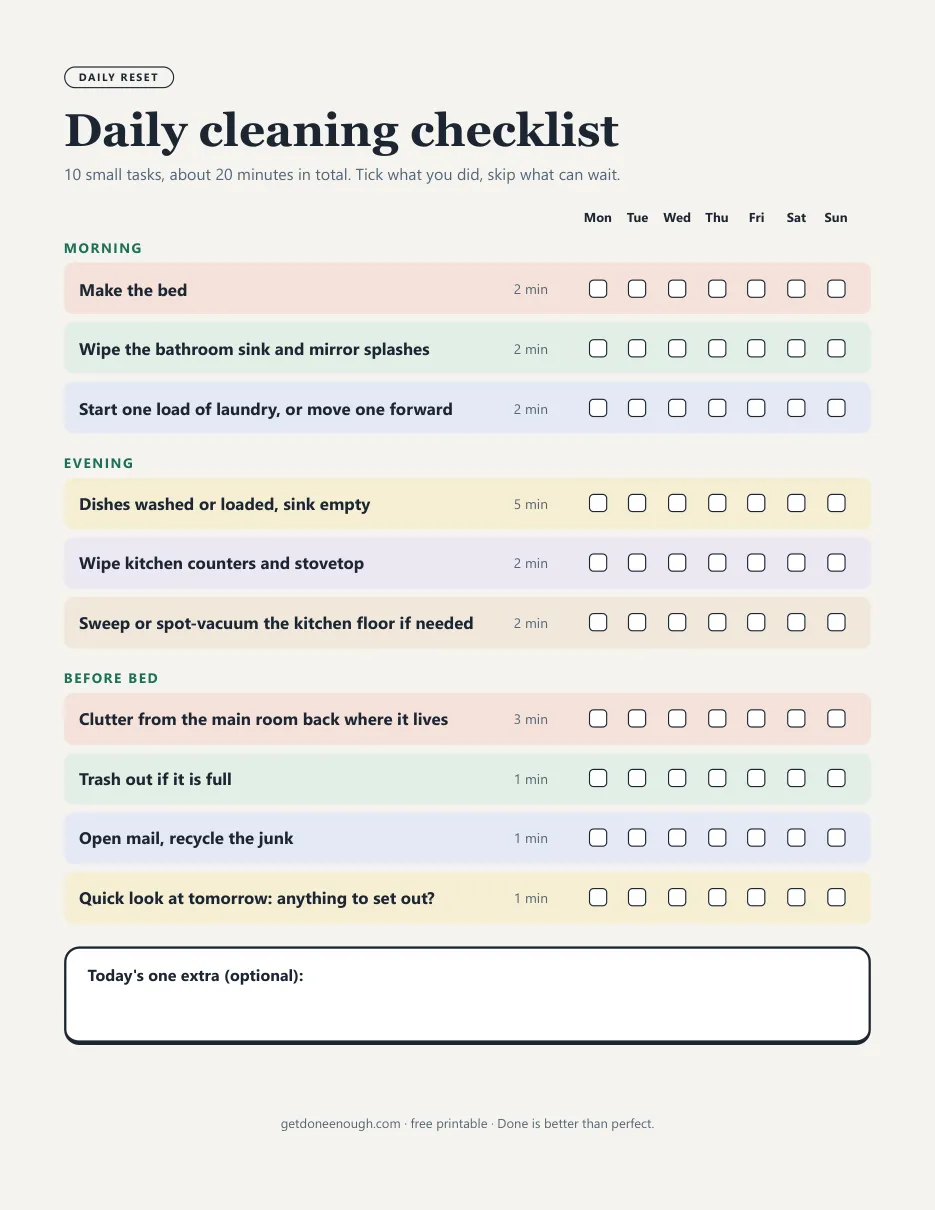
Free PDF: A one-page daily cleaning checklist with a checkbox for each day of the week.
Get the free PDFSee the planner on Etsy
The planner is sold in our own Etsy shop.
In this guide (20 parts)
- What is a good weekly cleaning schedule?
- Why does each zone come back every week?
- Clean, sanitize or disinfect: what does a weekly clean need?
- What is the best cleaning schedule for a home?
- An easy house cleaning schedule: 15 minutes a day
- Free PDF and blank template
- What should I include in my weekly cleaning roster?
- How to build a week that fits your home
- Why do fixed cleaning days work?
- How the four layers fit together
- Monthly home cleaning schedule
- What goes on a yearly cleaning schedule?
- What changes in a small apartment?
- What is the 6/10 rule for cleaning?
- Which days do people do housework?
- What did a 1950s cleaning schedule look like?
- What if you miss a day?
- Who’s behind Done Enough?
- How we wrote this guide
- Sources
A weekly cleaning schedule gives each day one zone of the house. Kitchen Monday, bathrooms Tuesday, floors Wednesday, dusting Thursday, bedrooms Friday, laundry and catch-up Saturday, and a light reset Sunday. Each zone takes about 15 minutes (our estimate), so no single day turns into a three-hour clean.
This guide is part of our cleaning schedule and checklist guide. The small jobs you do every day (dishes, counters, clutter) are on the daily cleaning checklist. This page covers the weekly layer on top of them: which zone goes on which day, what each zone includes, and how to build a week that fits your home.
The tracker below is a free editable cleaning schedule template. Add your own tasks or remove the ones you don’t need, then check off each zone across four weeks. Your changes stay on this device, and there’s no account to make.
One month of zones 0/28 done
| Task | Wk 1 | Wk 2 | Wk 3 | Wk 4 | Remove |
|---|---|---|---|---|---|
| Mon: kitchen | |||||
| Tue: bathrooms | |||||
| Wed: floors | |||||
| Thu: dusting and touch points | |||||
| Fri: bedrooms and sheets | |||||
| Sat: laundry and catch-up | |||||
| Sun: reset and plan |
Saved on this device only. No account.
What is a good weekly cleaning schedule?
A good weekly cleaning schedule puts each big job on a fixed day and keeps every day to about 15 minutes, with one light day for whatever you miss. In the version below, the bathroom is always Tuesday and the floors are always Wednesday.
| Day | Zone | What it covers | Time (our estimate) |
|---|---|---|---|
| Monday | Kitchen | Stovetop, microwave inside, appliance fronts, sink scrub, toss old fridge food, kitchen trash | 15 min |
| Tuesday | Bathrooms | Toilet, sink, counter, mirror, shower or tub, swap towels, bathroom trash | 15 min per bathroom |
| Wednesday | Floors | Vacuum the main rooms and rugs, then mop kitchen and bathroom floors | 15 to 20 min |
| Thursday | Dusting and touch points | Shelves, TV stand, tables, then light switches, doorknobs and handles | 10 to 15 min |
| Friday | Bedrooms | Strip and remake beds, clear nightstands, put clothes away | 15 min |
| Saturday | Laundry and catch-up | Wash sheets and towels, finish any zone skipped this week | 20 to 30 min |
| Sunday | Reset and plan | Trash and recycling out, look at next week, nothing else | 5 to 10 min |
A one-zone-a-day week works because each job gets a home on the calendar. Kitchen tasks belong to Monday, so you stop wondering on Thursday whether the microwave is due. Each zone is small enough to finish in about 15 minutes in a home that is already tidy (our estimate), which means you can do it on a workday evening without giving up the whole night. The schedule also keeps similar jobs together: floors get one day for the whole house, and so does dusting, so the vacuum comes out once a week instead of in every room. Saturday catches whatever slipped. Sunday stays light on purpose, because a week with no slack breaks the first time a child gets sick or work runs late. Start with these seven days, then move zones around after two weeks.
Inside each zone, keep the same order every time: clear clutter first, work from top to bottom, and go dry before wet (vacuum before you mop). The full room-by-room task lists are on the house cleaning checklist, and Tuesday’s steps are laid out minute by minute in the bathroom cleaning checklist.
Why does each zone come back every week?
Each zone of a weekly cleaning schedule repeats every seven days because the evidence on its main problem supports a short, regular cycle: bacteria in damp kitchen sponges and towels, spray from the toilet, dust and allergens on floors and in bedding, and moisture in bathrooms. Studies older than 12 months carry their year.
| Zone | What builds up | What the evidence says | Weekly step it supports |
|---|---|---|---|
| Monday: kitchen | Bacteria in sponges and towels | A 2017 study of 14 used sponges found up to 54 billion bacterial cells per cubic centimeter in the densest spots. A 2018 conference study found bacterial growth on 49 of 100 kitchen towels after a month of use | Swap the sponge and towels, check the fridge |
| Tuesday: bathrooms | Toilet aerosols | A 2022 study filmed a flush plume from a lidless toilet rising to 1.5 m (about 5 feet) within 8 seconds | Wipe the seat, flush handle and nearby surfaces |
| Wednesday and Thursday: floors and dusting | Dust and allergens | MedlinePlus allergy guidance: wipe dust with a damp cloth and vacuum once a week, with a HEPA vacuum | Damp dusting first, then vacuum |
| Friday and Saturday: bedrooms and laundry | Dust and allergens in bedding | MedlinePlus allergy guidance: wash bedding once a week at 130 to 140°F | Hot wash for sheets and pillowcases |
| Every zone | Moisture and mold | EPA: indoor humidity ideally 30 to 50 percent, dry wet areas within 24 to 48 hours | Look for damp spots as you clean |
Monday kitchen: sponges, towels and the fridge
Kitchen sponges can hold very dense bacterial populations. A 2017 study in Scientific Reports analyzed 14 used kitchen sponges and measured local densities of up to 5.4 x 10^10 cells per cubic centimeter, about 54 billion, in the most contaminated spots. Sponges that their owners sanitized regularly “did not show significantly reduced bacterial numbers,” so the authors suggest replacing sponges regularly, for example weekly. The study was small (14 sponges) and did not measure illness.
Kitchen towels showed a similar pattern. In a 2018 study presented at ASM Microbe by researchers at the University of Mauritius, 49 of 100 towels grew bacteria after one month of use. Counts rose with family size and with children, and towels used for several jobs or left damp had higher counts. It was a conference study, not a full peer-reviewed paper. Our reading for Monday: a new sponge, separate towels for hands and dishes, and fresh towels at least once a week (our tip).
The fridge check belongs here too. The FDA (2023) says to keep the refrigerator at or below 40°F (4°C) and the freezer at 0°F (-18°C), and to clean the fridge regularly and wipe spills immediately. A fridge thermometer makes the Monday check take seconds (our tip).
Tuesday bathrooms: what a flush sends into the air
A toilet flush throws a plume of droplets into the room, which is one reason the toilet, seat and flush handle get wiped every week. A 2022 study in Scientific Reports imaged the flush of a commercial lidless toilet. Its abstract reports a jet with velocities exceeding 2 m/s that carried aerosols to heights reaching 1.5 m (about 5 feet) within 8 seconds; in the detailed results, the measured plume passed 1.3 m by 7.5 seconds. The paper’s introduction, citing earlier work, notes that the largest droplets settle within seconds while aerosols smaller than 5 micrometers stay suspended.
The researchers tested a public-restroom style toilet (1.6 gallons per flush, no lid), not a home tank toilet. The bowl held only tap water, the tests ran in a large ventilated lab, and they did not measure whether anyone got sick. Two practical steps follow from the findings, both our suggestions: close the lid before flushing if your toilet has one, and on Tuesday wipe the bowl and the surfaces close to it (seat, lid, handle, the nearby wall and the floor around the base). The full step list is on the bathroom cleaning checklist.
Wednesday and Thursday: dust, allergens and the order of jobs
Weekly dusting and vacuuming are standard allergy advice. MedlinePlus (2026), the consumer health site of the US National Library of Medicine, tells people with allergies to “wipe away dust with a damp cloth and vacuum once a week,” and to use a vacuum with a HEPA filter “to help control the dust that vacuuming stirs up.” That page is written for people with allergies; for other homes it is a sensible default.
The schedule puts dusting on Thursday and the main vacuum on Wednesday so each job runs through the whole house in one pass. Inside a single room, the usual order still applies: dust high surfaces first, then vacuum, then mop (our tip). Our reading of the MedlinePlus advice: a damp cloth holds the dust it picks up, so less of it ends up on the floor you are about to vacuum. If someone at home has allergies, a HEPA vacuum is the upgrade with a direct source behind it.
Friday and Saturday: hot water for bedding, and humidity
Sheets get a fixed weekly slot because allergy guidance puts bedding on a seven-day cycle. MedlinePlus (2026) tells people with allergies to “wash bedding and pillows once a week in hot water,” at 130 to 140°F (54.4 to 60°C). The same page says keeping indoor humidity between 30 and 50 percent keeps mold spores down. Check each care label before using the hottest cycle, since not every fabric takes it.
Humidity matters in every room of the house. The EPA mold guide (2026) says to keep indoor humidity below 60 percent, ideally between 30 and 50 percent, and to dry water-damaged areas and items within 24 to 48 hours to prevent mold growth. Our suggestions for the weekly round: run the bathroom fan during and after showers, hang towels to dry fully, and note any damp corner during Tuesday’s zone. A cheap hygrometer shows whether a room sits inside the 30 to 50 percent range.
Clean, sanitize or disinfect: what does a weekly clean need?
A weekly clean in a healthy household mostly needs cleaning, which the EPA defines as removing dirt and organic matter with soap or detergent. Disinfecting is a separate step for specific situations, such as someone at home being sick. The EPA defines the three terms separately:
| Step | What it does (EPA, October 2026) | Where it fits on this schedule |
|---|---|---|
| Cleaning | Removes dirt and organic matter from surfaces using soap or detergents | Every zone, every week |
| Sanitizing | Kills bacteria on surfaces using chemicals; not intended to kill viruses | Optional, follow the product label |
| Disinfecting | Kills viruses and bacteria on surfaces using chemicals | When someone at home is sick, as the CDC advises |
Source: EPA, What’s the difference between products that disinfect, sanitize and clean surfaces, last updated October 8, 2026.
Contact time: the step most people skip
Contact time is how long a disinfectant must stay wet on a surface to work, and the EPA says to “pay close attention” to it. Spraying and wiping straight away skips it. Each product lists its own contact time on the label, so there is no single number to remember: read the label of the product in your caddy once, and write its time on your roster (our tip).
One concrete example comes from the CDC’s norovirus guidance (CDC, January 2025, older). After vomiting or diarrhea, the CDC recommends a bleach solution of 1,000 to 5,000 ppm, which it describes as 5 to 25 tablespoons of household bleach (5% to 8%) per gallon of water, left on the surface for at least 5 minutes. Soiled clothes and linens go in hot water on the longest cycle, then into the dryer on the highest heat. Use that plan for a sick week only, and go back to plain cleaning afterward.
What is the best cleaning schedule for a home?
The best cleaning schedule for home life is one you can still follow in your busiest week. It has three layers: a short daily list, one zone a day for the weekly jobs, and one deeper job a week for the monthly ones. Which version suits you depends on your time and your space. These matches are our suggestions:
| Your home | Start with | Where |
|---|---|---|
| Full-time work, short evenings | 15-minute zones with 5-minute fallbacks | The easy version below and the cleaning schedule for working parents |
| Small apartment, one or two people | Four or five zones, the rest of the week off | The apartment version below |
| Family or shared house | The same week with one name per job | The roster below and the chore chart for kids |
| House has slipped for weeks | One deep clean first, then the weekly zones | How to deep clean a house |
| Hard time getting started | 5-minute chunks in a fixed room order | ADHD cleaning checklist |
| Home office or small office | A separate roster for the office | Office cleaning schedule |
After two weeks on any of these, check which zones got done on their day, or at least by Saturday. A zone that keeps slipping is too big or sits on the wrong day, so shrink it or move it before you add anything new (our tip).
An easy house cleaning schedule: 15 minutes a day
An easy cleaning schedule keeps the same seven zones and cuts each one down to the part people notice. Set a timer for 15 minutes, or 5 on a bad day. These cuts are our suggestions:
| Day | 15-minute zone | 5-minute fallback |
|---|---|---|
| Monday | Stovetop, microwave, sink, fridge check | Stovetop and sink |
| Tuesday | Toilet, sink, mirror, shower walls, towels | Toilet and sink |
| Wednesday | Vacuum high-traffic paths, mop kitchen | Vacuum the entry and kitchen |
| Thursday | Dust living room surfaces, wipe switches and handles | Wipe handles and switches |
| Friday | Sheets on one bed, nightstands cleared | Clothes off the floor |
| Saturday | One load of sheets or towels, one skipped zone | Start the washer |
| Sunday | Trash out, glance at next week | Trash out |
When the timer rings, stop. A zone left half done can wait for Saturday’s catch-up or for its day next week, and the daily list keeps the house from sliding in the meantime. If even five minutes feels like too much, our speed cleaning guide is built for the moments when guests are on the way.
Free PDF and blank template
This page has three free options: the tracker at the top, a free cleaning schedule template to copy and a free PDF. The PDF is our daily cleaning checklist on one page, with a checkbox for each day of the week, in US Letter and A4. You get it by email from the free PDF box at the end of this page.
There is no separate PDF for the weekly zones. To make a free printable cleaning schedule for your own week, start from the blank template below.
Blank cleaning schedule template
The template has one row per day for the weekly zones, plus a row for the month’s deeper job and one for the year. To use it as a printable cleaning schedule template, copy it into a document or spreadsheet, add your zones (and names in the Who column if the work is shared), and print it from there.
| Day | Zone | Tasks | Who | Done |
|---|---|---|---|---|
| Monday | ☐ | |||
| Tuesday | ☐ | |||
| Wednesday | ☐ | |||
| Thursday | ☐ | |||
| Friday | ☐ | |||
| Saturday | Catch-up | ☐ | ||
| Sunday | Reset and plan | ☐ | ||
| This month | ☐ | |||
| This year | ☐ |
To turn your copy into a weekly cleaning schedule PDF, export it as a PDF from the app you pasted it into. Keep each zone’s tasks to one line. If a day needs more than that, the zone is too big for one day (our tip).
If you’d rather skip paper, your phone’s calendar can do the job. Most phone calendar apps let an event repeat weekly or monthly, so create one repeating event per zone on its day and one per monthly job, with a reminder at the time you usually start. The tracker at the top of this page also works on a phone and keeps your checkmarks between visits on the same device.
What should I include in my weekly cleaning roster?
A weekly cleaning roster is the same schedule with a name next to each job. In a shared home, it answers “whose turn is it?” before anyone has to ask.
| Job | Day | Who | Done |
|---|---|---|---|
| Kitchen zone | Monday | Name | ☐ |
| Bathrooms | Tuesday | Name | ☐ |
| Vacuum and mop | Wednesday | Name | ☐ |
| Dusting and touch points | Thursday | Name | ☐ |
| Sheets and bedrooms | Friday | Each person, own room | ☐ |
| Laundry: sheets and towels | Saturday | Name | ☐ |
| Trash and recycling out | Sunday (or pickup day) | Name | ☐ |
A weekly cleaning roster should include every job that comes back once a week, a fixed day for each, and one owner per job. The usual weekly jobs are toilets, showers and tubs, bathroom and kitchen sinks, the stovetop and microwave, kitchen surfaces, vacuuming, mopping, dusting, bed sheets, towels, and taking out the trash and recycling. The CDC adds a group that is easy to forget: high-touch surfaces such as light switches, doorknobs and countertops, which it says to clean regularly (CDC, January 2025, older). The same CDC page says household cleaners with soap or detergent remove germs and dirt from surfaces, and that you should disinfect as well when someone at home is sick. Write names, not “everyone”. A job with one owner is easy to check on Sunday. Rotate owners every week or every month if some jobs are clearly worse than others.
One safety rule belongs on every roster, especially when several people use the same cleaning closet: the CDC says not to mix products or chemicals with each other. Keep the label instructions with the products.
Cleaning product safety: what the data shows
Cleaning product mistakes are common enough that the CDC has measured them. In a 2020 CDC survey of 502 US adults, run online in May 2020 during the early COVID-19 pandemic, 39 percent reported at least one high-risk cleaning practice and 25 percent reported at least one health effect in the past month that they linked to cleaners or disinfectants. Only 58 percent knew bleach should not be mixed with ammonia, and only 35 percent knew it should not be mixed with vinegar. Earlier that year, poison centers logged 45,550 exposure calls about cleaners and disinfectants from January to March 2020, 20.4 percent more than in the same months of 2019, with bleaches accounting for 62.1 percent of the rise in cleaner calls. The authors note the data show a link in time, not proof that pandemic cleaning caused the rise.
Long-term use is studied too. A 2018 study followed 6,235 people for 20 years and found faster lung function decline (FEV1) in women who cleaned at home (22.1 ml a year) or worked as cleaners (22.4 ml) than in women who did not clean (18.5 ml). The link was not seen in men, and an observational study shows association, not cause. The EPA (2026) adds that concentrations of many volatile organic compounds (VOCs) are consistently higher indoors than outdoors, up to ten times higher, lists cleansers, disinfectants, aerosol sprays and air fresheners among the sources, and says to increase ventilation when using them.
Rules for the cleaning caddy, drawn from those sources plus our tips:
- Never mix products, and never combine bleach with ammonia or vinegar (CDC).
- Open a window or run a fan during each zone that uses sprays (EPA).
- Use the product at the strength on the label, and respect its contact time (EPA).
- Keep the week’s supplies in one caddy that moves from zone to zone, stored out of children’s reach (our tip). One caddy also means no zone day starts with a search for the toilet brush.
If children are on the roster, give them their own short list. The chore chart guide covers how to set one up so kids can check off their part of the week.
How to build a week that fits your home
The Monday-to-Sunday plan above is a starting point. Six steps turn it into a schedule built for your rooms and your calendar.
- Walk the house with a notepad and list every room and its weekly jobs, including the laundry area, the entry and any home office.
- Group the jobs into five to seven zones, by room (kitchen, bathrooms) or by task type (floors, dusting). The comparison below shows both.
- Look at your real week. Mark the days you get home late and the days you have more time.
- Put the heaviest zone on your lightest day. For many people that is the weekend.
- Leave one day almost empty to catch the zone you skipped.
- Run it for two weeks, then adjust. Move a zone only after it has failed twice on the same day.
A schedule or a chart comes down to which jobs, which day and who does them. Write down only the jobs that come back every week: daily jobs live on a separate list, and monthly jobs would make the weekly chart too long. Aim for zones of about 15 minutes each (our estimate). Put the chart where you look every day, such as the fridge, the inside of a cabinet door or your phone. In the first week you find the jobs that take longer than you thought, and in the second you see which days really work (our tips).
Three ways to split the week
| Split | Example | Works best for | Watch out for |
|---|---|---|---|
| By room | Mon kitchen, Tue bathrooms, Fri bedrooms | Small homes, one person cleaning | Floors done room by room take longer |
| By task type | Mon dusting, Tue vacuuming, Wed mopping | Homes with lots of floor space | The bathroom ends up spread over three days |
| Mixed (our week) | Rooms for kitchen, bathrooms, bedrooms; task days for floors and dusting | Most homes | Keep the order fixed so nobody has to think |
Our week mixes the two: rooms where the jobs are specific to that room, and task days where the same job runs through the whole house.
Why do fixed cleaning days work?
Fixed cleaning days work because a plan tied to a specific time and place is easier to act on than a vague intention. Psychologists call that kind of plan an implementation intention: “if it is Monday after dinner, then I clean the kitchen zone.” A 2025 meta-analysis by Paschal Sheeran, Olivia Listrom and Peter Gollwitzer in the European Review of Social Psychology pooled 642 independent tests and found that implementation intentions improved cognitive, emotional and behavioral outcomes, with effect sizes (d) between .27 and .66. Effects were larger when plans used an if-then format, when people were highly motivated and when the plan was rehearsed. The studies cover many kinds of goals, not cleaning in particular, so they explain why the format helps without showing what it will do for housework.
Turning each zone into an if-then line takes a minute:
| Vague plan | If-then plan (our examples) |
|---|---|
| “Clean the kitchen this week” | If it is Monday and the dinner dishes are done, then I do the 15-minute kitchen zone |
| “Do the bathroom sometime” | If it is Tuesday and I have just showered, then I wipe the toilet, sink and mirror |
| “Change the sheets” | If it is Friday morning and I get out of bed, then I strip the bed before breakfast |
| “Catch up on the weekend” | If it is Saturday at 10 a.m., then I finish the one zone I skipped |
The Saturday catch-up and the “stop when the timer rings” rule lean on a second finding. A 2025 meta-analysis of the Zeigarnik and Ovsiankina effects by Ghibellini and Meier “found no memory advantage for unfinished tasks,” but did find a general tendency to resume interrupted tasks. In plain terms, the popular idea that unfinished chores stick in your memory did not hold up, while the pull to go back to a started task did. A written catch-up slot gives that tendency a time and place.
How the four layers fit together
A daily, weekly and monthly house cleaning schedule sorts every recurring job by how fast it gets dirty. Daily jobs pile up within a day. Weekly jobs get one zone day each. Monthly jobs ride along with a zone day once every four weeks, and yearly jobs are spread over the calendar.
| Layer | How often | Examples | Time (our estimate) | Details |
|---|---|---|---|---|
| Daily | Every day | Dishes, counters, clutter, one laundry step, trash | About 20 min | Daily cleaning checklist |
| Weekly | One zone a day | Kitchen, bathrooms, floors, dusting, bedrooms, laundry | About 15 min a day | The 7-day table |
| Monthly | One job a week, each once a month | Inside the fridge, baseboards, windows, under beds | 30 to 45 min, once a week | Monthly schedule below |
| Yearly | Once or twice a year | Behind appliances, curtains, closets, smoke alarm batteries | A weekend, or a few short sessions | Yearly schedule below |
The daily layer is a routine you barely think about. The other layers are a schedule you look up. Keep them on separate lists, because one chart with every job on it gets too long to read at a glance (our tip). If you want all four layers on paper as one master cleaning schedule, the blank template above has a row for the month and one for the year. Copy it into any document app and save it as a PDF.
Monthly home cleaning schedule
This layer adds one deeper job to a zone day each week, so every job comes around once a month without a separate cleaning day. The four weeks match the tracker at the top of this page, and the jobs are the same four blocks we use on the daily cleaning checklist.
| Week | Add it to | Monthly job |
|---|---|---|
| Week 1 | Monday (kitchen) | Inside the fridge, inside the microwave and oven door, range hood filter |
| Week 2 | Thursday (dusting) | Baseboards, door frames, air vents |
| Week 3 | Saturday (catch-up) | Windows and mirrors, ceiling fan blades, light fixtures |
| Week 4 | Friday (bedrooms) | Under the beds, vacuum the mattress, wash pillows if the label allows |
| Every month | Sunday (reset) | Test the smoke alarms |
| Every 2 to 3 months | Sunday (reset) | Change the furnace or HVAC filter, or follow the filter maker’s schedule |
The US Fire Administration says to test smoke alarms monthly (USFA, page reviewed October 2026). The EPA says to replace HVAC filters as the manufacturer recommends, typically every 60 to 90 days, and more often if they come out heavily soiled (EPA, October 2026). The other jobs are our suggestions. Each week, the monthly job adds 30 to 45 minutes to the zone day it joins (our estimate), so if that day is usually a busy one, move the extra job to a day with more time. To turn the table into a monthly house cleaning schedule template, keep the four week rows and write your own jobs in the last column.
What goes on a yearly cleaning schedule?
An annual cleaning schedule holds the jobs that only need doing once or twice a year, plus a few safety checks with fixed timing. Spread them out, one or two a month, and none of them needs its own weekend.
| Job | How often | Basis |
|---|---|---|
| Replace smoke alarm batteries (9-volt alarms, or the backup battery in hardwired alarms) | At least once a year | USFA |
| Replace the whole smoke alarm | Every 10 years (long-life battery alarms: follow the manufacturer) | USFA |
| Clean behind and under the fridge and stove, if they move easily | Once or twice a year | Our tip |
| Empty and wipe inside the kitchen cabinets | Once a year | Our tip |
| Wash or vacuum curtains, wipe the blinds | Once or twice a year | Our tip |
| Wash windows inside and out | Once or twice a year | Our tip |
| Sort closets and drawers | Once a year, at a change of season | Our tip |
The smoke alarm rows come from the US Fire Administration (USFA, page reviewed October 2026). The furnace or HVAC filter needs changing more often than this, so it sits on the monthly list above. For the rest, our tip is to give each month one job, for example windows and curtains in spring and closets when the seasons change. If you’d rather do it all at once, our spring cleaning checklist and the guide on how to deep clean a house cover a full pass, room by room.
What changes in a small apartment?
A cleaning schedule for apartment living uses the same layers with fewer zones, because there are fewer rooms to split. In our version, five short zone days cover a one- or two-bedroom apartment and Thursday stays free. Times are our estimates:
| Day | Apartment zone | Time (our estimate) |
|---|---|---|
| Monday | Kitchen: stovetop, microwave, sink, fridge check | 10 min |
| Tuesday | Bathroom: toilet, sink, mirror, shower, towels | 10 to 15 min |
| Wednesday | Floors: vacuum every room, mop the kitchen and bathroom | 10 to 15 min |
| Thursday | Off | |
| Friday | Bedroom and dusting: sheets, nightstand, shelves, switches and handles | 10 to 15 min |
| Saturday | Laundry: sheets and towels | One wash |
| Sunday | Trash and recycling out | 5 min |
If the laundry room is shared or down the street, put sheets and towels into one Saturday trip. With less floor space, floors and dusting can also share a day, which frees a second day off. When the lease ends, the move-out cleaning checklist covers the deposit clean, room by room.
What is the 6/10 rule for cleaning?
The 6/10 rule for cleaning, also called the 6/10 cleaning method, is a list of 6 daily tasks plus 10 weekly tasks. Homes & Gardens summed it up as “a schedule of 6 daily and 10 weekly cleaning tasks” (Homes & Gardens, September 2023, older).
Prerna Jain, owner of Ministry of Cleaning and one of the experts quoted there, calls the method flexible and suggests adjusting the cleaning times to fit your schedule and the size of your home. It is a rule of thumb, and we found no study behind it.
The 6/10 method and a zone-a-day schedule fit together well. Your six daily tasks are the daily cleaning checklist. Your ten weekly tasks get spread over the seven days, one or two per day:
| Day | Weekly tasks from a 6/10 list (our example) |
|---|---|
| Monday | 1. Stovetop and microwave. 2. Fridge clear-out |
| Tuesday | 3. Toilets and sinks. 4. Showers and tubs |
| Wednesday | 5. Vacuum. 6. Mop |
| Thursday | 7. Dust surfaces and wipe touch points |
| Friday | 8. Change bed sheets |
| Saturday | 9. Wash towels and sheets |
| Sunday | 10. Trash and recycling out |
Which days do people do housework?
More people do housework on weekend days than on weekdays: 40 percent against 35 percent on an average day in 2025, according to the US American Time Use Survey (BLS, June 2026). That is one reason this schedule puts laundry and catch-up on Saturday.
The same release shows how much of the week household work takes. On an average day in 2025, 87 percent of women and 75 percent of men spent some time on household activities, and on the days they did, women spent an average of 2.8 hours on them and men 2.1 hours. The survey counts activities “such as housework, cooking, lawn care, or household management” in that category, so these hours are not the time a weekly clean needs.
The full time-use figures, including the time employed parents spend on household activities, are in our cleaning schedule for working parents.
What did a 1950s cleaning schedule look like?
We could not check a primary source for a 1950s cleaning schedule: the article we had planned to cite blocked access when we tried to open it on October 25, 2026, so we removed its day-by-day list rather than repeat it unchecked. What this page can show is its own week: one main job per weekday, short zones of about 15 minutes (our estimate), and Saturday kept for catch-up.
What if you miss a day?
Do a short version of that zone, such as the 5-minute fallback in the easy table above, or move it to Saturday’s catch-up. Never put two zones on one weeknight. Pick up where you left off instead of starting the week over: the 2025 Ovsiankina findings above suggest people tend to resume interrupted tasks, and Saturday is the slot for it. These are our suggestions, and our cleaning schedule for working parents has the full plan for a week that falls apart.
Who’s behind Done Enough?
Done Enough is a small independent shop. We build free planning tools and sell printables on Etsy. We are not professional cleaners or clinicians: each guide links its sources so you can check every claim, and our own tips are marked as suggestions.
How we wrote this guide
On October 24, 2026 we collected the questions people in the US ask about weekly cleaning schedules and related cleaning schedule searches (Semrush) and read the Google US results for “weekly cleaning schedule”. We read several of the ranking schedules to see what they cover.
After that we read the CDC’s home cleaning page, the BLS American Time Use Survey release, the Homes & Gardens article on the 6/10 method, the US Fire Administration’s smoke alarm page, and the EPA’s guide to air cleaners and filters. An Apartment Therapy article about a 1950s cleaning schedule was dropped on October 25, 2026 because its page could no longer be opened to check it.
On October 25, 2026 we added the science behind each zone. We read the studies and agency pages listed below in full or at abstract level, kept only sources from 2016 or later, and dropped figures we could not see on the source page. Studies are cited with their year, and their limits (sample size, conference study, observational design, lab setting) are stated next to the finding. Times marked “our estimate” are rough estimates, not measurements, and tips without a source are our suggestions. Sources older than 12 months are marked as older. No organization listed here endorses our shop.
Sources
Nineteen sources. The first five were read on October 24, 2026, the other fourteen on October 25, 2026. All were checked again on October 25, 2026.
- CDC (2025). When and How to Clean and Disinfect Your Home. Page dated January 31, 2025. https://www.cdc.gov/hygiene/about/when-and-how-to-clean-and-disinfect-your-home.html Older than 12 months.
- US Bureau of Labor Statistics (2026). American Time Use Survey Summary, 2025 results. Released June 25, 2026. https://www.bls.gov/news.release/atus.nr0.htm
- Homes & Gardens (2023). Why experts swear by the “6/10 cleaning method” for a spotless home, by Lola Houlton. Published September 8, 2023. https://www.homesandgardens.com/solved/6-10-cleaning-method Older than 12 months.
- US Fire Administration (2026). Smoke alarms. Page last reviewed October 13, 2026. https://www.usfa.fema.gov/prevention/home-fires/prepare-for-fire/smoke-alarms/
- US Environmental Protection Agency (2026). Guide to Air Cleaners in the Home. Last updated October 1, 2026. https://www.epa.gov/indoor-air-quality-iaq/guide-air-cleaners-home
- Cardinale et al. (2017). Microbiome analysis of 14 used kitchen sponges. Scientific Reports 7:5791. Published July 19, 2017. https://pmc.ncbi.nlm.nih.gov/articles/PMC5517580 Older than 12 months.
- American Society for Microbiology (2018). News release on a kitchen towel study presented at ASM Microbe 2018 (University of Mauritius), via ScienceDaily. Published June 11, 2018. https://www.sciencedaily.com/releases/2018/06/180609124645.htm Older than 12 months; conference study.
- US Food and Drug Administration (2023). Consumer update on storing food safely. Content current as of January 18, 2023. https://www.fda.gov/consumers/consumer-updates/are-you-storing-food-safely Older than 12 months.
- Crimaldi et al. (2022). Study of the aerosol plume from a commercial lidless toilet flush. Scientific Reports 12:20493. Published December 8, 2022. https://pmc.ncbi.nlm.nih.gov/articles/PMC9732293/ Older than 12 months.
- US Environmental Protection Agency (2026). The difference between products that disinfect, sanitize and clean surfaces. Last updated October 8, 2026. https://www.epa.gov/coronavirus-and-disinfectants/whats-difference-between-products-disinfect-sanitize-and-clean
- CDC (2025). Norovirus prevention page. Page dated January 13, 2025. https://www.cdc.gov/norovirus/prevention/index.html Older than 12 months.
- CDC, Morbidity and Mortality Weekly Report (2020). Survey of 502 US adults on household cleaning and disinfection practices, May 2020. MMWR 69(23). Published June 12, 2020. https://www.cdc.gov/mmwr/volumes/69/wr/mm6923e2.htm Older than 12 months.
- Chang et al., CDC Morbidity and Mortality Weekly Report (2020). Poison center calls about cleaners and disinfectants, January 1 to March 31, 2020. MMWR 69(16):496 to 498. Published April 24, 2020. https://www.cdc.gov/mmwr/volumes/69/wr/mm6916e1.htm Older than 12 months.
- Svanes et al. (2018). Cleaning at home and at work and lung function decline over 20 years. American Journal of Respiratory and Critical Care Medicine 197(9):1157 to 1163. Accepted February 16, 2018; issue dated May 1, 2018. https://spiral.imperial.ac.uk/handle/10044/1/56501 Older than 12 months; observational.
- US Environmental Protection Agency (2026). Volatile organic compounds and indoor air quality. Last updated June 23, 2026. https://www.epa.gov/indoor-air-quality-iaq/volatile-organic-compounds-impact-indoor-air-quality
- MedlinePlus, US National Library of Medicine (2026). Patient instructions on reducing dust and allergens. Review date May 3, 2026. https://medlineplus.gov/ency/patientinstructions/000487.htm
- US Environmental Protection Agency (2026). Brief guide to mold, moisture and your home. Last updated February 18, 2026. https://www.epa.gov/mold/brief-guide-mold-moisture-and-your-home
- Sheeran P, Listrom O, Gollwitzer PM (2025). The when and how of planning: meta-analysis of the scope and components of implementation intentions in 642 tests. European Review of Social Psychology 36(1):162 to 194. https://kops.uni-konstanz.de/handle/123456789/69905
- Ghibellini R, Meier B (2025). Interruption, recall and resumption: a meta-analysis of the Zeigarnik and Ovsiankina effects. Humanities and Social Sciences Communications 12. https://ideas.repec.org/a/pal/palcom/v12y2025i1d10.1057_s41599-025-05000-w.html
FAQ
How often should you replace a kitchen sponge?
The authors of a 2017 study in Scientific Reports, which analyzed 14 used kitchen sponges, suggest replacing sponges regularly, for example weekly. Sponges their owners sanitized regularly did not show significantly fewer bacteria. The study was small and did not measure illness. On this page the sponge swap sits on the Monday kitchen zone.
How often should you wash your sheets?
MedlinePlus, the NIH consumer health site, tells people with allergies to wash bedding and pillows once a week in hot water, 130 to 140°F (54.4 to 60°C). That advice is written for people with allergies. Check the care label before using the hottest cycle.
What is the difference between cleaning, sanitizing and disinfecting?
The EPA says cleaning removes dirt and organic matter with soap or detergent, sanitizing kills bacteria (it is not intended to kill viruses), and disinfecting kills viruses and bacteria with chemicals. For any disinfectant, the EPA says to respect the contact time, how long the surface must stay wet.
Can you mix bleach and ammonia?
No. The CDC says not to mix cleaning products or chemicals with each other. In a 2020 CDC survey of 502 US adults, only 58 percent knew bleach should not be mixed with ammonia, and 35 percent knew it should not be mixed with vinegar.
How long should a weekly clean take?
On the week on this page, about 1.5 to 2 hours in total, spread over seven days. That is our estimate for a tidy home with one bathroom. Each extra bathroom adds about 15 minutes, and the monthly block adds 30 to 45 minutes to one zone day each week.
How often should you change an HVAC filter?
The EPA says to follow the filter maker's instructions, typically every 60 to 90 days, which works out to about four to six changes a year. Change it more often if it comes out heavily soiled. On this page the filter change sits on the monthly list, with the Sunday reset.
How often should you test smoke alarms?
The US Fire Administration says to test smoke alarms once a month, replace the batteries in 9-volt alarms at least once a year and replace the whole alarm every 10 years. For alarms with long-life batteries, follow the manufacturer's instructions.