Cleaning
How to declutter your kitchen, one zone at a time
Updated · Written by the Done Enough team · Sources linked below
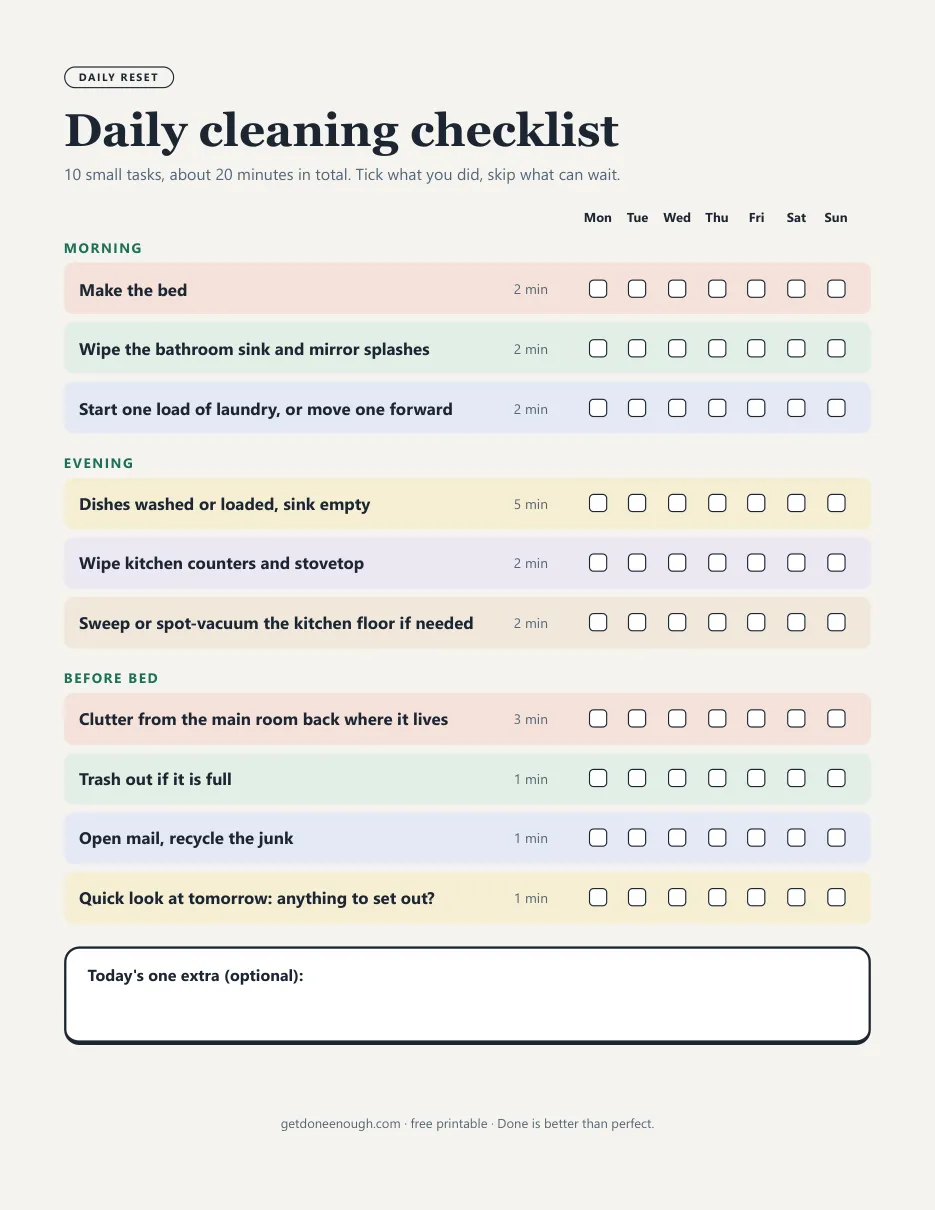
Free PDF: A one-page daily cleaning checklist with a checkbox for each day of the week.
Get the free PDFSee the planner on Etsy
The planner is sold in our own Etsy shop.
In this guide (14 parts)
- How do you declutter a kitchen?
- Zone 1: How to declutter kitchen countertops
- Zone 2: Cabinets and under the sink
- Zone 3: Drawers and the junk drawer
- Zone 3b: How to declutter a spice drawer or rack
- Zone 4: Fridge and freezer
- Zone 5: Pantry and expiration dates
- How much should you keep? A kitchen keep list
- Tips for small kitchens and for keeping it clear
- The 3-3-3 rule and the 20/20 rule for decluttering
- If you can’t make yourself start
- Who’s behind Done Enough?
- How we wrote this guide
- Sources
To declutter a kitchen, work one zone at a time in this order: countertops, cabinets, drawers, fridge and freezer, then pantry. Empty the zone, toss what is broken or spoiled, donate what you don’t use, put back only what you use, and store each item near where you use it. Most zones take about 20 to 45 minutes (our estimate); a packed pantry takes longer.
This guide is part of our cleaning schedule and checklist guide. Decluttering comes before cleaning: once the counters are clear, the kitchen cleaning checklist goes much faster.
The kitchen is worth the effort because many people work in it every day. In the 2025 American Time Use Survey, 65.2% of Americans did food preparation and cleanup on an average day, and those who did spent 1.09 hours on it (BLS, ATUS Table 1, 2026). This guide adds what most decluttering lists skip: what the research says about sponges, towels, cutting boards, cleaning products, fire risk and the psychology of letting things go.
Declutter list 0/10 done
| Task | Done | Remove |
|---|---|---|
| Set up 4 boxes: keep, donate, trash, elsewhere | ||
| Counters cleared | ||
| Upper cabinets | ||
| Lower cabinets and under the sink | ||
| Drawers | ||
| Spice rack or drawer | ||
| Fridge and freezer | ||
| Pantry | ||
| Label the zones | ||
| Donations in the car |
Saved on this device only. No account.
How do you declutter a kitchen?
Decluttering a kitchen works best one zone at a time with the same steps every time: empty it, lay everything out, sort, wipe the empty space, then put back only the keepers, grouped by function. The goal is simple to check at the end: the things you use every week are easy to reach.
- Set up four boxes or bags: keep, donate, trash, and “goes elsewhere” for things that belong in another room.
- Set a timer. One 60-minute session, or a 15-minute one if you are short on energy, keeps the job from spreading over the whole house (our tip).
- Pick one zone. Do not open every cabinet at once.
- Empty the zone completely onto the table or a clear counter.
- Lay like items side by side (all spatulas together, all mugs together) so duplicates show up before you decide anything.
- Sort each item with the questions below.
- Wipe the empty shelf or drawer while it is bare.
- Put back the keepers, grouped by function (cooking, baking, food storage, cleaning), with daily items in front.
- Label the zone if more than one person uses the kitchen, so things go back to the same place.
- Take the trash out and put the donate box by the door before you start the next zone.
Four questions decide most items (our tip):
| Question | If the answer is no |
|---|---|
| Did I use it in the last year? | Donate it, unless it is seasonal |
| Do I own something else that does the same job? | Keep the better one |
| Does it work and have all its parts (lids, blades, cords)? | Trash or recycle it |
| Would I buy it again today? | Donate it |
Why grouping by function works
Grouping kitchen items by function (cooking tools by the stove, baking tools together, food storage near the counter where you pack leftovers) should cut walking and searching (our reasoning) inside the room where Americans who cook or clean up on a given day spend about an hour on it (BLS, 2026). Laying all items of one kind side by side matters for a second reason: duplicates are hard to see when they sit in three different drawers. Labels then do the remembering for everyone in the household, which is why a labeled zone tends to stay sorted longer than an unlabeled one (our reading, not a measured result). The time figure is a national average for food preparation and cleanup, so it covers cooking as well as tidying.
Zone 1: How to declutter kitchen countertops
Take everything off, wipe the bare surface, and put back only what you use most days, each item in a fixed spot near where you use it. Everything else goes into a cabinet, another room or the donate box.
Counters collect mail, chargers, bags and appliances that never move. They are also the zone you see every day, and the other zones need a clear counter for sorting, so start here.
- Clear the counter completely. Mail, keys, toys and receipts go in the “elsewhere” box.
- Wipe the empty counter before anything goes back.
- Sort what’s left with the table below.
- Give each keeper a fixed spot, for example the coffee maker near the sink and the knife block near the cutting board.
- Clear the area around the stove first: no paper towels, packaging, mail or dish towels within reach of a burner.
- Make a landing spot (a small tray or basket) for the things that will keep arriving, and empty it once a week.
What should stay on a kitchen counter?
A kitchen counter should hold only the things you use most days, plus one or two pieces you like to look at. The table is our suggestion; a household that bakes every weekend may keep the stand mixer out.
| On the counter | Keep it out when | If not, store it |
|---|---|---|
| Toaster, kettle, coffee maker | You use it most days | In a cabinet near its outlet |
| Slow cooker, blender, stand mixer | You use it at least weekly | Lower cabinet, or a closet bin if used a few times a year |
| Knife block or utensil crock | It holds tools you reach for while cooking | Move the tools to a drawer |
| Oil, salt and pepper | You cook with them most days | Cabinet next to the stove, away from the burner |
| Fruit bowl | The fruit gets eaten before it goes soft | Fridge or pantry |
| Dish soap and sponge | Always, next to the sink | Nothing to change |
| Mail, chargers, keys | Never; they belong to another room | A tray or hook by the door |
| Decor | One or two pieces you like | Another room or the donate box |
If you declutter the kitchen counter and it fills up again within a week, check whether the mail, bags and chargers have a home outside the kitchen, and give each one a spot by the door (our tip).
Why a clear stovetop area matters: the fire data
Cooking is the leading cause of home fires in the United States, and a cluttered stovetop gives a pan fire something to spread to. According to the US Fire Administration, fire departments responded to an estimated 170,000 home cooking fires in 2021 (the latest year on the page, so older data), which caused about 135 deaths, 3,000 injuries and more than $494 million in losses. Unattended equipment was the top ignition factor, at 37% of nonconfined home cooking fires. In the USFA’s words, “Cooking is, by far, the leading cause of home fires and home fire injuries,” and its safety graphic tells cooks to keep anything that can catch fire away from the stovetop (USFA, reviewed September 28, 2026). Paper towel holders, cookbooks, oven mitts and takeout bags are the usual counter items to move first.
Zone 2: Cabinets and under the sink
Work by category when decluttering kitchen cabinets (mugs, then plates, then pots, then food storage containers) instead of one cabinet at a time. Pull out the whole category, count what you have, and compare it to what your household uses in a busy week. Keep that number plus a small spare and donate the rest.
Store the keepers by frequency: daily dishes at eye level near the dishwasher, occasional serving pieces up high or in a less handy spot. For food storage containers, match every container to a lid, recycle any piece without a partner, and keep only as many sets as fit in one cabinet or bin. Under the sink, gather every cleaning product, use up the duplicates first, and keep each one in its original container. Never pour two products into one bottle. For anything you no longer want, read the label for disposal directions first.
Under-sink products need extra care. The EPA counts some leftover household products, including some cleaners, as household hazardous waste, and says pouring them down the drain or putting them in regular trash can be improper disposal. It recommends keeping them in original containers, never mixing leftovers, and checking your local collection program (EPA, updated June 1, 2026).
Why fewer cleaning products is safer: the chemical evidence
Cutting the under-sink collection down to a few products reduces three documented risks: mixing, misuse and indoor air pollution. A 2020 CDC survey of 502 US adults found that 39% used cleaners in at least one high-risk way the CDC does not recommend, 19% had put bleach on food, and only 58% knew not to mix bleach with ammonia (35% for bleach with vinegar). A quarter reported a health effect they linked to cleaners in the past month (CDC MMWR, 2020). For young children, household cleaning substances were the most common poison exposure in 2024 national data: 87,031 cases, or 10.1% of exposures in children 5 and under (National Capital Poison Center, 2024 data). The EPA adds that levels of several organic compounds average 2 to 5 times higher indoors than outdoors, and that gases can escape even from closed containers (EPA, updated June 23, 2026).
What the evidence suggests for the sort:
| Under-sink finding | What to do while decluttering | Source |
|---|---|---|
| Many adults mix products or use them on food | Keep one product per job, in its original bottle | CDC MMWR, 2020 |
| Cleaners are the top poison exposure in children 5 and under | Store the keepers out of children’s reach (our tip: a high shelf or a latched cabinet) | NCPC, 2024 data |
| Old chemicals can leak gases even when closed | Dispose of partly full containers you no longer need through local collection | EPA, 2026 |
| EPA advises buying only what you will use soon | Use up duplicates before buying more | EPA, 2026 |
| Leaks feed mold | Check the pipes and the cabinet floor for damp while it is empty | EPA, 2026 |
Cleaning, sanitizing and disinfecting: what the CDC means
Cleaning, sanitizing and disinfecting are three different steps, and decluttering only makes the first one easier. The CDC defines them this way: cleaning removes most germs, dirt and impurities with soap, water and scrubbing; sanitizing reduces germs to levels public health codes consider safe; disinfecting kills most germs on surfaces. The CDC says to clean first, and that a disinfected surface should stay wet for the full contact time on the product label. It also advises sanitizing any surface touched by raw meat, poultry or their juices, including the inner sink, and never mixing products (CDC, January 31, 2025). Contact times differ between products, so follow the label.
| Step | What it does (CDC) | Typical tools | When in a declutter |
|---|---|---|---|
| Cleaning | Removes most germs and dirt | Soap, water, scrubbing | Every empty shelf and drawer |
| Sanitizing | Lowers germs to levels codes call safe | Weak bleach solution or sanitizing spray | Sink, raw-meat boards and surfaces |
| Disinfecting | Kills most germs | Stronger bleach solution or disinfectant, label contact time | Only where needed, after cleaning |
Moisture and mold under the sink
The cabinet under the sink is the kitchen’s dampest storage spot, so check it while it is empty. The EPA says that when wet materials are dried within 24 to 48 hours of a leak or spill, mold will not grow in most cases. It recommends keeping indoor relative humidity below 60% (ideally 30 to 50%), fixing plumbing leaks as soon as possible, and using exhaust fans or opening windows when cooking, running the dishwasher or washing dishes (EPA, updated February 18, 2026). Our tip: put back fewer bottles than you took out, so air can move and a drip shows up quickly.
Zone 3: Drawers and the junk drawer
Empty one drawer at a time onto the counter, lay the contents out by type so duplicates are visible, sort with the rules below, then put back only what you use.
- Utensil drawer: empty it, keep one of each tool you actually reach for, and donate the duplicate spatulas, ladles and whisks.
- Single-use gadgets: keep a gadget only if you used it in the last year (our tip).
- Towel and linen drawer: retire stained or torn towels to the rag bin.
- Junk drawer: dump it on the table. Trash dead pens and old takeout menus, move tools to the toolbox, and keep the rest in small dividers.
- Batteries: take lithium-ion, single-use lithium, button-cell and rechargeable batteries to a battery drop-off or household hazardous waste collection. The EPA says single-use alkaline batteries can go in the household trash in most communities (EPA, updated July 21, 2026), but California bans all batteries from the trash (CalRecycle).
- Takeout extras: sauce packets, plastic cutlery and chopsticks pile up fast. Keep a small handful and stop accepting new ones.
Sponges, towels and cutting boards: what the research found
Sponges, dish towels and cutting boards are the kitchen items where decluttering and hygiene overlap, because they are used wet, every day, and rarely replaced. Studies since 2017 point the same way: these items hold large bacterial loads, and cleaning them at home does not always fix that.
| Kitchen item | What the study found | Source |
|---|---|---|
| Used sponge | 14 sponges, up to 54 billion bacterial cells per cubic centimeter, 118 genera | Cardinale et al., Scientific Reports, 2017 |
| Sponge sanitized by its owner | Did not hold fewer bacteria than uncleaned sponges | Cardinale et al., 2017 |
| Microwaved sponge | 20 households, about 4 weeks: Acinetobacter share rose from 8.4% to 34.6% | Jacksch et al., Microorganisms, 2020 |
| Dish towel after one month | 100 towels, 49% grew bacteria; damp and multipurpose towels had higher counts | ASM Microbe data via ScienceDaily, 2018 |
| Kitchen sink | Over 50% of observed cross-contamination cases were linked to poor sink sanitation | Lavallee, Current Developments in Nutrition, 2020 |
| Plastic cutting board | Modeled estimate of 14.5 to 71.9 million polyethylene microplastics per person per year from chopping | Yadav et al., Environmental Science and Technology, 2023 |
Kitchen sponges. A 2017 study of 14 used household sponges found bacterial densities of up to 54 billion cells per cubic centimeter. Sponges their owners regularly sanitized did not contain fewer bacteria, and the authors suggested replacing sponges regularly, “for example, on a weekly basis” (Cardinale et al., 2017). A small 2020 study found that microwaving sponges 2 to 3 times a week changed their bacterial mix, with some groups rising in share; the authors say the health meaning is still unclear (Jacksch et al., 2020). For a declutter, that means: toss old sponges and keep a small, dated stack of new ones.
Dish towels. In 2018 conference data on 100 kitchen towels used for a month, 49% grew bacteria. Among those, 36.7% carried coliforms, 36.7% Enterococcus and 14.3% S. aureus, and counts were higher in larger families and households with children. The lead researcher said “humid towels and multipurpose usage of kitchen towels should be discouraged” (ScienceDaily, 2018). This was conference data, not a journal paper. Our tip: keep enough towels to switch to a dry one each day, and use separate towels for hands and dishes.
Cutting boards. An observational study of home cooks, published in 2020, found nearly 25% cross-contaminated a ready-to-eat side dish, and over half of cross-contamination cases were tied to poor sink sanitation (Lavallee, 2020). That supports keeping one board for raw meat and one for everything else. A 2023 modeling study estimated that chopping on plastic boards could add millions of microplastic particles to a person’s food each year, though a preliminary 72-hour test found no harm to mouse cells (Yadav et al., 2023). The study did not measure board wear, so replacing deeply scored boards is our tip, not a finding.
Zone 3b: How to declutter a spice drawer or rack
Spices deserve their own short session, because the same jar is often bought twice when nobody can see what is already there. Pull every jar out, lay them in alphabetical rows, and the duplicates show up at once.
- Combine duplicates of the same spice if both smell fresh, and keep the newer jar.
- Check the date and the jar. Treat a date on a spice jar as a quality guide, not a safety cutoff (our reading of the FDA date guidance in Zone 5), and judge by smell and color: a spice with little aroma or a faded color has lost flavor (our tip).
- Toss jars with clumps, damp or anything growing, which signals moisture got in.
- Store the keepers away from the stove’s heat and steam, in a drawer or a rack with labels on top or front so each jar is easy to find (our tip).
- Write the opening month on new jars with a marker, so the next review is fast.
Zone 4: Fridge and freezer
In the fridge, decluttering is about food safety as well as space. The FDA’s 2018 refrigerator and freezer storage chart gives “short but safe time limits” for a fridge at 40°F (4°C), and the CDC says to keep the fridge at 40°F or below and the freezer at 0°F or below (CDC, November 24, 2025).
Freezer times on the same chart are for quality only, because freezing at 0°F (-18°C) keeps food safe indefinitely. The chart also notes that product dates are not a guide for safe use (FDA storage chart, March 2018, older).
| Food (in the fridge at 40°F) | Time on the FDA chart (2018) |
|---|---|
| Meat leftovers, cooked meat and meat dishes | 3 to 4 days |
| Cooked poultry dishes and leftover pieces | 3 to 4 days |
| Soups and stews | 3 to 4 days |
| Egg, chicken, tuna, ham and macaroni salads (store-prepared or homemade) | 3 to 5 days |
| Lunch meats, opened package | 3 to 5 days |
| Hot dogs, opened package | 1 week |
| Hard-cooked eggs | 1 week |
Source: FDA Refrigerator and Freezer Storage Chart, March 2018 (older). For foods not on the chart, the FDA points to the FoodKeeper app (FDA, content current as of March 5, 2024).
A fridge declutter, step by step (our tip):
- Take out one shelf at a time, starting at the top.
- Toss anything past the chart times above, and anything that smells, looks or feels off.
- Wipe the shelf before the food goes back; sanitize any spot where raw meat juice dripped, as the CDC advises for surfaces touched by raw meat.
- Put the food that needs eating first at the front, at eye level.
- In the freezer, toss anything you can’t identify, then label the rest with the date.
Zone 5: Pantry and expiration dates
Most pantry decisions come down to reading date labels correctly. The FDA explains that, except for infant formula, manufacturers are not required by federal law or regulation to put quality-based date labels on packaged food. It supports “Best if Used By” as the standard phrase for when a product is at its best flavor and quality, and says consumers should examine foods past that date for signs of spoilage, avoiding food whose color, consistency or texture has noticeably changed. The FDA adds that freezing keeps most foods from going bad until you are ready to eat them (FDA, content current as of March 5, 2024, older). Its 2018 storage chart says the same thing more bluntly: product dates are not a guide for safe use (FDA, 2018).
Why date labels cause so much waste
Date label confusion is one of the main reasons good food leaves the pantry during a declutter. A 2019 study in Waste Management surveyed a nationally representative sample of 1,029 US adults and found that 84% discard food near the package date at least occasionally. More than a third wrongly believed date labels are federally regulated, and another 26% were unsure (Neff et al., 2019). The EPA estimates that 24% of material in US municipal solid waste landfills is food. Its Wasted Food Scale ranks preventing waste first and donating food second, with composting lower and landfilling, incineration and the drain last (EPA, updated September 16, 2026). In a pantry sort, that order means: eat it, donate it, compost it, and toss only what is spoiled or damaged.
| Pantry item | Keep, use, toss or donate |
|---|---|
| Past “Best if Used By,” no sign of spoilage | Check it first, then use it soon (FDA) |
| Dented, rusted or swollen can | Toss it (our tip) |
| Infant formula | The one food the FDA names as an exception to the no-federal-date rule; follow the date and label on the package (our tip) |
| Open bag that went stale or smells off | Toss it |
| Unopened food you won’t eat | Donate it (EPA ranks donation above composting) |
| Five half-used bags of the same pasta | Combine into one container (our tip) |
Pantry steps: empty one shelf, group like with like (baking, grains, cans, snacks, spices), check dates and condition, wipe the shelf, then put back the oldest items in front.
Containers, baskets and turntables: after the sort, not before
Pantry organizers only help once you know what you are keeping, so buy them last. Clear containers show how much flour or rice is left, which helps prevent the duplicate purchases that waste food. Baskets hold loose packets and snacks by category, and a turntable (lazy Susan) brings oils, vinegars and jars from the back of a deep corner shelf. Label each container or basket with what goes in it. All of this is our suggestion; we found no study comparing organizer types.
How much should you keep? A kitchen keep list
We found no official count for kitchen items, so the numbers below are our suggestion for a household that cooks most days. Adjust them to your home: a family of five who hosts often needs more than a couple who eats out.
| Item | How many to keep (our tip) |
|---|---|
| Plates, bowls, glasses | One per person, plus enough for one load in the dishwasher |
| Mugs | One or two per person, plus two for guests |
| Chef’s knife | One good one, plus a paring knife and a bread knife |
| Cutting boards | Two (one for raw meat, one for everything else), in line with CDC advice to sanitize surfaces raw meat touches |
| Pots and pans | One small pot, one large pot, one large skillet, one sheet pan |
| Spatulas, ladles, tongs | One of each you use |
| Food storage containers | As many full sets with lids as fit in one cabinet or bin |
| Dish towels | Enough to switch to a dry one daily for a week between laundry days |
| Sponges | The one in use plus a small stack of new ones |
| Cleaning products | One per job, in original bottles |
| Reusable shopping bags | As many as fit in one bag |
| Small appliances on the counter | Only the ones used most days |
Tips for small kitchens and for keeping it clear
A small kitchen has no spare room for things used once a year, so keep only daily and weekly items in the kitchen itself and move the rest out. The habits below speed up the sorting and keep the counters from filling up again. All of them are our own suggestions; no study is behind them.
- Run the dishwasher and take out the trash first, so clean dishes and a full trash can don’t get in the way.
- Check what your food bank or donation center accepts before you start, so the donate box goes out in one trip.
- Ask before you toss someone else’s things. Put a partner’s or roommate’s items in a box for them to decide on.
- Make a backup bin. Holiday platters, the roasting pan and the stand mixer you use twice a year can live in a labeled bin in a closet.
- Use the walls and doors. A magnetic knife strip or hooks free up a drawer.
- Keep the counter at three items or fewer if space is very tight.
- Measure shelves and drawers after you sort, and only then buy an organizer.
- One in, one out. A new mug means an old one leaves.
- Reset the counter for five minutes every evening and put each thing back after use.
- Review the fridge, pantry and under the sink every 3 to 6 months, and do the full five zones about once a year.
- Do the fridge and pantry the day before a grocery trip, when they hold the least food, and write the shopping list from what you find so you don’t buy duplicates.
The house cleaning checklist puts a short daily reset into the rest of the week, and speed cleaning covers fast resets when guests are on the way.
The 3-3-3 rule and the 20/20 rule for decluttering
Two quick rules come up in searches about decluttering. Neither is an official standard; both are rules of thumb.
| Rule | What it says | Kitchen use (our tip) |
|---|---|---|
| 3-3-3 rule | No single agreed version; the name is used for several quick routines built around the number three | Three short sessions, three small zones, remove at least three things each time |
| 20/20 rule | If you can replace it for under $20 in under 20 minutes, you can let it go | Spare spatulas, extra mugs, duplicate measuring cups |
The 3-3-3 rule for decluttering is a different idea from our 3-3-3 method, which is a way to plan your work day, not a way to sort a kitchen.
If you can’t make yourself start
If you know how to declutter the kitchen but can’t face the first cabinet, make the first session so small that it is easy to begin. The ideas below are our suggestions.
- Pick the smallest zone. One drawer counts.
- Set a 15-minute timer and stop when it rings.
- Start with trash only. Broken, spoiled and lidless items take no decisions.
- Put on music or call a friend while you sort.
- Leave the hard decisions in a “maybe” box with a date on it, and donate it if you haven’t opened it in a month (our tip).
What research says about clutter and indecision
Clutter and indecision are linked in the research, which is why a “maybe” box can help. A 2023 study of 225 US adults, mostly clients of professional organizers recruited through the Institute for Challenging Disorganization and 92.5% women, found that the negative effect of clutter on quality of life correlated with indecision (r = 0.62) and with hesitation (r = 0.68). The authors sorted participants into three profiles: efficient (about 28%), hesitant (about 38%) and deterred declutterers (about 33%) (Patel, Graupmann and Ferrari, IJERPH, 2023). The sample was not representative and the link is a correlation, not proof that indecision causes clutter. A separate 2025 meta-analysis found “no memory advantage for unfinished tasks,” but did find a general tendency to resume them (Ghibellini and Meier, 2025). Our reading: stopping halfway through a zone, with the boxes left out, is fine, because people tend to come back to an interrupted task.
More ideas for low-energy days are in cleaning motivation and, if you struggle to get going on tasks in general, in how to stop procrastinating. If you are planning a bigger reset, the kitchen declutter fits as the first step of the spring cleaning checklist.
The cleaning planner mentioned on this page is sold in our own Etsy shop, Done Enough. Full disclosure: that’s us.
Who’s behind Done Enough?
Done Enough is a small independent shop, not a clinic. We build free planning tools and sell printables on Etsy. We are not professional cleaners or clinicians: each guide links its sources so you can check every claim, and our own tips are marked as suggestions.
How we wrote this guide
On October 24, 2026 we pulled US keyword and question data about decluttering a kitchen from Semrush, and the Google US results for “declutter kitchen,” with their People Also Ask questions, through DataForSEO. On October 25, 2026 we compared the top Google results for “how to declutter kitchen” and added the topics they cover (spice storage, time boxes, labels, pantry organizers, regular reviews), then the research none of them covers: hygiene, chemical safety, fire risk and clutter psychology.
Food storage times come from the FDA’s 2018 storage chart, date label guidance from the FDA, fridge and freezer temperatures from the CDC, disposal and indoor air guidance from EPA pages, cleaning definitions from the CDC, fire data from the US Fire Administration, time use data from BLS, and poison data from the National Capital Poison Center. Hygiene and psychology findings come from peer-reviewed studies and one conference report, each named with its year. Studies published before 2016 were not used. Times, quantities and tips marked “our tip” or “our estimate” are our own suggestions, not measurements. No organization listed here endorses our shop.
Sources
Twenty-two sources. Every page below was opened and checked on October 25, 2026. The publisher page for the Yadav study blocked access, so its figures were checked against the study abstract indexed in Europe PMC (PMID 37220346). Sources older than 12 months are marked.
- US Bureau of Labor Statistics (2026). American Time Use Survey, Table 1, 2025 annual averages. Last modified June 25, 2026. https://www.bls.gov/news.release/atus.t01.htm
- US Fire Administration, FEMA (2026). Cooking fire safety. Reviewed September 28, 2026; fire data from 2021 (older). https://www.usfa.fema.gov/prevention/home-fires/prevent-fires/cooking/
- US EPA (2026). Household Hazardous Waste (HHW). Last updated June 1, 2026. https://www.epa.gov/hw/household-hazardous-waste-hhw
- US EPA (2026). Volatile Organic Compounds’ Impact on Indoor Air Quality. Last updated June 23, 2026. https://www.epa.gov/indoor-air-quality-iaq/volatile-organic-compounds-impact-indoor-air-quality
- US EPA (2026). A Brief Guide to Mold, Moisture and Your Home. Last updated February 18, 2026. https://www.epa.gov/mold/brief-guide-mold-moisture-and-your-home
- US EPA (2026). Wasted Food Scale. Last updated September 16, 2026. https://www.epa.gov/sustainable-management-food/food-recovery-hierarchy
- US EPA (2026). Used Household Batteries. Last updated July 21, 2026. https://www.epa.gov/recycle/used-household-batteries
- CalRecycle. Wastes Banned From the Trash. No update date shown on the page. https://calrecycle.ca.gov/homehazwaste/info/
- CDC (2025). When and How to Clean and Disinfect Your Home. January 31, 2025 (older than 12 months). https://www.cdc.gov/hygiene/about/when-and-how-to-clean-and-disinfect-your-home.html
- CDC (2020). MMWR 69(23), survey of household cleaning and disinfection practices, June 12, 2020 (older). https://www.cdc.gov/mmwr/volumes/69/wr/mm6923e2.htm
- National Capital Poison Center. Poison Statistics, National Data 2024 (older than 12 months). https://www.poison.org/poison-statistics-national
- Cardinale et al. (2017). Study of 14 used kitchen sponges. Scientific Reports 7, 5791, July 19, 2017 (older). https://pmc.ncbi.nlm.nih.gov/articles/PMC5517580
- Jacksch et al. (2020). Study of microwave sanitization of kitchen sponges in 20 households. Microorganisms, May 2020 (older). https://pmc.ncbi.nlm.nih.gov/articles/PMC7284620/
- American Society for Microbiology, ASM Microbe 2018, via ScienceDaily (2018). Study of 100 kitchen towels. June 11, 2018 (older; conference data). https://www.sciencedaily.com/releases/2018/06/180609124645.htm
- Lavallee (2020). Observational study of home cooks. Current Developments in Nutrition (older; abstract). https://pmc.ncbi.nlm.nih.gov/articles/PMC7258352
- Yadav H. et al. (2023). Cutting boards: an overlooked source of microplastics. Environmental Science and Technology 57(22), 8225 to 8235 (older). https://doi.org/10.1021/acs.est.3c00924
- Neff et al. (2019). Misunderstood food date labels and reported food discards: a survey of U.S. consumer attitudes and behaviors. Waste Management 86, 123 (older). https://hls.harvard.edu/bibliography/misunderstood-food-date-labels-and-reported-food-discards-a-survey-of-u-s-consumer-attitudes-and-behaviors
- Patel, Graupmann and Ferrari (2023). Study of 225 adults considering a decluttering project. International Journal of Environmental Research and Public Health (older). https://pmc.ncbi.nlm.nih.gov/articles/PMC9915205/
- Ghibellini R. and Meier B. (2025). Meta-analysis of the Zeigarnik and Ovsiankina effects. Humanities and Social Sciences Communications 12 (2025). https://ideas.repec.org/a/pal/palcom/v12y2025i1d10.1057_s41599-025-05000-w.html
- US Food and Drug Administration (2024). How to Cut Food Waste and Maintain Food Safety. Content current as of March 5, 2024 (older than 12 months). https://www.fda.gov/food/consumers/how-cut-food-waste-and-maintain-food-safety
- US Food and Drug Administration (2018). Refrigerator and Freezer Storage Chart. March 2018 (older). https://www.fda.gov/media/74435/download
- CDC (2025). Preventing Food Poisoning. November 24, 2025. https://www.cdc.gov/food-safety/prevention/index.html
FAQ
How often should you declutter a kitchen?
No official schedule exists. Our suggestion: a full pass through the five zones about once a year, a quick review of the fridge, pantry and under the sink every 3 to 6 months, and a ten-minute sweep of one zone each month.
What are the biggest decluttering mistakes?
Our view of the common ones: emptying every cabinet at once and running out of time, keeping duplicates just in case, and tossing food on its Best if Used By date, which the FDA says marks best flavor and quality; past it, the FDA says to check the food for signs of spoilage. A 2019 survey of 1,029 US adults found 84% discard food near the package date at least occasionally (Neff et al., Waste Management).
What is the 5 5 5 rule for decluttering?
We found no single official version. In the kitchen we use it this way: 5 minutes a day, 5 days in a row, removing 5 things each time. That clears 25 items in a week without a long session, and it suits drawers and the junk drawer best (our suggestion).
How often should you replace a kitchen sponge?
A 2017 study of 14 used kitchen sponges (Cardinale et al., Scientific Reports) found up to 54 billion bacterial cells per cubic centimeter and suggested replacing sponges regularly, for example weekly. Sponges their owners said they sanitized did not hold fewer bacteria.
Is it safe to microwave a kitchen sponge?
The evidence is unclear. In a small 2020 study of 20 households (Jacksch et al., Microorganisms), microwaving sponges 2 to 3 times a week changed their bacterial community, and some groups such as Acinetobacter rose in share. The authors say the health effect still needs study, so replacing the sponge is the simpler option.
How often should you wash kitchen towels?
No study we found gives a fixed interval. In 2018 conference data on 100 kitchen towels used for one month, 49% grew bacteria, and damp or multipurpose towels had higher counts. Our tip: swap in a dry towel daily and keep a separate towel for hands and for dishes.