Cleaning
House cleaning checklist: room by room, plus a deep clean list
Updated · Written by the Done Enough team · Sources linked below
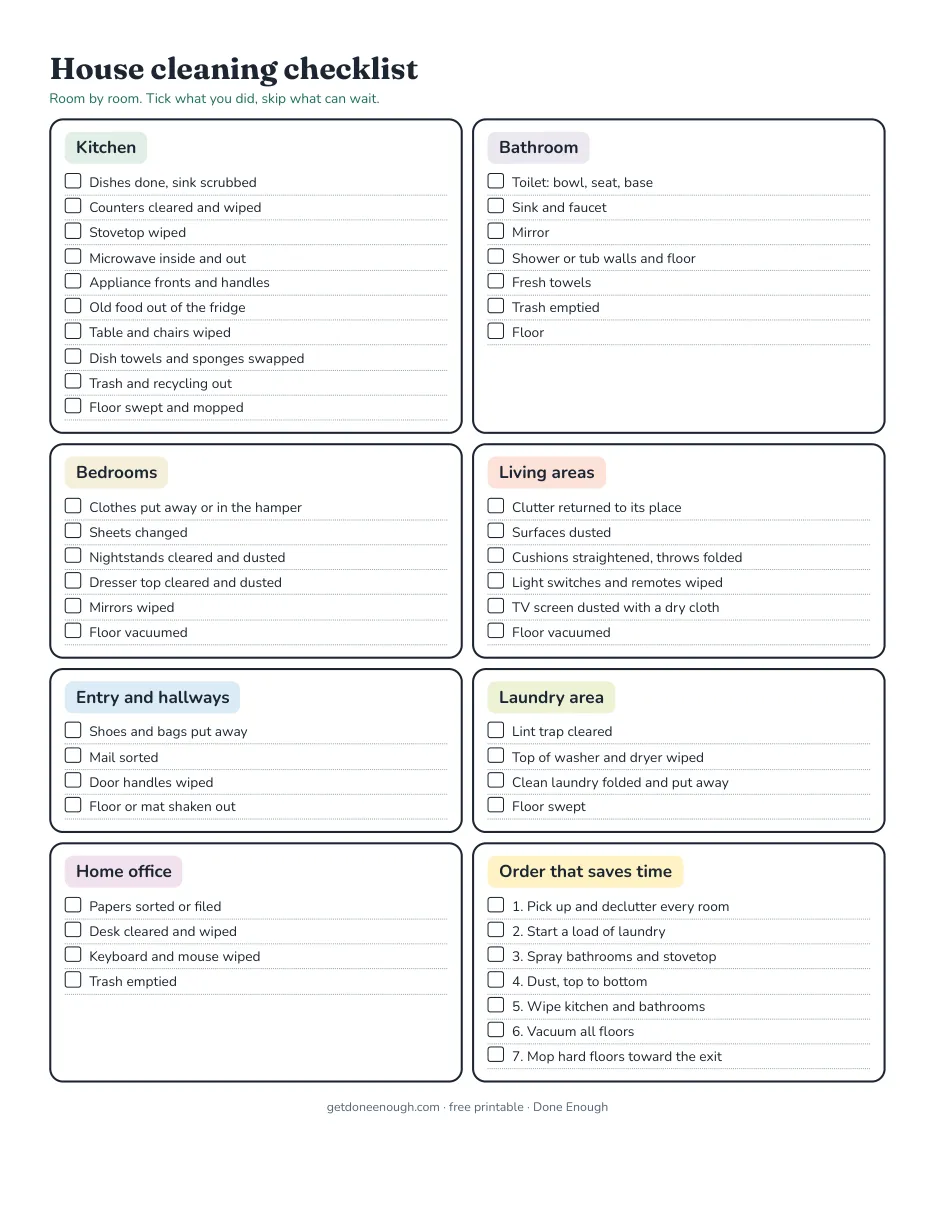
Free PDF: Seven rooms, one box each, plus the cleaning order that saves time.
Get the free PDFSee the planner on Etsy
The planner is sold in our own Etsy shop.
In this guide (16 parts)
- What is the correct order to clean a house?
- Cleaning, sanitizing or disinfecting: what does a house cleaning checklist need?
- What goes on a regular house cleaning checklist?
- Why each room’s tasks are on the list: the science
- What should a deep cleaning checklist include?
- Is it safe to mix cleaning products?
- Regular vs. deep clean: what is the difference?
- How often should you clean each room?
- How long does it take to clean a house?
- How do you create your own cleaning checklist?
- How do you make the checklist stick?
- If you have ADHD or your brain stalls on cleaning
- What people on Reddit say about cleaning a whole house
- Who’s behind Done Enough?
- How we wrote this guide
- Sources
A house cleaning checklist lists the same tasks for each room, in the same order, so you can clean without deciding what comes next. Use the regular checklist weekly and the deep cleaning checklist once or twice a year, plus before a move or a sale (our suggestion).
This page is part of our cleaning schedule and checklist guide. To spread these tasks across the week, use the weekly cleaning schedule. If you only need the everyday basics, start with the daily cleaning checklist.
Each task on this list has a reason behind it, and where public health agencies or published studies give that reason, we link it: why sponges get a swap instead of a microwave, why sheets go in hot water every week, why the bathroom fan matters for mold, and why two cleaners should never share a bucket.
Today's list 0/6 done
| Task | Done | Remove |
|---|---|---|
| Kitchen | ||
| Bathroom | ||
| Bedrooms | ||
| Living room | ||
| Entry and hallways | ||
| Hallway and entry floors last |
Saved on this device only. No account.
What is the correct order to clean a house?
Declutter every room first, then clean the kitchen, then the bathrooms, then dust and wipe the other rooms from top to bottom. Each room ends with its own floor, and the entry and hallway floors come last, so you finish at the door. Inside each room, five rules keep the order:
- Declutter. Clear the piles and take out the trash first, so every surface is reachable.
- Top to bottom. Dust shelves and fixtures before surfaces, surfaces before floors.
- Dry before wet. Dust and vacuum before you wipe and mop.
- Spray and wait. Spray the shower and toilet first, then do something else while the cleaner works.
- Floor last in each room, working toward the door.
Our tip for the order of rooms is to do the kitchen first and the bathrooms next, because they take the longest and the cleaner needs time to sit. Then dust and wipe the bedrooms and living areas, and finish with the entry and hallway floors, so you vacuum your way out.
| Step | Why it comes here |
|---|---|
| 1. Pick up and declutter every room | Clutter hides surfaces and slows every later step |
| 2. Start a load of laundry | It runs while you do everything else |
| 3. Spray bathrooms and stovetop | The cleaner works while you start on the kitchen |
| 4. Clean the kitchen | It takes the longest, so it is the first room |
| 5. Clean the bathrooms | The product has had time to loosen grime |
| 6. Clean bedrooms and living areas, top to bottom, floor last | Dust falls onto surfaces and floors you haven’t cleaned yet |
| 7. Vacuum the entry and hallways | You walk through them all day, so they go last |
| 8. Mop hard floors there, toward the exit | You don’t walk on wet, clean floor |
The “spray and wait” step has a measurable basis when the product is a disinfectant. The CDC says a disinfectant has to stay on the surface long enough to kill germs, and for diluted household bleach it gives a minimum of 1 minute with the surface visibly wet (CDC, April 2024). Wiping right after spraying skips that time.
Cleaning, sanitizing or disinfecting: what does a house cleaning checklist need?
A house cleaning checklist needs cleaning for almost every task, and disinfecting only for high-touch surfaces when someone at home is sick. A January 2025 CDC page defines the three steps: cleaning removes most germs, dirt and impurities with water, soap and scrubbing; sanitizing reduces germs to levels public health codes consider safe; disinfecting kills most germs on surfaces (CDC, January 2025). The same page says to disinfect “when someone is sick” or when someone at home has a weakened immune system. So the weekly list below says “wipe”: soap, water and friction do most of the work, and the CDC treats disinfecting as an extra step after cleaning. Save the disinfecting step for the handful of surfaces many hands touch, during an illness, and follow the label for how long the product must stay wet.
| Step | What it does (CDC, January 2025) | When it belongs on a home checklist |
|---|---|---|
| Cleaning | Removes most germs, dirt and impurities with water, soap and scrubbing | Every task, every time |
| Sanitizing | Reduces germs to levels public health codes or regulations consider safe | Only when a product label says it sanitizes (our suggestion) |
| Disinfecting | Kills most germs on surfaces and objects | High-touch surfaces when someone at home is sick or at higher risk |
Which surfaces count as high-touch?
High-touch surfaces are the spots many hands touch every day. The CDC gives light switches, doorknobs and countertops as examples (CDC, January 2025). Our list adds the same kind of spot room by room, as our suggestion: faucet handles, the toilet flush handle, fridge and microwave handles, remotes, stair rails, the keyboard and mouse, and phone screens (check the phone maker’s cleaning advice first).
How long does a disinfectant need to stay wet?
A disinfectant needs to stay wet for the contact time printed on its label, and for diluted household bleach the CDC gives at least 1 minute. The table sums up the verified numbers for bleach from the CDC’s April 2024 page; for any other product, the label sets the time.
| Product | Contact time | Mix and storage rule | Source |
|---|---|---|---|
| Soap or detergent and water (cleaning) | No contact time: scrub, rinse, dry | n/a | CDC, January 2025 |
| Diluted household bleach, 5% to 9% sodium hypochlorite | At least 1 minute, surface visibly wet | 5 tablespoons (1/3 cup) per gallon, or 4 teaspoons per quart, of room temperature water; make a new batch daily, it loses strength after 24 hours | CDC, April 2024 |
| Any other disinfectant | The time on its label, surface kept wet | Follow the label; never mix with other products | CDC, January 2025 |
The CDC adds that bleach outside the 5% to 9% range, or with no percentage on the bottle, is not suited to disinfecting, and that the bottle’s own directions come first when it has them.
What goes on a regular house cleaning checklist?
The regular list is the weekly one, split by room. Kitchen tasks include dishes, counters, stovetop, microwave and floor. Bathroom tasks include toilet, sink, mirror, shower and floor. Bedrooms, living areas, entry, laundry area and home office each get a short list too.
This is the weekly list. Copy it into your notes or keep this page open on your phone, and go room by room.
Kitchen
- ☐ Dishes done, sink scrubbed
- ☐ Counters cleared and wiped
- ☐ Stovetop wiped
- ☐ Microwave inside and out
- ☐ Appliance fronts and handles
- ☐ Old food out of the fridge
- ☐ Table and chairs wiped
- ☐ Dish towels and sponges swapped
- ☐ Trash and recycling out
- ☐ Floor swept and mopped
The kitchen has its own full list, with daily and deep tasks, in the kitchen cleaning checklist.
Bathroom
- ☐ Toilet: bowl, seat, base
- ☐ Sink and faucet
- ☐ Mirror
- ☐ Shower or tub walls and floor
- ☐ Fresh towels
- ☐ Trash emptied
- ☐ Floor
The full breakdown, with daily and monthly tasks, is in the bathroom cleaning checklist.
Bedrooms
- ☐ Clothes put away or in the hamper
- ☐ Sheets changed
- ☐ Nightstands cleared and dusted
- ☐ Dresser top cleared and dusted
- ☐ Mirrors wiped
- ☐ Floor vacuumed
Living areas
- ☐ Clutter returned to its place
- ☐ Surfaces dusted
- ☐ Cushions straightened, throws folded
- ☐ Light switches and remotes wiped
- ☐ TV screen dusted with a dry cloth
- ☐ Floor vacuumed
Entry and hallways
- ☐ Shoes and bags put away
- ☐ Mail sorted
- ☐ Door handles wiped
- ☐ Floor or mat shaken out
Laundry area
- ☐ Lint trap cleared
- ☐ Top of washer and dryer wiped
- ☐ Clean laundry folded and put away
- ☐ Floor swept
Home office
- ☐ Papers sorted or filed
- ☐ Desk cleared and wiped
- ☐ Keyboard and mouse wiped
- ☐ Trash emptied
Why each room’s tasks are on the list: the science
Several tasks on the weekly house cleaning checklist come straight from public health guidance or published research. The table links each one to its evidence, then the sections below explain the mechanism.
| Checklist task | What the evidence says | Source |
|---|---|---|
| Sponges swapped | Used kitchen sponges held up to 54 billion cells per cubic centimeter; regularly sanitized sponges had more of two dominant bacterial groups | Cardinale et al., 2017 |
| Old food out of the fridge | Keep the fridge at or below 40°F (4°C), freezer at 0°F (-18°C); clean regularly, wipe spills at once | FDA, 2023 |
| Sheets changed weekly | Wash bedding weekly in hot water, 130 to 140°F, to kill dust mites | NIEHS, March 2026 |
| Shower and bathroom floor | Keep indoor humidity below 60%, ideally 30% to 50%; dry wet areas within 24 to 48 hours | EPA, February 2026 |
| Surfaces dusted | Dust with a damp cloth; a dry cloth stirs up allergens | NIEHS, March 2026 |
| Floor vacuumed | HEPA filter on carpet and upholstery; people with asthma or allergies should leave the room | EPA, July 2026 |
Kitchen sponges: why “swap” beats “sanitize”
Kitchen sponges are one of the most heavily colonized objects in a home, which is why the checklist says to swap them rather than clean them. A 2017 study in Scientific Reports analyzed used kitchen sponges with DNA sequencing and microscopy and found bacteria throughout the sponge tissue, at local densities of up to 5.4 x 10^10 cells per cubic centimeter, about 54 billion (Cardinale et al., 2017). In sponges their owners said they sanitized regularly, two dominant bacterial groups, related to Chryseobacterium hominis and Moraxella osloensis, made up a greater share, which the authors say calls home sanitizing methods into question “in a long term perspective.” The study is from 2017, so it is older than 12 months, and it looked at bacterial DNA, not at illness in the households. Our suggestion: give sponges a short, fixed replacement interval you will actually keep, and use separate cloths for counters and dishes.
The study did not test dish towels. Swapping towels on the same day as sponges is our suggestion, so the kitchen has one reset moment instead of two.
Fridge cleanout: temperature first, then the shelves
A fridge cleanout starts with the temperature, because that is the number food safety guidance sets. The FDA says to keep the refrigerator at or below 40°F (4°C) and the freezer at 0°F (-18°C), and that an appliance thermometer is the best way to know those temperatures (FDA, page current as of January 2023). The same page says to clean the fridge regularly and wipe spills right away. In practice, the weekly “old food out of the fridge” task has three parts, in this order (our suggestion): check the thermometer, throw out what is past its date, then wipe the shelves where spills sat. A full shelf-out wash belongs on the deep clean list.
Bedding and dust mites: why sheets are weekly and hot
Weekly sheets in hot water are on the list because that is the dust mite guidance from the National Institute of Environmental Health Sciences. NIEHS says to “wash all bedding and blankets once a week in hot water,” at 130 to 140°F, to kill dust mites, and to keep indoor humidity at or below 50% with a dehumidifier or air conditioner (NIEHS, last reviewed March 2026). NIEHS also recommends allergen-impermeable covers for mattresses and pillows, a damp mop or rag for dust (never a dry cloth, which stirs allergens up), a HEPA filter or double-layered microfilter bag in the vacuum, a mask while vacuuming, and staying out of the vacuumed room for 20 minutes. Check the care label before washing at 130°F, since some fabrics cannot take it. The TV screen is the one surface our list keeps for a dry cloth (our suggestion: check the maker’s cleaning advice).
Bathroom mold, humidity and ventilation
Bathroom mold grows where moisture stays, so the checklist targets water and air before it targets stains. The EPA says to keep indoor humidity below 60%, ideally between 30% and 50%, and to dry water-damaged areas and items within 24 to 48 hours to prevent mold growth (EPA, updated February 18, 2026). For mold that keeps coming back in damp bathroom areas, the EPA suggests more ventilation and cleaning more often. Its asthma page adds: use exhaust fans or open a window in the bathroom and kitchen when showering, cooking or washing dishes, and dry wet things completely within one to two days (EPA, updated July 6, 2026). A cheap hygrometer, sold at hardware stores per the same EPA page, shows whether the room stays in range. Our suggestion: run the fan during the shower and for a while after, and squeegee or wipe the walls before you leave.
What should a deep cleaning checklist include?
A deep clean goes on top of the regular list and covers hidden spots: inside the oven and fridge, grout and caulk, under the bed, baseboards, vents, behind the machines, door frames, light fixtures and inside windows.
A deep clean still needs very little disinfecting. The CDC says cleaning with water, soap and scrubbing removes most germs, dirt and impurities from surfaces, and it saves disinfecting for when someone at home is sick or at higher risk (CDC, January 2025, older). Deep cleaning before a holiday? The Thanksgiving checklist has a short list of what to clean before guests arrive.
Mold on a hard surface such as tile is a cleaning job as well: the EPA says to scrub it off with detergent and water and dry the area completely (EPA, updated February 18, 2026).
| Room | Deep clean tasks |
|---|---|
| Kitchen | Inside oven, inside fridge and freezer, range hood filter, cabinet fronts, backsplash, small appliances, under the sink, behind the fridge if it moves |
| Bathroom | Grout and caulk, shower head, exhaust fan cover, behind the toilet, inside cabinets, wash the bath mat and shower curtain |
| Bedrooms | Vacuum mattress, wash pillows and duvet if the labels allow, under the bed, closet floor, window sills |
| Living areas | Under sofa cushions and furniture, baseboards, vents, ceiling fan, lampshades, curtains |
| Laundry | Washer gasket and detergent drawer, behind the machines, dryer vent hose if reachable |
| Whole house | Door frames and doors, light fixtures, inside windows and tracks, trash cans washed |
Our tip is to run a deep clean one room per day for a week, on top of a short daily reset. Day one kitchen, day two bathrooms, day three bedrooms, and so on. Each day stays manageable and you still finish the whole house. The full room-by-room method, with the order and timings, is in how to deep clean a house. Leaving a rental? Use the move out cleaning checklist, which adds the spots landlords check.
Follow the label on every product. The CDC says not to mix products or chemicals with each other (CDC, January 2025, older), and the EPA warns never to mix chlorine bleach with cleaners that contain ammonia (EPA, updated February 18, 2026). Our tip: test a new product on a hidden spot first.
Is it safe to mix cleaning products?
Mixing cleaning products is not safe, and the CDC says never to mix household bleach, or any disinfectant, with other cleaners, because it can release vapors that are dangerous to breathe (CDC, April 2024). Many adults do not know the rule. In a 2020 CDC survey of 502 US adults, run in May 2020, only 58% knew bleach should not be mixed with ammonia and only 35% knew it should not be mixed with vinegar (CDC MMWR, June 2020). In the same survey, 39% reported at least one high-risk practice, such as putting bleach on food (19%), and 25% reported at least one adverse health effect in the previous month. The authors list limits: an opt-in online panel, possible social desirability bias, and a cross-sectional design that cannot tie a symptom to a practice. The survey ran early in the COVID-19 pandemic, so it reflects that moment.
Where to store cleaning products
Cleaning products belong out of the reach of children and pets, as the CDC puts it (CDC, January 2025). Poison center data show why. In 2024, US poison centers recorded nearly 2.1 million human exposures (2,092,689), and household cleaning substances were the top category for children 5 and under, with 87,031 exposures, or 10.1% (National Capital Poison Center, 2024 data). For adults, cleaning substances ranked fifth, at 74,838 (5.9%). The 2024 figures are the latest on that page, so the data are older than 12 months. Our suggestion: a high or latched cabinet, original containers only and a cabinet away from food.
Ventilation, VOCs and the Safer Choice label
Cleaning products are one source of volatile organic compounds (VOCs) indoors, and the EPA lists “cleansers and disinfectants” among household sources (EPA, updated June 23, 2026). The EPA notes that no federally enforceable standards exist for VOCs in non-industrial settings, and its advice is practical: increase ventilation when you use these products, “meet or exceed any label precautions,” and buy limited quantities. The CDC gives the same ventilation advice for bleach: open windows and doors (CDC, April 2024).
One long cohort adds a reason to take this seriously, with a caveat. A 2018 study followed 6,235 adults in the European Community Respiratory Health Survey at three time points over 20 years (Svanes et al., 2018). Lung function (FEV1) fell by 18.5 ml a year in women who did not clean, versus 22.1 ml in women who cleaned at home and 22.4 ml in occupational cleaners. No significant link was found in men. The study shows an association, not proof that cleaning products caused the decline.
If you want a shortcut when buying, the EPA Safer Choice label means the EPA reviewed every chemical ingredient, the product must perform comparably to conventional products, and VOC content is limited. Nearly 2,000 products qualify (EPA Safer Choice, updated September 1, 2026).
Regular vs. deep clean: what is the difference?
A regular clean happens weekly, focuses on surfaces people see and touch, and is short and split by day. A deep clean, in our suggestion once or twice a year plus before a move or a sale, targets hidden build-up under, behind and inside things, and takes several hours or a weekend.
| Compare | Regular clean | Deep clean |
|---|---|---|
| How often (our suggestion) | Weekly | Once or twice a year, plus before a move or a sale |
| Focus | Surfaces people see and touch | Hidden build-up: under, behind, inside |
| Time | Short, split by day | Several hours, or a weekend |
| Best with | The weekly schedule | A list you check off over several days |
How often should you clean each room?
Daily for dishes and a quick bathroom wipe, weekly for floors, sheets and a full bathroom clean, monthly for baseboards and the oven, and once or twice a year for the rest. These frequencies are our suggestion, not an official schedule, except where the last column names a source:
| Task | Daily | Weekly | Monthly | Once or twice a year |
|---|---|---|---|---|
| Dishes and counters | Yes | |||
| Quick bathroom wipe (sink, toilet seat) | Yes | |||
| Full bathroom clean | Yes | |||
| Vacuum and mop floors | Yes | |||
| Change sheets | Yes (NIEHS: wash bedding weekly for dust mites) | |||
| Dust surfaces | Yes | |||
| Clean out the fridge | Yes | |||
| Baseboards, vents, light fixtures | Yes | |||
| Inside oven and microwave deep clean | Yes | |||
| Wash pillows, duvet, curtains | Yes | |||
| Behind and under furniture | Yes | |||
| Windows and tracks | Yes |
For the full rotation, see the monthly cleaning schedule, or the day-by-day plan in the weekly cleaning schedule guide.
How long does it take to clean a house?
Our estimates for one person in a lived-in home: a regular clean, done weekly, takes about 20 to 30 minutes in the kitchen and about 15 in a bathroom. A deep clean, done once or twice a year, takes about 2 to 3 hours in the kitchen.
A home with pets, kids, more rooms or a long gap since the last clean will take longer.
| Room | Regular clean (our estimate) | Deep clean (our estimate) |
|---|---|---|
| Kitchen | about 20-30 min | about 2-3 hours |
| Bathroom | about 15 min | about 1 hour |
| Bedroom | about 15 min | about 1 hour |
| Living room | about 20 min | about 1-2 hours |
| Entry and hallway | about 5-10 min | about 30 min |
What the American Time Use Survey measures
The American Time Use Survey gives a measured benchmark for housework time in the US, separate from our per-room estimates. In its 2025 results, released June 25, 2026, the Bureau of Labor Statistics found that 36.1% of people did housework (cleaning, laundry and similar) on an average day, 47.9% of women and 23.8% of men (BLS, 2026). Averaged over everyone, housework took 0.56 hours a day: 0.81 for women and 0.30 for men. Food preparation and cleanup is counted separately, at 65.2% of people and 0.71 hours a day. More people did housework on weekend days than on weekdays, 40% versus 35% (BLS news release, 2026). Averages include people who did none that day, so they are not the time one full clean takes.
| ATUS 2025, average day | Total | Women | Men |
|---|---|---|---|
| Did housework | 36.1% | 47.9% | 23.8% |
| Hours of housework (all people) | 0.56 | 0.81 | 0.30 |
| Did food preparation and cleanup | 65.2% | 72.2% | 57.9% |
| Hours of food prep and cleanup (all people) | 0.71 | 0.91 | 0.51 |
Our tip: if the total looks like too much for one day, split it into 20 to 30 minutes a day instead of one long Saturday. Speed cleaning covers the fast version for when guests are on the way.
How do you create your own cleaning checklist?
To create your own cleaning checklist, list every room, write its tasks in the order you do them, and tag each task with how often it happens. The list above is a starting point. Your home and your habits decide what stays.
- Walk through and list every room, including the ones you forget (laundry area, stairs, car).
- Write the tasks per room in the order you would do them: declutter, dust, wipe, floor.
- Tag each task daily, weekly, monthly or once or twice a year.
- Cut what you never do. If you have never once cleaned the light fixtures weekly, move them to monthly.
- Put it where you clean. Inside a cabinet door, on the fridge, or on your phone.
- Review after two weeks. Anything you skip every time is either in the wrong frequency or not needed.
Want a ready-made layout? The blank cleaning schedule template is a table with daily, weekly and monthly rows that you can copy into a notes app or a spreadsheet.
How do you make the checklist stick?
Keep the list short and visible, and tie it to a fixed slot in your week. These tips are our suggestions:
- Write one list per room and keep it where you clean (inside a cabinet door works).
- Go down the list in order. Check off each task as you finish it, so you never have to decide what comes next.
- Trim it. Drop or move any task you skip every time, so the list stays short enough to finish.
- Pair it with a fixed time. Same day, same slot, so it becomes routine.
- Can’t start? Put three rooms on the task wheel and let it pick one.
Why an if-then plan helps
An if-then plan names the moment and the first action in one sentence, such as “If it is Saturday at 9 am, then I start the kitchen list.” Psychologists call this an implementation intention. A 2021 meta-analysis in Frontiers in Psychology pooled 24 effect sizes from 21 studies, with 15,907 participants, on mental contrasting with implementation intentions (MCII): picturing the goal and the obstacle, then writing an if-then plan (Wang, Wang and Gai, 2021). The authors found MCII helps goal attainment with “a small to medium effect size” (g = 0.336). The effect was larger when people worked through it with an experimenter (g = 0.465) than from a document alone (g = 0.277). The studies covered goals in general, not house cleaning, so it supports trying the method without promising results for cleaning. Our suggestion for the checklist: write one if-then line per cleaning slot and add the likely obstacle, for example “If I am too tired, then I do only the kitchen counters.”
If you have ADHD or your brain stalls on cleaning
ADHD is common in adults, and a 2024 CDC report estimates that 15.5 million US adults (6.0%) had a current ADHD diagnosis in late 2023, with more than half (55.9%) diagnosed in adulthood (CDC MMWR, October 2024). The National Institute of Mental Health lists inattention, including trouble “staying organized,” among the symptoms, and notes that symptoms “can make it hard to get things done” (NIMH, last reviewed August 2026). A checklist is not a treatment, and the tips below have not been tested in a study we could find. If ADHD symptoms affect daily life, a doctor or mental health professional is the right person to talk to.
If a full checklist looks like a wall of tasks, make each start smaller. These are our suggestions, not findings from a study:
- Work in timer chunks. Set 10 or 15 minutes, do one room’s list until it rings, then decide whether to keep going.
- Name the first physical move. “Pick up the cups on the coffee table” is easier to start than “clean the living room.”
- Body doubling. Clean while someone is in the room or on a call, even if they are doing something else.
- Keep the list visible. On the wall or fridge, not in a drawer or an app you have to open.
- Use a “goes elsewhere” basket. Drop anything that belongs in another room into one basket and put it all away at the end, instead of walking back and forth.
- Lower the bar. Stop when a room is mostly done today, and leave the rest for the next pass.
The ADHD cleaning checklist breaks each room into 5-minute chunks. For days when starting is the hard part, see cleaning motivation.
What people on Reddit say about cleaning a whole house
Two threads from r/CleaningTips, in our words. Personal accounts, not proof that a method works.
- A thread asking for low-effort, clean-as-you-go tips (r/CleaningTips, January 2026). One commenter suggests timing a dreaded task to see how long it really takes, and found the dishes take about twice as long once they pile up for a few days. Another uses the couple of minutes the microwave runs to clean something, and a third keeps cleaning wipes in the bathroom so a quick wipe needs no trip for supplies.
- A thread on keeping up without losing the weekend (r/CleaningTips, February 2026). One commenter splits the problem in two, treating dirt and clutter as separate jobs. Our list uses the same split: every room starts with clutter and only then moves to surfaces.
Who’s behind Done Enough?
Done Enough is a small independent shop, not a clinic. We build free planning tools and sell printables on Etsy. We are not professional cleaners or clinicians: each guide links its sources so you can check every claim, and our own tips are marked as suggestions.
How we wrote this guide
In October 2026 we read the CDC’s home cleaning and bleach guidance, the EPA’s pages on mold, air ducts, asthma triggers, VOCs and the Safer Choice label, the NIEHS dust mite page, the FDA’s food storage page, the BLS American Time Use Survey, national poison center statistics, NIMH’s ADHD page, and the published studies listed below, and checked US search data for the questions people ask about this topic. Times marked “our estimate” are our own rough estimates, not measurements.
Tips without a source are our suggestions. The two Reddit threads were read on October 10, 2026; they are personal accounts, not evidence that a method works. Anything older than 12 months is marked with its year. We did not use any study published before 2016.
Sources
- CDC (2025). When and How to Clean and Disinfect Your Home. Page dated January 31, 2025. https://www.cdc.gov/hygiene/about/when-and-how-to-clean-and-disinfect-your-home.html Older than 12 months.
- CDC (2024). Cleaning and Disinfecting with Bleach. Page dated April 24, 2024. https://www.cdc.gov/hygiene/about/cleaning-and-disinfecting-with-bleach.html Older than 12 months. Read October 25, 2026.
- CDC (2020). Survey of household cleaning and disinfection practices, May 2020. MMWR 69(23):705-709, June 2020. https://www.cdc.gov/mmwr/volumes/69/wr/mm6923e2.htm Older than 12 months.
- National Capital Poison Center. National poison statistics, 2024 data. https://www.poison.org/poison-statistics-national Data older than 12 months. Read October 25, 2026.
- Cardinale M. et al. (2017). Study of used kitchen sponges. Scientific Reports 7:5791, July 19, 2017. https://www.nature.com/articles/s41598-017-06055-9 Older than 12 months.
- Svanes Ø. et al. (2018). Cleaning at home and at work and lung function decline, European Community Respiratory Health Survey. American Journal of Respiratory and Critical Care Medicine 197(9):1157. https://academic.oup.com/ajrccm/article/197/9/1157/8498721 Older than 12 months.
- Wang, Wang and Gai (2021). Meta-analysis of mental contrasting with implementation intentions (MCII) and goal attainment. Frontiers in Psychology, May 12, 2021. https://www.frontiersin.org/articles/10.3389/fpsyg.2021.565202/full Older than 12 months.
- FDA. Are You Storing Food Safely? Content current as of January 18, 2023. https://www.fda.gov/consumers/consumer-updates/are-you-storing-food-safely Older than 12 months.
- NIEHS. Dust Mites and Cockroaches. Last reviewed March 6, 2026. https://www.niehs.nih.gov/health/topics/agents/allergens/dustmites Read October 25, 2026.
- EPA (2026). A Brief Guide to Mold, Moisture and Your Home. Page last updated February 18, 2026. https://www.epa.gov/mold/brief-guide-mold-moisture-and-your-home Read October 25, 2026.
- EPA (2026). Asthma Triggers: Gain Control. Page last updated July 6, 2026. https://www.epa.gov/asthma/asthma-triggers-gain-control Read October 25, 2026.
- EPA (2026). Volatile Organic Compounds’ Impact on Indoor Air Quality. Page last updated June 23, 2026. https://www.epa.gov/indoor-air-quality-iaq/volatile-organic-compounds-impact-indoor-air-quality Read October 25, 2026.
- EPA (2026). Learn About the Safer Choice Label. Page last updated September 1, 2026. https://www.epa.gov/saferchoice/learn-about-safer-choice-label Read October 25, 2026.
- EPA (2026). Should You Have the Air Ducts in Your Home Cleaned? Page last updated February 19, 2026. https://www.epa.gov/indoor-air-quality-iaq/should-you-have-air-ducts-your-home-cleaned Read October 24, 2026.
- BLS (2026). American Time Use Survey, 2025 Results. Released June 25, 2026. https://www.bls.gov/news.release/atus.nr0.htm and Table 1, https://www.bls.gov/news.release/atus.t01.htm Read October 25, 2026.
- CDC (2024). Report on ADHD diagnosis in US adults, data from October to November 2023. MMWR 73(40):890-895, October 10, 2024. https://www.cdc.gov/mmwr/volumes/73/wr/mm7340a1.htm Older than 12 months.
- NIMH. Attention-Deficit/Hyperactivity Disorder. Last reviewed August 2026. https://www.nimh.nih.gov/health/topics/attention-deficit-hyperactivity-disorder-adhd Read October 25, 2026.
- Reddit, r/CleaningTips, thread posted January 2026 (link). Read October 10, 2026. Personal accounts, not evidence.
- Reddit, r/CleaningTips, thread posted February 2026 (link). Read October 10, 2026. Personal accounts, not evidence.
FAQ
What is not included in a deep clean?
In our list, left out: carpet shampooing, outside windows above the ground floor, and moving heavy or fixed furniture. Two limits follow the EPA: for mold on more than about 10 square feet it points to its remediation guide and an experienced contractor if you hire one, and it recommends cleaning air ducts only as needed, not routinely.
What is a professional house cleaning checklist?
We did not find an industry-standard list. If you hire a cleaning company, ask to see the list it works from before you book. The room-by-room list on this page is ours, written for doing it yourself.
What is a housekeeping checklist?
In a home, a housekeeping checklist is the same thing as a house cleaning checklist: the tasks for each room, in the order you do them, tagged daily, weekly, monthly or once or twice a year. The room lists on this page are one you can copy.
What are home cleaning essentials?
There is no official list. Our suggestion: an all-purpose cleaner or dish soap, a bathroom cleaner, a glass cleaner, microfiber cloths, a scrub brush, a vacuum, a mop and bucket, rubber gloves and trash bags. The CDC says not to mix products or chemicals with each other. If you want help choosing products, the EPA Safer Choice label means the EPA reviewed every chemical ingredient in the product.