Cleaning
How to deep clean a house room by room, in the right order
Updated · Written by the Done Enough team · Sources linked below
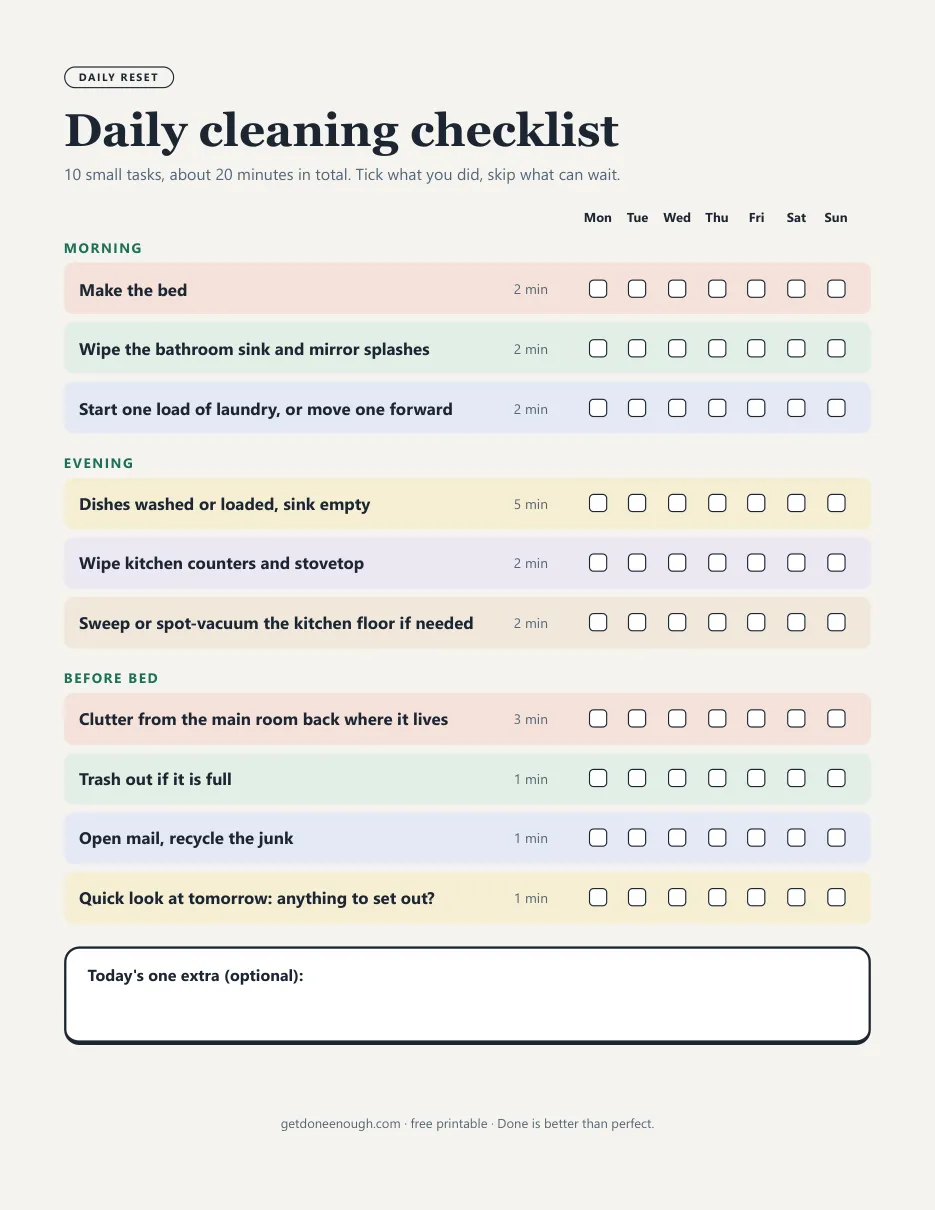
Free PDF: A one-page daily cleaning checklist with a checkbox for each day of the week.
Get the free PDFSee the planner on Etsy
The planner is sold in our own Etsy shop.
In this guide (23 parts)
- What is a deep clean of a house?
- What does deep cleaning include?
- Deep cleaning vs regular cleaning: what is the difference?
- Which spots in a house collect the most germs and grime?
- In what order should you clean the house?
- What to gather before you start
- Is deep cleaning safe?
- A deep house cleaning checklist
- How do you deep clean your house, room by room?
- How do you clean carpet, floors and the couch?
- Apartment deep cleaning checklist
- A new house, a house for sale, or after construction
- One weekend or six sessions: two plans
- How long does it take to deep clean a house?
- How often should you deep clean your house?
- What are the benefits of deep cleaning?
- What is the 20/10 rule for cleaning?
- Do you need to disinfect everything?
- Tips that save time on the day
- How do you keep the house clean afterward?
- Who’s behind Done Enough?
- How we wrote this guide
- Sources
To deep clean a house room by room, declutter the whole house first, then clean one room at a time from top to bottom and dry before wet, with each room’s floor last. Start with the kitchen and bathrooms, where products need time to work, then bedrooms, living areas, entry and laundry, and finish with the hallway and entry floors. Split it over one weekend or six shorter sessions.
This guide is part of our cleaning schedule and checklist guide. It covers what a deep clean is, how to deep clean the house in the right order, a checklist, the steps in each room, and a plan. For the regular weekly clean, use the house cleaning checklist instead.
It also explains the science behind each step: why kitchen sponges and shower heads deserve special attention, how long a disinfectant needs to stay wet, what cleaning sprays do to indoor air, and why humidity matters as much as scrubbing. Every figure links to the study or agency page it comes from, with its year.
Deep clean order 0/8 done
| Task | Done | Remove |
|---|---|---|
| Declutter every room | ||
| Kitchen | ||
| Bathrooms | ||
| Bedrooms | ||
| Living areas | ||
| Entry and hallways | ||
| Laundry area | ||
| Hallway and entry floors last |
Saved on this device only. No account.
What is a deep clean of a house?
A deep clean is a slow, top-to-bottom clean of every room that removes the build-up a regular clean leaves behind: the furniture gets moved and the appliances get opened instead of wiped around. It also covers jobs too long for a normal week, such as degreasing the range hood filter or scrubbing grout.
What does deep cleaning include?
Deep cleaning includes the regular clean plus baseboards and door frames, vents and light fixtures, the inside of the oven and fridge, grout and caulk, under beds and sofas, behind appliances that move, and inside windows and their tracks. It also covers washing pillows, curtains, cushion covers and bath mats, when their labels allow it.
Our list leaves out anything that needs special equipment or a trade: carpet shampooing, outside windows above the ground floor, duct cleaning, and mold on more than a small area.
| On our list | Left off our list |
|---|---|
| Baseboards, door frames, doors, switches | Carpet shampooing or steam cleaning |
| Vents (covers), light fixtures, ceiling fans | Air duct cleaning |
| Inside oven, fridge, freezer, microwave | Outside windows above the ground floor |
| Grout, caulk, shower head, behind the toilet | Mold on a large area |
| Under and behind furniture you can move | Moving heavy furniture or appliances that are fixed in place |
| Inside windows, sills and tracks | Walls repainted or patched |
Two of those limits follow EPA guidance. For mold on an area of “less than about 10 square feet”, the EPA says that in most cases you can handle the job yourself; for larger areas it points to its remediation guidance and advises choosing an experienced contractor if you hire one (EPA, updated February 18, 2026). For air ducts, the EPA “does not recommend that the air ducts be cleaned routinely, but only as needed” (EPA, updated February 19, 2026). Wiping the vent covers is still part of the job.
Deep cleaning vs regular cleaning: what is the difference?
The difference between deep cleaning and regular cleaning is depth and frequency. Regular cleaning, also called standard or basic cleaning, keeps the surfaces you use every day clean each week; a deep clean adds the jobs listed above and happens far less often.
In a regular house clean you wipe the stovetop; in a deep clean you also degrease the range hood filter and clean inside the oven. Read across a row to compare the two jobs in the same room.
| Area | Regular cleaning | Deep cleaning |
|---|---|---|
| Kitchen | Dishes, counters, stovetop, sink, outside of appliances | Also inside the oven and fridge, range hood filter, behind the stove and fridge |
| Bathroom | Toilet, sink, mirror, shower walls, floor | Also grout and caulk, shower head, fan cover, behind the toilet |
| Bedroom | Bed made, surfaces dusted, floor vacuumed | Also mattress vacuumed, pillows washed, under the bed, closet floor |
| Living areas | Pick up, dust, vacuum the open floor | Also under cushions and furniture, curtains, lampshades, ceiling fan |
| Whole house | Floors, trash out | Also baseboards, door frames, vent covers, light fixtures, inside windows |
| How often (our suggestion) | Weekly | Once or twice a year, plus before a move or a sale |
The weekly side in full, room by room, is on the house cleaning checklist. If a cleaning company offers standard vs deep cleaning, ask to see both lists before you book.
Which spots in a house collect the most germs and grime?
The household spots with the strongest published evidence of microbial build-up are the kitchen sponge, the cutting board and the shower head, plus the dust that settles on floors and furniture. Each is moist, used daily or rarely moved, and a weekly clean tends to skip them. The table summarizes what researchers measured in real homes.
| Spot | What researchers found | Study, year |
|---|---|---|
| Kitchen sponge | 14 used sponges; bacterial densities up to 54 billion (5.4 x 10¹⁰) cells per cubic centimeter in the most colonized spots | Cardinale et al., Scientific Reports, 2017 |
| Cutting board | 100 home boards; plastic boards had higher counts of aerobic bacteria and Enterobacteriaceae; E. coli on 5%, Listeria monocytogenes on 3% | LWT, vol. 221, 2025 |
| Shower head | Biofilm sampled in 656 homes in the US and 13 European countries; Mycobacterium was the most abundant genus | Gebert et al., reported by CIRES, 2018 |
| House dust | 45 consumer-product chemicals pooled across US studies; 10 found in over 90% of dust samples, phthalates at the highest levels | Mitro et al., Environmental Science & Technology, 2016 |
These numbers describe what lives on surfaces, not how often people get sick from them, so read them as a guide to where effort pays off. The room sections below turn each finding into a concrete step.
In what order should you clean the house?
Declutter every room first, then clean the kitchen and bathrooms, then the bedrooms and living areas, then the entry, hallways and laundry area. Each room ends with its own floor, and the hallway and entry floors come last, toward the front door, since you walk through them all day. Inside each room, five rules apply:
- Declutter first, everywhere. Put things away and bag the trash in every room before you clean any of them, so every surface is reachable. Our tip: keep a donate box and a trash bag by the door while you go.
- Top to bottom: ceiling fan and light, then shelves and tops of doors, then counters and furniture, then baseboards, then floor. Dust falls, so anything you clean below it first gets dirty again.
- Dry before wet. Dust and vacuum before you wipe or mop, so a wet cloth does not smear the dust around.
- Spray and wait. Spray the oven, shower and toilet first, then do something else while the product works. The label gives the time, and for a disinfectant the EPA says the surface should stay wet the whole time (see the disinfecting section below).
- Back to front. In each room, start in the far corner and finish at the door, floor last.
Our tip is to start with the kitchen and bathrooms because they take the longest, they need products to sit, and they are easier while you still have energy.
The six steps in every room
Every room follows the same six steps, from a child’s bedroom to a home office.
| In every room | What you do |
|---|---|
| 1. Clear | Surfaces and floor emptied, trash out, laundry to the machine |
| 2. Pre-treat | Spray what needs to soak (oven, shower, toilet, sticky spots) |
| 3. Dust high | Ceiling fan, light, tops of doors, frames, curtain rods |
| 4. Wipe middle | Counters, furniture, fronts of cabinets, switches, handles |
| 5. Wipe low | Baseboards, under and behind furniture |
| 6. Floor | Vacuum, then mop hard floors toward the door |
What to gather before you start
The basics are an all-purpose cleaner, a bathroom cleaner, a degreaser, glass cleaner, microfiber cloths, a scrub brush, a duster, a vacuum with its tools, a mop and bucket, rubber gloves and trash bags. Keep them in one caddy to save trips. This list is our suggestion, not a shopping requirement: use what you already own.
| Item | What it is for |
|---|---|
| All-purpose cleaner or dish soap in warm water | Most surfaces, cabinet fronts, baseboards |
| Bathroom cleaner | Soap scum, toilet, sink |
| Degreaser or oven cleaner | Stovetop, range hood filter, oven |
| Glass cleaner | Mirrors, windows, glass doors |
| 6 to 10 microfiber cloths | Separate cloths for the toilet and the rest |
| Scrub brush and an old toothbrush | Grout, faucet bases, tracks |
| Extendable duster | Ceiling fans, corners, tops of cabinets |
| Vacuum with crevice and brush tools | Mattresses, sofa, baseboards, vents |
| Mop and bucket | Hard floors, last |
| Rubber gloves, trash bags, a laundry basket | The basket collects things that belong in other rooms |
Is deep cleaning safe?
It can be, if you follow each product label and a few official precautions: do not mix products, keep the room ventilated, wear the gloves or goggles the label recommends, and take extra care with old paint and mold.
The CDC says “Do not mix products or chemicals with each other”, to ensure good ventilation indoors, and to wear the recommended protective equipment, such as gloves or goggles (CDC, January 31, 2025, older). The EPA adds never to mix bleach with cleaners that contain ammonia (EPA, 2026).
Older homes need one more precaution. If your home was built before 1978, it is more likely to have lead-based paint. If you see peeling, chipping or cracking paint, the EPA says to clean the area right away with a wet cloth, wipe or sponge, to pick up chips with a damp paper towel, and not to dry sweep or use steel wool, scouring pads or abrasive cleaners. It also advises wet mopping floors to reduce lead dust, and says not to try removing lead-based paint yourself (EPA, updated October 5, 2026).
Our tip for the high work: use a step stool or a stable ladder for ceiling fans and the tops of cabinets, never a chair or a stack of boxes.
What poison center data show about cleaning products
US poison center data show that cleaning product exposures rise when people clean more, and the CDC lists mixing products as one form of improper use. In the first three months of 2020, US poison centers received 45,550 exposure calls about cleaners and disinfectants (28,158 for cleaners, 17,392 for disinfectants), 20.4% more than in the same months of 2019. Bleach accounted for 62.1% of the rise in cleaner calls, and calls about inhaling disinfectants more than doubled, up 108.8% (CDC MMWR, April 2020). The report adds that these call data cannot show a causal link to any one behavior. A second 2020 CDC survey of 502 US adults found that many people do not know the basic mixing rules, and 25% reported at least one adverse health effect they linked to cleaners or disinfectants (CDC MMWR, June 2020). So use one product per surface, rinse before switching, and never combine bleach with anything else.
| Rule (2020 CDC survey, 502 adults) | Share who knew it |
|---|---|
| Do not mix bleach with ammonia | 58% |
| Do not mix bleach with vinegar | 35% |
| Reported at least one high-risk cleaning practice | 39% |
| Reported an adverse health effect | 25% |
The American Lung Association gives the same warning: “Never mix bleach or any bleach-containing product with any cleaner containing ammonia” (ALA, updated June 11, 2026).
What cleaning products do to indoor air
Cleaning products release volatile organic compounds (VOCs), gases that build up indoors while you clean. The EPA lists products for household cleaning among the sources of indoor air pollutants (EPA, updated March 19, 2026). The American Lung Association names aerosol sprays, air fresheners, chlorine bleach, detergent and dishwashing liquid, rug and upholstery cleaners, furniture and floor polish, and oven cleaners among products that can contain VOCs, and advises opening windows and doors and never cleaning in a small, enclosed space (ALA, 2026).
Measurements in real homes back this up. A 2022 study sampled the breathing-zone air of 50 women cleaning their own homes in California for 46 VOCs and semi-volatile compounds. Women who used conventional bleach products, disinfecting wipes and dish soap had higher air levels of several VOCs, including chloroform and 1,4-dioxane. In a test chamber, 75% of the highest VOC emissions came from conventional products, but “green” products also emitted some VOCs of concern (Calderon et al., Indoor Air, 2022).
A 2025 study measured air before and after surface cleaning in several indoor locations. Total VOCs rose by 10 to 104 parts per billion after cleaning, about 27 on average. Leaving a quaternary ammonium bathroom cleaner to sit for 10 minutes raised fine particles (PM2.5) by 22.2 micrograms per cubic meter, and spaces with poor ventilation showed 146% to 346% higher fine particle loadings than better ventilated ones (Souza et al., ACS Earth and Space Chemistry, 2025). The authors used a low-cost sensor and caution that its values are comparative, not exact.
| Evidence | What it means for your deep clean |
|---|---|
| Conventional bleach, wipes and dish soap raised breathing-zone VOCs (2022) | Use the smallest amount the label allows |
| “Green” products also emitted some VOCs (2022) | A green label does not replace ventilation |
| Poor ventilation: 146% to 346% more fine particles (2025) | Open windows or run the bathroom fan while products sit |
| Long dwell in a closed bathroom raised PM2.5 and VOCs (2025) | Leave the room while a product works, door open |
Cleaning sprays and the lungs
Regular use of cleaning sprays or other cleaning products at home has been linked to faster lung function decline in women in one long-term study. A 2018 study followed 6,235 adults in the European Community Respiratory Health Survey for more than 20 years. Women who cleaned at home lost lung function (FEV1, the air you can blow out in one second) 3.6 ml per year faster than women who did not clean, and women who worked as cleaners 3.9 ml per year faster. The link was not seen in men (Svanes et al., reported by ScienceDaily, 2018). This is an association, not proof that sprays caused the decline, it concerns years of regular use, and the article notes that the comparison group of women who did not clean was very small. Lead author Øistein Svanes said “microfiber cloths and water are more than enough for most purposes.” Our takeaway for a deep clean: pour or wipe instead of spraying into the air where you can, and save stronger products for the jobs that need them.
A deep house cleaning checklist
This checklist puts the deep cleaning tasks for each room in one place, so you can check them off as you go. Work down it in order, kitchen first and the hallway and entry floors last. Your checkmarks are saved in this browser, so you can stop and pick it up another day.
Deep cleaning checklist by room 0/18 done
| Task | Done | Remove |
|---|---|---|
| Kitchen: inside the oven and microwave | ||
| Kitchen: fridge emptied, shelves and drawers washed | ||
| Kitchen: range hood filter and stove grates degreased | ||
| Kitchen: behind and under the fridge and stove | ||
| Bathrooms: grout, caulk and shower head | ||
| Bathrooms: fan cover, behind and around the toilet | ||
| Bathrooms: mats, towels and shower curtain liner washed | ||
| Bedrooms: mattress vacuumed, pillows and duvet washed | ||
| Bedrooms: under the bed and the closet floor | ||
| Living areas: under cushions and furniture | ||
| Living areas: curtains, lampshades and ceiling fan | ||
| Entry and stairs: door, rail, mat, stairs top down | ||
| Laundry: washer gasket, lint filter, behind the dryer | ||
| Every room: baseboards, door frames, switches, handles | ||
| Every room: vent covers and light fixtures | ||
| Every room: inside windows, sills and tracks | ||
| Trash cans washed and dried | ||
| Hallway and entry floors last, toward the front door |
Saved on this device only. No account.
How do you deep clean your house, room by room?
Take the rooms in the order above, kitchen first, and run the six steps in each one. The lists below add only the work specific to each room.
Kitchen
-
Empty the fridge, toss expired food, and wash the shelves and drawers.
-
Spray the oven or start its cleaning cycle, and soak the range hood filter and stove grates in hot soapy water.
-
Dust the tops of the cabinets, the light and the top of the fridge.
-
Wipe cabinet fronts and handles, the backsplash, and the outside of every appliance.
-
Clean the microwave, the small appliances, and under the sink.
-
Wipe out the oven, rinse the filter and grates, and put everything back.
-
Pull out the fridge or stove if they move, and clean behind and under them.
-
Scrub the sink and faucet last, then the floor.
-
Replace the kitchen sponge and check the cutting boards (see below).
The full kitchen routine, daily to monthly, is on the kitchen cleaning checklist.
Why the sponge and the cutting board matter
A kitchen sponge is one of the most densely colonized objects in a home. A 2017 study sequenced the bacteria in 14 used kitchen sponges and found local densities up to 54 billion cells per cubic centimeter. Sponges that their owners said they regularly sanitized, by heating in a microwave or rinsing with hot soapy water, did not hold significantly fewer bacteria (p = 0.78), and two bacterial types closely related to risk group 2 species (species that can cause disease in some people) made up a larger share in them; the authors note that this relatedness is only a weak indicator of disease potential. The authors suggested “replacement of kitchen sponges, for example, on a weekly basis” (Cardinale et al., Scientific Reports, 2017). They describe sponges as porous, water-soaking incubators where bacteria concentrate on the internal cavity walls, and they suggest, without having tested it, that resistant bacteria survive sanitizing and quickly recolonize the sponge. During a deep clean, throw the old sponge away instead of trying to rescue it.
Cutting boards are the second kitchen hot spot. A 2025 study tested 100 home cutting boards: plastic boards had higher counts of aerobic bacteria and Enterobacteriaceae, newer wooden boards also showed high counts, and E. coli (5%) and Listeria monocytogenes (3%) showed no significant difference by material. In the survey part of the study, 87% of food handlers used one board for all foods and 75% had used theirs for more than two years (LWT, 2025). Neither material is automatically safe, so wash boards with hot soapy water after each use, and our tip is to replace any board with deep knife grooves and keep a separate one for raw meat.
Bathrooms
- Remove everything: toiletries, mats, towels, shower caddy, trash.
- Spray the shower, tub, sink and toilet and let the product sit.
- Dust the fan cover, light and top of the mirror.
- Scrub grout and caulk with a brush, clean the shower head, and rinse.
- Clean the mirror, sink, faucet, counter and inside the cabinet.
- Toilet: outside, base and behind it, then the bowl, with its own cloth.
- Wash the mats, towels and shower curtain liner.
- Floor last, corners included.
Why the shower head is on the list
A shower head is a damp pipe end where bacteria form a biofilm, the slimy layer that lines the inside of the head. A 2018 study led by Matt Gebert, a researcher at CIRES (University of Colorado Boulder), sampled shower head biofilms in 656 households in the United States and 13 European countries and found that Mycobacterium was the most abundant genus. Shower heads on municipal water held substantially more mycobacteria than those on well water (CIRES, November 1, 2018). The researchers say most shower head microbes are harmless, and Gebert said “There is definitely no reason to fear showering.” The same article notes that some mycobacteria can cause lung disease, and that areas with more potentially pathogenic mycobacteria in shower heads roughly matched areas with high rates of nontuberculous mycobacterial lung disease. If someone in your home has a lung condition, ask their doctor whether extra steps make sense. For everyone else, our tip is to unscrew and clean the head during a deep clean, following its maker’s instructions.
If you see mold on tile, the EPA says to scrub it off hard surfaces with detergent and water and dry the area completely (EPA, updated February 18, 2026). The weekly version of this room is on the bathroom cleaning checklist.
Bedrooms
- Strip the bed and start the wash first, because the sheets and pillows take the longest.
- Clear the nightstands, dresser and floor, and take out anything that belongs in another room.
- Dust from the top down: ceiling fan, light, curtain rod, tops of the door and frames, shelves, then the furniture.
- Wipe the door, handles, light switches and baseboards.
- Vacuum the mattress, then under the bed and the closet floor.
- Wash pillows and the duvet as well, if their labels allow it.
- Make the bed with clean sheets and vacuum the floor last, toward the door.
If someone in the home has a dust mite allergy, the American Academy of Allergy, Asthma & Immunology recommends washing bedding every week in hot water (130°F), then drying it in a hot dryer (AAAAI, page dated July 16, 2026).
Living areas
These steps work the same for a living room, a family room or a den.
- Pick up and take out anything that lives elsewhere.
- Dust the ceiling fan, light fixtures, curtain rods and the tops of frames and shelves.
- Vacuum curtains and lampshades with the brush tool, or wash curtains if the label allows.
- Take the cushions off the sofa, vacuum under them and the frame, and wash removable covers.
- Dust electronics, decor and the TV with a dry cloth.
- Wipe doors, switches, remote controls and handles.
- Move the furniture you can, vacuum under it, and wipe the baseboards.
- Clean the inside of the windows, sills and tracks.
Entry, hallways and stairs
- Empty the shoe pile and the hooks, and wash or shake out the mat.
- Dust the light fixture and the tops of door frames.
- Wipe the front door, handles, light switches and the stair rail.
- Wipe baseboards and the stair edges.
- Vacuum stairs from the top down.
Laundry area
- Wipe the outside and top of the machines and the detergent drawer.
- Clean the washer gasket and run the cleaning cycle if your machine has one.
- Clean the dryer lint filter, and the area behind the dryer if you can reach it.
- Wipe the shelves and the floor.
Our tip is to clear the lint filter after every load as well, not only during the deep clean. The U.S. Fire Administration reports that failure to clean (31%) was the leading factor in home clothes dryer fires from 2018 to 2020 (USFA, page reviewed May 4, 2023, older).
Whole house, last
- Vent covers and return grilles, vacuumed or wiped.
- Light switches and door handles in every room.
- Trash cans washed and dried.
- Hallway and entry floors, from the back of the house to the front door.
How do you clean carpet, floors and the couch?
Deep cleaning carpet means vacuuming slowly in two directions, treating the spots, then using a carpet cleaning machine (hot water extraction) or booking a professional. Hard floors get a dry pass first, then the mop and product their maker allows. The couch follows its care tag. In each room, the floor comes last, once everything above it is done.
Carpet
- Vacuum slowly in overlapping passes, in two directions, with the crevice tool along the baseboards. For people with allergies, the AAAAI suggests a vacuum with a HEPA filter or a double-layered bag (AAAAI, page dated July 16, 2026).
- Blot spots with a white cloth instead of rubbing them.
- Test any cleaner on a hidden spot first. A University of Georgia Extension stain guide says to “pretest each cleaning agent on an inconspicuous area first” (UGA Extension, April 8, 2021, older).
- For the full clean, run a carpet cleaning machine as its manual says, or hire a carpet professional. Our tip: read your carpet warranty before you choose a method, in case it sets conditions.
- Dry it fast with open windows and fans, and keep off it until it is dry. The EPA advises drying water-damaged areas and items within 24 to 48 hours to prevent mold growth (EPA, updated February 18, 2026); our tip is to treat a carpet soaked by a machine the same way.
Homemade carpet spot cleaner
A homemade carpet cleaner is enough for small spots. Our tip is to keep it mild: a little clear dish soap in warm water, blotted on, then blotted again with plain water. Test it on a hidden spot, use as little liquid as you can, and never add bleach or ammonia to a home mix.
Hard floors
Hard floors start dry: vacuum or sweep, with the crevice tool along the baseboards and under the furniture you moved. Then wash the floor with the product and amount of water its maker allows, which matters most on wood and laminate. Work from the far corner toward the door, change the water when it turns gray, and let the floor dry before anyone walks on it.
Couch
Start with the care tag under the cushions or on the frame, and follow what it says about cleaners and water. With no tag, test any cleaner on a hidden spot first. Take the cushions off, vacuum the frame, the crevices and both sides of each cushion with the brush tool, and wash removable covers only if their label allows it.
For a vegetable stain on upholstered furniture, the UGA Extension guide (2021, older, linked above) sponges the stain with cool water, then works it with a pad dampened with a homemade wet spotter: 1 part glycerin, 1 part white dishwashing detergent and 8 parts water, with a few drops of white vinegar added. The guide says to blot or dab on sturdier fabrics, then let the couch dry fully before anyone sits on it.
Apartment deep cleaning checklist
An apartment follows the same order as a house: declutter, kitchen and bathroom first, then the bedroom and living room, with each floor last. Use the house deep clean checklist above and skip the rooms you do not have.
A few things change in an apartment. With less space, a studio or one-bedroom fits in one long day (see the time estimates below). Some items belong to the landlord, such as the carpet, the appliances and the window screens, so read your lease before you use a strong product or rent a carpet machine. Shared hallways and laundry rooms are not yours to deep clean unless the lease says so. Moving out? The move-out cleaning checklist covers that version.
A new house, a house for sale, or after construction
These three jobs use the same order as any deep clean. What changes is when you do them and what you add.
A new house
Start before the boxes come in, while every cabinet and floor is empty. A new house deep clean follows the room checklist above, plus the inside of every cabinet, drawer and closet shelf, since you fill those first. The move-in version is on the move-out cleaning checklist.
Before selling
Deep cleaning a house before selling works best before the listing photos are taken, so the clean house is what the photos show. Our tips: put the deepest work into the kitchen, bathrooms, entry and inside windows, and clear counters and closets as you go. Once the house is for sale, switch to a short reset before each showing: counters, sinks, toilets, floors and trash. A speed cleaning routine fits that reset.
After construction
Wait until the work is finished and the dust has settled. Deep cleaning after construction then goes top to bottom like any other deep clean, with more vacuuming. For renovation dust, the EPA’s lead-safe cleanup steps for DIYers are a good model: vacuum all remaining surfaces and objects, furniture and fixtures included, with a HEPA vacuum, wipe surfaces with wet disposable cloths until the cloths come away clean, and mop hard floors thoroughly (EPA, updated August 20, 2026). Those steps matter most in a home built before 1978. Our tip: change the HVAC filter once the cleanup is done, and wipe the vent covers last.
One weekend or six sessions: two plans
Pick the plan that fits your hours: one weekend of two long days, or six shorter sessions spread over two or three weeks, on top of a short daily reset. Both cover the same work in the same order, kitchen and bathrooms first and the hallway and entry floors last, so you can switch halfway.
The weekend plan uses about 5.5 hours on Saturday and 6.5 hours on Sunday, with breaks. The six sessions use the same blocks, from about 1 hour to about 3 hours each. All the times are our estimates for a lived-in 3-bedroom, 2-bathroom home cleaned by one person; a home with pets, young children, more bathrooms or a long gap since the last deep clean will take longer. Start the laundry first in every session, so the washing runs while you clean.
Plan A: one weekend
| When | What (our estimate) |
|---|---|
| Saturday, 1 hour | Declutter every room, start laundry, spray oven and showers |
| Saturday, 2.5 hours | Kitchen |
| Saturday, 2 hours | Bathrooms |
| Sunday, 3 hours | Bedrooms (about 1 hour each), bedding washed |
| Sunday, 1.5 hours | Living areas |
| Sunday, 1 hour | Entry, hallways, laundry area |
| Sunday, 1 hour | Vent covers, switches, hallway and entry floors toward the front door |
Plan B: six shorter sessions
| Session | What |
|---|---|
| 1 | Declutter the whole house, start laundry |
| 2 | Kitchen |
| 3 | Bathrooms |
| 4 | Bedrooms |
| 5 | Living areas and entry |
| 6 | Laundry area, vents, switches, hallway and entry floors |
Between sessions, keep a 10-minute daily reset so the clean rooms stay clean while you work on the rest. The weekly cleaning schedule shows one zone a day if you prefer to keep going that way after the deep clean.
Can you deep clean a house in one day?
A one-day deep clean works for a studio or a one-bedroom apartment, which takes about 4 to 6 hours for one person in our estimate. A bigger house in one day needs two or more people working in different rooms, or a smaller goal: deep clean the kitchen, bathrooms and floors, and leave the other rooms for Plan B. Start early, put the laundry on first, and keep the same order as the weekend plan.
How long does it take to deep clean a house?
There is no standard time for a deep house clean, and we did not find a reliable published figure. The table is our rough estimate for one person working alone. Also in our estimate, two people working in different rooms can roughly halve the clock time.
| Home (one person, our estimate) | Deep clean time |
|---|---|
| Studio or 1-bedroom apartment | about 4-6 hours |
| 2-bedroom, 1 bathroom | about 6-8 hours |
| 3-bedroom, 2 bathrooms | about 8-12 hours |
| 4-bedroom or more, 3 bathrooms | about 12-16 hours, best split over two weekends |
What makes it longer: clutter that has to be sorted first, pets, a kitchen with heavy grease, hard water in the bathrooms, and how long it has been since the last deep clean.
How much time do Americans spend cleaning?
Americans aged 15 and over spent an average of 0.33 hours a day, about 20 minutes, on interior cleaning in 2025, according to the American Time Use Survey from the Bureau of Labor Statistics. Women averaged 0.45 hours a day and men 0.20 hours. Laundry added 0.17 hours a day, and all household activities together took 1.99 hours (BLS, 2025 data). On an average day, 87% of women and 75% of men did some household activity, and 40% of people did housework on weekend days compared with 35% on weekdays (BLS news release, June 25, 2026).
| American Time Use Survey, 2025 (age 15+) | All | Men | Women |
|---|---|---|---|
| Interior cleaning, hours per day | 0.33 | 0.20 | 0.45 |
| Laundry, hours per day | 0.17 | 0.07 | 0.26 |
| All household activities, hours per day | 1.99 | 1.58 | 2.38 |
These are daily averages across everyone, not deep cleans. Read against our estimate of 8 to 12 hours for a 3-bedroom deep clean, they show why a deep clean feels so big: it packs several weeks of typical cleaning time into one weekend. Weekends are also when housework is most common, which fits Plan A.
How often should you deep clean your house?
There is no official schedule for deep cleaning a whole house. Our suggestion is once or twice a year, plus once before a move or a sale, with one smaller deep task rotated in each week between deep cleans.
A few parts of the house have their own rhythm, set by official guidance where we found it:
| Item | How often | Source |
|---|---|---|
| Bedding, if someone has a dust mite allergy | Weekly, in hot water (130°F) | AAAAI, 2026 |
| Air ducts | Only as needed, not routinely | EPA, 2026 |
| Wet carpet or water damage | Dried within 24 to 48 hours | EPA, 2026 |
| Dryer lint filter | Every load | Our tip (USFA data on dryer fires, 2023, older) |
| Whole house deep clean | Once or twice a year, plus before a move or a sale | Our suggestion |
What are the benefits of deep cleaning?
The main benefits are less dust in the spots a weekly clean skips, fewer germs left on surfaces, and leaks or mold found early. Here is what each one rests on:
- Less dust in the spots a weekly clean skips, such as under the bed, on the ceiling fan and in the curtains. For homes where someone has a dust mite allergy, the AAAAI recommends a related weekly task, washing bedding in hot water (AAAAI, 2026).
- Fewer germs. The CDC says cleaners with soap or detergent remove germs and dirt from surfaces (CDC, 2025, older).
- Problems found early. Emptying cabinets and pulling out appliances is when you see a leak or a patch of mold, and the EPA says the key to mold control is moisture control (EPA, 2026).
- Less fire risk in the laundry area, since failure to clean was the leading factor in home dryer fires from 2018 to 2020 (USFA, older, see the laundry section).
- A faster weekly clean afterward, because the build-up is gone (our tip).
What is in household dust?
Besides dirt and skin flakes, household dust holds chemicals from everyday products. A 2016 meta-analysis pooled US studies of 45 chemicals from consumer products found in indoor dust and reported that 10 of them were detected in over 90% of samples, with phthalates at the highest concentrations (Mitro et al., Environmental Science & Technology, 2016). The study team’s advice for reducing exposure was to use a strong vacuum with a HEPA filter and to wash hands often (Silent Spring Institute, 2016). Dust collects under beds, behind sofas and along baseboards, the places a weekly vacuum misses, so a deep clean should reach them. Our tip is to dust with a damp microfiber cloth so the dust is picked up rather than sent back into the air, and to vacuum after dusting.
Why humidity matters as much as scrubbing
Indoor humidity decides whether mold and dust mites come back after a deep clean. The EPA advises keeping indoor humidity “below 60 percent (ideally between 30 and 50 percent)” and drying water-damaged areas within 24 to 48 hours to prevent mold growth (EPA, updated February 18, 2026). The AAAAI says dust mites thrive at temperatures of 70°F or above and humidity levels above 75 percent (AAAAI, page dated July 16, 2026). Drier air slows what grows back after you scrub.
| Target | Value | Source |
|---|---|---|
| Indoor humidity for mold control | Below 60%, ideally 30% to 50% | EPA, 2026 |
| Humidity where dust mites thrive | Above 75%, at 70°F or above | AAAAI, 2026 |
| Drying time after a leak or spill | Within 24 to 48 hours | EPA, 2026 |
| Bedding for a dust mite allergy | Weekly, hot water about 130°F, hot dryer | AAAAI, 2026 |
Our tip: a cheap hygrometer in the bathroom and bedroom tells you whether to run the fan, open a window or use a dehumidifier.
What is the 20/10 rule for cleaning?
The 20/10 rule means 20 minutes of cleaning followed by a 10-minute break, repeated until you are done.
A 2018 article by Dana McMahan with NBC News, republished by Euronews, explains the method through the advice of Rachel Hoffman, author of Unf*ck Your Habitat, who said: “Set a timer. When it goes off, you stop and do something else” (Euronews, January 25, 2018, older). Our tip is to use it for a deep clean, since a whole house is too long to do in one push. A 2-hour session in Plan B is four rounds of 20/10.
Why short breaks and if-then plans work
Research on breaks supports the idea behind the 20/10 rule, although the studies below did not test the rule itself. A 2022 meta-analysis of 22 study samples (2,335 participants) looked at micro-breaks, defined as “short discontinuities in one’s tasks of no longer than 10 minutes.” Micro-breaks raised vigor (effect size d = 0.36) and reduced fatigue (d = 0.35), while the effect on overall performance was small and not statistically significant (d = 0.16) (Albulescu et al., PLOS ONE, 2022). So a 10-minute break may leave you less drained over a 12-hour weekend, even if it does not speed you up.
Getting the deep clean on the calendar is a separate problem, and implementation intentions (if-then plans) address it. A 2025 meta-analysis of 642 tests found that forming such plans improved cognitive, emotional and behavioral outcomes, with effect sizes from d = 0.27 to 0.66, and the effects were larger when plans used an if-then format, when people were strongly motivated, and when plans were rehearsed (Sheeran, Listrom and Gollwitzer, European Review of Social Psychology, 2025).
| Tool | What the research found | How to use it here (our suggestion) |
|---|---|---|
| Micro-breaks of 10 minutes or less (2022) | More vigor, less fatigue | 20 minutes on, 10 off, timer on |
| If-then plans (2025) | Better outcomes, strongest with an if-then wording | “If it is Saturday 9 a.m., then I start the kitchen” |
| Rehearsing the plan (2025) | Larger effects | Read the plan aloud the night before |
If starting is the hard part, cleaning motivation has more ways to get moving, and the ADHD cleaning checklist breaks each room into smaller steps.
Do you need to disinfect everything?
No. A deep clean is about removing dirt and build-up. The CDC says household cleaners with soap or detergent remove germs and dirt, and that disinfecting is for when someone is sick or at higher risk of getting sick.
If you disinfect, clean the surface with soap and water first and leave the disinfectant on long enough, as the label says (CDC, January 31, 2025, older).
Clean vs sanitize vs disinfect: what is the difference?
Cleaning, sanitizing and disinfecting are three different jobs with three different results, and the CDC defines each one. Cleaning “removes most germs, dirt, and impurities from surfaces,” usually with soap or detergent and water. Sanitizing “reduces germs to levels public health codes or regulations consider safe.” Disinfecting “kills most germs on surfaces and objects,” and it works best on a surface that has already been cleaned. A disinfectant only works if it stays on long enough: this is the contact time printed in the directions, and the CDC says the surface should stay wet during the entire contact time (CDC, January 31, 2025, older). The EPA’s six-step guide for disinfectants says the same, adding that you should pre-clean with soap and water if the surface is visibly dirty, wear gloves, and keep products locked away from children (EPA infographic, 2020). A quick wipe that dries in seconds is cleaning, not disinfecting.
| Job | What it does (CDC) | When to use it at home | What makes it work |
|---|---|---|---|
| Cleaning | Removes most germs, dirt and impurities | Every surface, every deep clean | Soap or detergent, scrubbing, rinsing |
| Sanitizing | Reduces germs to levels codes consider safe | Surfaces where the label calls for it | Following the label |
| Disinfecting | Kills most germs on surfaces | When someone is sick or at higher risk of getting sick | Pre-cleaning, then the label contact time, surface kept wet |
The EPA infographic also asks you to check that a disinfectant has an EPA registration number and to read the directions for the surfaces it suits. Our tip: if the contact time is several minutes, spray first, do another job, and come back, which is the same “spray and wait” order used in each room.
Tips that save time on the day
These are our own suggestions, not findings from a study:
- Empty the vacuum and check its filter before you start, so it picks up well all day.
- Finish one room completely before you start the next, so you can stop at any point and still have clean rooms.
- Take a photo of a cabinet or closet before you empty it, so putting things back goes fast.
- Keep people and pets out of a room once its floor is done.
- Write down anything broken or worn you find, such as cracked caulk or a dead bulb, and fix it after the clean instead of in the middle of it.
How do you keep the house clean afterward?
Our suggestion is to go back to the weekly list, keep a short daily reset, and rotate in one deep task a week:
- Go back to the weekly list. The regular room lists are on the house cleaning checklist.
- Keep a 10-minute daily reset: dishes, counters, a quick bathroom wipe, things back in place.
- Rotate one deep task a week, baseboards one week, fridge the next. The monthly cleaning schedule spreads them out.
- For guests, speed cleaning covers the 30-minute pass.
Our tip: put the next deep clean on the calendar now, six months to a year out, so it does not depend on remembering.
Who’s behind Done Enough?
Done Enough is a small independent shop, not a clinic. We build free planning tools and sell printables on Etsy. We are not professional cleaners or clinicians: each guide links its sources so you can check every claim, and our own tips are marked as suggestions.
How we wrote this guide
On October 24, 2026 we noted the questions people in the US search for on this topic (Semrush) and read the Google US results page for “how to deep clean a house room by room”.
We then read the CDC, EPA (mold, air ducts and two lead pages), AAAAI and U.S. Fire Administration pages, a University of Georgia Extension stain guide and a 2018 article on the 20/10 rule, all listed below. Times marked “our estimate” are our own rough estimates, not measurements, and tips without a source are our suggestions. Anything older than 12 months is marked as such. No organization listed here endorses our shop.
On October 25, 2026 we added the science sections. We opened each study or agency page and checked every figure against it: two CDC MMWR reports (2020), peer-reviewed studies on kitchen sponges (2017), cutting boards (2025), shower heads (2018), indoor air during cleaning (2022 and 2025), cleaning and lung function (2018), chemicals in house dust (2016), micro-breaks (2022) and if-then plans (2025), plus American Lung Association, EPA, AAAAI and Bureau of Labor Statistics pages. We used no study published before 2016. Where a study shows an association, we say so.
Sources
Twenty-six sources: the first nine read October 24, 2026, the rest October 25, 2026.
- CDC (2025). When and How to Clean and Disinfect Your Home. Page dated January 31, 2025. https://www.cdc.gov/hygiene/about/when-and-how-to-clean-and-disinfect-your-home.html Older than 12 months.
- EPA (2026). A Brief Guide to Mold, Moisture and Your Home. Last updated February 18, 2026. https://www.epa.gov/mold/brief-guide-mold-moisture-and-your-home
- EPA (2026). Should You Have the Air Ducts in Your Home Cleaned? Last updated February 19, 2026. https://www.epa.gov/indoor-air-quality-iaq/should-you-have-air-ducts-your-home-cleaned
- EPA (2026). Reduce the Risk of Lead Exposure at Home. Last updated October 5, 2026. https://www.epa.gov/lead/reduce-risk-lead-exposure-home
- EPA (2026). Lead-Safe Renovations for DIYers. Last updated August 20, 2026. https://www.epa.gov/lead/lead-safe-renovations-diyers
- American Academy of Allergy, Asthma & Immunology (2026). Managing Indoor Allergen Culprits. Page dated July 16, 2026. https://www.aaaai.org/tools-for-the-public/conditions-library/allergies/managing-indoor-allergen
- U.S. Fire Administration (2023). Appliance and Electrical Fire Safety. Page last reviewed May 4, 2023. https://www.usfa.fema.gov/prevention/home-fires/prevent-fires/appliance-and-electrical/ Older than 12 months.
- McMahan, D. (2018). House a mess? The 20/10 rule will change the way you clean. Euronews, with NBC News, January 25, 2018. https://www.euronews.com/2018/01/25/why-20-10-method-will-change-way-you-clean-your-ncna840211 Older than 12 months.
- University of Georgia Extension, Textiles (2021). Remove Stains From Vegetables. Page dated April 8, 2021 in the site’s metadata. https://site.extension.uga.edu/textiles/care/stain-removal/remove-stains-from-vegetables/ Older than 12 months.
- Cardinale, M., et al. (2017). Study of the microbiome of 14 used kitchen sponges. Scientific Reports, 7, 5791. Published July 19, 2017. https://pmc.ncbi.nlm.nih.gov/articles/PMC5517580 Older than 12 months.
- LWT (2025). Study of 100 household wooden and plastic cutting boards, vol. 221. Record in the UNESP repository. https://repositorio.unesp.br/entities/publication/2264ac8a-18bf-4c11-9bc2-dc28d2fc8193 Older than 12 months.
- CIRES, University of Colorado Boulder (2018). News article on the shower head biofilm study led by Matt Gebert. November 1, 2018. https://cires.colorado.edu/news/your-showerhead-slime-alive-and-mostly-harmless Older than 12 months.
- EPA (2020). 6 Steps for Safe and Effective Disinfectant Use (infographic). https://www.epa.gov/sites/default/files/2020-04/documents/disinfectants-onepager.pdf Older than 12 months.
- EPA (2026). Introduction to Indoor Air Quality. Last updated March 19, 2026. https://www.epa.gov/indoor-air-quality-iaq/introduction-indoor-air-quality
- CDC (2020). Report on cleaner and disinfectant exposure calls to US poison centers, January to March 2020. MMWR 69(16). April 24, 2020. https://www.cdc.gov/mmwr/volumes/69/wr/mm6916e1.htm Older than 12 months.
- CDC (2020). Survey of 502 US adults on household cleaning and disinfection knowledge and practices, May 2020. MMWR 69(23). June 12, 2020. https://www.cdc.gov/mmwr/volumes/69/wr/mm6923e2.htm Older than 12 months.
- American Lung Association (2026). Page on cleaning supplies and household chemicals. Updated June 11, 2026. https://www.lung.org/clean-air/indoor-air/indoor-air-pollutants/cleaning-supplies-household-chem
- Calderon, L., et al. (2022). Air concentrations of volatile organic compounds associated with conventional and “green” cleaning products in real-world and laboratory settings. Indoor Air, 32, e13162. https://eta-publications.lbl.gov/sites/default/files/calderon_et_al._-_2022_-_air_concentrations_of_volatile_organic_compounds_a.pdf Older than 12 months.
- Souza, et al. (2025). Study of indoor air quality before and after surface cleaning. ACS Earth and Space Chemistry, 9(6), 1622 to 1632. Published June 2, 2025. https://pmc.ncbi.nlm.nih.gov/articles/PMC12183735/ Older than 12 months.
- ScienceDaily (2018). Summary of Svanes et al., a 20-year study of cleaning and lung function in 6,235 adults (European Community Respiratory Health Survey). February 16, 2018. https://www.sciencedaily.com/releases/2018/02/180216084912.htm Older than 12 months.
- Mitro, S. D., et al. (2016). Meta-analysis of consumer product chemicals in US indoor dust. Environmental Science & Technology, 50(19), 10661 to 10672. Published September 14, 2016. https://pmc.ncbi.nlm.nih.gov/articles/PMC5052660/ Older than 12 months.
- Silent Spring Institute (2016). News release on the house dust meta-analysis. September 14, 2016. https://www.silentspring.org/news/toxic-chemicals-widespread-household-dust Older than 12 months.
- Bureau of Labor Statistics (2026). American Time Use Survey charts: time spent in household activities, 2025 annual averages. https://www.bls.gov/charts/american-time-use/activity-by-hldh.htm
- Bureau of Labor Statistics (2026). American Time Use Survey news release, 2025 data. June 25, 2026. https://www.bls.gov/news.release/atus.nr0.htm
- Albulescu, P., et al. (2022). Meta-analysis of micro-breaks, well-being and performance. PLOS ONE. August 31, 2022. https://journals.plos.org/plosone/article?id=10.1371/journal.pone.0272460 Older than 12 months.
- Sheeran, P., Listrom, O., and Gollwitzer, P. M. (2025). Implementation intentions meta-analysis. European Review of Social Psychology, 36(1), 162 to 194. https://kops.uni-konstanz.de/handle/123456789/69905 Older than 12 months.
FAQ
How often should you replace a kitchen sponge?
A 2017 study of 14 used kitchen sponges found bacterial densities up to 54 billion cells per cubic centimeter, and sponges that their owners regularly sanitized did not carry significantly fewer bacteria. The authors suggested replacing kitchen sponges regularly, for example on a weekly basis (Cardinale et al., Scientific Reports, 2017).
Is it safe to mix bleach and vinegar?
No. The CDC says not to mix cleaning products or chemicals with each other. In a 2020 CDC survey of 502 US adults, only 35% knew bleach should not be mixed with vinegar, and 58% knew it should not be mixed with ammonia. Use one product, rinse, and ventilate the room.
What should I remove first when decluttering?
Our suggestion: start with what needs no decision, such as trash, recycling, dirty dishes and laundry, then anything that belongs in another room. Leave papers and keepsakes for later, since they take the most thought. A trash bag and a donate box by the door keep you moving.
What are the 7 steps of cleaning?
We found no official seven-step standard, and guides number the steps differently. The agency steps cited on this page come down to: clean with soap or detergent and water, pre-clean before any disinfectant, then leave the disinfectant wet for the full contact time on the label (CDC, 2025; EPA, 2020). At home, the CDC says to disinfect when someone is sick or at higher risk of getting sick.
How long should a cleaner take to clean a 3 bedroom house?
We did not find a published standard time for professional cleaners; it depends on the team, the bathrooms, the clutter and pets, so ask the company for its estimate. For comparison, our rough estimate for one person deep cleaning a lived-in 3-bedroom, 2-bathroom house alone is 8 to 12 hours.