Cleaning
Restaurant kitchen cleaning checklist: opening, closing, weekly and quarterly
Updated · Written by the Done Enough team · Sources linked below
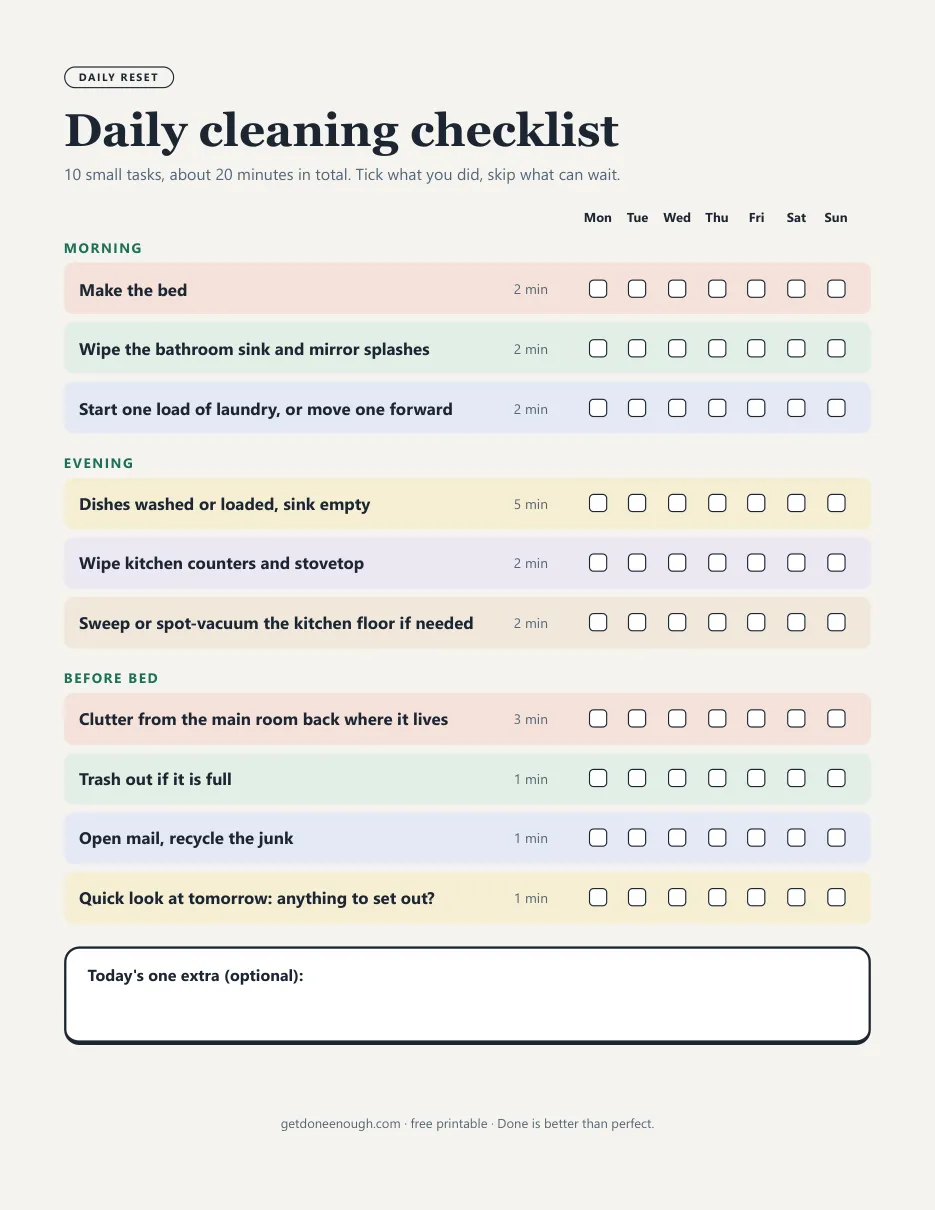
Free PDF: A one-page daily cleaning checklist with a checkbox for each day of the week.
Get the free PDFSee the planner on Etsy
The planner is sold in our own Etsy shop.
In this guide (23 parts)
- Why a restaurant kitchen cleaning checklist matters: what inspectors find
- Your local health code comes first
- Commercial kitchen cleaning checklist by zone
- Front of house vs back of house cleaning
- What the FDA Food Code requires
- Opening checklist for a restaurant kitchen
- How do you clean a commercial kitchen at closing?
- Restaurant kitchen cleaning: weekly, monthly and quarterly tasks
- Commercial kitchen deep cleaning checklist
- Walk-in cooler and freezer cleaning
- Ice machine and soda dispenser cleaning
- How to wash, rinse and sanitize
- Aprons, towels and wiping cloth laundry
- Cleaning vs sanitizing vs disinfecting
- Norovirus and vomit cleanup in a restaurant
- Equipment cleaning, item by item
- Kitchen hood, canopy and exhaust duct cleaning
- Staff safety while cleaning a restaurant kitchen
- Cleaning schedule template for each station
- How do you create a cleaning schedule for a restaurant?
- Who’s behind Done Enough?
- How we wrote this guide
- Sources
A restaurant kitchen cleaning checklist runs on two clocks. The food safety clock comes from the FDA Food Code: food-contact surfaces used with TCS food are cleaned at least every four hours, cooking equipment at least every 24 hours, and most floor and wall cleaning happens when the least food is out, such as after closing. The build-up clock covers the rest: hood filters, the walk-in, drains and the space behind equipment, on a weekly, monthly and quarterly rotation.
This guide is part of our cleaning schedule and checklist hub. Our kitchen deep cleaning checklist is written for a home kitchen. This page is about commercial kitchen cleaning in a restaurant, café or cafeteria, where an inspector checks the work. TCS food, a term you will see a lot below, is the Food Code’s name for food that needs time and temperature control for safety.
Tonight's closing shift 0/11 done
| Task | Done | Remove |
|---|---|---|
| Food put away, labeled and covered | ||
| Line cooled, cooking surfaces and microwave cleaned | ||
| Fryer oil filtered or covered | ||
| Slicer taken apart, cleaned and sanitized | ||
| Prep tables cleaned and sanitized | ||
| Dish machine, sinks and drainboards cleaned | ||
| Wiping cloths sent to the laundry | ||
| Trash out, lids closed | ||
| Drain baskets emptied, floor cleaned with a dustless method | ||
| Mops hung to dry, chemicals stored away from food | ||
| Cleaning log signed |
Saved on this device only. No account.
Why a restaurant kitchen cleaning checklist matters: what inspectors find
In FDA’s study of 851 US restaurants (421 fast food, 430 full-service), observed in 2017 and 2018 and published in 2023, food-contact surfaces were not properly cleaned and sanitized in 39.43% of fast food restaurants and 57.44% of full-service restaurants (FDA, 2023). The same report found that only 2% of full-service restaurants had no out-of-compliance items, and the median full-service kitchen had five.
The table shows how cleaning compares with the other practices FDA data collectors watched.
| Practice observed (FDA, 2023 report, 2017 to 2018 data) | Fast food out of compliance | Full-service out of compliance |
|---|---|---|
| Food-contact surfaces properly cleaned and sanitized | 39.43% (166 of 421) | 57.44% (247 of 430) |
| Contaminated equipment risk factor (cleaning plus protection from contamination) | 52.49% | 76.05% |
| Employees practice proper handwashing | 58.67% | 74.42% |
| Foods requiring refrigeration held at proper temperature | 62.23% | 79.77% |
| Median number of primary items out of compliance | 3 | 5 |
FDA found that restaurants with well-developed food safety management systems had significantly fewer out-of-compliance practices, while having a Certified Food Protection Manager was not a significant predictor once all factors were considered (FDA, 2023). A posted checklist with an owner and a log is one part of such a system.
Outbreak data points the same way. CDC reviewed 800 foodborne illness outbreaks linked to 875 retail food establishments from 2017 to 2019, published in 2023. Norovirus caused 47.0% of the outbreaks with a confirmed or suspected agent, and Salmonella 18.6%. CDC also reported that “outbreak establishments with cleaning and glove use policies had smaller norovirus outbreaks” (CDC MMWR, 2023).
Your local health code comes first
Your local health department sets the rules your kitchen is inspected against, and this page does not replace them.
The FDA describes its Food Code as a model that local, state, tribal and federal regulators use when they write their own rules (FDA, page current as of October 22, 2026). The most recent full edition is the 2026 Food Code, and FDA encourages its partners to adopt it (FDA, page current as of September 30, 2026).
Adoption takes years. FDA’s adoption data, reported as of 2024 and published before the 2026 edition existed, showed 11 state agencies in 7 states on the 2022 edition, and 46 state agencies in 36 states on one of the 2022, 2017 or 2013 editions (FDA, page current as of December 9, 2025). Your county may enforce an older edition with different details. The section numbers below come from the 2026 edition so you can compare them with your own code. Where they disagree, follow your local code.
Commercial kitchen cleaning checklist by zone
Sort the list by zone, because each station has its own staff, tools and risks. The table gives the task, how often, and where the frequency comes from.
“Food Code” means a rule in the 2026 edition. “Our suggestion” means a frequency we propose for a kitchen open every day, which you should adjust to your volume and your inspector’s advice.
| Zone | Task | How often | Basis |
|---|---|---|---|
| Line | Cutting boards, pans, tongs and slicers used with TCS food: wash, rinse, sanitize | At least every 4 hours | Food Code 4-602.11(C) |
| Line | Griddle, range top, ovens and other cooking surfaces | At least every 24 hours | Food Code 4-602.12(A) |
| Line | Microwave cavity and door seals, using the manufacturer’s method | At least every 24 hours | Food Code 4-602.12(B) |
| Line | Fryer filtering and boil-out | On a schedule your regulator approves (the 24-hour rule does not apply) | Food Code 4-602.12(A), 4-602.11(D)(6) |
| Prep | Boards, knives and containers between raw meat and ready-to-eat food | Every change of task | Food Code 4-602.11(A) |
| Prep | Wiping cloths kept in sanitizer between uses | Laundered daily | Food Code 3-304.14 |
| Dish | Dish machine, sink compartments and drainboards | Before use, through the day, at least every 24 hours | Food Code 4-501.14 |
| Dish | Sanitizer strength checked with a test kit | Each new batch | Test kit required by Food Code 4-501.116; frequency is our suggestion |
| Walk-in | Spills wiped, expired food out | Right away | Our suggestion |
| Walk-in | Shelves, door gasket and floor | Weekly | Our suggestion |
| Hood | Filters degreased | Weekly, sooner if grease builds up | Our suggestion |
| Hood | Exhaust ducts and fan | On the schedule your fire authority sets | Food Code 6-501.14, NFPA 96 |
| Floors | Spills | Right away (spills are the exception to the after-closing rule) | Food Code 6-501.12(B), 6-501.13(B) |
| Floors | Line, prep and dish areas, with dustless methods such as wet cleaning or mopping | After closing | Food Code 6-501.12(B), 6-501.13(A) |
| Floors | Under and behind equipment | Weekly | Our suggestion |
| Drains | Food debris out of floor drain baskets | Every closing | Our suggestion |
| Drains | Drains and grates scrubbed and flushed | Weekly | Our suggestion |
| Trash | Trash cans washed, away from food and clean equipment | As often as needed | Food Code 5-501.116 |
Two more rules belong next to the table. Mop water goes down a mop sink or floor drain, never into a food prep sink, handwashing sink or dish sink (Food Code 6-501.15). And a handwashing sink is for handwashing only, kept clear at all times (Food Code 5-205.11).
Front of house vs back of house cleaning
A restaurant cleaning checklist splits into back of house (line, prep, dish, walk-in, storage) and front of house (dining room, bar, self-service and host stand). Back of house is where most Food Code food-contact rules apply. Front of house is mostly non-food-contact surfaces and high-touch points, cleaned often enough to stop soil building up (Food Code 4-602.13), plus the self-service rules in section 4-602.11(E).
| Area | Back of house | Front of house |
|---|---|---|
| Main surfaces | Boards, knives, slicers, prep tables, pans (food-contact) | Tables, chairs, menus, counters (mostly non-food-contact) |
| Rule that drives frequency | 4 hours for TCS food, 24 hours for cooking equipment | Often enough to stop soil building up; self-service before restocking or every 24 hours |
| Wiping cloths | Held in sanitizer solution, laundered daily | Cloths for food spills on tableware kept dry and used for nothing else (3-304.14(A)) |
| Typical high-touch points | Walk-in handle, reach-in handles, faucet handles, ticket rail, knobs | Door handles, light switches, POS screens, card readers, menus, restroom doors |
| Who usually owns it | Cooks, prep and dish staff | Servers, bussers, bar staff, host |
The high-touch row is our suggestion. On those points, the main risk is hands, which is why the handwashing numbers in the FDA table above matter as much as the surfaces themselves. We suggest wiping door handles, light switches and POS screens at least every shift, using a product the screen maker allows. After a vomiting or diarrhea event, treat them as part of the cleanup zone described below. For a front of house that works like an office, our office cleaning schedule covers desks, shared screens and break rooms.
What the FDA Food Code requires
The Food Code sets a few fixed minimums, and a restaurant kitchen cleaning schedule is built around them (FDA Food Code 2026):
- Food-contact surfaces and utensils used with TCS food are cleaned “throughout the day at least every four hours” (section 4-602.11(C)).
- They are also cleaned at other points listed in section 4-602.11(A), including before each use with a different raw animal food, at every change from raw to ready-to-eat food, before a food thermometer is used or stored, and any time contamination may have happened.
- Cooking and baking equipment food-contact surfaces, plus microwave cavities and door seals, are cleaned at least every 24 hours (section 4-602.12).
- For food that is not TCS food, iced tea dispensers and self-service tongs, scoops and ladles are cleaned at least every 24 hours, and self-service equipment such as condiment dispensers and display containers before it is restocked (section 4-602.11(E)).
- Tongs and other utensils used with TCS food, self-service ones included, stay on the four-hour rule (section 4-602.11(C)). One exception covers salad bar, deli and cafeteria line containers of ready-to-eat TCS food kept at the right temperature and topped up with more of the same food: those containers are cleaned at least every 24 hours (section 4-602.11(D)(3)).
- Ice bins, beverage nozzles, ice makers, syrup lines and coffee bean grinders follow the manufacturer’s frequency, or are cleaned often enough to stop soil or mold building up (section 4-602.11(E)(4)).
- Floors, walls and other parts of the building are cleaned as often as needed, and outside of spills, during periods “when the least amount of food is exposed such as after closing” (section 6-501.12).
- Floors are cleaned with dustless methods only, such as wet cleaning, vacuuming, mopping with treated dust mops, or sweeping with a broom and a dust-arresting compound. Spills between floor cleanings are the exception (section 6-501.13).
- The kitchen has written procedures for staff to follow when someone vomits or has diarrhea on a surface in the establishment (section 2-502.11).
The four-hour rule has exceptions. One is a refrigerated prep room: at 41°F or less, utensils and equipment can go 24 hours between cleanings, with shorter intervals as the room gets warmer, and the kitchen has to document the frequency it uses (section 4-602.11(D)(2)). Another is a schedule your regulator approves. In that case the regulator weighs four factors: the equipment and how it is used, the type of food, how much food residue builds up, and the temperature the food is held at (section 4-602.11(D)(6)). Anything longer than four hours should be agreed with your inspector first.
Why four hours?
The Food Code explains the rule in its Annex 3 (public health reasons). Utensils, cutting boards, thermometers and other food-contact surfaces can carry microorganisms from one food to another, so surfaces used with TCS food “must be cleaned no less than every four hours to prevent the growth of microorganisms” (FDA Food Code 2026, Annex 3). The same annex says refrigeration slows the generation time of bacterial pathogens, which is why the clock gets longer, not shorter, when the room is colder, though never past 24 hours: the refrigerated prep room chart allows 24 hours at 41°F or less, 20 hours above 41°F to 45°F, 16 hours above 45°F to 50°F and 10 hours above 50°F to 55°F (section 4-602.11(D)(2)).
The rule is often missed in practice. In a 2016 CDC study of 298 delis (data collected in 2012), 50.5% of managers and 54.2% of workers said slicers were fully cleaned less often than every four hours. Chain delis had higher odds of meeting the frequency than independent ones, with an adjusted odds ratio of 2.78 by manager report (CDC MMWR, 2016). A timer at each station, with a line on the log, makes the interval easier to keep.
Opening checklist for a restaurant kitchen
The opening shift sets up the tools that make cleaning possible all day. This list mixes Food Code rules with our suggestions on order.
- ☐ Handwashing sinks clear, with soap and paper towels (sink always accessible, Food Code 5-205.11)
- ☐ Sanitizer buckets mixed and checked with a test kit (one must be on hand, Food Code 4-302.14)
- ☐ Three-compartment sink set up: wash, rinse, sanitize
- ☐ Dish machine wash and sanitize readings checked against its data plate
- ☐ Walk-in and reach-in temperatures checked, so cold food stays at 41°F or less (Food Code 3-501.16)
- ☐ Hot holding units up to temperature, 135°F or above, before food goes in (Food Code 3-501.16)
- ☐ Prep tables and boards sanitized before the first task
- ☐ Thermometer probes cleaned and sanitized
- ☐ Quick check for droppings or other signs of pests (premises inspected routinely, Food Code 6-501.111)
- ☐ Front of house: door handles, host stand and POS screens wiped before doors open (our suggestion)
During service, the four-hour clock runs. A timer or a line on the cleaning log for each station helps the team keep it. Wiping cloths go back into the sanitizer bucket between uses, and the solution has to stay free of food debris and visible soil, so change it when it isn’t (Food Code 3-304.14).
How do you clean a commercial kitchen at closing?
At closing, work from the food out and from the top down: food put away first, cooking equipment next, then prep surfaces, the dish area, and the floors and drains last. This is the order we suggest for cleaning a restaurant kitchen after the last ticket:
- Put food away, labeled and covered, so it is not exposed while you clean.
- Turn off and cool the line. Scrape the griddle, clean the range top, ovens and microwave.
- Filter or cover the fryer oil as the manufacturer says.
- Take apart the slicer and other food machines, wash, rinse and sanitize the parts, and let them air-dry.
- Clean and sanitize prep tables, then send boards, pans and smallwares to the dish area.
- Run the last loads, then clean the dish machine, the sink compartments and the drainboards.
- Send wiping cloths to the laundry.
- Take out trash and recycling, and close the trash can lids.
- Empty floor drain baskets, then clean the floor with a dustless method, such as a wet mop worked toward the drains (Food Code 6-501.13(A)).
- Dump mop water in the mop sink, hang mops to air-dry (Food Code 6-501.16), and store chemicals below and away from food (Food Code 7-201.11).
- Sign the cleaning log.
The checklist at the top of this page has the same eleven closing steps as checkboxes. Front of house closes in parallel: tables, chairs and booths wiped, condiment dispensers cleaned before restocking, menus wiped, high-touch points done last, then floors.
Restaurant kitchen cleaning: weekly, monthly and quarterly tasks
Weekly, monthly and quarterly tasks catch the grease, ice and dirt that daily cleaning misses. The Food Code does not set these intervals for most of them, so the rotation below is our suggestion for a kitchen open every day.
The Food Code says the non-food-contact surfaces of equipment are cleaned often enough to stop soil residue building up (section 4-602.13), and the building itself, floors, walls and ceilings included, as often as needed to keep it clean (section 6-501.12).
| Frequency | Back of house | Front of house | Basis |
|---|---|---|---|
| Every 4 hours | Food-contact surfaces used with TCS food | Self-service utensils used with TCS food | Food Code 4-602.11(C) |
| Daily | Cooking equipment, microwave, dish machine, wet wiping cloths laundered | Tables, high-touch points, iced tea dispensers | Food Code 4-602.12, 4-501.14, 4-802.11(D), 4-602.11(E) |
| Weekly | Behind equipment, walk-in shelves, hood filters, drains | Chair and booth seams, menu covers, window ledges | Our suggestion |
| Monthly | Ice machine, beverage lines, freezer, light fixtures | Light fixtures, vents, upholstery | Manufacturer’s schedule or our suggestion |
| Quarterly | Deep clean day, walk-in fully emptied, hood duct visit if due | Deep clean of dining room and bar | Our suggestion, fire authority for ducts |
Daily (Food Code minimums)
- ☐ Food-contact surfaces on the 4-hour clock
- ☐ Cooking surfaces and microwave
- ☐ Dish machine, sinks and drainboards
- ☐ Wet wiping cloths laundered
- ☐ Floors, drain baskets and trash
Weekly (our suggestion)
- ☐ Pull out line equipment on casters, clean behind and under it
- ☐ Walk-in shelves, door gasket and floor; expired food out
- ☐ Hood filters degreased
- ☐ Floor drains and grates scrubbed and flushed
- ☐ Reach-in coolers wiped inside
- ☐ Dry storage shelves and floor
- ☐ Walls and splash zones around the line
Monthly (our suggestion, or the manufacturer’s schedule where one exists)
- ☐ Ice machine cleaned and sanitized as the manufacturer says
- ☐ Beverage nozzles and syrup lines, as the manufacturer says
- ☐ Coffee bean grinder, as the manufacturer says
- ☐ Freezer emptied in sections and wiped
- ☐ Light fixtures, ceiling vents and the tops of walls and shelves
- ☐ Dust off condenser coils you can reach safely
Quarterly (our suggestion)
- ☐ Exhaust ducts and fan, by a hood cleaning contractor, if your fire authority’s schedule calls for it
- ☐ Deep clean day: walls, ceilings and behind every fixed unit
- ☐ Walk-in fully emptied and scrubbed
- ☐ Review of the cleaning log and the schedule with the team
For the grease interceptor, follow the schedule your city or wastewater utility sets.
Why floor drains get a weekly scrub
Floor drains collect water, food debris and nutrients every shift, which makes them a place where bacteria can settle into biofilm. A 2025 study in a meat processing plant, not a restaurant, sampled six floor drains and found the same clones of Listeria monocytogenes persisting in the facility for 3 to 5 years; the authors note that floor drains “represent one of the most common sites of persistence” (Fagerlund et al., Frontiers in Microbiology, 2025). A restaurant drain is a different setting, and the study did not test restaurant cleaning routines. Our suggestion, based on that finding: empty the drain basket nightly and scrub the grate weekly to remove the food layer that biofilm can grow on, use a separate brush for drains, and keep high-pressure hoses away from drains near food or clean equipment so splashes do not reach them.
Commercial kitchen deep cleaning checklist
A deep clean covers everything the daily and weekly lists skip because it needs equipment moved, emptied or taken apart. Plan it for a closed day or a slow morning, and split the zones between crews. This list is our suggestion.
| Zone | Deep clean tasks |
|---|---|
| Line | Move equipment, degrease walls, floor and the sides of each unit; clean gas line covers and casters |
| Hood | Filters, canopy inside and out, grease gutters and cups |
| Prep | Under tables, shelving, wall behind sinks, the undersides of shelves |
| Dish | Behind the dish machine, the curtain and arms (per the manual), walls and ceiling over the dish area |
| Walk-in | Everything out to a cold spot, shelves washed, walls, door gasket, fan guard, floor |
| Storage | Dry storage emptied shelf by shelf, older stock moved to the front |
| Floors and drains | Corners scrubbed, grout, drains and grates, floor sinks |
| Building | Ceiling tiles, vents, light covers, doors and door handles |
An industrial kitchen cleaning checklist, in a large cafeteria for example, uses the same zones with longer lists. If you also make or pack food that is sold somewhere else, ask your regulator which rules cover that part of the work. For the same top-down, zone-by-zone logic at home, see how to deep clean a house.
Walk-in cooler and freezer cleaning
The hard part of walk-in cooler cleaning is keeping the food cold while you do it. Cold holding was the most often missed practice in FDA’s restaurant study: foods requiring refrigeration were out of compliance in 62.23% of fast food and 79.77% of full-service restaurants (FDA, 2023). A cleaning day that leaves food on a cart in a warm kitchen adds to that risk, so plan the walk-in clean around the 41°F limit for cold TCS food (Food Code 3-501.16).
Our suggested order for a walk-in deep clean:
- Check the walk-in and the backup space (reach-ins, a second walk-in) are at 41°F or less before you start.
- Move food out one section at a time, never the whole box at once.
- Throw out expired or unlabeled food.
- Wash shelves with detergent, rinse, then sanitize any shelf that holds unwrapped food.
- Wipe walls, the door gasket and the fan guard. Look for mold on the gasket folds.
- Clean the floor last and squeegee it dry, since standing water freezes in a freezer and becomes a slip hazard.
- Put food back with the oldest stock in front, raw meat below ready-to-eat food.
- Log the temperature again when the door has been closed for a while.
For the freezer, work in sections so the unit never warms up. Ice build-up on the floor or walls can point to a door or gasket problem; in our suggestion, call a refrigeration technician rather than treating it as a cleaning task.
Ice machine and soda dispenser cleaning
Ice is food under the Food Code, and ice machines, ice bins, beverage nozzles and syrup lines are cleaned at the manufacturer’s frequency, or often enough to stop soil or mold building up (section 4-602.11(E)(4)). The scoop matters as much as the machine: the inside of the bin is where hands, scoops and splashes meet.
Contamination data supports a regular schedule. A 2017 study in the Journal of Water and Health tested ice, ice chests and water collected from food businesses. E. coli was found in 6.7% of ice samples and 21.9% of ice chest samples, and none of the water samples. Coliforms were found in 51.4% of ice, 67.6% of ice chests and 12.4% of water (Hampikyan et al., 2017). The paper does not describe the samples as coming from US restaurants, so treat it as a signal, not a US rate. In that sample set the water was cleaner than the ice and the chests it was stored in. Our reading, which the numbers suggest but do not prove, is that handling and storage matter as much as the water supply.
The Food Code’s own reasoning points the same way: ice makers, ice bins and beverage nozzles are cleaned on a routine basis to stop slime, mold or soil residues that can let microorganisms build up (FDA Food Code 2026, Annex 3, section 4-602.11).
| Item | Food Code 2026 rule | Practical step (our suggestion) |
|---|---|---|
| Ice machine and bin | Manufacturer’s frequency or before soil or mold builds up (4-602.11(E)(4)) | Follow the manual for descaling and sanitizing; check the bin and chute for slime monthly |
| Ice scoop | Between uses, stored in a clean, protected location (3-304.12(E)) | Keep it in a clean holder outside the bin, wash it with the smallwares |
| Soda nozzles and diffusers | Manufacturer’s frequency or before soil or mold builds up (4-602.11(E)(4)) | Pull and soak nightly if the manual allows; look inside the nozzle for slime or mold |
| Syrup lines | Manufacturer’s frequency or before soil or mold builds up (4-602.11(E)(4)) | Usually a service visit; keep the date on the log |
| Iced tea dispenser | At least every 24 hours (4-602.11(E)(2)) | Empty, wash, rinse, sanitize at closing |
The practical steps column is our suggestion; check your local code and the machine manual for the exact wording that applies to you.
How to wash, rinse and sanitize
Every food-contact item goes through the same order: scrape, wash, rinse, sanitize, air-dry. The Food Code sets each step (FDA Food Code 2026):
- Scrape food debris into the trash or disposal first, and presoak or scrub when needed (section 4-603.12).
- Wash with detergent and hot water, using brushes or scouring pads as needed (section 4-603.14). Manual washing uses a sink with at least three compartments (section 4-301.12), and the wash solution is kept at 110°F or more, or the temperature on the detergent label (section 4-501.19).
- Rinse in a separate water rinse after washing and before sanitizing, to remove abrasives and cleaning chemicals (section 4-603.16).
- Sanitize by hot water immersion at 171°F or above for at least 30 seconds, or with a chemical sanitizer used as its EPA-registered label says (sections 4-501.111, 4-703.11).
- Let sanitized items air-dry or drain before they touch food. Towel drying is not allowed (section 4-901.11).
Why the order works
Each step in wash, rinse, sanitize removes something the next step cannot handle. Detergent and hot water lift grease and food soil; the rinse takes away detergent and loosened soil; only then can a sanitizer reach the microorganisms that are left. The Food Code’s own definition of sanitization only applies to cleaned surfaces: heat or chemicals that achieve a 5-log reduction, which equals 99.999%, of representative disease-causing microorganisms (section 1-201.10). That is why the Food Code puts the rinse between washing and sanitizing: it removes abrasives and removes or dilutes cleaning chemicals first (section 4-603.16). A sanitizer bucket or sink full of food debris also has to be changed, which the wiping cloth rule spells out (section 3-304.14(D)).
Air-drying finishes the job without a towel that could put soil back on the surface (section 4-901.11). A detergent-sanitizer that does both jobs in one product is allowed only when the same product is used in the wash and sanitize steps (section 4-501.115).
Sanitizer concentration, temperature and contact time
Chemical sanitizers come with their own numbers. Contact time is at least 10 seconds for chlorine, or at least 7 seconds for a 50 mg/L chlorine solution at pH 10 or less and 100°F or above (or pH 8 or less and 75°F or above), and at least 30 seconds for most other chemical sanitizers, always consistent with the label (section 4-703.11(C)). Solution temperature and strength also matter:
| Sanitizer | Food Code 2026 conditions (section 4-501.114) |
|---|---|
| Chlorine, 25 to 49 mg/L | Water at least 120°F |
| Chlorine, 50 to 99 mg/L | Water at least 100°F at pH 10 or less, or 75°F at pH 8 or less |
| Chlorine, 100 mg/L | Water at least 55°F |
| Iodine | 12.5 to 25 mg/L, water at least 68°F, pH 5.0 or less (or the label’s limit) |
| Quaternary ammonium | Water at least 75°F, label concentration, water hardness 500 mg/L or less (or the label’s limit) |
The table shows a trade-off you can use. A weaker chlorine solution needs warmer water, and a stronger one works in cooler water, because temperature, strength and pH together set how fast the sanitizer acts. Contact time is the part staff skip most often. The EPA describes it as “the time the product must be applied to the surface” for it to work (EPA List G, updated June 3, 2026), so a quick spray and wipe can undercut a correct dilution.
| Method | Key number | Where it applies |
|---|---|---|
| Manual wash water | 110°F or more, or detergent label | Three-compartment sink (4-501.19) |
| Hot water sanitizing, manual | 171°F or above, at least 30 seconds | Sanitize sink (4-501.111, 4-703.11) |
| Dish machine hot water final rinse | Not more than 194°F; at least 165°F for a stationary rack, single temperature machine, 180°F for all other machines | Hot water dish machine (4-501.112) |
| Chlorine sanitizer | At least 10 seconds, or 7 seconds at 50 mg/L under the stated pH and temperature | Sink or bucket (4-703.11(C)) |
| Most other chemical sanitizers | At least 30 seconds, per label | Sink or bucket (4-703.11(C)) |
The concentration has to be checked with a test kit or another accurate device (section 4-501.116). Large equipment that can’t go in a sink, like a prep table or a mounted slicer, follows the same steps in place.
Aprons, towels and wiping cloth laundry
Wiping cloths and linens are tools that can spread soil, and the Food Code sets how they are used and laundered (FDA Food Code 2026). Wet cloths used on counters and equipment are held in sanitizer between uses and laundered daily; cloths for wiping food spills on tableware are kept dry and used for nothing else; and cloths used on surfaces that touch raw animal food are kept separate from the rest (section 3-304.14).
| Item | Food Code 2026 rule | Section |
|---|---|---|
| Wet wiping cloths | Laundered daily | 4-802.11(D) |
| Dry wiping cloths | Laundered as needed to prevent contamination of food and clean serving utensils | 4-802.11(E) |
| Linens that do not touch food (aprons, towels) | Laundered between operations if wet, sticky or visibly soiled | 4-802.11(A) |
| Cloth napkins | Laundered between each use | 4-802.11(C) |
| Soiled linens | Kept in clean, nonabsorbent containers or washable laundry bags | 4-803.11 |
| Staff outer clothing | Clean, to prevent contamination of food, equipment and utensils | 2-304.11 |
| Sanitizer bucket | Free of food debris and visible soil, stored off the floor | 3-304.14(D), (E) |
Why the sanitizer bucket matters
A wiping cloth picks up whatever is in its bucket. In a 2020 study in Food Protection Trends, a cloth and bucket used with plain buffer moved Listeria innocua across large surfaces at 4.8 log CFU per surface, while a quaternary ammonium bucket left little transfer of these vegetative bacteria. Bacillus cereus spores, which resist many sanitizers, were still spread at 6.5 to 7.8 log CFU per surface even with the quat bucket, and when the sanitizer failed, the bucket held more than 87.9% of the original load (Goulter et al., 2020).
Three practical rules follow from that study and the Food Code (our suggestion): test the bucket with a strip each time you mix it and whenever it looks cloudy; change it when it holds food debris or visible soil; and send cloths to the laundry at the end of the day instead of rinsing and reusing them.
Cleaning vs sanitizing vs disinfecting
Cleaning, sanitizing and disinfecting are three different jobs, and a restaurant kitchen needs all three at different times. Cleaning removes food, grease and soil you can see. Sanitizing is a second step on a cleaned surface that kills the bacteria left behind. Disinfecting is a stronger step used after illness events, such as vomit, because it targets viruses as well.
The EPA draws the line clearly: “Sanitizing kills bacteria on surfaces using chemicals. It is not intended to kill viruses.” Disinfecting kills both viruses and bacteria (EPA, updated October 8, 2026).
| Step | What it does | Typical product | Where it is used in a restaurant |
|---|---|---|---|
| Cleaning | Removes dirt and organic matter with soap or detergent | Detergent, degreaser | Every surface, before any other step |
| Sanitizing | Kills bacteria on a cleaned surface; the Food Code standard is a 5-log (99.999%) reduction of representative pathogens | Chlorine, quat or iodine at the Food Code strength, or 171°F hot water | Food-contact surfaces, wiping cloth buckets |
| Disinfecting | Kills viruses and bacteria; EPA testing requirements are more rigorous than for sanitizers | EPA-registered disinfectant, such as a List G product for norovirus | Vomit and diarrhea cleanup, high-touch points after an illness event |
In practice, every food-contact surface gets cleaned and then sanitized: boards, knives, slicer parts, prep tables, pans. Floors, walls, the outside of equipment and the hood are cleaned, because they don’t touch food. Wiping cloths sit in sanitizer between uses so they don’t spread soil from one surface to the next (section 3-304.14).
Norovirus and vomit cleanup in a restaurant
A vomit or diarrhea event needs its own procedure, and the Food Code requires a written one that tells staff how to limit the spread of contamination to people, food and surfaces (section 2-502.11). Norovirus is the reason. It caused 47.0% of the retail food outbreaks with a confirmed or suspected agent in CDC’s 2017 to 2019 review, and ill or infectious food workers contributed to 41.0% of the outbreaks where a factor was identified (CDC MMWR, 2023). Only 16.1% of the establishments had ill-worker policies covering all four components CDC looked for.
CDC’s norovirus guidance, dated January 13, 2025, gives these figures (CDC, 2025):
| Step | CDC figure |
|---|---|
| Bleach solution for surfaces | 1,000 to 5,000 ppm, which is 5 to 25 tablespoons of household bleach (5% to 8%) per gallon of water |
| Alternative | An EPA-registered product for norovirus (EPA List G) |
| Contact time for bleach | Leave on the surface at least 5 minutes |
| Sick workers | Stay out of food work for at least 48 hours after symptoms stop |
Compare that bleach strength with the 50 to 100 mg/L used for routine food-contact sanitizing in the Food Code table above: the norovirus solution is at least ten times stronger, which is why we suggest mixing it fresh for the event only. For any food-contact surface it touches, follow the product label on rinsing before the surface is used for food again. Follow the product label and your local code, and keep a ready kit (gloves, disposable towels, bags, the disinfectant, a mask if the label calls for one) where staff can reach it.
Equipment cleaning, item by item
Kitchen equipment cleaning follows each item’s own rule in the Food Code, then the manufacturer’s manual. This table collects the rules for common equipment (FDA Food Code 2026).
| Equipment | Food Code 2026 rule | Section |
|---|---|---|
| Slicer, mixer attachments, boards used with TCS food | At least every 4 hours, and between raw and ready-to-eat food | 4-602.11(A), (C) |
| Griddle, range, ovens | Food-contact surfaces at least every 24 hours | 4-602.12(A) |
| Fryer (hot oil cooking and filtering) | Exempt from the 24-hour rule if cleaned on an approved schedule | 4-602.12(A) |
| Microwave | Cavity and door seals at least every 24 hours, manufacturer’s method | 4-602.12(B) |
| Ice machine and ice bin | Manufacturer’s frequency, or often enough to stop soil or mold | 4-602.11(E)(4) |
| Soda nozzles, syrup lines | Manufacturer’s frequency, or often enough to stop soil or mold | 4-602.11(E)(4) |
| Iced tea dispenser | At least every 24 hours | 4-602.11(E)(2) |
| Self-service tongs, scoops, ladles, food that is not TCS | At least every 24 hours | 4-602.11(E)(2) |
| Condiment dispensers and display containers, food that is not TCS | Before restocking | 4-602.11(E)(3) |
| Tongs and other utensils used with TCS food, self-service included | At least every 4 hours | 4-602.11(C) |
| Salad bar or deli containers of ready-to-eat TCS food, topped up with the same food | At least every 24 hours | 4-602.11(D)(3) |
| Utensils held in hot water | Water at 135°F or more, container and utensils cleaned at least every 24 hours | 4-602.11(D)(7) |
| Reach-in refrigerator used for storage | Often enough to stop soil residue building up | 4-602.11(D)(5) |
| Dish machine | Before use, through the day, at least every 24 hours | 4-501.14 |
| Outside of equipment, knobs, handles | Often enough to stop soil building up | 4-602.13 |
When the manual and this table seem to disagree, ask your inspector which applies to your unit. The slicer row is the one inspectors and researchers flag most: see the 2016 CDC deli data in the “Why four hours?” section above.
Kitchen hood, canopy and exhaust duct cleaning
Hood and kitchen ventilation cleaning falls under two sets of rules: food safety and fire safety.
On the food side, the Food Code says hood systems, including fans, guards and ducting, are designed so grease or condensation does not drip onto food or equipment (section 4-204.11), and that intake and exhaust ducts are cleaned and filters changed so they are not a source of contamination (section 6-501.14).
On the fire side, the reference is NFPA 96, the Standard for Ventilation Control and Fire Protection of Commercial Cooking Operations (NFPA). Ask your local fire marshal which edition they enforce and how often your system has to be inspected and cleaned. We did not list those intervals here because we could not check them in NFPA’s own published text.
Grease build-up is a fire hazard, and the numbers are large. The US Fire Administration estimates 33,300 cooking fires in nonresidential buildings in 2023, with $50.3 million in losses, and 35,800 fires with $92.7 million in losses in 2022. Nonresidential cooking fires rose 13% from 2014 to 2023 (USFA, page last reviewed February 14, 2025). These figures cover all nonresidential buildings, not only restaurants.
Grease traps, hood filters and exhaust ducts compared
| Part | What builds up | Who usually cleans it | Frequency set by |
|---|---|---|---|
| Hood filters | Grease caught from cooking vapor | Kitchen staff | Our suggestion: weekly, sooner on heavy fry lines |
| Canopy, gutters, grease cups | Grease runoff from filters | Kitchen staff | Our suggestion: weekly with the filters |
| Exhaust ducts and fan | Grease that passed the filters | Hood cleaning contractor | Your fire authority (NFPA 96) |
| Grease trap or interceptor | Fats, oils and grease from sinks and dish area | Staff for small traps, a pumping service for interceptors | Your city or wastewater utility |
Cleaning the hood filters
Your own staff can handle commercial kitchen hood filter cleaning. Our suggested steps:
- Turn off the hood and cooking equipment, and let the filters cool.
- Lift the filters out of their track.
- Soak them in hot water with a degreaser made for kitchen filters, or run them through the dish machine if the filter and machine manufacturers allow it.
- Scrub, rinse and let them dry.
- Put them back in the direction marked on the filter.
Our tip: keep a spare set of filters, so a clean set goes back in right away and the dirty set can be cleaned when the dish area is quiet.
Kitchen canopy cleaning covers the hood body you can reach: wipe the inside and outside of the canopy with degreaser, and empty and wash the grease cups and gutters. We suggest leaving everything past that point, meaning kitchen exhaust duct cleaning, the fan and the roof area around it, to a hood cleaning contractor. After each kitchen duct cleaning visit, ask for a written report with photos of the ducts and fan, and file it with your cleaning log.
Staff safety while cleaning a restaurant kitchen
Cleaning a restaurant kitchen exposes staff to the same injuries as cooking: cuts, burns, slips and chemicals. BLS data for full-service restaurants in 2018 (page last modified October 5, 2020) counts cases serious enough to need days away from work (BLS, 2020):
| Injury type (full-service restaurants, 2018) | Cases | Rate per 10,000 full-time workers | All private industry rate |
|---|---|---|---|
| Cuts, lacerations | 6,770 | 19.8 | 7.7 |
| Heat (thermal) burns | 2,710 | 7.9 | 1.4 |
| Exposure to harmful substances or environments | 3,330 | 9.7 | 4.0 |
| Falls, slips, trips | 7,850 (5,170 on the same level) | Not given | Not given |
Each row maps to a cleaning habit (our suggestion, not a BLS finding):
- For cuts, take the slicer apart only when it is unplugged, wear cut-resistant gloves for the blade, and never leave knives in a sink full of soapy water.
- For burns, let griddles, fryers and hood filters cool before cleaning; boil-outs follow the fryer manual.
- For chemicals, mix only one product at a time, never bleach with ammonia-based or acid cleaners, and follow the label for gloves and ventilation (Food Code 7-202.12 requires chemicals to be used as the manufacturer’s label directs).
- For slips, put up wet floor signs, mop toward the drains, and squeegee walk-in floors dry.
Cleaning schedule template for each station
The template has one line per task and one column per day, so each person initials what they did. Copy this layout into a spreadsheet and fill it in for each station:
| Task | Zone | How often | Who | Mon | Tue | Wed | Thu | Fri | Sat | Sun |
|---|---|---|---|---|---|---|---|---|---|---|
| Food-contact surfaces, TCS food | Line, prep | Every 4 hours | ||||||||
| Cooking surfaces and microwave | Line | Every closing | ||||||||
| Dish machine, sinks, drainboards | Dish | Every closing | ||||||||
| Wiping cloths to laundry | All | Every closing | ||||||||
| Floors and drain baskets | All | Every closing | ||||||||
| High-touch points and POS | Front of house | Every shift | ||||||||
| Hood filters | Hood | Weekly | ||||||||
| Walk-in shelves and floor | Walk-in | Weekly | ||||||||
| Behind and under equipment | Line | Weekly | ||||||||
| Ice machine | Bar, line | Manufacturer’s schedule |
Cleaning and sanitizer log
Next to the schedule, keep a short log with these columns: date, time, task or station, sanitizer reading in mg/L (ppm), initials, and a manager check. A log is the simplest way to show your inspector what was done and when. If you use the refrigerated prep room option, the Food Code requires the cleaning frequency to be documented (section 4-602.11(D)(2)).
Health inspection compliance check
Before an inspection, walk the kitchen with the items inspectors most often find out of compliance in FDA’s restaurant data (FDA, 2023):
- ☐ Handwashing sinks stocked and clear, staff washing at the right times
- ☐ Cold food at 41°F or less, hot food at 135°F or above
- ☐ Food-contact surfaces cleaned and sanitized on the 4-hour clock, with the log filled in
- ☐ Sanitizer buckets and sinks at the right strength, test strips on hand
- ☐ Raw animal food stored below ready-to-eat food
- ☐ Written vomiting and diarrhea cleanup procedure and illness policy available (Food Code 2-502.11, 2-501.11)
- ☐ Chemicals labeled and stored below and away from food
How do you create a cleaning schedule for a restaurant?
You create a cleaning schedule for a restaurant by listing every surface and piece of equipment, then giving each one a frequency, a method and an owner. The order we suggest:
- Walk each zone (line, prep, dish, walk-in, storage, hood, floors, drains, front of house) and write down every surface and machine.
- Next to each item, write the Food Code minimum from the tables above, or the manufacturer’s schedule.
- Check your local health code and change anything it sets differently.
- Add your own weekly, monthly and quarterly tasks for build-up.
- Assign each task to a shift and a role, so nothing belongs to “everyone.”
- Post the schedule at each station and keep the log next to it.
- Review the log every week and move tasks that keep getting skipped to a better slot.
For a home kitchen version of the same idea, see our weekly cleaning schedule and the daily cleaning checklist.
Who’s behind Done Enough?
Done Enough is a small independent shop, not a clinic. We build free planning tools and sell printables on Etsy. We are not professional cleaners or clinicians: each guide links its sources so you can check every claim, and our own tips are marked as suggestions.
How we wrote this guide
On October 24, 2026 we checked US search data in Semrush for restaurant and commercial kitchen cleaning searches and the questions people ask about kitchen cleaning schedules.
We then read the 2026 FDA Food Code (the full PDF), the sections on equipment, warewashing, wiping cloths, linens, employee illness, physical facilities and pests, along with FDA’s Food Code pages, FDA’s adoption data, and NFPA’s page for NFPA 96. On October 25, 2026 we added FDA’s restaurant risk factor report, CDC outbreak and norovirus data, EPA definitions, US Fire Administration and BLS figures, and three peer-reviewed studies, each read on the source page. Studies older than 12 months are labeled with their year. Frequencies marked “our suggestion” are ours, not rules or measurements. Section numbers point to the 2026 edition so you can check each rule. No organization listed here endorses our shop.
Sources
Fifteen sources, read October 24 and 25, 2026.
- FDA (2026). Food Code 2026. Recommendations of the United States Public Health Service, Food and Drug Administration. Page content current as of September 30, 2026. https://www.fda.gov/food/fda-food-code/food-code-2026 (PDF: https://www.fda.gov/media/194741/download)
- FDA (2026). FDA Food Code. Content current as of October 22, 2026. https://www.fda.gov/food/retail-food-protection/fda-food-code
- FDA (2025). Adoption of the FDA Food Code by State and Territorial Agencies Responsible for the Oversight of Restaurants and Retail Food Stores. Content current as of December 9, 2025 (data as of 2024). https://www.fda.gov/food/fda-food-code/adoption-fda-food-code-state-and-territorial-agencies-responsible-oversight-restaurants-and-retail
- FDA (2023). FDA Report on the Occurrence of Foodborne Illness Risk Factors in Fast-Food and Full-Service Restaurants, 2017-2018. Published June 2023. https://www.fda.gov/media/169390/download
- CDC (2023). Foodborne illness outbreaks at retail food establishments in 25 state and local health departments, 2017 to 2019. MMWR Surveillance Summaries 72(6), June 2, 2023. https://www.cdc.gov/mmwr/volumes/72/ss/ss7206a1.htm
- CDC (2016). Deli slicer cleaning practices, Environmental Health Specialists Network. MMWR 65(12):306 to 310, April 1, 2016 (data collected in 2012). https://www.cdc.gov/mmwr/volumes/65/wr/mm6512a2.htm
- CDC (2025). Preventing Norovirus. Page dated January 13, 2025. https://www.cdc.gov/norovirus/prevention/index.html
- EPA (2026). What’s the difference between products that disinfect, sanitize, and clean surfaces? Last updated October 8, 2026. https://www.epa.gov/coronavirus/whats-difference-between-products-disinfect-sanitize-and-clean-surfaces
- EPA (2026). List G: EPA’s Registered Antimicrobial Products Effective Against Norovirus. Last updated June 3, 2026. https://www.epa.gov/pesticide-registration/list-g-epas-registered-antimicrobial-products-effective-against-norovirus
- Goulter RM et al. (2020). Characterizing microbial cross-contamination on large surfaces using a traditional cloth and bucket. Food Protection Trends 40(6):392 to 401, November 2020. http://www.foodprotection.org/publications/food-protection-trends/archive/2020-11-characterizing-microbial-cross-contamination-on-large-surfaces-using-a-traditional-cloth-and/
- Hampikyan H et al. (2017). Study of E. coli and coliforms in ice, ice chests and water from food businesses. Journal of Water and Health 15(3):410 to 417. https://earsiv.beykent.edu.tr/items/78902e11-3a6d-4ea0-8e8c-3f24052af6c0/full
- Fagerlund A et al. (2025). Study of Listeria monocytogenes in floor drains of a meat processing plant (article 10.3389/fmicb.2025.1541481). Frontiers in Microbiology, volume 16. https://public-pages-files-2025.frontiersin.org/journals/microbiology/articles/10.3389/fmicb.2025.1541481/text
- US Fire Administration (2025). Nonresidential building cooking fires. Page last reviewed February 14, 2025. https://www.usfa.fema.gov/statistics/nonresidential-fires/cooking.html
- BLS (2020). Full-service restaurants, 2018 injury and illness factsheet. Last modified October 5, 2020. https://www.bls.gov/iif/factsheets/full-service-restaurants-2018.htm
- NFPA. NFPA 96, Standard for Ventilation Control and Fire Protection of Commercial Cooking Operations. Product page, no date shown; we used it for the standard’s title only. https://www.nfpa.org/product/nfpa-96-standard/p0096code
FAQ
What is the cleaning schedule for kitchen equipment determined by?
Under the FDA Food Code 2026, equipment that touches TCS food is cleaned at least every four hours, unless an exception in section 4-602.11(D) applies, such as a refrigerated prep room or a schedule your regulator approves after weighing the equipment, food type, residue build-up and holding temperature. Cooking equipment has its own 24-hour rule. Local code decides.
What is a cleaning schedule in a kitchen?
A kitchen cleaning schedule is a written plan that says what gets cleaned, how often, how, and by whom. In a restaurant it combines the food code minimums with tasks you add for build-up, like hood filters, drains and the walk-in, and it often comes with a log that staff initial when each task is done.
How often should a restaurant kitchen be deep cleaned?
The Food Code ties it to build-up: floors, walls and ceilings are cleaned as often as needed to keep them clean (section 6-501.12), and the outside of equipment often enough to stop soil building up (section 4-602.13). This page suggests a quarterly deep clean day, with hood ducts on your fire authority's schedule.