Cleaning
Office cleaning schedule: daily, weekly and monthly, with a free template
Updated · Written by the Done Enough team · Sources linked below
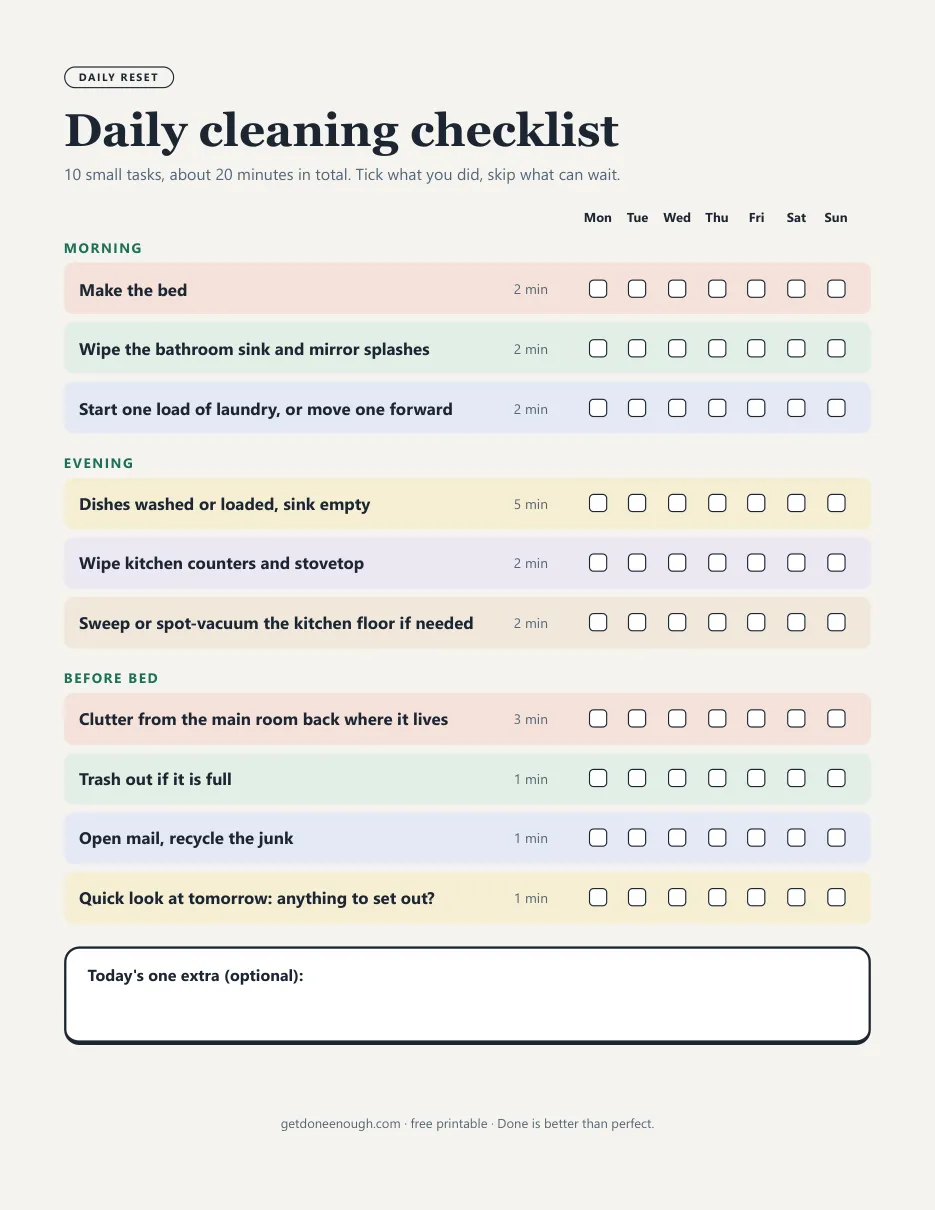
Free PDF: A one-page daily cleaning checklist with a checkbox for each day of the week.
Get the free PDFSee the planner on Etsy
The planner is sold in our own Etsy shop.
In this guide (18 parts)
- What goes on an office cleaning schedule?
- How often should an office be cleaned?
- Where do germs spread in an office? The tracer studies
- Clean or disinfect: what does the evidence say?
- How do you keep office air healthy while cleaning?
- Office cleaning schedule template: daily, weekly and monthly
- Who cleans what in a small office?
- Do hand hygiene and sick-day rules belong on an office schedule?
- How do you keep an office break room clean?
- How often should an office bathroom be cleaned?
- How do you clean desks and shared electronics?
- How often should office floors, chairs and glass be cleaned?
- How often should an office be deep cleaned?
- How do you keep a home office clean?
- How do you clean an office safely?
- Who’s behind Done Enough?
- How we wrote this guide
- Sources
An office cleaning schedule sorts the work by how often it comes back. Every working day: trash out, desks and high-touch points wiped, the break room reset and the restroom checked. Every week: floors vacuumed and mopped, a full restroom clean, the fridge cleared out and surfaces dusted. Every month: slow build-up such as fridge shelves, chairs, vents, baseboards and glass. Each shared job gets one named owner.
This guide is part of our cleaning schedule and checklist guide. It sets out a cleaning schedule for office spaces with a few desks, one break room and one or two restrooms, and for a home office you clean yourself. For the house around a home office, the weekly cleaning schedule gives each room its own day.
The schedule below is built on what researchers have measured in real offices: where germs travel, which surfaces carry the most, what cleaning removes and what disinfecting adds, and how cleaning products affect the air people breathe at their desks. Each section explains the evidence first, then turns it into tasks.
This week's office checks 0/35 done
| Task | Mon | Tue | Wed | Thu | Fri | Remove |
|---|---|---|---|---|---|---|
| Trash and recycling emptied | ||||||
| Food waste out | ||||||
| Desks cleared and wiped | ||||||
| Door handles, exit push bar, switches and buttons wiped | ||||||
| Break room counters, sink, faucet and fridge handle | ||||||
| Restroom wiped, soap dispensers wiped, restocked | ||||||
| Entry floor spot-swept |
Saved on this device only. No account.
What goes on an office cleaning schedule?
An office cleaning schedule lists each shared zone, the tasks in it and how often each task comes back. Daily tasks keep the office usable, weekly tasks reset the floors and restrooms, and monthly tasks catch the build-up nobody sees from one day to the next.
Splitting the work this way keeps the daily list short enough that people actually do it (our tip). A good schedule also names who is in charge of each task (our suggestion). The roster further down gives each shared job a name.
| How often | Zone | Task |
|---|---|---|
| Daily | Desks | Each person clears and wipes their own desk |
| Daily | High-touch points | Door handles, exit push bars, light switches, elevator buttons, shared pens, touchpads |
| Daily | Break room | Counters, sink, faucet handles and table wiped, fridge and drawer handles wiped, dishes washed or loaded |
| Daily | Restroom | Sinks, toilets, handles and soap dispensers wiped, soap and paper restocked |
| Daily | Trash | Food waste out, full bins emptied |
| Daily | Entry | Spot-sweep or vacuum where people walk in |
| Weekly | Floors | Vacuum carpets and rugs, mop hard floors |
| Weekly | Restroom | Full clean: toilets, sinks, mirrors, partitions, floor |
| Weekly | Break room | Old food out of the fridge, microwave inside, appliance fronts, sponge replaced |
| Weekly | Electronics | Keyboards, mice, phones, printer touch panels |
| Weekly | Meeting rooms | Tables wiped, whiteboards cleaned, chairs back in place |
| Weekly | Dusting | Shelves, windowsills, monitors, tops of cabinets |
| Weekly | Trash and recycling | All bins emptied, liners replaced, recycling out |
| Monthly | Break room | Fridge shelves and drawers washed, coffee maker and kettle cleaned |
| Monthly | Chairs | Fabric seats vacuumed, arms and bases wiped |
| Monthly | Glass | Inside windows, glass doors and partitions |
| Monthly | Walls | Baseboards, air vents, door frames |
| Monthly | Bins | Trash cans washed inside |
| Monthly | Moisture check | Under sinks, behind the fridge, around the water dispenser |
| Monthly | Supplies | Cleaning products, liners and gloves restocked |
| Every few months | Deep clean | Carpets, upholstery, inside cabinets, behind equipment, light fixtures |
These frequencies are our suggestions for a small office used five days a week. A busy office, or one with a lot of visitors, can move some weekly tasks up to daily. The CDC says much the same for high-traffic spaces: you may choose to clean them more often, or disinfect them as well as clean them (CDC, April 16, 2024, older).
How often should an office be cleaned?
Our suggestion is a short clean every working day, a fuller clean once a week and a deeper pass once a month, with the daily list built around what people touch and where they eat. Only the food waste interval below comes from a rule.
The CDC’s guidance for community buildings, which names offices, says to clean high-touch surfaces regularly and other surfaces when they are visibly dirty. It does not say daily. Its examples of high-touch surfaces include door handles, elevator buttons, touchpads, restroom fixtures and desks. Disinfecting is a separate step that comes after cleaning. The CDC says to disinfect areas where people have obviously been ill, for example vomiting on a surface, and that in a high-traffic area you may choose to disinfect in addition to cleaning (CDC, April 16, 2024, older). If people eat at work, OSHA writes one daily task into its sanitation standard: food waste containers must be “emptied not less frequently than once each working day, unless unused” (29 CFR 1910.141(g)(3), Cornell LII).
| Frequency | What it covers | Basis |
|---|---|---|
| Every working day | High-touch points, desks, break room, restroom check, food waste | OSHA for food waste; the CDC (older) says to clean high-touch points regularly, and the daily timing is our suggestion |
| Weekly | Floors, full restroom clean, fridge clear-out, electronics, dusting | Our suggestion |
| Monthly | Fridge shelves, chairs, glass, vents, baseboards, bins | Our suggestion |
| Every few months | Carpets, upholstery, inside storage, behind equipment | Our suggestion |
| When someone has obviously been ill (for example, vomited) | Clean, then disinfect that area | CDC (older) |
What makes an office need more frequent cleaning?
An office needs more frequent cleaning when more hands meet the same surfaces. The drivers below are the ones the sources support; how far each one moves your schedule is our judgment.
| Driver | What the evidence says | What to change (our suggestion) |
|---|---|---|
| Foot traffic and visitors | The CDC (2024, older) says high-traffic spaces may be cleaned more often, or disinfected as well as cleaned | Entry floor and exit door daily, restroom check twice a day |
| Food eaten on site | OSHA requires food waste out at least once each working day, unless unused | Break room on the daily list, fridge clear-out weekly |
| Shared desks and rooms | A 2020 Norwegian registry study linked shared and open-plan offices to a higher risk of certified sick leave (details below) | Shared keyboards, phones and meeting tables wiped daily, not weekly |
| Someone has been ill at work | The CDC (2024, older) says to clean, then disinfect, that area | Run the vomit protocol in the clean vs disinfect section |
| Water near surfaces | The EPA says to dry water damage within 24 to 48 hours | Monthly moisture check under sinks and appliances |
Where do germs spread in an office? The tracer studies
Germs in an office travel along the surfaces people share, and the break room is the busiest stop. Three peer-reviewed studies, all older than 12 months, tested this by planting a harmless marker and tracking where it went, or by sampling office surfaces for a year.
A 2019 study in the International Journal of Hygiene and Environmental Health placed a harmless virus (MS2 phage) on a door handle and on one volunteer’s hand in an office building, then sampled surfaces. The most contaminated sites were the break room refrigerator, drawer handles and sink faucets, the push bar on the main exit, and the soap dispensers in the women’s restroom. A hygiene intervention (disinfectant sprayed on high-touch surfaces, plus hand sanitizer and wipes with instructions) cut viable phage on hands and on shared and personal surfaces by an average of 85.4% (Kurgat et al., 2019).
A 2021 study in the Journal of Hazardous Materials ran two 13-hour office experiments with 23 to 26 occupants and a tracer bacterium spread by one carrier. Contamination moved mainly through shared public surfaces such as door handles and “hidden” public surfaces such as desks and chair seatbacks (Wang et al., 2021).
| Office surface | Why it is on the daily list | Source |
|---|---|---|
| Break room fridge handle, drawer handles, sink faucet | Among the most contaminated sites in a tracer study | Kurgat et al., 2019 |
| Main exit push bar | Among the most contaminated sites; nearly everyone touches it leaving | Kurgat et al., 2019 |
| Restroom soap dispensers | Among the most contaminated sites (women’s restroom) | Kurgat et al., 2019 |
| Door handles | Main shared route for a tracer bacterium | Wang et al., 2021 |
| Desks and chair seatbacks | “Hidden” shared surfaces that also spread the tracer | Wang et al., 2021 |
| Floors versus ceilings | Microbes differed by location in the room, not by surface material | Chase et al., 2016 |
Why location matters more than surface material
Office surface microbes differ by where they sit in a room, not by what the surface is made of. A 2016 study in mSystems sampled nine offices in Flagstaff, San Diego and Toronto for about a year and found that bacterial communities “do not differ on the basis of surface material,” while they did differ between floors and ceilings. At least 25 to 30% of the office surface microbiome came from people, with human skin the largest identifiable source (Chase et al., 2016). So the schedule follows hands and feet: what people touch daily and where they walk. A laminate desk and a metal handle both go on the daily list because people touch them.
Clean or disinfect: what does the evidence say?
Cleaning removes dirt and most germs with soap or detergent; disinfecting uses a registered chemical to kill germs left on a surface, and it only works on a surface that is already clean. On an ordinary office day, cleaning does most of the work; disinfecting is for specific events.
A 2021 CDC science brief on surface transmission, now archived, found the risk of catching SARS-CoV-2 from a contaminated surface low, with each contact carrying “less than a 1 in 10,000 chance” of infection. Studies of other microbes found that cleaning with soap or detergent could reduce microbe levels by 90 to 99.9%. The brief said there is little scientific support for routine disinfectant use in community settings, and that without a suspected or confirmed case indoors, cleaning high-touch surfaces is generally enough. It advised disinfecting when a suspected or confirmed case had been indoors in the last 24 hours (CDC science brief, April 5, 2021, archived). That brief covers one virus; for stomach bugs the rules are stricter, as the table shows.
Contact time: why a quick spray and wipe often fails
Contact time is how long a disinfectant must stay wet on a surface to work. The EPA says that “the surface should be visibly wet for the full duration of the contact time” listed on the product label (EPA, March 30, 2026). Wiping a disinfectant off within seconds can leave the surface cleaner but not disinfected.
| Product or situation | Contact time or rule | Source |
|---|---|---|
| Soap or detergent cleaning | No dwell time needed; removes dirt and most microbes (90 to 99.9% in studies of other microbes) | CDC brief, 2021, archived |
| Any EPA-registered disinfectant | Surface stays visibly wet for the full contact time on its label | EPA, 2026 |
| Chlorine bleach for norovirus (vomit or diarrhea) | 1,000 to 5,000 ppm, which is 5 to 25 tablespoons of 5% to 8% household bleach per gallon of water, left at least 5 minutes | CDC, January 13, 2025 |
| Hand sanitizer against norovirus | “Hand sanitizer does not work well against norovirus”: wash with soap and water | CDC, January 13, 2025 |
What to do when someone vomits at work
When someone vomits at work, clean the area first and then disinfect it, because the CDC says dirt can make it harder for a disinfectant to kill germs (CDC, April 16, 2024, older). Steps drawn from the CDC pages above:
- Open windows or increase air flow, and put on gloves.
- Clean up the visible mess and wash the surface with soap or detergent.
- Apply the disinfectant. For a suspected stomach bug, use the CDC’s bleach ratio of 5 to 25 tablespoons of 5% to 8% household bleach per gallon of water and leave it at least 5 minutes (CDC norovirus, January 13, 2025). Check the label first that the surface can take it.
- Keep the surface wet for the full contact time.
- Remove gloves and wash hands with soap and water for 20 seconds.
How do you keep office air healthy while cleaning?
Office cleaning changes the air as well as the surfaces, because many cleaning products release volatile organic compounds (VOCs). The EPA says Americans spend about 90% of their time indoors, where some pollutants are often 2 to 5 times higher than typical outdoor levels, and it says cleaning products can release VOCs into indoor air (EPA, May 27, 2026).
Repeated exposure seems to matter over years. A 2018 study in the American Journal of Respiratory and Critical Care Medicine followed 6,235 adults in a European cohort over 20 years. Lung function (FEV1) fell by 22.1 ml a year in women who cleaned at home and 22.4 ml a year in women working as cleaners, against 18.5 ml a year in women who did not clean. The link was not significant in men, and the study was observational, so it shows an association rather than proof that cleaning caused the decline (Svanes et al., 2018).
Practical steps from these findings (the product choices are our suggestions):
- Ventilate while you clean: the CDC says to open doors and windows or use fans or HVAC settings to increase air circulation.
- Use the least product that does the job: soap or detergent for routine cleaning, a disinfectant only when the situation calls for it.
- Pour or wipe rather than spray where you can, so less product goes into the air. In women, the 2018 study linked both sprays and other cleaning agents to faster decline, so this reduces exposure rather than removing it.
- Clean shared rooms at the end of the day or before people arrive, so the air clears before the room fills.
Humidity, leaks and mold
Office mold grows where water sits, so moisture belongs on the monthly checklist. The EPA advises keeping indoor relative humidity “below 60 percent (ideally between 30 and 50 percent)” and drying water-damaged areas and items within 24 to 48 hours to prevent mold growth (EPA, February 18, 2026). Once a month, look under the break room and restroom sinks, behind the fridge and around the water dispenser for drips or damp. A cheap hygrometer on a shelf tells you whether the office sits in that 30 to 50% range (our tip).
Office cleaning schedule template: daily, weekly and monthly
The template is the frequency table above split into three checklists. The checker at the top of this page covers the daily tasks for each weekday. To post the lists by the break room door, copy them into your own document first. Times are our estimates for a small office with the work split between a few people.
Daily (about 15 min in total, our estimate)
- ☐ Trash and recycling emptied where full, food waste out
- ☐ Desks cleared and wiped, each person their own
- ☐ Door handles, exit push bar, light switches, elevator buttons and shared pens wiped
- ☐ Break room counters, sink, faucet, table, fridge and drawer handles wiped, dishes done
- ☐ Restroom sinks, toilets, handles and soap dispensers wiped, soap and paper restocked
- ☐ Entry floor spot-swept or vacuumed
Weekly (about 45-60 min in total, our estimate)
- ☐ Carpets and rugs vacuumed, hard floors mopped
- ☐ Restroom full clean, floor included
- ☐ Old food out of the fridge, microwave cleaned inside, break room sponge replaced
- ☐ Keyboards, mice, phones and printer panels wiped
- ☐ Meeting room tables and whiteboards cleaned
- ☐ Shelves, sills and monitors dusted
- ☐ All bins emptied, liners replaced, recycling out
Monthly (about 1-2 hours in total, our estimate)
- ☐ Fridge shelves and drawers washed
- ☐ Coffee maker, kettle and water dispenser cleaned as the maker’s manual says
- ☐ Fabric chairs vacuumed, arms and bases wiped
- ☐ Inside windows and glass doors
- ☐ Baseboards, vents and door frames
- ☐ Trash cans washed inside
- ☐ Under sinks, behind the fridge and around the water dispenser checked for damp
- ☐ Cleaning products, liners and gloves restocked
Inside each session, use the order from our deep clean guide: top to bottom, dry before wet, floors last. Dust the shelves before you vacuum, and vacuum before you mop.
Who cleans what in a small office?
A business cleaning schedule works when every shared task has one owner for the week. When a job belongs to “everyone,” each person can assume someone else did it. Our suggestion for a small team: each person keeps their own desk, and the shared jobs rotate every week.
| Shared job | How often | Owner this week | Backup | Done |
|---|---|---|---|---|
| Trash, recycling and food waste | Daily | Name | Name | ☐ |
| High-touch points and exit push bar | Daily | Name | Name | ☐ |
| Break room reset | Daily | Name | Name | ☐ |
| Restroom check and restock | Daily | Name | Name | ☐ |
| Fridge clear-out and new sponge | Weekly, Friday | Name | Name | ☐ |
| Floors, if no cleaning service | Weekly | Name | Name | ☐ |
| Moisture check | Monthly | Name | Name | ☐ |
| Own desk and keyboard | Daily and weekly | Each person | None | ☐ |
Rules that keep a roster going (our suggestions):
- Rotate the shared jobs every Monday in a fixed order, so everyone can see whose week is next.
- Name a backup for each job to cover sick days and vacations.
- Post the roster where people wait, such as next to the coffee maker, and keep a copy in a shared folder.
- Announce the fridge clear-out day. Anything unlabeled goes out that afternoon.
- If a cleaning service does the floors and restrooms, write its visit days on the roster so nobody does the same job twice.
- If a job is skipped two weeks running, it is either too big or has no real owner. Split it or give it a name.
If you employ people, a few federal rules apply to the workplace itself. OSHA’s sanitation standard covers permanent places of employment and says they “shall be kept clean to the extent that the nature of the work allows.” The same standard says washing facilities are kept in a sanitary condition, that employees may not eat or drink in a toilet room, and that food and drinks may not be stored there (29 CFR 1910.141, Cornell LII). OSHA’s walking-working surfaces standard adds that the floor of each workroom is kept clean and, where feasible, dry (29 CFR 1910.22, Cornell LII). The CDC tells employers to set policies and train workers before handing out cleaning or disinfecting tasks, including how to use protective equipment and read hazard labels (CDC, April 16, 2024, older). This is a plain-language summary, not legal advice: read the full standards for your own workplace.
Do hand hygiene and sick-day rules belong on an office schedule?
Hand hygiene and sick-day rules belong next to the office cleaning schedule, because surfaces get contaminated by hands and by people who come in ill.
The CDC reports that handwashing education in the community reduces the number of people who get sick with diarrhea by 23 to 40% and respiratory illnesses such as colds by 16 to 21% (CDC, April 17, 2024, older). For sick days, the CDC’s respiratory virus guidance says people can go back to normal activities when, for at least 24 hours, their symptoms are improving overall and they have had no fever without fever-reducing medication. It then advises added precautions for the next 5 days, such as cleaner air, hand hygiene, a mask, distance and testing (CDC, August 18, 2025, older). Ask a doctor or your workplace policy for anything beyond that general guidance.
Office layout may play a part too. A 2020 study in the Scandinavian Journal of Work, Environment and Health linked survey answers from 6,328 Norwegian office workers to registry data. Compared with private (cell) offices, the risk of at least one day of medically certified sick leave was higher in shared offices (risk ratio 1.18, 95% CI 1.10 to 1.27) and open-plan offices (1.12, 95% CI 1.02 to 1.22). Office design was not related to the number of sick days (Nielsen and Knardahl, 2020). The study is observational and did not test cleaning, so it is a reason to give shared spaces closer attention, not proof that cleaning prevents sick leave.
Practical steps (our suggestions): keep soap and paper towels stocked on the daily check, put the soap dispenser on the wipe list, and keep a hand sanitizer by the entrance while remembering that it does not replace soap and water for stomach bugs.
How do you keep an office break room clean?
The break room gets the most daily tasks on this schedule, because dishes, food waste and the fridge all pile up between cleans. Daily, someone washes or loads the dishes, wipes the counters, table and sink, and takes the food waste out, which OSHA requires at least once each working day wherever employees eat on site. The fridge handle, drawer handles and faucet join the daily wipe, since the 2019 tracer study found them among the most contaminated sites in the building.
Weekly, the fridge loses anything old or unlabeled, the microwave gets cleaned inside, and the fronts and handles of the fridge, microwave and coffee maker get wiped. Monthly, the fridge shelves and drawers come out to be washed and dried, and the coffee maker and kettle get cleaned the way their manuals describe.
The break room sponge goes on the weekly list. A 2017 study in Scientific Reports analyzed 14 used kitchen sponges, found 362 bacterial types (OTUs) and local densities of up to 5.4 x 10^10 cells per cubic centimeter. Sponges that their owners regularly sanitized did not have significantly lower bacterial numbers, and the authors suggested replacing sponges “for example, on a weekly basis” (Cardinale et al., 2017).
Our tips: give the fridge to one owner per week, and keep a roll of masking tape and a marker on top of it so people can label and date their food. For food safety rules on sponges, cutting boards and fridge temperature, see the kitchen cleaning checklist. An office that serves food to customers needs stricter rules than this: see the restaurant kitchen cleaning checklist.
How often should an office bathroom be cleaned?
An office bathroom needs a quick wipe and restock every working day and a full clean at least once a week, more often when many people share it (our suggestion). The daily pass covers sinks, toilet seats and handles, faucet and door handles, soap dispensers, and the soap, toilet paper and paper towel supply.
The weekly clean adds the toilets inside, mirrors, partitions and the floor. OSHA’s sanitation standard says every workplace “shall be kept clean to the extent that the nature of the work allows” and that washing facilities are kept in a sanitary condition (29 CFR 1910.141(a)(3)(i) and (d)(1), Cornell LII). Neither rule sets a cleaning interval, so the daily and weekly timings are ours. The CDC lists restroom fixtures among the high-touch surfaces to clean regularly, and the 2019 tracer study found restroom soap dispensers among the most contaminated sites, which is why they sit on the daily wipe.
Work from the cleanest area to the dirtiest so the toilet comes last before the floor. The bathroom cleaning checklist gives the full order and a 15-minute weekly routine. Our tip: tape a restock list inside the supply closet door (soap, toilet paper, paper towels, trash can liners) so whoever is on the roster can see what runs low.
How do you clean desks and shared electronics?
Desks are on the CDC’s list of high-touch surfaces to clean regularly, and the 2021 tracer study found desks and chair seatbacks spreading contamination between occupants. A daily wipe of the work area is our suggestion, with each person owning their own desk, keyboard, mouse and phone.
Shared equipment such as printer panels, conference phones, shared screens and the coffee machine buttons goes on the roster. For electronics, the CDC says to follow the manufacturer’s cleaning instructions and suggests a wipeable cover, which makes cleaning easier (CDC, April 16, 2024, older).
Our tip: a clear-desk Friday. When desks are empty at the end of the week, the person wiping them and the person vacuuming under them can do the whole job in one pass.
How often should office floors, chairs and glass be cleaned?
Floors are a weekly job in most small offices, with a daily spot-clean at the entry where people track dirt in. Vacuum carpets and rugs, which is also what the CDC recommends for soft surfaces, then mop hard floors. Wipe spills right away: OSHA’s walking-working surfaces standard says workroom floors are kept clean and, as far as feasible, dry.
Chairs and glass fit the monthly list. Vacuum fabric seats, wipe arms and bases, and clean the inside of windows, glass doors and partitions. Carpets and upholstery move to the deep clean every few months. The weekly and monthly timings here are our suggestions.
How often should an office be deep cleaned?
We found no official deep cleaning interval for a small office. Our suggestion is every few months, timed for a quiet week such as the days between holidays. A deep clean covers what the monthly list skips:
| Zone | Deep clean tasks |
|---|---|
| Floors | Carpets shampooed or steam-cleaned, hard floors scrubbed at the edges |
| Furniture | Fabric chairs and sofas cleaned, under and behind desks |
| Storage | Inside cabinets, drawers and shelves emptied and wiped |
| Equipment | Behind and under printers, the fridge and the microwave |
| Fixtures | Light fixtures, vents, tops of door frames |
| Break room | Inside cabinets, under the sink, the dishwasher filter if there is one |
| Glass | Windows inside and, where you can reach safely, outside |
If someone has obviously been ill at work, for example vomited on a surface, the CDC says to clean and then disinfect that area. Clean the surface first, because dirt can make it harder for a disinfectant to kill germs. Then use an EPA-registered disinfecting product for the specific germ, if known, and check its label to make sure it can be used on that surface (CDC, April 16, 2024, older). The step-by-step version is in the clean vs disinfect section above.
How do you keep a home office clean?
A home office you work in alone needs the same three layers, cut down to a few minutes. The jobs are smaller and there is no roster, so the schedule mostly fixes when each job happens.
| When | Home office tasks | Time (our estimate) |
|---|---|---|
| End of each workday | Cups and plates back to the kitchen, papers into one tray, desk wiped if needed | 2 min |
| Weekly | Keyboard, mouse, phone and desk wiped, shelves and monitor dusted, floor vacuumed, trash out, papers filed | 10 to 15 min |
| Monthly | Under the desk, cables, chair, window, desk drawers | 20 to 30 min |
On our weekly cleaning schedule, the home office fits into Thursday, the dusting and touch points day, since the jobs are the same. The room-by-room house cleaning checklist has a short home office list, and the daily cleaning checklist keeps the rest of the house moving while you work.
How do you clean an office safely?
Office cleaning is safe when products are used one at a time, as labeled, with fresh air. Poison center data show what happens otherwise: a 2020 CDC report counted 45,550 calls about cleaner and disinfectant exposures from January to March 2020, up 20.4% on the same months of 2019. Bleach made up 62.1% of the rise in cleaner calls, and inhalation exposures rose 35.3% for cleaners and 108.8% for disinfectants. The report described a case of breathing trouble after a person mixed bleach, vinegar and hot water. The authors note the data show an association with the pandemic period, not a proven cause (CDC MMWR, April 24, 2020). The CDC’s bleach guidance is short: “Never mix bleach with ammonia or any other cleaner,” and open windows and doors when using it indoors (CDC, reviewed August 26, 2026).
The CDC’s facility guidance sets a few rules that apply to anyone on the roster (CDC, April 16, 2024, older):
- Read the product label to check it can be used on that surface.
- Never mix products or chemicals with each other.
- Before you start, open doors and windows, or use fans or HVAC settings, to increase air circulation.
- Wear the recommended protective equipment, such as gloves or goggles. The product’s Safety Data Sheet lists it.
- Clearly label every cleaning or disinfecting solution, and store products out of the reach of children and animals.
- Wash your hands with soap and water for 20 seconds right after disinfecting.
Our tips: keep the cleaning closet locked or high if visitors bring children into the office, and keep each product in its original container so the label stays with it.
Who’s behind Done Enough?
Done Enough is a small independent shop, not a clinic. We build free planning tools and sell printables on Etsy. We are not professional cleaners or clinicians: each guide links its sources so you can check every claim, and our own tips are marked as suggestions.
How we wrote this guide
On October 24, 2026 we checked the US search terms people use for office cleaning schedules in Semrush. We then read the CDC’s facility cleaning page and the two OSHA standards listed below, in the copy of the Code of Federal Regulations published by Cornell Law School’s Legal Information Institute (LII). On October 25, 2026 we added the peer-reviewed studies and the CDC and EPA pages on surface spread, disinfecting, indoor air, mold, hand hygiene and chemical safety, opening each one and checking every figure against the page.
Frequencies and times marked “our estimate” or “our suggestion” are ours, not measurements or legal requirements. Sources older than 12 months are marked with their year or “older.” We used no study published before 2016. Several studies are observational, and we say so where it matters. No organization listed here endorses our shop.
Sources
Eighteen sources, read October 24 and 25, 2026.
- CDC (2024). When and How to Clean and Disinfect a Facility. Page dated April 16, 2024. https://www.cdc.gov/hygiene/about/when-and-how-to-clean-and-disinfect-a-facility.html Older than 12 months.
- OSHA. 29 CFR 1910.141, Sanitation. Code of Federal Regulations text, Cornell Law School Legal Information Institute. https://www.law.cornell.edu/cfr/text/29/1910.141
- OSHA. 29 CFR 1910.22, General requirements (walking-working surfaces). Code of Federal Regulations text, Cornell Law School Legal Information Institute. https://www.law.cornell.edu/cfr/text/29/1910.22
- Kurgat et al. (2019). Hygiene intervention and virus tracer spread in an office building. International Journal of Hygiene and Environmental Health 222(3). https://experts.arizona.edu/en/publications/impact-of-a-hygiene-intervention-on-virus-spread-in-an-office-bui/ Older than 12 months.
- Wang et al. (2021). Surface touch networks and bacterial tracer spread in offices. Journal of Hazardous Materials. https://midasnetwork.us/papers/surface-touch-network-structure-determines-bacterial-contamination-spread-on-surfaces-and-occupant-exposure/ Older than 12 months.
- Chase et al. (2016). Office surface microbiome in nine offices in three cities. mSystems 1(2). https://pmc.ncbi.nlm.nih.gov/articles/PMC5069741 Older than 12 months.
- CDC (2021). Science brief on SARS-CoV-2 surface (fomite) transmission in indoor community settings. Updated April 5, 2021, archived. https://archive.cdc.gov/www_cdc_gov/coronavirus/2019-ncov/more/science-and-research/surface-transmission.html Older than 12 months.
- EPA (2026). List N help page on disinfectant contact time. Last updated March 30, 2026. https://www.epa.gov/node/252513
- CDC (2025). Norovirus prevention page. Page dated January 13, 2025. https://www.cdc.gov/norovirus/prevention/index.html Older than 12 months.
- CDC (2024). Handwashing facts and statistics. Page dated April 17, 2024. https://www.cdc.gov/clean-hands/data-research/facts-stats/index.html Older than 12 months.
- CDC (2025). Respiratory virus guidance: precautions when you are sick. Page dated August 18, 2025. https://www.cdc.gov/respiratory-viruses/prevention/precautions-when-sick.html Older than 12 months.
- Nielsen and Knardahl (2020). Office design and medically certified sickness absence in 6,328 Norwegian office workers. Scandinavian Journal of Work, Environment and Health 46(3). https://www.sjweh.fi/article/3859 Older than 12 months.
- EPA (2026). Report on the Environment, indoor air quality page. Last updated May 27, 2026. https://www.epa.gov/report-environment/indoor-air-quality
- Svanes et al. (2018). Cleaning at home and at work and lung function decline over 20 years. American Journal of Respiratory and Critical Care Medicine. https://doi.org/10.1164/rccm.201706-1311OC Older than 12 months.
- EPA (2026). Brief guide to mold, moisture and your home. Last updated February 18, 2026. https://www.epa.gov/mold/brief-guide-mold-moisture-and-your-home
- CDC MMWR (2020). Report on cleaner and disinfectant exposure calls to US poison centers, January to March 2020. MMWR 69(16), April 24, 2020. https://www.cdc.gov/mmwr/volumes/69/wr/mm6916e1.htm Older than 12 months.
- CDC (2026). How to safely clean and sanitize with bleach. Reviewed August 26, 2026. https://www.cdc.gov/natural-disasters/safety/how-to-safely-clean-and-sanitize-with-bleach.html
- Cardinale et al. (2017). Microbiome of 14 used kitchen sponges. Scientific Reports 7:5791. https://pmc.ncbi.nlm.nih.gov/articles/PMC5517580 Older than 12 months.
FAQ
Does OSHA say how often an office must be cleaned?
Only for food waste. OSHA's sanitation standard says workplaces are kept clean to the extent the nature of the work allows, and that food waste containers are emptied at least once each working day unless unused. It sets no interval for desks, floors or restrooms, so the frequencies in this guide are our suggestions.
Do you need to disinfect an office every day?
The CDC sets no daily rule. It says to clean high-touch surfaces regularly and to disinfect, after cleaning, areas where someone has obviously been ill, for example vomited. For high-traffic spaces, it says you may choose to clean more often or to disinfect as well as clean.
How often should an office bathroom be cleaned?
Our suggestion: a quick wipe and restock every working day and a full clean at least once a week, more often when many people share it. OSHA requires washing facilities kept sanitary but sets no interval. The CDC lists restroom fixtures among the high-touch surfaces to clean regularly.